Sinagoga de Besalú: A Medieval Synagogue Complex in Spain
Site at a Glance
- Rating
- 4.2
- Popularity
- Very Low
- Country
- Spain
- Primary era
- Medieval
- External website
- Open
- Eras represented
- Medieval
- Civilizations
- Crown of Aragon
- Site type
- Religious
- Remains
- Synagogue
On this page8 sections
History
Sinagoga de Besalú is the archaeological remains of a medieval Jewish synagogue complex in Spain, broadly dated to the twelfth century and built in the Romanesque period. The site served both as a place of worship and as a community center for Besalú’s Jewish population.
The Jewish community and synagogue
Besalú’s Jewish community first appears in the historical record in 1229, in a royal document that reserved moneylending for Jews. On 4 October 1264, James I of Aragon, the thirteenth-century king whose rule included Aragon and Catalonia, formally authorized the community to build a synagogue. The complex provided space for religious services, community assemblies, and the teaching of children and adolescents. Its courtyard was also used for weddings and other communal events.
By 1342, approximately 200 Jews lived in Besalú, around one-quarter of the town’s population. The community had previously been subordinate to Barcelona, but by this time it had become independent. A papal bull issued in 1415 by Antipope Benedict XIII, a rival claimant to the papacy during the Western Schism, led to the concentration of Besalú’s Jews in a call, the Jewish quarter of a medieval Iberian town. The quarter centered on the synagogue and the town’s main square.
Decline and later recognition
The Jewish community dissolved in 1435, when its members emigrated to Castelló d’Empúries and Granollers. The complex remained buried for centuries, which helped preserve it in relatively good condition. The mikveh, a Jewish ritual bath used for purification, was found in 1964 by Esteve Arboix, the property owner. It lay beneath accumulated debris in a basement that had previously been used as a dye works, and archaeological excavation followed.
Rabbi Henri Schilli of Paris and Rabbi David Mordoch of Perpignan subsequently examined the installation and confirmed that it met the requirements of a ritual bath, including the necessary water capacity and direct connection with groundwater. The complex became a cultural property of local interest in 2008 and a cultural property of national interest in 2013, in the archaeological-area category, under the Department of Culture of the Generalitat of Catalonia. A study by Manuel Grau Monserrat lists 25 physicians living in Besalú between 1297 and 1408, illustrating the range of professions within the medieval Jewish community.
Remains
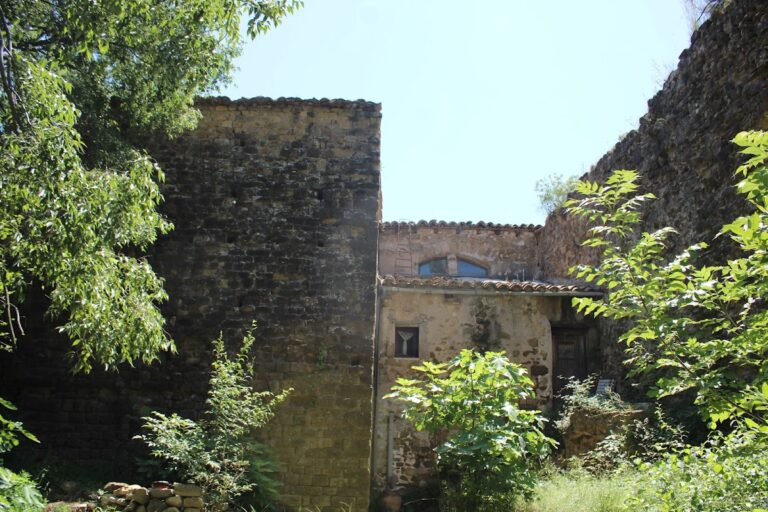
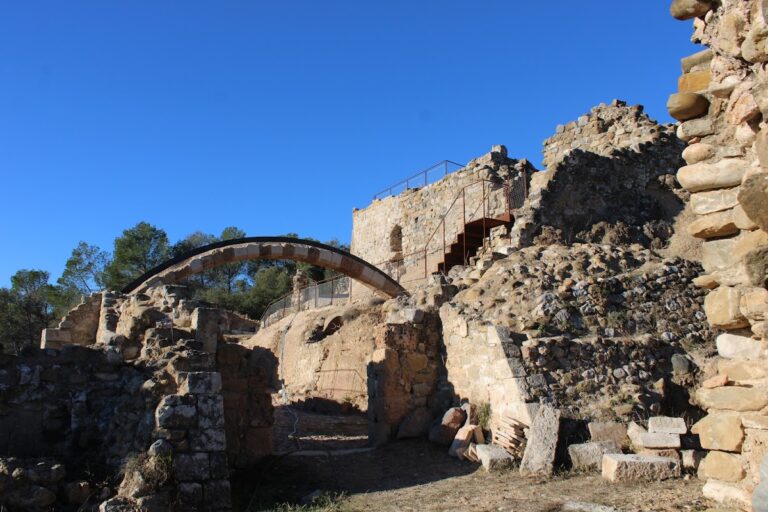
The surviving complex comprises the remains of a medieval synagogue, its courtyard, adjoining teaching rooms, and a subterranean mikveh. The synagogue area includes a prayer hall with a women’s gallery above it, while the associated rooms served the education of children and adolescents. Together, these spaces preserve the religious, communal, and educational functions of the medieval site.
The synagogue and courtyard
Prayer hall and teaching rooms
The synagogue’s surviving area contains the prayer hall and a women’s gallery positioned above it. Adjoining rooms were used for teaching, forming part of the wider community complex rather than serving only as private domestic spaces.
Community courtyard
The courtyard formed another part of the synagogue complex. It provided a setting for community weddings and other events, linking the religious building with the social activities of Besalú’s Jewish population.
The ritual bath
The mikveh occupies a subterranean chamber beneath the medieval synagogue. A stone staircase descends through 36 steps, arranged as three flights of twelve, to the chamber. The space is covered by a Romanesque barrel vault, a form of rounded vaulted construction associated with heavy medieval masonry. Dressed stone and travertine were used in its construction, and an east-facing window provides light.
The basin held more than 40 seah, a traditional Jewish measure used to establish the minimum volume of water required for a valid ritual bath. One description gives the capacity as approximately 331 liters. The depth of the chamber allowed it to fill through direct contact with groundwater, without pumping or specially built water channels. That groundwater was connected with the Fluvià River and a thermal spring. The bath is described as the only Jewish ritual bath of its type on the Iberian Peninsula and as probably unique in Spain.