Franciscan Friary: A Medieval Religious Complex in Bolzano, Italy


Site at a Glance
- Rating
- 4.5
- Popularity
- Low
- Country
- Italy
- Primary era
- Medieval
- External website
- Open
- Eras represented
- Medieval, Early Modern, Modern
- Civilizations
- Habsburg, Holy Roman Empire, Italian
- Site type
- Religious
- Remains
- Monastery
On this page17 sections
History
Franciscan Friary is a religious complex in Bolzano, Italy, established by the Franciscan Order during the thirteenth century. Franciscan friars reached the city in 1221 while travelling over the Brenner route on a mission connected with Francis of Assisi, the Italian founder of their order. After receiving permission to preach from the Bishop of Trento, some of the friars apparently remained in Bolzano. The friary later became a centre of worship, education, pastoral activity, and Franciscan scholarship.
Foundation outside the city walls
A Franciscan settlement by Bolzano’s walls is recorded in 1237. The first friary grew around a farmyard provided by the Bishop of Brixen immediately outside the city’s northern walls. Its buildings incorporated the Chapel of Saints Ingenuinus and Erhard. A separate Franciscan cemetery and burial rights are recorded in 1285, showing that the community had established a recognized institutional presence by the late thirteenth century.
Fire destroyed the original Romanesque building in 1291. The friary was rebuilt by 1322, and the associated Franciscan Church was ready for consecration in 1348. According to an unconfirmed tradition, the young Francis of Assisi once accompanied his cloth-merchant father, Pietro Bernardone, on a business journey to Bolzano. The tradition says that Francis served at Mass and rang the bell in the Chapel of Saints Ingenuinus and Erhard, which later became part of the friary complex.
Reform and educational work
A decline in monastic discipline, particularly in observance of the Franciscan ideal of poverty, led to reform in 1514. The friary was then taken over by Franciscans of the Observant movement, a reform within the order that sought stricter adherence to that ideal. In 1580, the community became part of the newly established Franciscan Tyrolean Province.
Education became an important part of the friary’s work in the eighteenth century. In 1780, Empress Maria Theresa ordered the establishment of Bolzano’s Franciscan Gymnasium, an academically oriented secondary school, and assigned the friars responsibility for its administration and teaching. During Bavarian rule, the friary was suppressed in 1810. Some members of the community were expelled, and parts of the buildings were temporarily used as a military barracks. The Franciscans returned in 1813.
War, reconstruction, and the modern community
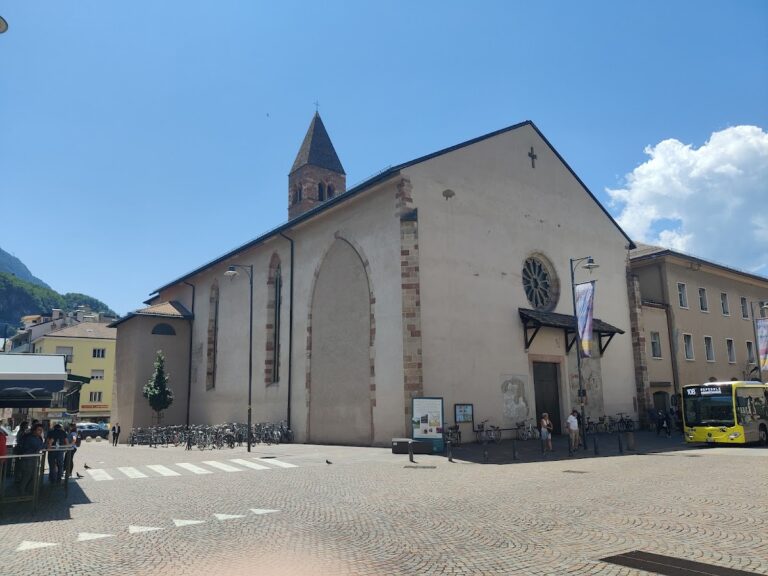
An aerial bomb destroyed the Franciscan Church on 29 March 1944. The church was rebuilt after the Second World War. Its external portico and facade belong to that postwar reconstruction, while the interior was extensively renovated between 1990 and 1992.
In the immediate postwar years, the friary was used as a temporary hiding place for high-ranking Nazis fleeing Europe. Adolf Eichmann, a senior Nazi official who organized major aspects of the deportation of European Jews during the Holocaust, was brought there by Johann Corradini, the priest of Sterzing.
After South Tyrol was transferred to Italy, pressure from the Italian authorities separated the region’s Franciscan houses from the Tyrolean Franciscan Province. Since 2007, the Bolzano friary has belonged to the Province of Austria of Saint Leopold, based in Salzburg. Franciscans continue to occupy parts of the complex, conduct pastoral work at the friary church, and teach at the Franciscan Gymnasium.
The friary also retains part of its archive and an extensive library. Much of the older catalogued collection is now held at the Franciscan Gymnasium, while older manuscripts are dispersed, including holdings documented at the University Library of Innsbruck. A 1480 incunable, a book printed in Europe before 1501 during the earliest period of movable-type printing, was printed in Ulm by Johann Zainer and bears a handwritten provenance note from the Franciscans of Bolzano. It appeared on the United States antiquarian book market in 2024.
Remains
The surviving complex includes the Gothic Franciscan Church, the cloister, the Chapel of Saints Ingenuinus and Erhard, the Chapel of Saint Erhard, the Chapel of Saint John, and a churchyard west of the church and cloister. The church has a three-aisled nave and a polygonal choir, while the cloister preserves medieval stonework, frescoes, later paintings, and devotional imagery from several periods.
Franciscan Church
Nave, choir, and tower
The Gothic church has a three-aisled nave intended for lay worshippers and a polygonal choir with wall shafts and vault ribs made of coloured sandstone. The nave was originally flat-roofed, but a net-rib vault and octagonal pillars were added between 1450 and 1454. The church tower, completed in 1376, rises 44 metres. Its pointed roof has an octagonal pyramidal form, and eight sound openings end in trefoil shapes.
Stained glass and devotional sculpture
Three large stained-glass windows made in 1954 by the Innsbruck artist Josef Widmoser fill the apse. The central window shows the stigmatisation of Saint Francis, the appearance of wounds resembling those of Christ’s crucifixion, which relates to the feast dedicated to the church. The left window presents Francis returning money and clothing to his father, appearing before Pope Innocent III, and showing King Louis IX of France with Saint Elizabeth of Thuringia. The right window depicts Francis between Christ and Mary, preaching to birds, and dying.
On the south side, a large window representing the Beatitudes was made in 1994 by the Graz artist Hans Szyszkowitz. Near the front of the choir are an eighteenth-century figure of Our Lady of Sorrows and a figure of Saint Joseph made in 1904 by the sculptor Franz Tavella.
Altars and chapels
The choir contains a late Gothic carved and painted winged altar made by Hans Klocker around 1500. A winged altar is an altarpiece with hinged wings that reveal different scenes when opened or closed. The work originally stood in the Chapel of Saint Anne, built parallel to the church and donated by the Bolzano Vintler family in 1373. Its central shrine presents the Nativity, surrounded by the retinue of the Magi and framed by foliage and figures forming a Jesse Tree.
When open, the altar wings show the Annunciation, the Presentation of Jesus in the Temple, the Circumcision of Jesus, and the Death of the Virgin Mary. When closed, they display four scenes of the Apostles’ farewells. The open lower section, or predella, shows Saint Anne with the Virgin and Child, John the Baptist, and the Apostle James, with Joachim and Anne on its inner wings. The closed predella shows the Annunciation, Saint Anne with the Virgin and Child, and Saint Clare of Assisi.
Three Baroque side chapels were built along the south side of the church in 1680, replacing the demolished Chapel of Saint Anne. The first contains an Antonius altar donated by the Bolzano Merchants’ Guild in 1683. The third contains Stations of the Cross paintings made in 1954 by the Austrian artist Leo Sebastian Humer. On the north side, the Sebastian altar has a painting made by Anton Psenner in 1826.
Organ and painted frieze
Beside the main entrance is the Doctors’ Frieze, made shortly after 1500. It originally portrayed 35 learned members of the Franciscan Order, and 21 figures remain. The group includes the Franciscan popes Alexander V, Nicholas IV, and Sixtus IV, together with Saint Bonaventure and John Duns Scotus. The figures are arranged according to ecclesiastical office rather than chronological order.
The former Baroque organ was made by Andreas Butz in 1618, and its wing doors were painted in 1636 by the Munich court painter Georg Fischer. The present organ was built in 1995 by Johann Pirchner Junior of Steinach am Brenner. It has 44 stops, including nine reed stops, three manuals, and pedals. Its design is principally inspired by Baroque instruments and also accommodates Romantic music, especially the French Romantic repertoire.
Cloister
Medieval structure and east wing
The Gothic cloister was probably added north of the church before the choir was completed in 1348. A cloister is a covered ambulatory surrounding an open courtyard and linking the principal spaces of a religious community. The columns are connected by deeply moulded trefoil arches. Three piers follow the columns, while the south wing has four piers.
The cloister was vaulted before 1484 with support from Archduke Sigmund the Rich in Coins. His coats of arms appear as keystones in the east wing. The vaulting damaged parts of the earlier decoration, and new painting on dry plaster, known as secco painting, was added in the east wing around 1490 to 1520.
South-wing frescoes
The south wing contains frescoes from the Giotto school dating approximately to 1320 to 1330, including a Crucifixion and a Descent from the Cross. A fresco from around 1360 shows a Franciscan presenting two laypeople to the Virgin. A contemporary frieze depicts the heads of prophets.
Later paintings and medallions
Other works in the cloister include Ludwig Pfendter’s 1607 Adoration of the Magi and a fourteenth-century relief of the Man of Sorrows measuring 90 centimetres in height. Thirty medallions depicting hermits, dated 1609, were uncovered in the north wing during the 1970s. The lunettes retain 13 of an original 25 oil paintings of the life of Saint Francis by Hilarius Auffenbacher, produced between 1711 and 1719. One of these paintings is by Lukas Plazer.
Chapels and churchyard
Chapel of Saints Ingenuinus and Erhard
The complex incorporates the Chapel of Saints Ingenuinus and Erhard, around which the first friary developed outside Bolzano’s northern walls. The Chapel of Saint Erhard, with frescoes from the fourteenth and seventeenth centuries, and the Chapel of Saint John stand on the east side of the cloister within the enclosure.
Churchyard tombstone
A churchyard lies west of the cloister and church. It contains the tombstone of Prince Peter the Lame of Moldavia, who had been driven out by the Turks and was buried in the church in 1594.
Nearby sites