Shrewsbury Castle: A Norman Fortress and Military Museum


Site at a Glance
- Rating
- 4.5
- Popularity
- Medium
- Country
- United Kingdom
- Primary era
- Medieval
- External website
- Open
- Eras represented
- Medieval, Early Modern, Modern
- Civilizations
- British, English, Norman
- Site type
- Military
- Remains
- Castle
On this page18 sections
History
Shrewsbury Castle is a red-sandstone fortress in Shrewsbury, United Kingdom, founded by the Normans around 1067 during the years after the Norman Conquest. William I ordered its construction, and Roger de Montgomery greatly enlarged it around 1070. The castle stood at the neck of a meander of the River Severn, where it protected the town and provided a base for operations in Wales as well as an administrative centre.
Norman foundation and early conflict
The new castle transformed the town’s landscape. The Domesday Book, a survey of landholding and resources commissioned by William I and completed in 1086, records that at least 51 houses were displaced by its construction. In 1069, Eadric Cild attempted to capture the stronghold during an Anglo-Saxon revolt against Norman rule, but the attack failed.
Shrewsbury Castle became Crown property in 1102 after Henry I defeated his brother Robert Curthose. Robert of Bellême, Earl of Shrewsbury, had supported Curthose, and the change brought the castle directly under royal control. By the middle of the twelfth century, the original timber fortification was being replaced by a stone castle.
The twelfth and thirteenth centuries
During the Anarchy, the civil war between supporters of Stephen and Empress Matilda, William FitzAlan held Shrewsbury Castle for Matilda in 1138. Stephen captured it after a short siege and had the surviving garrison hanged from the battlements. Llywelyn the Great briefly held the castle in 1215, and Simon de Montfort used it during his rebellion against Henry III around 1265.
Welsh attacks prompted the construction of town walls around 1215. The walls radiated from the castle and enclosed Shrewsbury, linking the stronghold with the town’s wider defences. During the thirteenth century, the castle repeatedly served as a base for military campaigns against Welsh rebels. The principal medieval building work was complete by the middle of that century.
Decline and conversion into a residence
After the conquest of Wales, Shrewsbury Castle lost its strategic function and began to decay, probably from around 1300. It remained Crown property, but from the fourteenth century until the first half of the seventeenth century it played no major political role.
Richard Onslow leased the ruin in 1565, during the reign of Elizabeth I, and converted it into a private residence. He had served as Speaker of the House of Commons and Solicitor General for England and Wales, and had acquired wealth through the wool trade. His alterations included adding a storey above the great hall.
Civil War and later ownership
During the English Civil War, the conflicts fought between Royalist supporters of the monarchy and Parliament from 1642 to 1651, Baron Capell and Rupert of the Palatinate strengthened the castle between 1642 and 1644. Ditches were dug and palisades erected around the defences. Parliamentary forces besieged the stronghold, which surrendered on 12 March 1645 after Parliamentary troops captured Shrewsbury following a small skirmish.
Most Royalist soldiers were permitted to march to Ludlow Castle. During the Commonwealth, the republican government established after the execution of Charles I in 1649, Cromwellian troops were quartered at Shrewsbury Castle. In 1663 the castle passed from the Crown to Sir Francis Newport, later Earl of Bradford. His descendants retained it until 1775.
Sir William Pulteney, an eighteenth-century Member of Parliament for Shrewsbury and patron of Thomas Telford, occupied the castle from 1775. He commissioned extensive alterations by Telford, a British civil engineer and architect, to designs associated with Robert Adam. The work adapted the medieval building to Pulteney’s personal preferences.
Municipal use, museum, and archaeology
The Downward family occupied the castle during the nineteenth century. After the family died out following the First World War, the Shropshire Horticultural Society purchased the building in 1924 and transferred it to the municipal authorities. It then served as Shrewsbury Borough Council’s headquarters for more than 50 years. The former upper-floor rooms were later recombined into a single great hall.
In 1985 the castle became the home of collections belonging to six army regiments, previously held at Copthorne Barracks and other local sites. The Shropshire Regimental Museum was renamed the Soldiers of Shropshire Museum in 2019. It presents local military history from 1755 to 1970 and holds more than 40,000 items.
A bomb attack in August 1992 caused extensive damage to the castle and destroyed irreplaceable museum objects. Two other bombs exploded in Shrewsbury shopping centres on the same day, and the Irish Republican Army claimed responsibility. Princess Alexandra officially reopened the museum on 2 May 1995.
Archaeological projects by Shropshire Council and the University of Chester investigated the castle interior in 2019 and 2020. The earlier excavation revealed the original ditch around the approximately 1067 motte, a raised artificial mound used for fortification, together with medieval pottery and two arrowheads or crossbow-bolt heads. The later work found evidence of high-status feasting, including the bones of a pike and possibly a swan. The castle is owned by Shropshire Council and has been a Grade I listed building, a designation for structures of exceptional architectural or historic interest in England, since 10 January 1953.
Remains
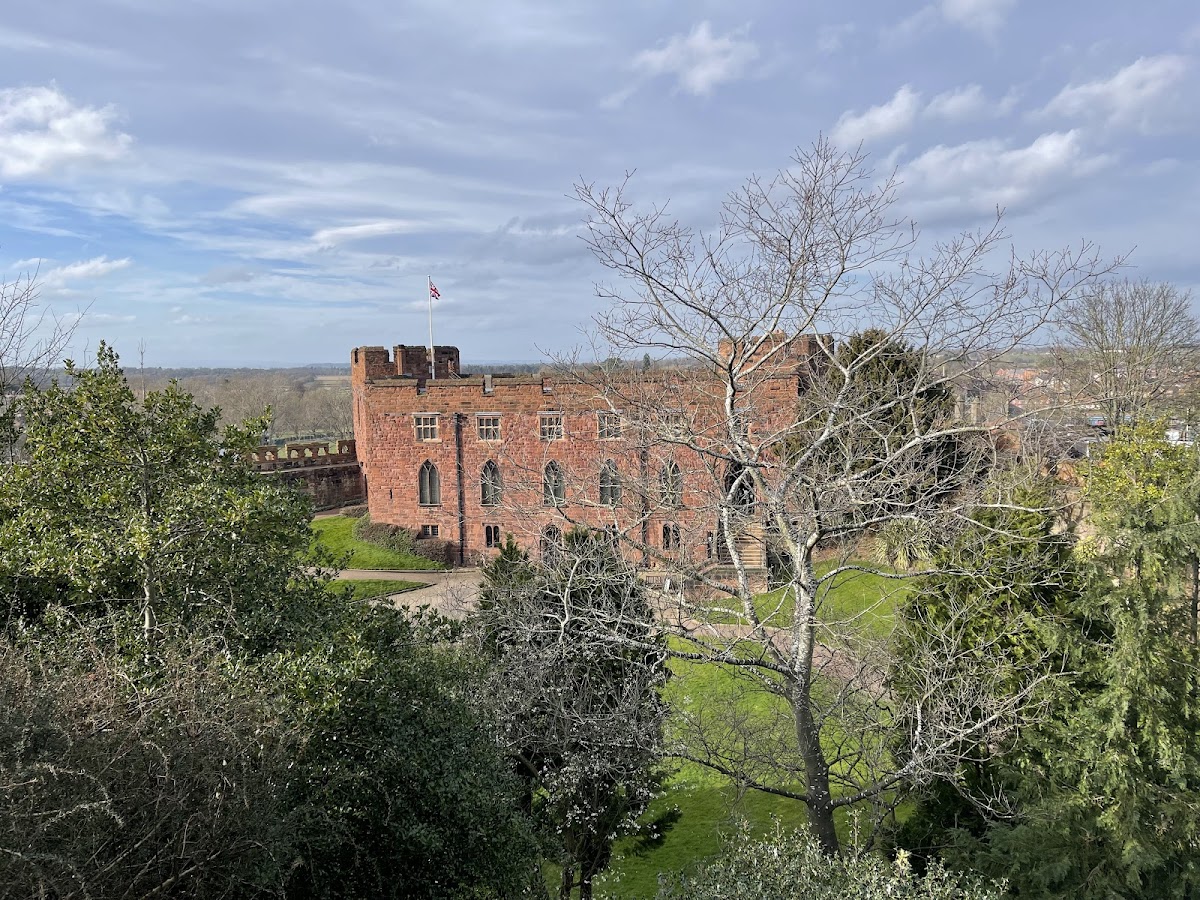
Shrewsbury Castle occupies a hill at the neck of the River Severn’s meander, directly above Shrewsbury railway station and northeast of the historic town centre. Its red-sandstone buildings and earthworks occupy the town’s only position not surrounded by the river. The surviving precinct covers about 40 ares and broadly corresponds to the former inner bailey, an enclosed area adjoining the motte.
Earthworks and medieval defences
The motte
The original motte was circular and carried a medieval timber tower. Around 1271, flooding by the River Severn caused part of the mound to subside, bringing down the tower and changing the mound’s form. The 2019 excavation exposed the ditch that had surrounded the approximately 1067 motte. Laura’s Tower now stands on the artificial mound. Sir William Pulteney built the tower in 1790 as a birthday present for his daughter Laura.
Inner and outer baileys
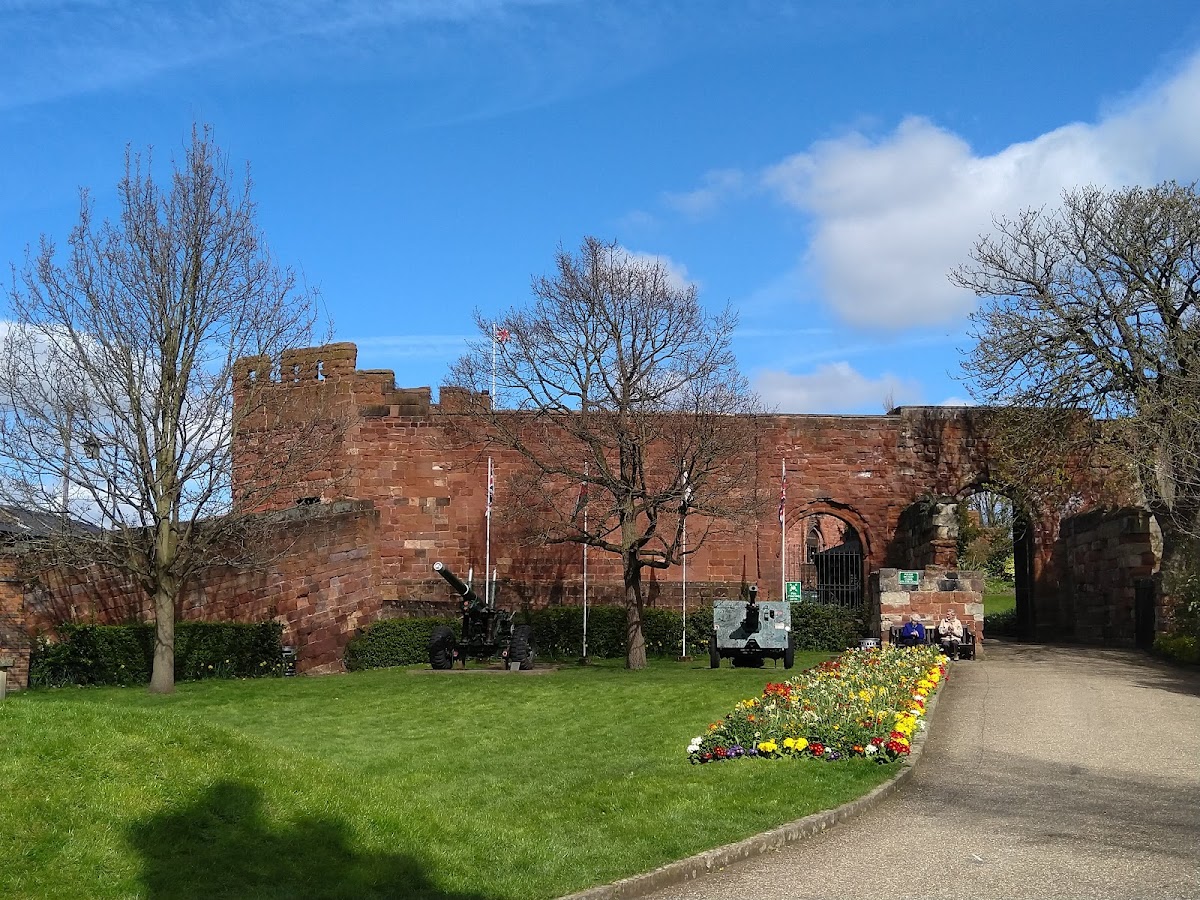
The inner-bailey walls, gatehouse, and lowest levels of the lower storey date from about 1160. These structures are partly built on artificial earthworks belonging to the Norman motte castle. The original outer bailey extended into the town and connected with Shrewsbury’s town walls. Its former area now lies beneath later shops and buildings. Soil investigations indicate that the inner bailey contained stables and workshops.
The bailey defences were strengthened during the English Civil War. A low wall beside the approach to the gatehouse survives from those fortifications, while much of the curtain wall is a reconstruction associated with Telford’s late-eighteenth-century work. The gatehouse retains a wooden entrance gate marked by musket fire from the Civil War.
Medieval buildings
The great hall
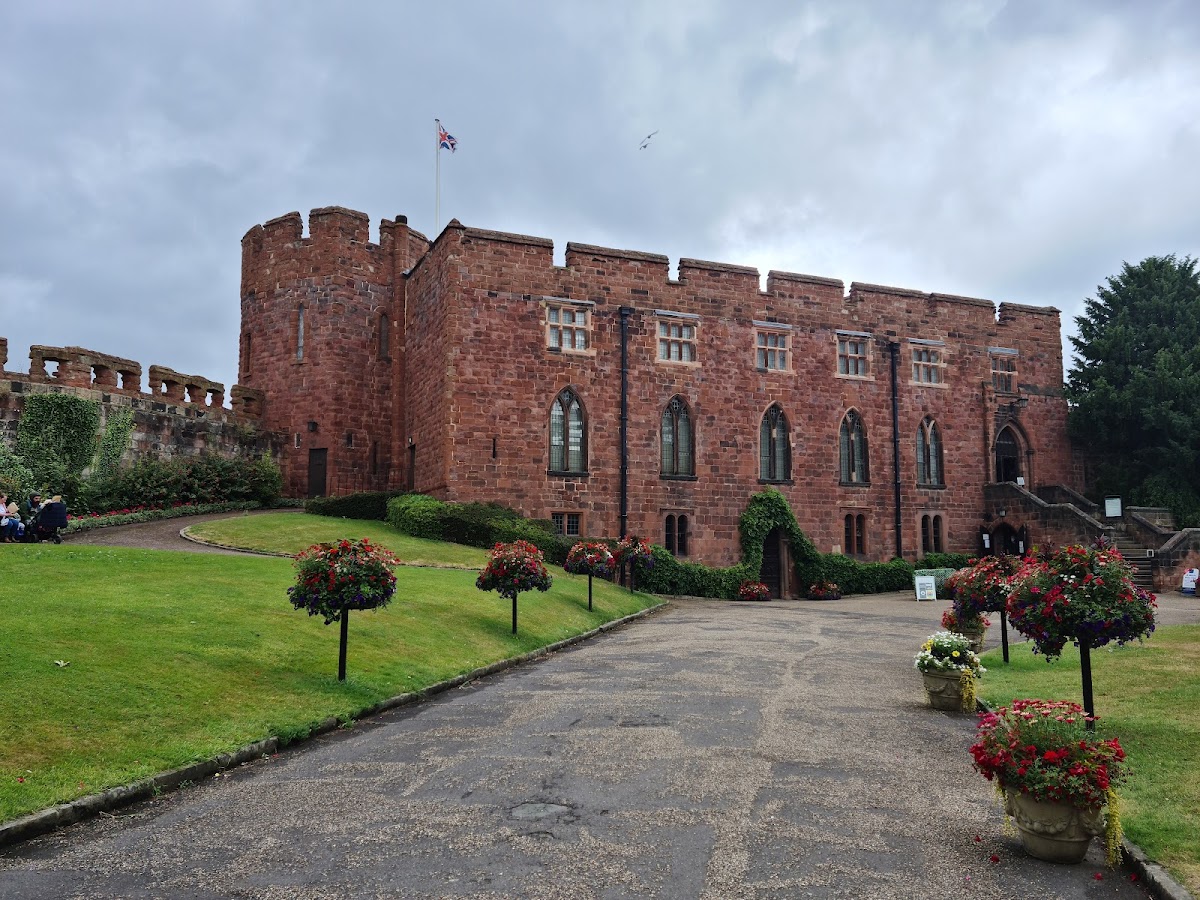
The great hall was built during the reign of Henry III, using part of the castle’s defences. It is flanked by the west and east towers, which also date from the thirteenth-century building programme. The central block now has two storeys, although it had three during the Elizabethan period. The great hall occupied the first floor, while the ground floor probably functioned as a basement.
The hall originally contained arrow slits. Telford replaced them with tall, pointed windows and restored the open fireplace. Rectangular windows belong to the Elizabethan upper storey. A mansard storey that once stood above the hall’s timber ceiling has disappeared. The museum now occupies the great hall and east tower.
The west tower
The upper storey of the west tower preserves traces of medieval rib vaulting. Telford fitted out its lower and middle storeys as the Round Room and the mayoral rooms. The Round Room was used for conferences and lectures, while the mayoral rooms served civic receptions.
The east tower
The east tower forms part of the military museum and contains its visitor centre. Its windowless basement may have served as a storage room and is informally known as the dungeon. A small exhibition on Shrewsbury’s earlier history occupies this basement.
Entrances and later features
Gatehouse and postern
The present entrance to the castle building is reached by a stair constructed around 1926. Although first-floor entrances sometimes served defensive purposes in medieval great halls, this arrangement has not been established as original to Shrewsbury Castle. The grounds also contain a probably circa 1600 postern, a small secondary gate or passage, which formerly provided access towards the River Severn. Construction of the nineteenth-century railway blocked that passage.
Saint Nicholas foundations
The outer bailey contained a chapel dedicated to Saint Nicholas. It was demolished in the nineteenth century and replaced by a Saint Nicholas church, which now functions as a restaurant. This later building reflects the continuing change in use of the castle’s former outer precinct.
Museum collections
The Soldiers of Shropshire Museum occupies the great hall and east tower. Its collections include the Grand Admiral’s Baton belonging to Karl Dönitz, a lock of Napoleon Bonaparte’s hair, and Victoria Crosses awarded to Captain Alfred Kirke Ffrench, Private Charles Irwin, and Sergeant Major Harold Whitfield. Other objects include a wooden canopy used by the mayor during council meetings and the Zutphen Clock, presented to Shrewsbury by its partner city of Zutphen in 1980.