Cave Temples of Mahabalipuram: Pallava Rock-Cut Hindu Shrines
Site at a Glance
- Rating
- 4.6
- Popularity
- Low
- Country
- India
- Primary era
- Medieval
- Eras represented
- Medieval
- Civilizations
- Unclassified
- Site type
- Religious
- Remains
- Sanctuary
On this page22 sections
History
The Cave Temples of Mahabalipuram are Pallava-period rock-cut Hindu shrines at Mahabalipuram in Tamil Nadu, India. Created mainly during the seventh and early eighth centuries, they represent a transitional phase in South Indian temple architecture and form part of the Group of Monuments at Mahabalipuram, inscribed on the UNESCO World Heritage List in 1984.
Mahabalipuram under the Pallavas
The Pallavas were a South Indian ruling dynasty that supported major developments in Tamil Hindu architecture and sculpture between roughly the sixth and ninth centuries. The caves are associated with the reigns of Mahendravarman I, Narasimha Varman I, also known as Mamalla, Rajasimha or Narasimhavarman II, and Parameshvara Varman I. Individual dates and attributions remain debated, but the principal cave temples belong broadly to the seventh and early eighth centuries.
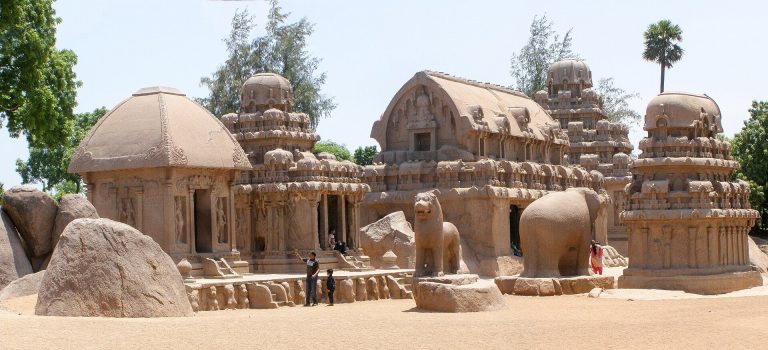
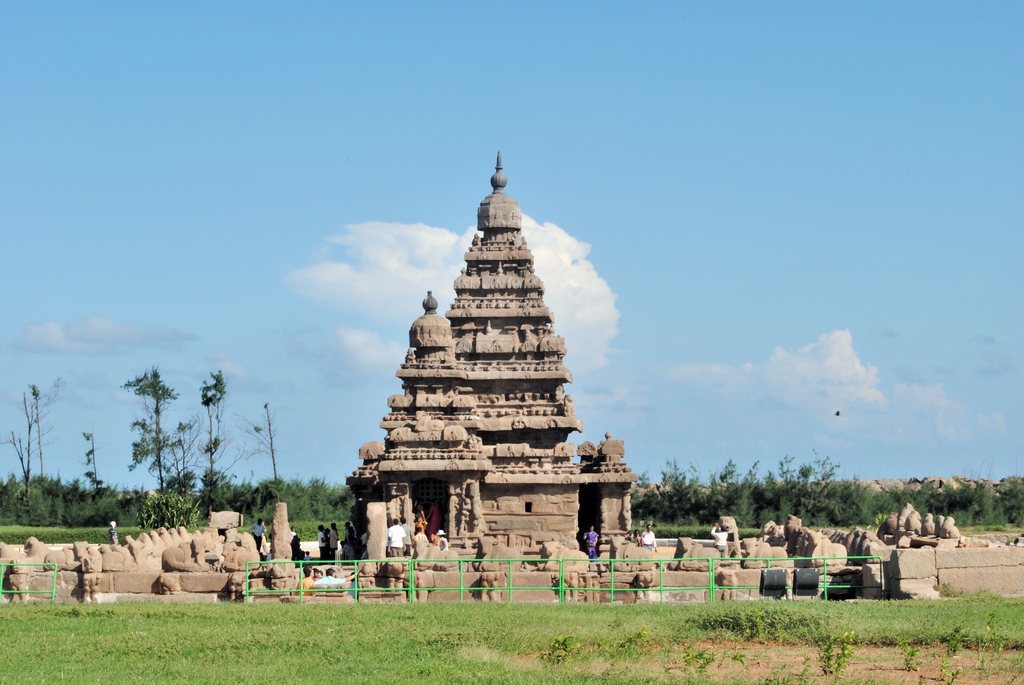
During this period, Mahabalipuram developed as a prosperous coastal settlement and port on the Coromandel Coast of the Bay of Bengal. The Chinese traveller Xuanzang reportedly noted its importance in AD 642 while visiting the Pallava court. The Vaishnava poet Thirumangai Alvar also referred to the prosperity of the city and its ships. The caves were part of a wider Pallava programme that included monolithic ratha temples, structural temples, and open-air rock reliefs.
Creating the rock-cut shrines
Unlike a structural temple assembled from separately cut blocks, a cave temple was excavated directly into natural rock. Artisans first prepared a flat rock face, marked the intended colonnade, and removed the stone needed for the hall and shrine spaces. Sculptors and finishers then shaped the architectural surfaces, reliefs, motifs, and images. The surviving unfinished areas preserve evidence of these successive stages of work.
Many of the excavations were left incomplete. Traces indicate that some interiors originally received plaster and painted decoration, although most of that treatment has disappeared. The monuments also reveal the coexistence of Shaivism, centred on Shiva, Vaishnavism, centred on Vishnu, and Shaktism, centred on the Goddess or Shakti. Their subjects include Vishnu rescuing the earth goddess Bhumi, Durga defeating Mahishasura, Krishna lifting Govardhana, and Shiva with Parvati and Skanda.
Later history and preservation
The caves continued to be altered and reused after their original creation. The Ramanuja Cave, for example, was changed into a shrine associated with the Vaishnava scholar Ramanuja after earlier images and guardian figures were chiselled away. At the Atiranachanda Cave, a later linga and drainage channel were installed. Such changes preserve evidence of continuing religious engagement with the excavations.
Restoration work was undertaken after 1960, and the monuments are managed by the Archaeological Survey of India. Archaeological investigations at Mahabalipuram have continued since 1990 and have produced unexpected discoveries. Some cave temples belong to the UNESCO-listed monument group, while nearby excavations such as the Koneri Mandapa, Yali Mandapa, and Kotikal Mandapa are not individually included in that listing.
Remains
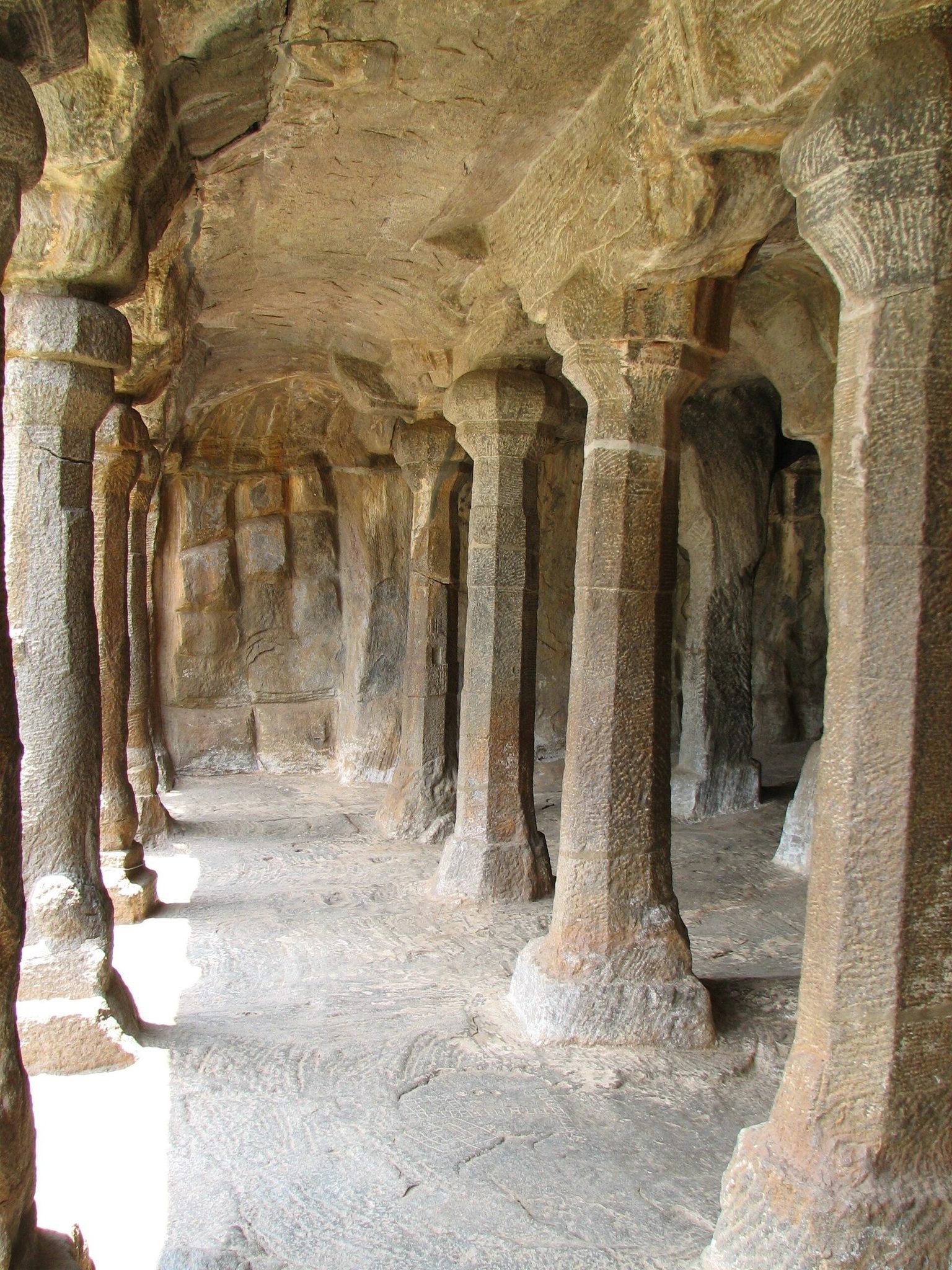
The caves are cut into the natural hills and boulders of Mahabalipuram. Their usual plan consists of a pillared facade, a hall, one or more shrine cells, and sculpted panels on the walls. Many columns are slender and faceted or rounded, with moulded bases, carved capitals, or seated lions. The wider group comprises approximately eleven visible mandapas, a term meaning a pillared hall or pavilion that also denotes a rock-cut shrine at Mahabalipuram.
Major shrines on the main hill
Varaha Cave
The Varaha Cave was cut into a vertical rock face on the western side of the main hill. Its facade has two pillars and two pilasters, above a pillared platform leading into the mandapa and the rear sanctum, the enclosed sacred chamber of a temple. The pillars have lotus-shaped square bases, seated lion figures, octagonal shafts, ornamented capitals, and a frieze containing six kudu arches, a horseshoe-shaped decorative motif.
Its principal panels represent the Varaha, Vamana-Trivikrama, Durga, and Gajalakshmi legends. Varaha, Vishnu’s boar incarnation, rescues Bhumi from the cosmic waters. In this unusual version, he turns to his right and holds the goddess close to his raised knee rather than lifting her on his tusk. The Vamana-Trivikrama panel shows Vishnu taking his immense third step across the cosmos.
Side niches contain Durga and Gajalakshmi. Gajalakshmi sits on a lotus while elephants pour water from vessels, and Durga appears with devotees, a lion, an antelope, and a warrior preparing for self-sacrifice. Brahma, Narada, Surya, Chandra, devotees, ganas, apsaras, elephants, and other mythological figures complete the sculptural programme.
Kotikal Cave
The Kotikal Cave is a simple early excavation with two pilasters at its facade. Sockets in front indicate that a structural main hall once stood before the rock-cut shrine. Inside, an oblong half-hall leads to a square sanctum whose mouldings resemble those of a free-standing temple.
Two female guardians flank the sanctum. One holds a sword and shield, while the other carries a bow and stands in a three-bend posture. The chamber contains a moonstone, moulded base elements, part of a wall, and a kudu arch. A Grantha inscription includes the name or epithet “Sri Vamankusa.” The original deity is no longer present and is generally considered to have been Durga.
Dharmaraja Cave
The Dharmaraja Cave, also called the Atyantakama Cave, lies on the southern side of the main hill near the Mahishasuramardini Cave. Slim four-sided pillars and pilasters form its facade, main hall, and half-hall. The inner hall opens into three shrine cells on a shared moulded base.
The central cell is the largest and was dedicated to a Shiva linga, an aniconic representation of Shiva. The side cells were associated with Brahma and Vishnu, although their images are missing. A fourteen-line Sanskrit inscription in Grantha script survives in the cave. Its attribution has been assigned variously to Rajasimha, Parameshvara Varman I, or the Mahendra period.
Ramanuja Cave
The Ramanuja Cave is one of the most complete and sophisticated excavations. Located on the eastern scarp of the main hill, it contains a rectangular half-hall and three square shrine cells on a shared raised base. Six roughly cut free-standing pillars were added at the front during a later renovation, probably to extend the mandapa.
The three cells may originally have been dedicated to Brahma, Shiva, and Vishnu, or to three forms of Shiva. The central shrine once contained a five-foot-square Somaskanda panel, showing Shiva, Parvati, and the infant Skanda. Most of that image has been erased, and the side shrines retain no sculptural panels. Plaster remnants and traces on the ceilings indicate that the cells may once have been painted.
Later artisans removed the walls between the three shrines and converted the excavation into a shrine associated with Ramanuja. Most of the original wall reliefs and guardian figures were then chiselled away. A Grantha inscription praising Rudra indicates that the cave was originally Shaivite and places it broadly in the seventh century.
Koneri Mandapa
The Koneri Mandapa is cut into the western side of the main hill beside the Koneri-pallam tank. Dedicated to Shiva, it has a main hall with five shrine cells, an entablature, and a cornice containing ten kudu arches. Five interconnected upper structures known as salas rise above the cornice.
Two rows of four pillars and two pilasters organize the hall. The front row is simpler, while the row beside the shrines is more elaborately carved. Each shrine entrance has a pair of guardian figures. Their different forms, crowns, ornaments, trident-like elements, and fang-like teeth vary in condition through erosion. The five pairs have been interpreted as the five aspects of Shiva.
Krishna Mandapa
The Krishna Mandapa is a sophisticated cave near the Descent of the Ganges rock relief. Four leonine vyala figures, stylized mythical animals used in South Indian column architecture, support its facade pillars, which are accompanied by two pilasters and followed by another row of pillars.
The principal relief shows Krishna lifting Govardhana Mountain to shelter people and cattle. Other scenes portray seventh-century Tamil village life, including milkmaids carrying containers and fodder, a man milking a cow, a calf being licked by its mother, and Krishna playing the flute while people and animals listen.
Additional Pallava cave temples
Atiranachanda Cave
The Atiranachanda Cave lies at Saluvankuppam, north of Mahabalipuram. Its small facade has two octagonal pillars and two four-sided pilasters, followed by an intermediate hall and a small square sanctum. Empty mortise holes in front probably belonged to a later hall that no longer survives.
Shaiva guardian figures flank the sanctum, which contains a later black, polished, sixteen-sided Shiva linga. A later drainage channel carries away water used in ritual bathing or libations, known as abhisheka. The rear wall bears a Somaskanda panel, and two additional Somaskanda panels are carved in the intermediate hall.
A separate tall, polished linga stands in the sand in front of the cave and probably belonged to a former free-standing temple. Nearby, a three-by-six-foot relief shows Shakti in the Mahishasuramardini form, riding a lion and pursuing an army led by Mahishasura.
Identical sixteen-line Sanskrit inscriptions appear on the cave’s south and north walls, written respectively in Grantha and Nagari scripts. They dedicate the temple to Shiva, Parvati, and Skanda and support a date in the early eighth century.
Adivaraha Cave
The Adivaraha Cave, also called the Maha Varaha Vishnu Temple, stands at the northern end of the main hill on its western side. Four vyala pillars and two pilasters form the facade. Beyond them are an oblong community hall and a single sanctum. Inscriptions in Tamil, Sanskrit, and Telugu occur within the temple.
The reliefs include Varaha, Durga, Gangadhara, Harihara, and Gajalakshmi. Gangadhara represents Shiva receiving or bearing the descent of the Ganges, while Harihara combines Vishnu and Shiva. The sanctum contains a stucco Varaha relief that was once painted. Other sculptures show Adisesha, Shiva as Gangadhara, Brahma, and a standing figure in the three-bend tribhanga posture.
Additional panels portray Gajalakshmi, Durga, a standing Vishnu with two devotees, and a standing Harihara. Unlike the Varaha Cave, this cave does not contain panels of the Varaha and Vamana-Trivikrama legends. A mid-seventh-century inscription presents Buddha as the ninth incarnation of Vishnu.
Mahishasuramardini Cave
The Mahishasuramardini Cave, or Mahishamardini Mandapa, occupies the southern end of the site on the eastern scarp of the main hill, near the ruins of the Olakkanesvara Temple. Its oblong hall has four pillars and two pilasters. One original pillar was moved to the Adivaraha Temple and replaced by a plain modern pillar, while another is damaged.
Three shrine cells open from a central trapezoidal hall. The side shrines stand about one foot above the central shrine. The central chamber contains a large Somaskanda relief of Shiva, Parvati, and the infant Skanda, with Brahma, Vishnu, and Surya behind them.
The northern wall carries a detailed relief of Durga defeating Mahishasura, the buffalo-demon of Hindu tradition. The southern wall shows Vishnu reclining in the Anantasayi form, accompanied by the demons Madhu and Kaitabha. The interior sculpture was completed before the facade, ceiling, and floor, indicating that several artisans worked on different parts of the cave in parallel.
Panchapandava Cave
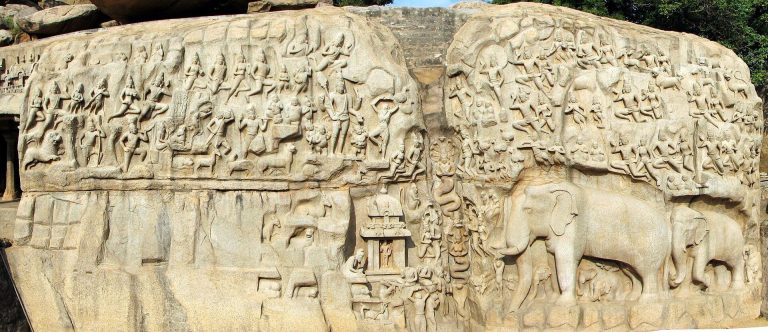
The Panchapandava Cave lies just south of the Arjuna’s Penance, or Descent of the Ganges, relief. It is the largest unfinished cave at Mahabalipuram. Six pillars and two pilasters form the facade, with another row of pillars in the inner hall and unfinished passages along the sides.
The incomplete plan indicates that the cave was intended to contain a passage for walking around the shrine and large wall reliefs. Its architectural style has been associated broadly with the reign of Narasimha Varman I and may have continued into the period of Rajasimha.
Trimurti Cave
The Trimurti Cave is an unfinished or partly completed shrine divided into three sections dedicated to Brahma, Shiva, and Vishnu. Each shrine is cut into the rock and has guardian figures beside its entrance. Separate reliefs of the three deities, accompanied by devotees, are carved on the rear wall.
Unfinished and peripheral excavations
Pulipudar Caves
The Pulipudar caves lie near the Koneri-pallam tank and belong to the group of unfinished or less-complete cave monuments around Mahabalipuram. Together with the other excavations, they contribute to the evidence for the varied stages of Pallava rock-cut construction.
Tiger Cave
The Tiger Cave, also called the Yali Mandapa, is at Saluvankuppam about four kilometres north of Mahabalipuram, near the Atiranachanda Cave. It is a shallow excavation cut into a large boulder about 1.8 metres above ground level. A south-eastern entrance opens onto a three-sided pavilion reached by stairs, with lion-decorated parapets.
Eleven sculpted yali heads frame the portico. The principal relief shows Durga riding a tiger, while a female figure riding a lion and lion-based half-columns add to the animal imagery. Two side niches are uncarved. The cave has been interpreted as a possible open-air performance or festival pavilion, although that function remains uncertain. A carving of the creator is also reported in the cave, and the imagery has been associated with Rajasimha.
Sculptural character and religious imagery
The caves share a Pallava sculptural language marked by relatively shallow reliefs, elegant elongated figures, oval faces with prominent cheekbones, simple hair arrangements and crowns, and limited jewellery. Individual, often prismatic lingas occur in the shrines, while drainage for ritual offerings is present in some caves but not every one.
Across the group, Shaiva, Vaishnava, and Shakta imagery appears in combination. The surviving subjects include Varaha rescuing Bhumi, Vamana-Trivikrama taking the three cosmic steps, Gajalakshmi, Durga defeating Mahishasura, Krishna lifting Govardhana, Shiva with Parvati and Skanda, and Vishnu reclining on Ananta Shesha. Together with inscriptions, unfinished surfaces, later alterations, and traces of painted plaster, these features preserve both the religious programme and the working process of the Pallava cave temples.