Descent of the Ganges: A Pallava Rock Relief at Mahabalipuram
Site at a Glance
- Rating
- 4.6
- Popularity
- Medium
- Country
- India
- Primary era
- Medieval
- Eras represented
- Medieval
- Civilizations
- Pallava
- Site type
- Civic
- Remains
- Rock Art
On this page9 sections
History
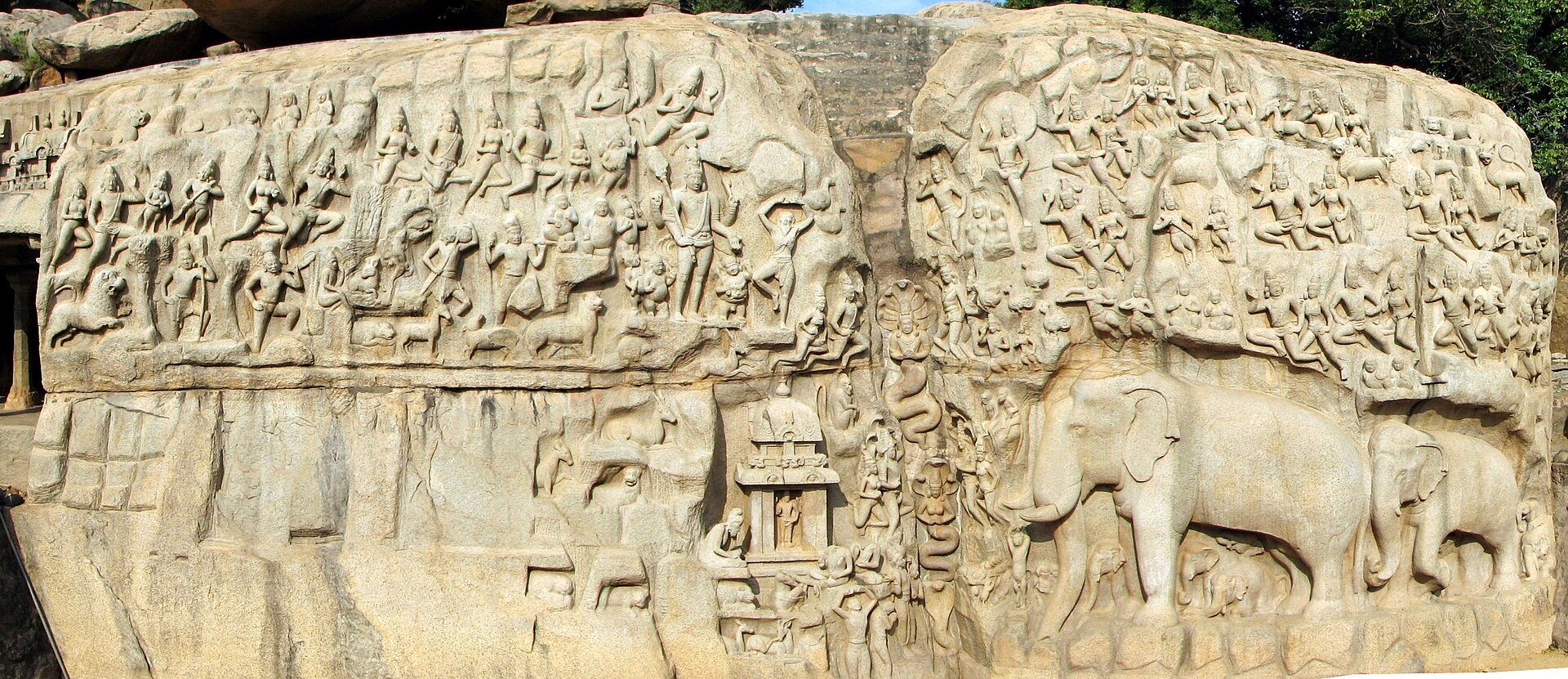
Descent of the Ganges is a seventh-century Pallava open-air rock relief at Mahabalipuram in Tamil Nadu, India. Created during the reign of Narasimhavarman I, who ruled from 630 to 668 CE, it belongs to the Pallava period of rock-cut art and is generally connected with the king’s victory over the Chalukya emperor Pulakesin II. Its principal subject is the descent of the sacred Ganges from heaven to earth, although the central ascetic has also been identified with Arjuna from the Mahabharata.
The Pallava setting
The Pallavas were a South Indian dynasty whose patronage shaped the development of Mamallapuram’s rock-cut monuments during the seventh century. The town took its name from Narasimhavarman I’s title, Mamallan, meaning “great wrestler” or “great warrior.” He was the son of Mahendravarman I. Under Narasimhavarman, sculptors made in-situ carving, meaning the cutting of figures directly into natural rock, a major artistic medium. This approach replaced earlier work in materials such as wood and loose stone and later influenced temple sculpture produced under the Imperial Cholas in the late ninth century.
The relief is generally understood as part of the artistic program associated with Narasimhavarman I’s victory over Pulakesin II. Its imagery brings together gods, ascetics, celestial beings, people, and animals within a single natural rock surface. This union of mythological and earthly life has been interpreted as an early Indian expression of the continuity of living things.
The Ganges and the ascetic
The main narrative presents Bhagiratha, a legendary king and ascetic, performing severe austerities to bring the Ganges from heaven to earth. According to the tradition, the river’s waters could release his dead relatives from their sins by flowing over their ashes. Shiva, a Hindu deity associated with transformation, asceticism, and divine power, receives the descending river in his matted hair and divides its force into many streams before it reaches the earth.
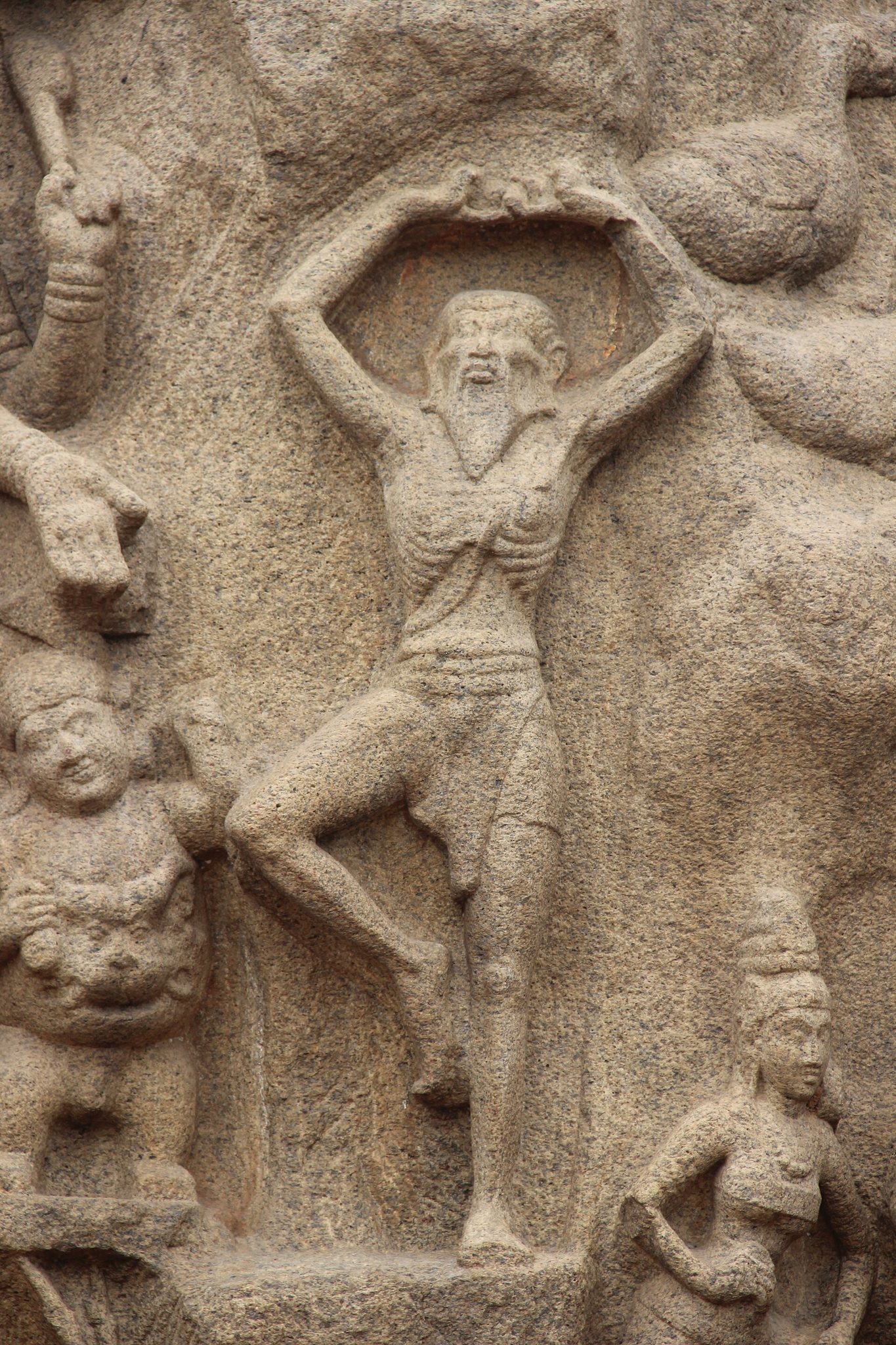
The relief’s central ascetic has also produced a major alternative interpretation. He may be Arjuna, the great warrior of the Mahabharata, undertaking austerities to obtain the Pashupata, Shiva’s powerful weapon, for the epic war. In the related Kiratarjuniya episode, Shiva appears as a hunter, defeats Arjuna in a dispute over a slain boar, reveals his identity, blesses him, and grants him the weapon. A further reading identifies the ascetic as Bhagiratha praying for prosperity and happiness for humanity. In that interpretation, Shiva and the other gods bless him, while the nagas, serpent-associated beings with human features, represent fertility and wealth.
Interpretive and moral imagery
A separate humorous scene shows a cat standing on one leg. It has been related to a Panchatantra story in which a false ascetic uses deception to draw prey within reach. The cat’s posture and expression give the relief a pointed moral element, contrasting outward austerity with concealed intent.
The Descent of the Ganges forms part of the Group of Monuments at Mahabalipuram, which was inscribed on the UNESCO World Heritage List in 1984 under criteria (i), (ii), (iii), and (vi). The open-air reliefs formed one of the categories through which the group’s heritage value was recognized. The monument is maintained by the Archaeological Survey of India through its Chennai Circle. Sculptors’ descendants are also described as continuing the Pallava artistic legacy within the culture of the modern town.
Remains
Rock surface and water channel
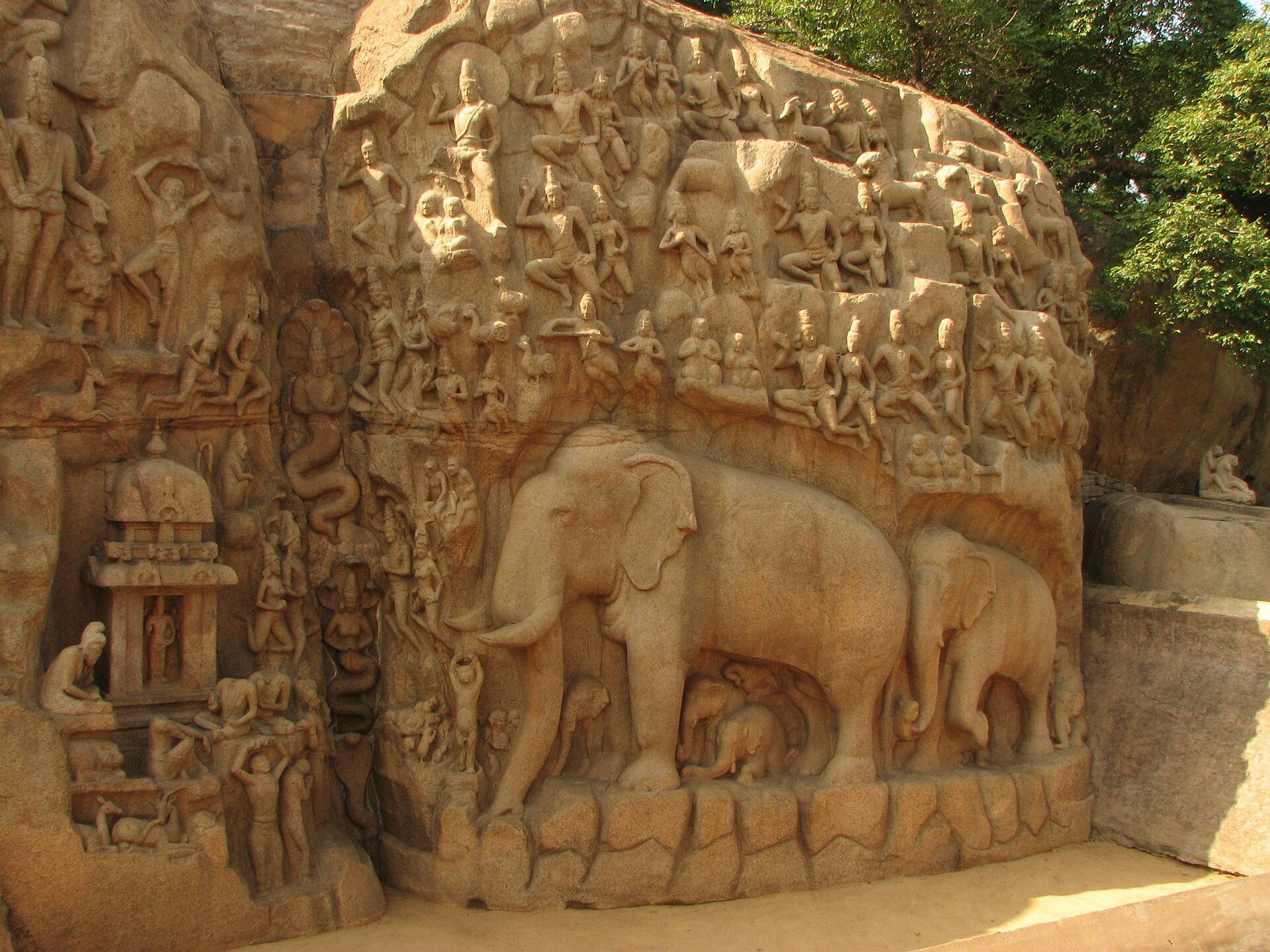
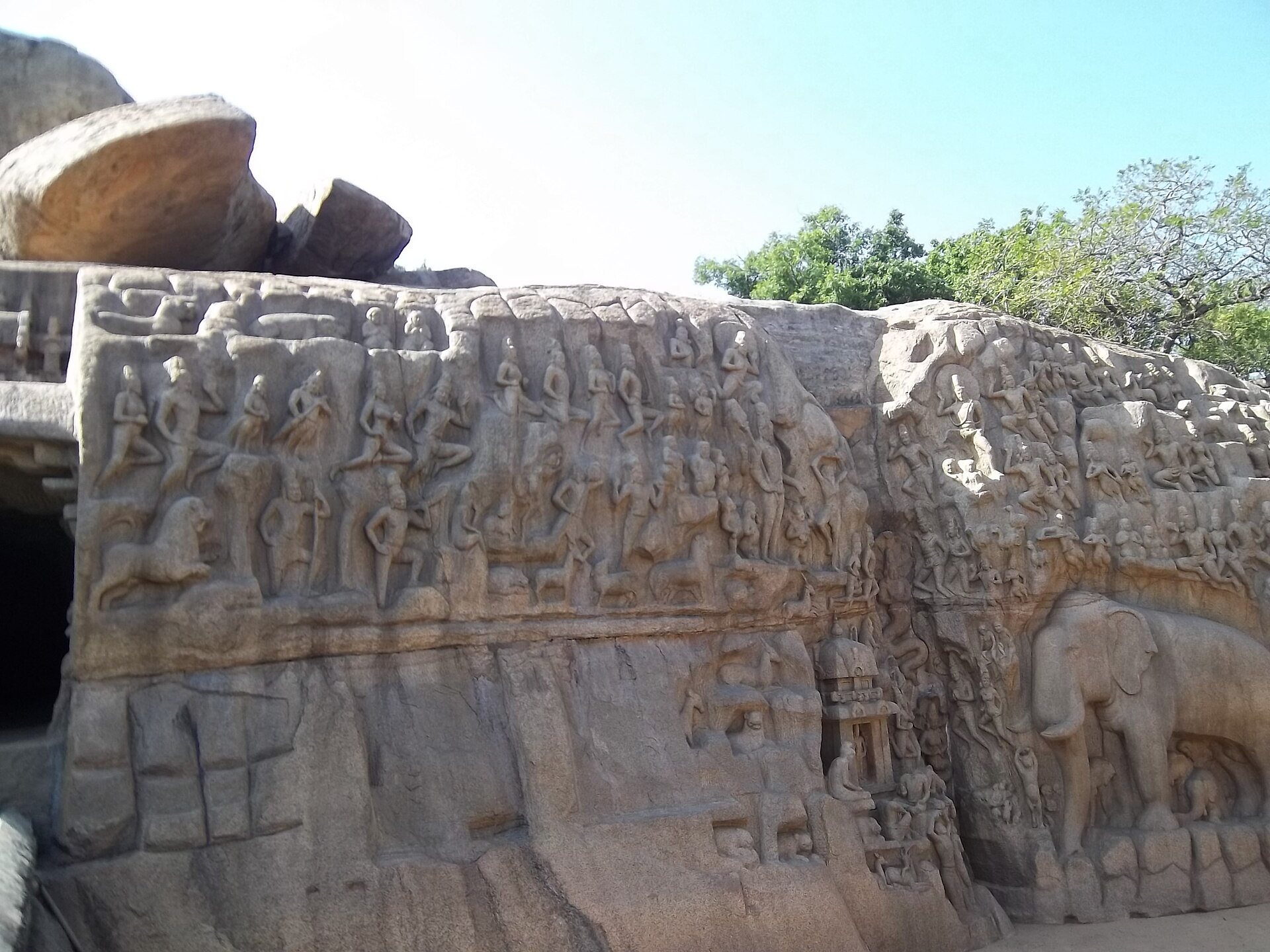
The monument is a giant bas-relief, a sculpture whose figures project from a background surface, measuring approximately 96 by 43 feet, or 29 by 13 metres. It covers two large pink-granite boulders, each measuring about 15 by 30 metres. The east-facing composition stands near the centre of Mamallapuram, a short distance from the Bay of Bengal coast and the Shore Temple.
A natural, nearly vertical cleft separates the boulders. Rather than being treated as a break in the stone, it was incorporated into the image as the river channel through which the Ganges descends. A water tank or collecting pool formerly stood above it. Water could be released down the cleft and over the relief during festivals, creating the appearance of the sacred river flowing from Shiva’s matted hair. A brick-built cistern at the top of the cleft provides physical evidence for this arrangement.
Divine figures and celestial beings
More than one hundred figures cover the rock, with approximately 146 also counted. Gods, humans, half-human beings, and animals are carved in the composition, many at roughly life size. Shiva stands beside the central one-legged ascetic to the right of the cleft, holding a weapon interpreted as the Pashupata. In the upper part of the relief, he appears beside kinnaras, mythological half-human, half-bird beings associated with music. The male figure holds an alapini vina, a stringed instrument, while the female figure holds a cymbal.
Other celestial figures approach the river through the air. Two pairs of kinnaras and three pairs of celestial couples move toward the cleft, accompanied by lions, monkeys, and other animals. Gandharvas, celestial musicians, Apsaras, celestial female beings, and Ganas, the attendants and devotees of Shiva, also form part of the scene. Divine Nagas appear in human and serpent form within the river-like cleft. Some swim in the channel, while others gather near its upper point with their hands joined in anjali, a gesture of reverence made by joining the palms.
Animals, landscape, and hunting scenes
A herd of elephants moves toward the river to drink. The group includes a male followed by a female, three calves associated with the male, and two associated with the female. The adult elephants are almost life size, while the calves are carefully rendered behind them. Elsewhere, a deer scratches its nose and monkeys imitate the yogic postures of sages.
The upper part of the panel includes the Sun on the left and the Moon on the right, together with a Kim-purusha, a dwarf-like figure with elongated ears, a cap, and a drum. Himalayan imagery appears in the form of large-maned wild lions and rams, which are interpreted as references to the Himalayan habitat associated with the river’s descent.
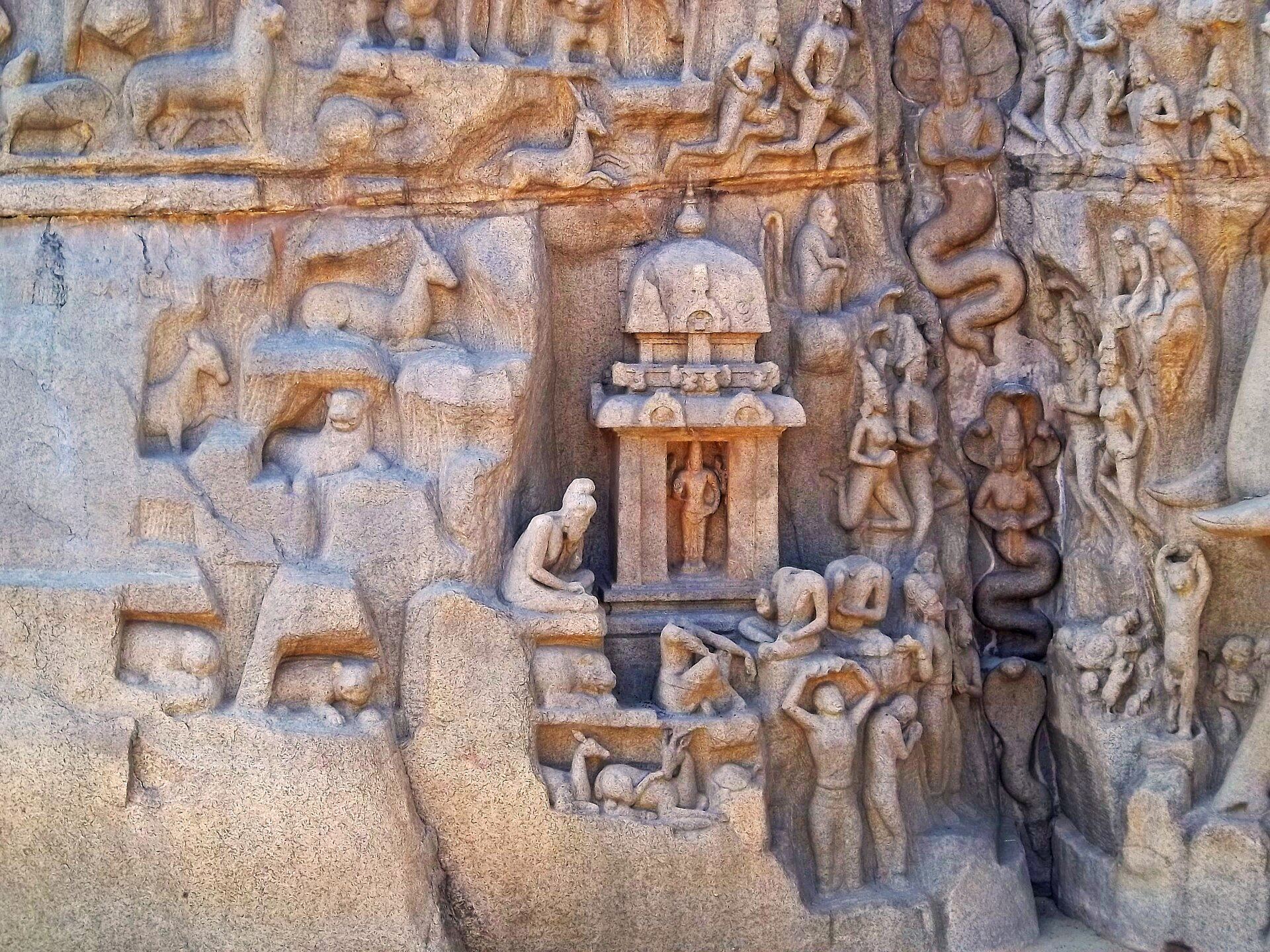
Hunting scenes occupy another part of the rock surface. They include a hunter carrying a bow, two hunters concealed beneath trees, a lion preparing to attack two hunters, hunters carrying a pitcher, and another hunter carrying hunted animals. A separate forest scene includes monkeys, a lion in a cave or den, and deer positioned in front of it.
Temple and teaching scene
At the lower end of the panel, to the right of the cleft, a small simple temple is carved into the rock. It contains an image of Vishnu. Its roof follows the style of Draupadi Ratha and has a square, curving, dome-like tower. The flat top carries a central stupi, a temple-roof finial, and a kudu, a horseshoe-shaped ornamental window motif used in South Indian architecture. Floral designs decorate the corners, while the cornices contain kudus with human faces. Lion motifs appear above the cornice, and a square element supports the dome-like roof.
A seated sage appears before the temple, preaching or teaching students. Beneath this scene are a lion in a cave or den and a pair of deer. A tortoise beside the temple indicates the presence or proximity of water. Together with the cleft, the tank, and the many figures gathered around the descending river, these features make the monument a unified composition in which divine, human, animal, and natural forms are carved directly into the living rock.