Fort Sadras: A Dutch East India Company Fort in India
Site at a Glance
- Rating
- 4
- Popularity
- Medium
- Country
- India
- Primary era
- Early Modern
- External website
- Open
- Eras represented
- Early Modern
- Civilizations
- Dutch
- Site type
- Military
- Remains
- Fort
On this page8 sections
History
Fort Sadras is a Dutch East India Company fort near Kalpakkam in Tamil Nadu, India, built in 1711 to protect an earlier Dutch trading station on the Coromandel Coast. The Dutch East India Company, known as the VOC, was a chartered corporation that operated trading posts, warehouses, ships, and fortified settlements across Asia from 1602 to 1799. Sadras became an important centre for cotton textiles and regional commerce before warfare and political change ended its commercial role.
Trading station and fortified settlement
The VOC had traded at Sadras from the beginning of the seventeenth century. Around 1650, it established a factory, meaning a European trading station with offices, warehouses, and residences rather than primarily an industrial building, on leased land north of the mouth of the Palar River. The surrounding area belonged successively to the Carnatic, Golconda, Maratha, and Mughal states during the VOC period.
Sadras specialized in high-quality cotton textiles, particularly muslin. It also produced a valued building stone used as ship ballast and as paving and gravestone material at Dutch establishments elsewhere in Asia. The settlement included European and Asian artisans, merchants, weavers, washers, and dyers. Facilities within the trading compound included places for bleaching cotton cloth and an indigo factory.
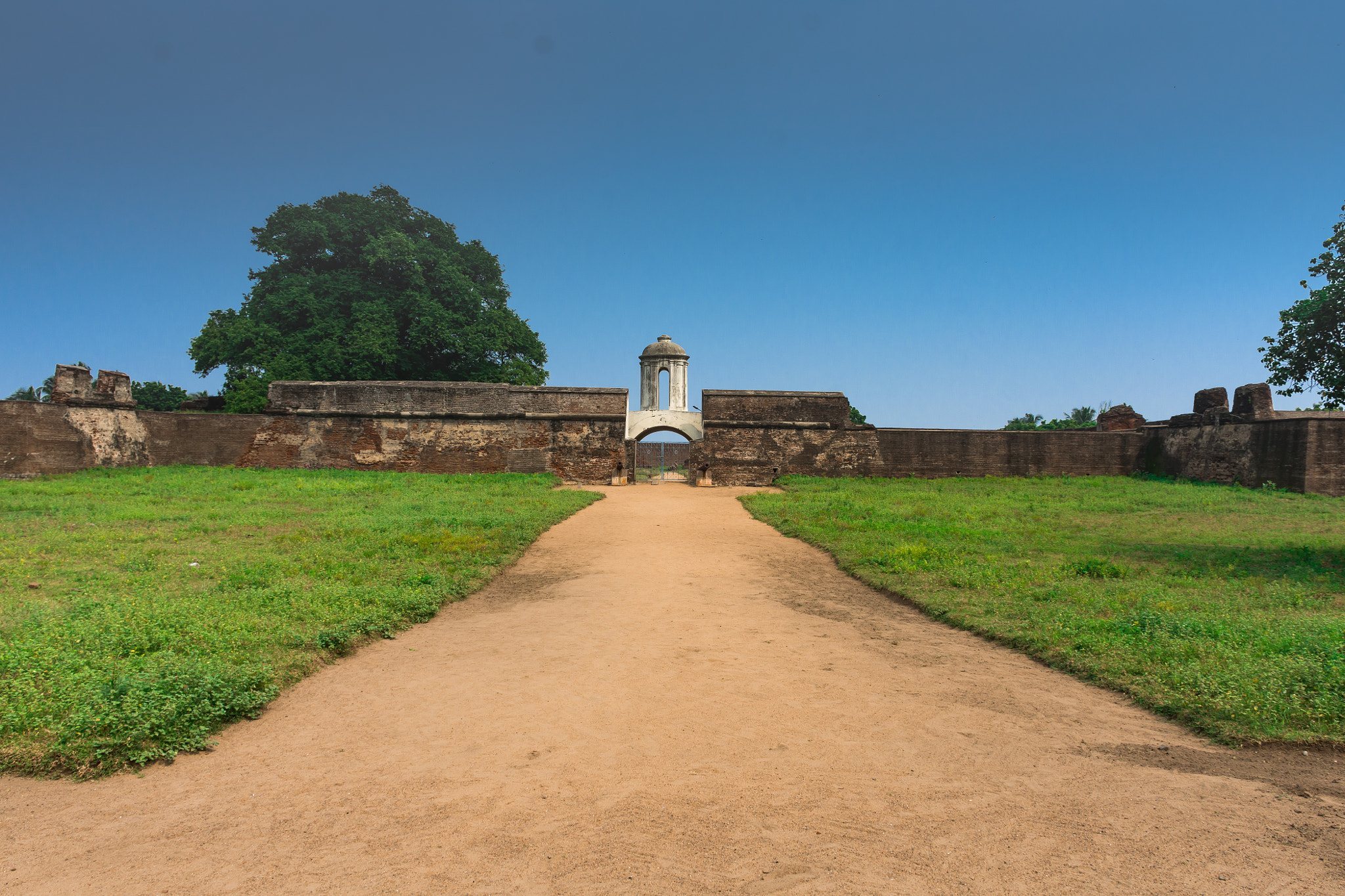
In 1711, the trading station was enclosed by fortifications. The fort was strengthened again in 1749, when bastions, projecting parts of a defensive wall that allowed fire along adjoining walls, were added. New warehouses were constructed, and the principal entrance was moved from the seaward side to the landward side, where it received a small projecting tower. The works cost more than 16,000 pagodas, a monetary unit formerly used in southern India. Engineer Coenraad Pieter Keller was criticized in Batavia because the fortifications were considered too elaborate and expensive.
The fort was intended to protect the VOC station from the Marathas, the British, and the French. Until about 1740, Dutch trade on the Coromandel Coast exceeded the combined British and French trade. During the second half of the eighteenth century, however, famine and regional warfare weakened the Dutch commercial position.
French occupation and British capture
In 1758, French forces confiscated the richly loaded VOC return ship Haarlem as it sailed from Sadras toward Pondicherry. Early in 1759, French troops entered Sadras after Tamerius Canter Visscher, the acting head and a junior merchant, allowed them to pass through the fort. They then refused to withdraw and occupied the settlement for three months. The British accused the VOC of helping the French during their siege of Madras.
British forces captured Sadras by surprise in June 1781 during the Fourth Anglo-Dutch War, fought from 1780 to 1784 between Great Britain and the Dutch Republic. The local soldiers deserted when the British appeared, leaving about fifty VOC soldiers to abandon the fort. The Europeans were taken to Madras, while the fort and warehouses were looted and partly destroyed with explosives. The British commander, George Mackay, had recently visited Jan Pieter de Neys, the head of Sadras, ostensibly as a courtesy but in practice to examine the fort’s defenses.
Naval conflict also reached the settlement. In February during the same period, a British fleet commanded by Edward Hughes fought a French fleet under De Suffren offshore in the Battle of Sadras. The engagement was inconclusive.
Decline and changing colonial control
The loss of VOC protection accelerated the decline of the settlement around the fort. Soldiers associated with Haider Ali of Mysore plundered the village, and the Chalisa famine of 1783 to 1784, brought on by a hurricane, caused further devastation. Houses and streets were left in ruins, while much of the population dispersed or was lost through famine and war.
Sadras was returned to the VOC in 1784, but the fort and other returned establishments had already been destroyed with gunpowder. Dutch commercial activity on the coast consequently ended. By 1786, the fort was too dilapidated for habitation, and returning merchants lived in the director’s country residence instead.
In 1795, the British took Sadras again under the Kew Letters, instructions issued by the Dutch stadholder William V from Kew that directed Dutch colonial authorities to accept British protection and prevent revolutionary France from seizing Dutch overseas possessions. After the VOC became bankrupt, Sadras passed to the United Kingdom of the Netherlands in 1818 under the Treaty of London of 1814.
Jacob Andries van Braam was appointed in 1817 to supervise the transfer of former VOC possessions in Bengal and on the Coromandel Coast. After the loss of Nagapattinam and the greater destruction of Paliacatte, Sadras became the new Dutch headquarters. The formal transfer took place on 31 March in the presence of John Hodgson of Madras and Francis Casparus Regel, the new head of Sadras.
British control of the surrounding territory, together with restrictive import and export duties, made the remaining Dutch establishments commercially unviable. A treaty signed on 17 March 1824 required the Netherlands to surrender its remaining Indian and Malayan establishments and its claims to Singapore. Sadras passed definitively into British hands on 1 June 1825. The Archaeological Survey of India, the Indian government agency responsible for archaeological research and monument conservation, began restoring the fort from 1990 onward.
Remains
Fort enclosure and internal layout
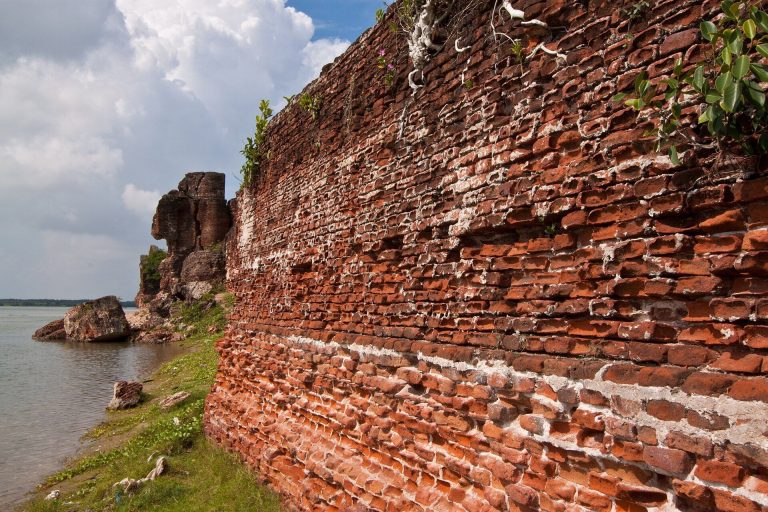
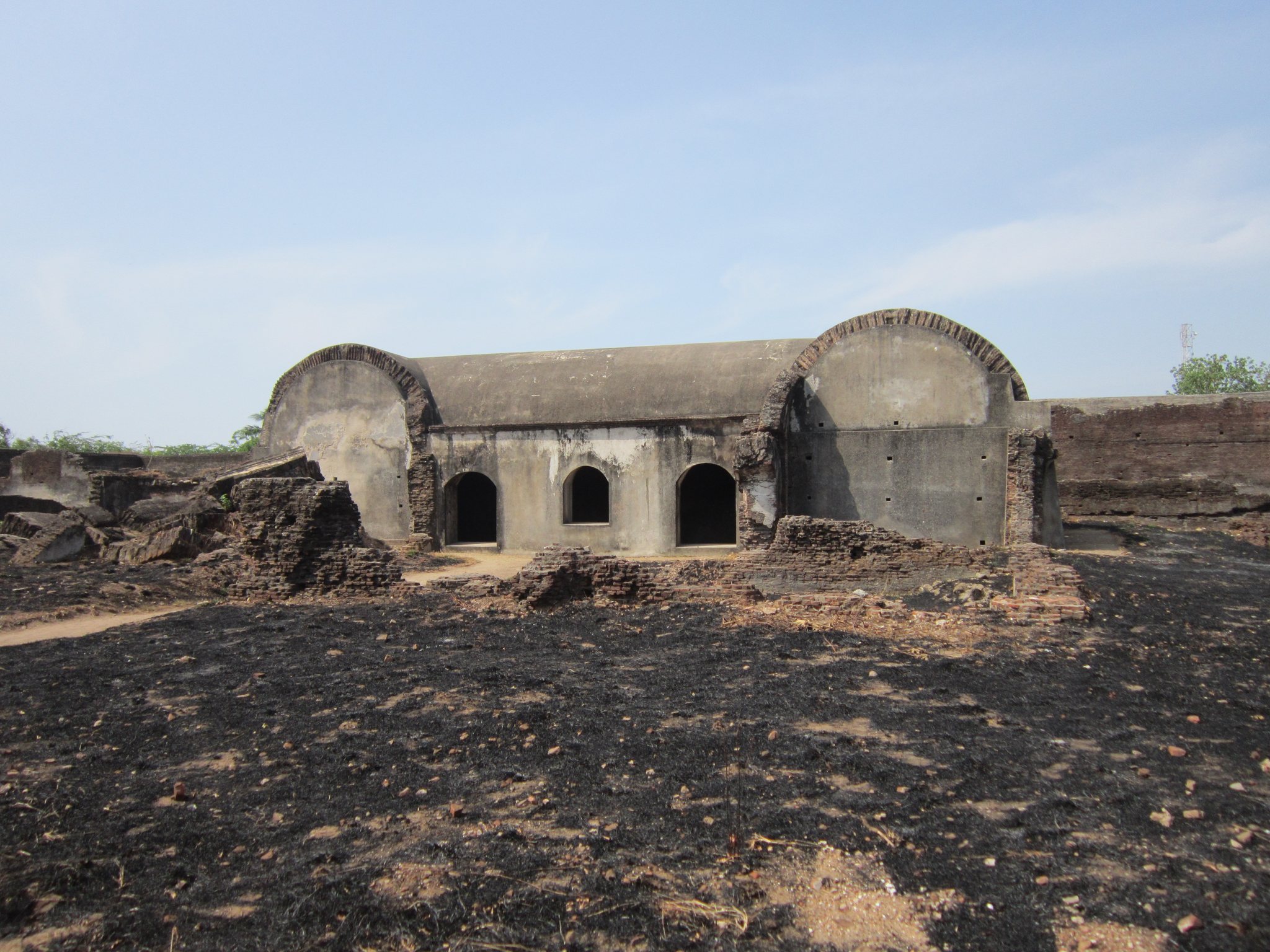
Fort Sadras is a rectangular enclosure aligned from east to west and positioned close to the beach. Its walls rise several metres, and three of the original four corner bastions survive. The main gate also remains, including the small tower added when the entrance was moved to the landward side. Inside, the courtyard measures approximately 150 by 80 metres. Two large warehouses occupy its eastern side, while floors from vanished buildings preserve parts of the earlier internal arrangement.
Textile-production features
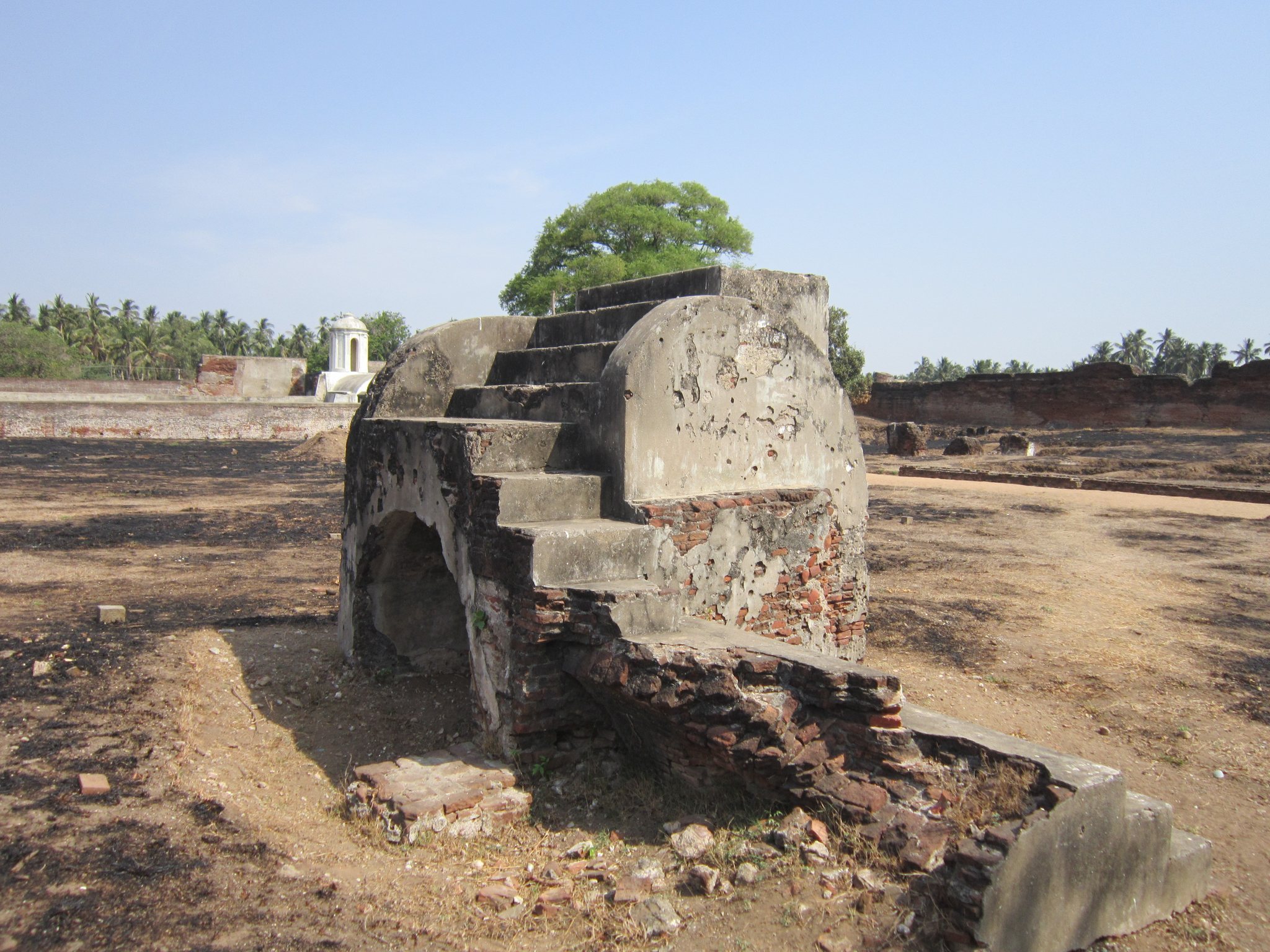
Basins used for washing and dyeing cotton textiles survive within the fort, together with a drainage system. These features reflect the processing activities that supported Sadras’s textile trade. A raised stone platform is also preserved in the enclosure. Its function is uncertain, although it is believed to have served as a mounting platform for elephants brought from Ceylon.
Gateway stone and cemetery
A carved ornamental stone dated 4 May 1749, probably once part of the gateway, is now held by the Government Museum in Chennai. The fort cemetery contains nearly twenty graves dating from 1644 to 1790. Surviving memorials include the gravestone of a son of Dirk van Cloon; the stone of Barent Clebout, a captain and major of the Ceylon militia who died in 1679; and the gravestone of Abraham van Valencyn of Delft, who headed Sadras around 1660.
Other surviving burials commemorate the skipper Pieter Adriaanse van Somerdijck, who died in 1673; Ammarentia Blochovius, who died in childbirth at Sadras in 1670, and her stillborn daughter; and her son Pieter Hemsinck, who died in 1682. The cemetery also contains the gravestone of Anna Macharius, wife of the head of Sadras Laurens van Buyten, who died in 1693, as well as memorials to the military captain Mauris Teesar du Thiel and the fiscal Maarten van den Briel and his sons Johannes and Marcus.