Selbu Church: A Medieval Parish Church in Norway


Site at a Glance
- Rating
- 4.3
- Popularity
- Very Low
- Country
- Norway
- Primary era
- Medieval
- External website
- Open
- Eras represented
- Medieval, Early Modern, Modern
- Civilizations
- Denmark–Norway, Norwegian
- Site type
- Religious
- Remains
- Church
On this page10 sections
History
Selbu Church is an active parish church in Mebonden, Norway, whose medieval stone construction probably began around 1150. It belongs to Selbu Parish in the Stjørdal Deanery of the Diocese of Nidaros, the Church of Norway diocese centered on Trondheim, and its earlier denomination was the Catholic Church. The earliest surviving written record dates from 1409, although the church already existed by that time.
Medieval construction
The medieval church was probably built in stages. A choir was constructed around the middle of the twelfth century, followed by the nave. Dendrochronology, the dating of timber through its annual growth rings, places the felling of wood used in the nave roof in 1176 or 1177.
A western tower was probably erected as a free-standing structure during the 1280s. Its bell bears the date 1283. The nave was later extended westward until it joined the tower, creating the connected arrangement that forms part of the church today.
Early modern furnishings
In 1656, the Trøndelag woodcarver Johan Johansen, also known as Johan bilthugger, made a Baroque altarpiece. Johan Hanssønn, a portrait painter, provided its painted decoration. The Baroque style is associated with dramatic forms, carving, and ornament.
Nineteenth-century enlargement
Between 1804 and 1806, the medieval choir was demolished and replaced. The nave was enlarged with two transept arms, giving the building its present cruciform plan. A cruciform church has a cross-shaped layout formed by transepts projecting from the nave, but Selbu Church retained the seating arrangement of a long church, with seats directed toward the choir.
Constitutional and modern history
In 1814, Selbu Church served as an election church during the elections for Norway’s Constituent Assembly. The assembly met at Eidsvoll to draft and adopt Norway’s constitution. Selbu parish acted as an electoral constituency, choosing electors who later helped select the parish’s representatives to the assembly.
The building underwent extensive restoration and rebuilding in 1888. A further restoration took place from 1949 to 1963 under the supervision of John Egil Tverdahl. Much of the Gothic interior, associated with the medieval architectural and artistic style that preceded the Baroque period, was removed. Parts of the earlier altarpiece were recovered and reconstructed using patterns from comparable altarpieces. Selbu Church is automatically protected as a Norwegian cultural heritage site.
Remains
Plan and construction
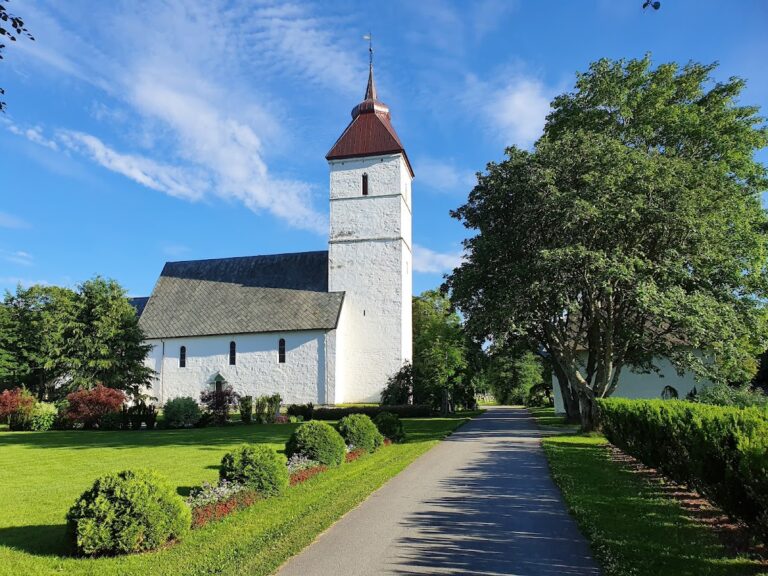
Selbu Church is a white stone building constructed from dressed sandstone. Its present form is cruciform, with two small transept arms projecting from the nave. The original medieval arrangement was a single-nave long church, organized along a lengthwise axis toward the choir. The medieval choir was narrower than the nave and had a lower roof line at the southeastern end.
Western tower
A large tower occupies the western end of the church and contains the entrance porch. It is now attached to the nave, although its earlier form was probably free-standing. The tower houses the church bell dated 1283, linking this surviving architectural element with the medieval development of the building.
Interior and altarpiece
The interior continues to follow a longitudinal arrangement, with seating facing the choir despite the building’s later cross-shaped outline. The carved and painted Baroque altarpiece made in 1656 remains an important furnishing. During the restoration of 1949 to 1963, recovered parts of the former altarpiece were reconstructed, while much of the Gothic interior was altered or removed.
Coins beneath the former floor
When a new floor was installed in 1959, 118 coins were found in the soil beneath the former church floor. Most were Norwegian or Swedish. The Swedish examples date from 1275 to 1560, while 34 of the 58 Norwegian coins were minted during the reign of Håkon Håkonsson, a thirteenth-century king of Norway.
The church accommodates approximately 550 people and continues to function as a parish church within the Church of Norway.