Schottenkirche: The Baroque Church of Vienna’s Schottenstift
Site at a Glance
- Popularity
- High
- Country
- Austria
- Primary era
- Early Modern
- Eras represented
- Medieval, Early Modern, Modern
- Civilizations
- Austria-Hungary, Austrian Empire, Duchy of Austria, Habsburg, Habsburg Austria, Holy Roman Empire
- Site type
- Religious
- Remains
- Church
On this page16 sections
History
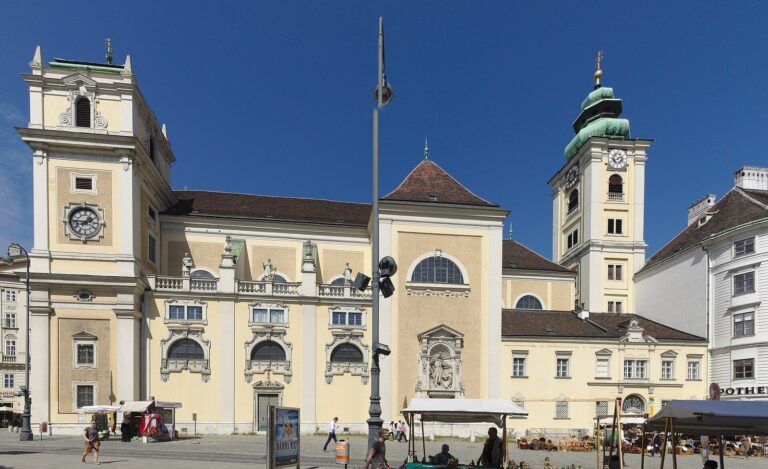
The Schottenkirche is the church of the Schottenstift in Vienna, Austria, a Benedictine abbey founded in 1155 by Duke Henry II Jasomirgott and Irish monks. Benedictines belong to a Catholic monastic order guided by the Rule of Saint Benedict. Church construction began soon after the abbey’s foundation, and Bishop Wolfger of Passau consecrated it in 1200. The present building is Baroque, but its history reaches back to the Romanesque church of the abbey’s early years. The name “Schotten” reflects medieval use of the Latin term Scoti for Irish people, rather than the name’s modern association with Scotland.
Medieval foundation and parish
The abbey secured parish rights for its Viennese territory after a dispute with the city’s parish priest. An arbitration ruling granted those rights on 28 August 1265, at first limiting baptism and burial; they became unrestricted in 1269. The parish served parts of what is now Vienna’s Inner City, as well as Roßau and Alservorstadt. The abbey also held suburban parishes at St. Ulrich and Gumpendorf, and later at Schottenfeld. These were separate from the abbey parish.
A city fire destroyed the original church in 1276. It was rebuilt in an early Gothic style and ready by 1317. An earthquake around 1443 damaged the building, after which the choir was remodeled in Gothic form between 1446 and 1449. A large winged altar, now known as the Schottenmeister Altar, was made for the choir between 1469 and 1475.
After a period of decline, Duke Albert V transferred the abbey in 1418 to German-speaking Benedictine monks from Melk Abbey. The change followed the Council of Constance and formed part of the Melker Reform, a fifteenth-century effort to renew Benedictine observance.
Baroque rebuilding and Marian traditions
On 21 May 1634, masonry fell from the church vault while Emperor Ferdinand II, his wife, and their daughters were inside. The resulting panic knocked the emperor down. Lightning struck a tower in 1638, causing it to collapse and prompting a major rebuilding. Abbot Johann Walterfinger initiated work on the choir and tower. Under Abbot Anton Spindler von Hofegg, the choir and tower were rebuilt from 1638 to 1641; work on the nave and west side followed from 1643 to 1648. The church was consecrated on 31 May 1648 by Vienna’s Bishop Philipp Friedrich von Breuner.
In 1645, as Swedish forces threatened Vienna, Emperor Ferdinand III sought the protection of the Virgin Mary through the church’s Marian image. On 29 March the image was carried in procession to the cathedral for public veneration. The Swedish advance’s halt was credited to the Virgin Mary. During the Ottoman campaign against Vienna in 1683, people likewise attributed the extinguishing of a fire to the intervention of Our Lady of the Scots. The church was restored after the Ottoman siege.
Restoration and modern changes
Plans to raise the west towers were discussed repeatedly but never carried out. The choir tower was consecrated in 1893. From 1883 to 1887, Abbot Ernest Hauswirth commissioned a restoration and partial remodeling. Most Baroque altars were replaced, while the Benedictus and Gregory altars were retained. The work also included a new high altar and ceiling paintings. A monument to Henry II was installed, and, after several reinterments, his remains were placed in the crypt in a Neo-Romanesque sarcophagus in 1901.
In 1958, Pope Pius XII granted the church the honorific rank of minor basilica. From 1992 to 1994, the choir was rearranged in response to twentieth-century liturgical reforms. The church’s bells were lost during the Second World War. Three bells cast in 1957 were later considered unsatisfactory because their tones clashed and their bronze had too little tin; in 2022, five new bells were cast for the church.
Parish records, burials, and music
The parish registers are valuable for genealogical research into Vienna’s former residents. The oldest baptismal register dates to 1598, the oldest marriage register to 1599, and the oldest burial register to 1649. Henry II was buried in the church in 1177; his wife Theodora and their daughter Agnes were later buried with him. Other people buried there included Vienna’s defender Ernst Rüdiger von Starhemberg; court and provincial officials Philipp and Seyfried von Breuner; Johann Ferdinand von Porcia; Field Marshal Ludwig Andreas von Khevenhüller; diplomats Gottlieb Amadeus von Windisch-Graetz, Franz von Lisola, Ferdinand von Plettenberg, and Johann Rudolf Schmid von Schwarzenhorn; court stonemason Peter Concorz; sculptor Johann Jacob Pock; court mathematician Johann Jakob Marinoni; and painter Paul Troger.
Joseph Haydn, first buried quietly at Vienna’s Hundsturm cemetery during the French occupation, was commemorated at the church with a solemn service on 15 June 1809. Mozart’s Requiem was performed. The Baroque composer Johann Joseph Fux served as the church’s organist from 1696 to 1702.
Remains
Plan and Romanesque fabric
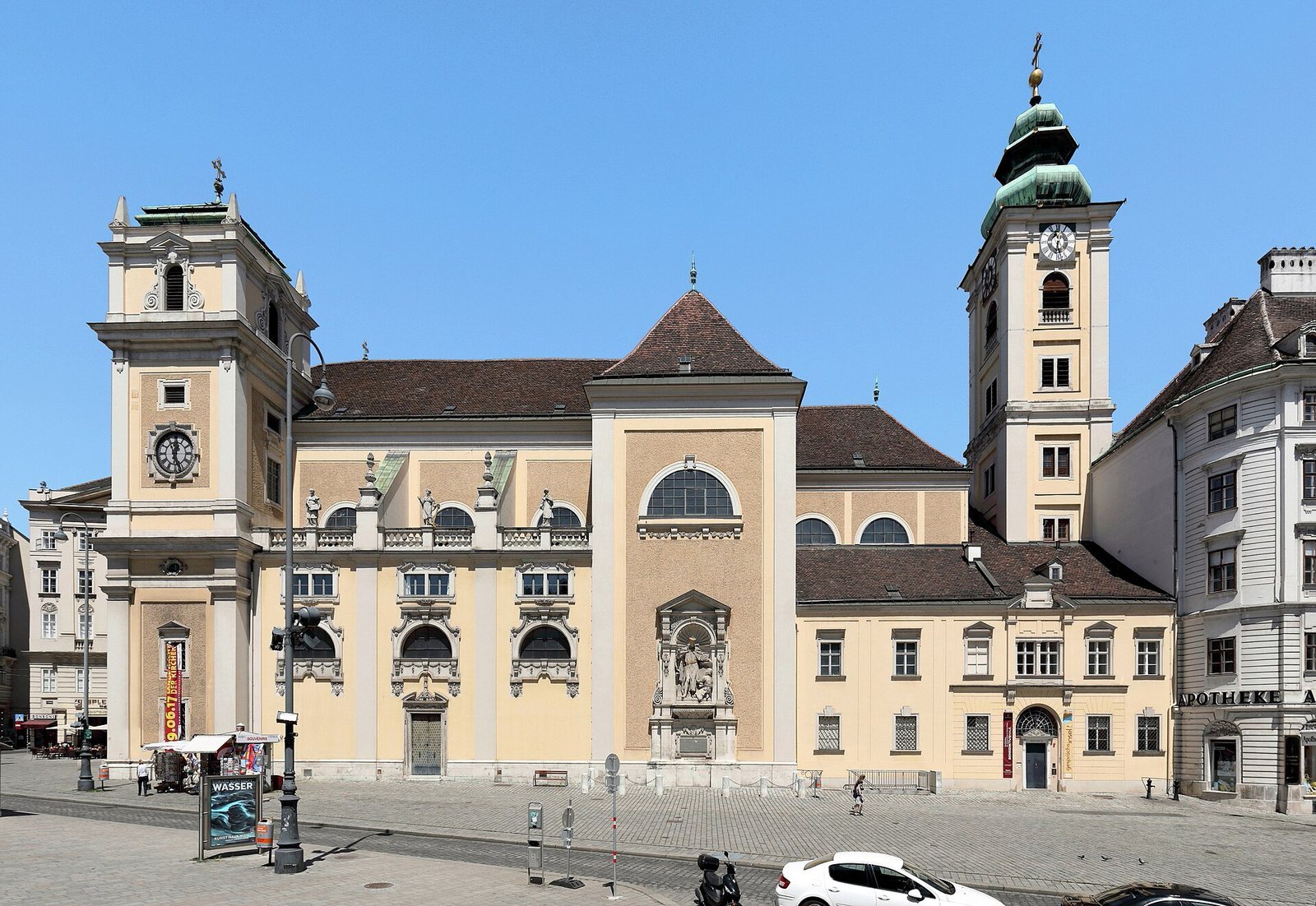
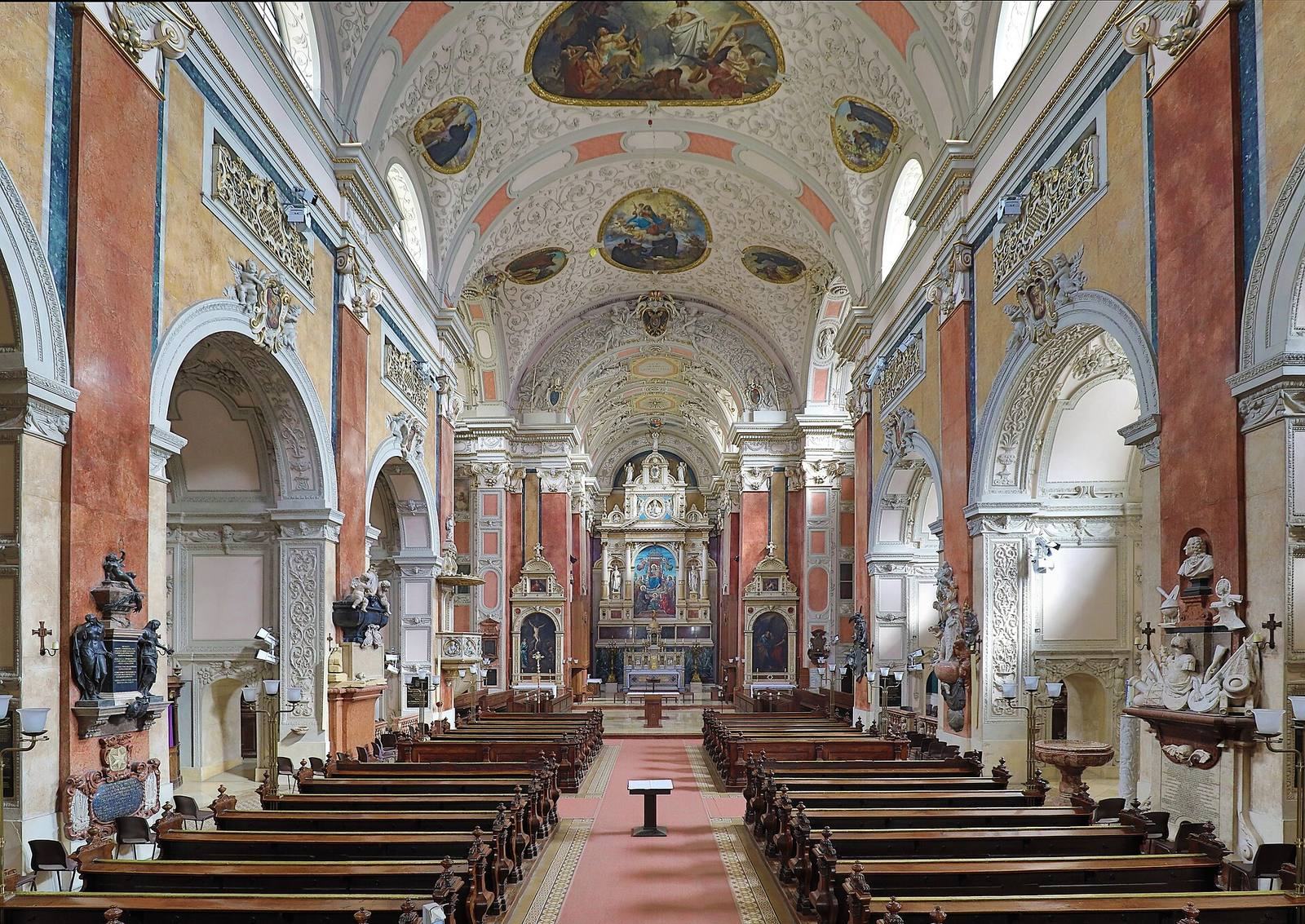
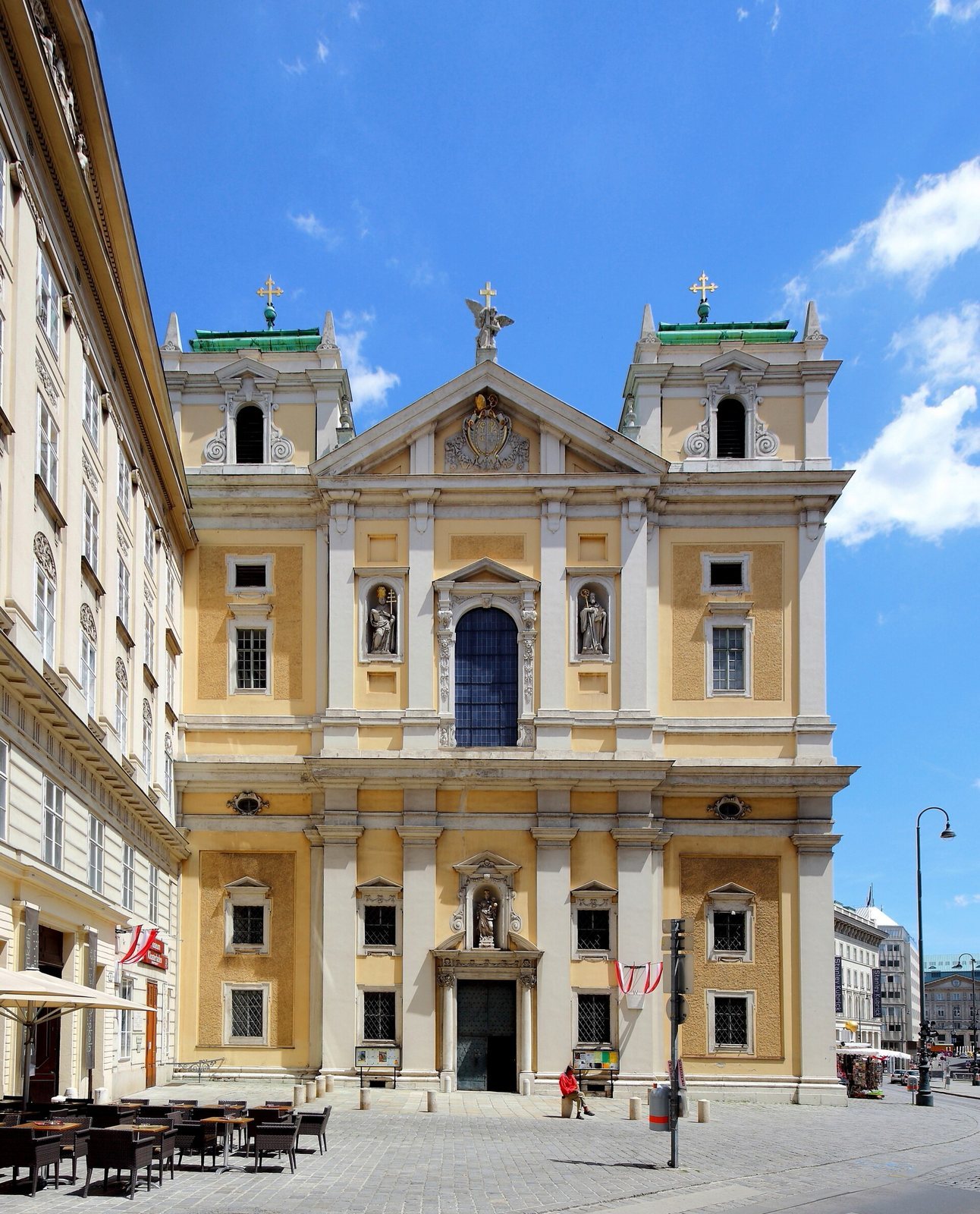
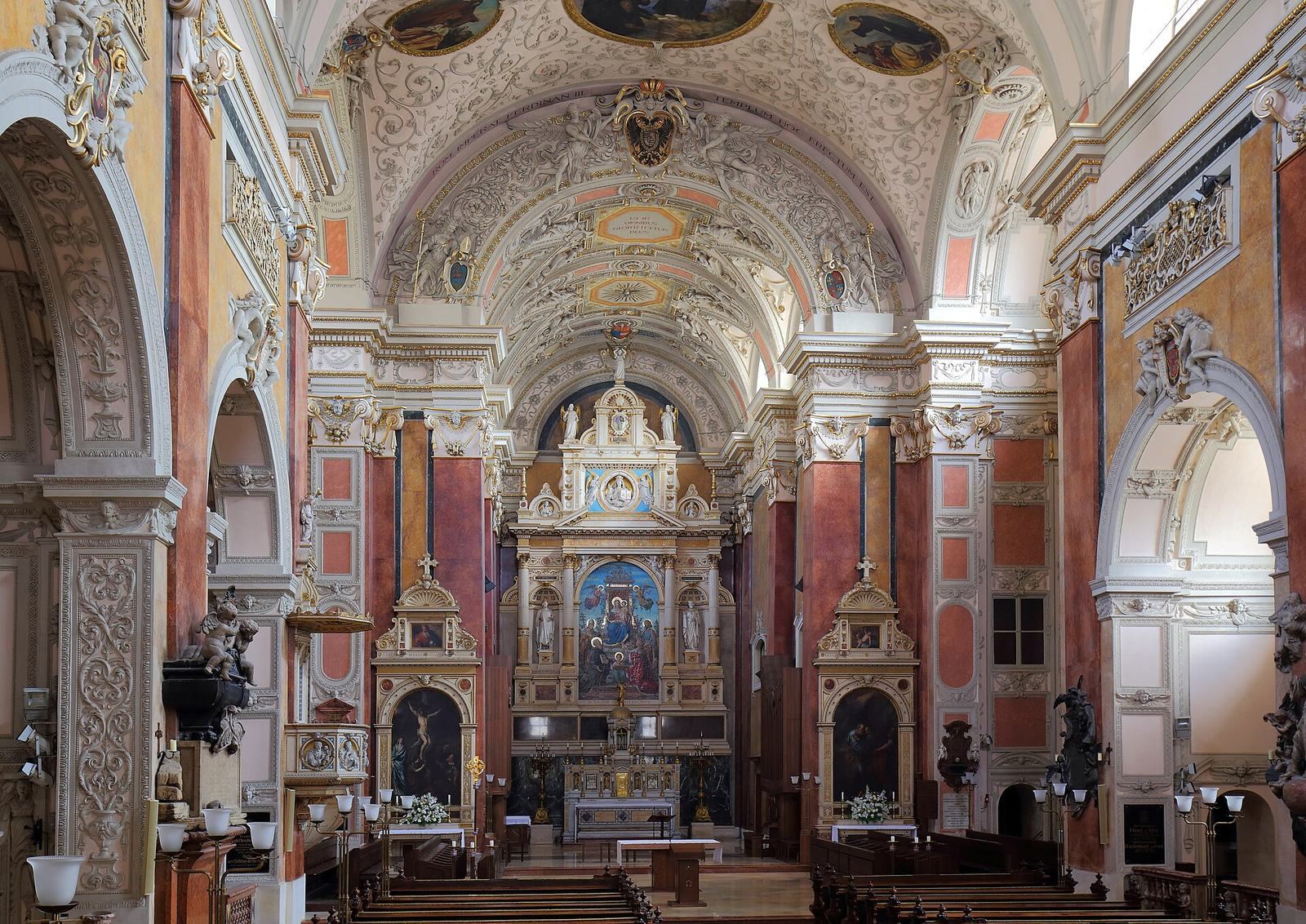
The west-facing church is 55 metres long and 25 metres wide, with a nave 15 metres across. Its interior follows a wall-pier plan, with internal supports formed by thick wall sections, beneath a barrel vault, or continuous arched ceiling. Several chapels form part of the building, and a transept, the crosswise arm of a church plan, is suggested in the layout. The Baroque rebuilding shortened the church, leaving its tower no longer directly beside the nave; the west towers rise only slightly above the façade.
Romanesque remains and Marian image
The first church was a three-aisled Romanesque pillar church with a single apse, or rounded end. Remains of it survive in the Dark Sacristy and the Romanesque Chapel, which serves as a day chapel. The chapel also houses a Romanesque image of the Virgin Mary and Child, dating to around 1250 and considered the oldest depiction of Mary in Vienna. It shows Mary seated with the infant Jesus on her left knee. The crowns and colors were added in the nineteenth century. Once placed above the tabernacle of the Marian altar beside the pulpit, the image was moved to the chapel after the 1994 renovation.
Stonework and portal
Peter Concorz carried out stonework for the rebuilding and acquired a quarry at Kaisersteinbruch under a contract with Abbot Michael II Schnabel of Heiligenkreuz Abbey. In 1651, court stonemason Bartholomäus Khöll built the main portal in the tower façade. Tobias Kracker made the Virgin and Child statue for its niche.
Altars and paintings
Seventeenth-century altarpieces
Joachim von Sandrart painted the Apostle Altar picture in 1652 and the Cross Altar picture in 1654. His high-altar painting, Heavenly Glory, dates to 1671 and is now in the abbey’s Prelates’ Hall. Tobias Pock painted pictures for the Sebastian Altar between 1649 and 1650, the Marian Altar between 1651 and 1655, and the Benedictus Altar in 1654. A fresco of Saint Wolfgang by Pock, dating to around 1655, was uncovered in the late twentieth century. Georg Bachmann painted the Gregory Altar picture between 1651 and 1652. Panels for the Anna and Barbara altars, both made between 1656 and 1659, are attributed to Jeronimus Joachims.
Nineteenth-century altar and ceiling
The high altar introduced during the 1883–1887 restoration followed Heinrich Ferstel’s design and was completed by Max Haas; Michael Rieser made its mosaic. Julius Schmid painted the ceiling decorations. The Henry II monument stands on the church’s south side.
Crypt and family vaults
The Baroque rebuilding established the church crypt, which includes a separate burial chamber. Noble families with vaults beneath the side altars included the Unverzagt, Leslie, Zinzendorf, Porcia, Dietrichstein, and Khevenhüller families.
Organs and bells
Organs
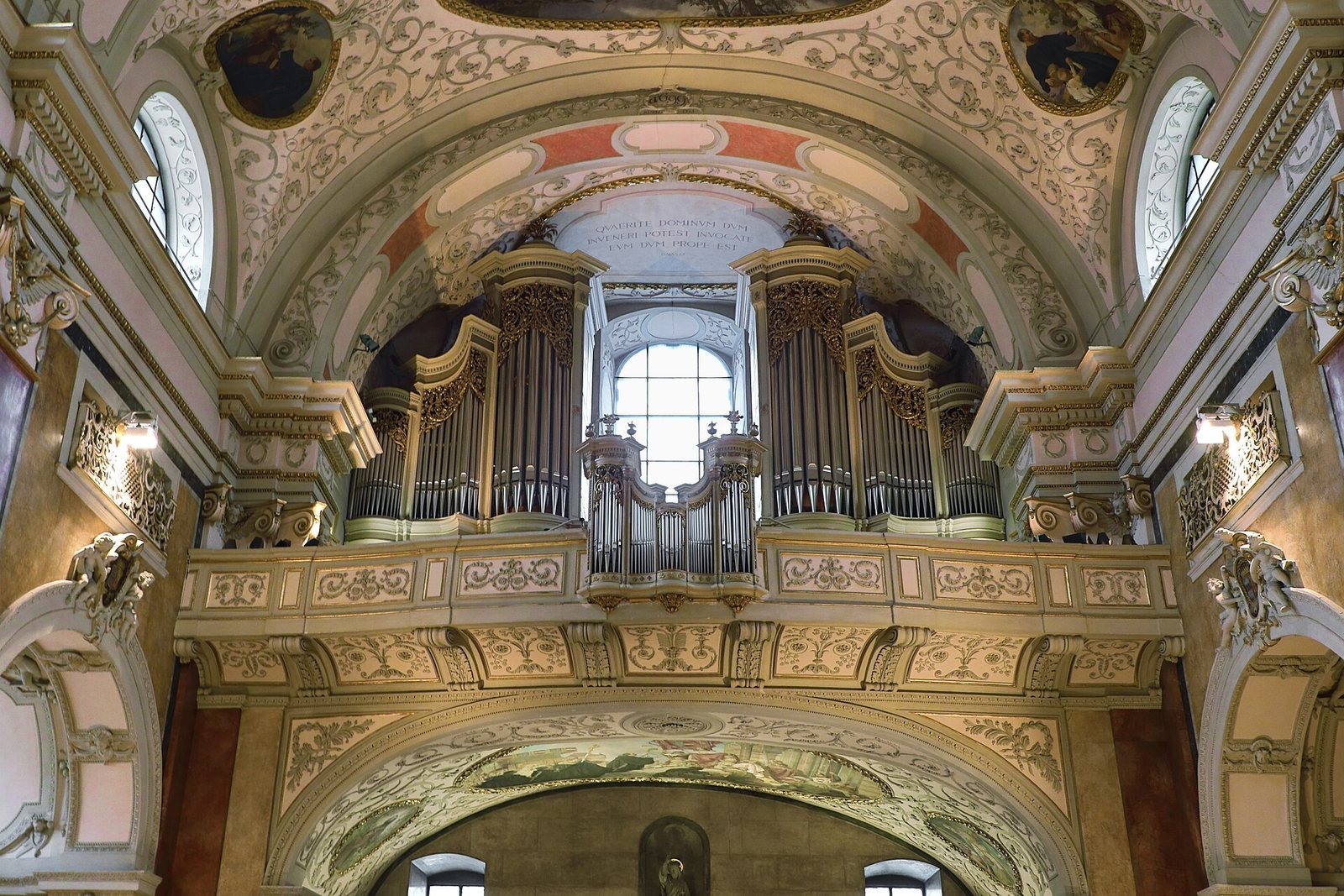
Two organs made by Mathis Orgelbau were installed during later renovations. The choir organ, dating to 1994, has 20 stops, controls that select sets of pipes, across two manuals, or hand-played keyboards, and a pedal. It is divided between the choir’s side walls: the main division and console are on the right, while the swellable secondary division and pedal are on the left, behind a matching case.
The main organ, installed in 1996, occupies the historic case made for Ignaz Kober’s 1804 organ. It has 49 stops across three manuals and a pedal, mechanical key and stop actions, and an electronic combination system. Couplers link manuals II and III and the pedal to manual I, connect manuals II and III to each other, and link all three manuals to the pedal. Its listed registration aid is Organo Pleno, a full-organ setting that typically uses principal stops.
Bells
The five bells cast in 2022 have pitches arranged in the Salve Regina ringing motif, based on a traditional Latin prayer to the Virgin Mary. South Tyrolean artist Lois Anvidalfarei designed their decoration with the prayer’s text as inspiration. The smallest bell from the previous peal remains in the tower as a death bell; the other two earlier bells were melted down.