Schlosskirche: The Teutonic Order Church in Ellingen, Germany


Site at a Glance
- Rating
- 4.8
- Popularity
- Very Low
- Country
- Germany
- Primary era
- Early Modern
- External website
- Open
- Eras represented
- Medieval, Early Modern
- Civilizations
- Holy Roman Empire, Teutonic Order
- Site type
- Religious
- Remains
- Church
On this page16 sections
History
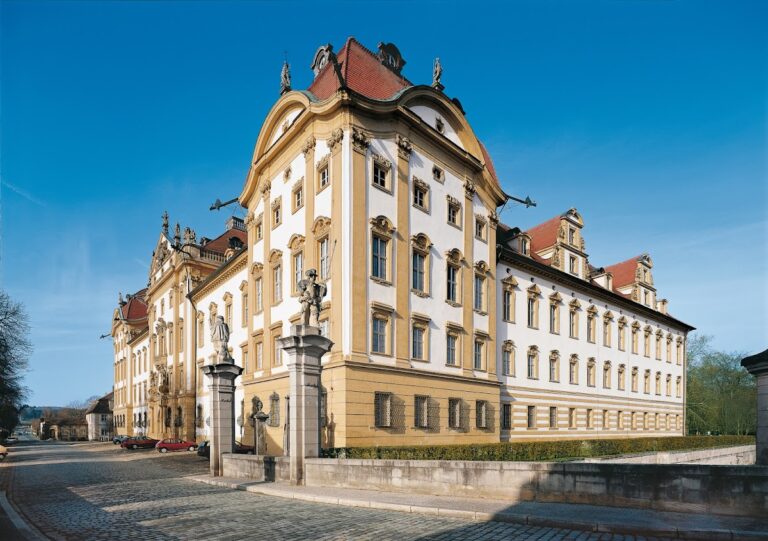
Schlosskirche is a church in Ellingen, Germany, built for the Teutonic Order in the thirteenth century in the High Gothic style. Dedicated to the Assumption of Mary and Saint Ulrich, it is the only surviving medieval part of the Ellingen palace complex apart from a remnant of the castle tower.
Foundation and Medieval Church
Construction began in 1274 under the commanders of the Ellingen commandery of the German Order, the medieval religious-military institution that administered commanderies such as Ellingen. A choir inscription that no longer survives stated that the work was completed by 1330 at the latest. The church was known as a Pohrkirche, or poor church, and followed the architectural type associated with mendicant orders.
Destruction and Rebuilding
During the Second Margrave War, a conflict in the Holy Roman Empire from 1552 to 1554, Albrecht II Alcibiades of Brandenburg-Kulmbach attacked Ellingen in 1552. His forces burned and plundered the church, leaving only the enclosing walls. The nave received a new vault with stucco ribs in 1573, and the springers, the points from which the ribs rise, remain above the present vault.
Under Landkomtur Karl Heinrich von Hornstein, a Landkomtur being a senior regional commander of the order, the church was vaulted again and given a Baroque interior in 1717 and 1718. Franz Joseph Roth directed the rebuilding and designed the Régence stucco decoration, an early eighteenth-century ornamental style. Johann Anton Pinck painted the ceiling frescoes. In 1746, under Landkomtur Franz Sigismund Friedrich Graf von Satzenhofen, the Gothic choir was encased so that it harmonized with the remodeled nave. The alterations were completed and the present tower was built under the master builder Matthias Binder.
Later History and Associations
The church’s furnishings and memorials preserve the close connection between Schlosskirche and the German Order. Numerous seventeenth- and eighteenth-century epitaphs commemorate members of the order, while the four oldest were made around 1600 for Landkomture who had died several decades earlier. In April 1945, members of the Third US Army discovered a storage depot in the church that may have contained art looted by the Nazi regime.
Schlosskirche is included in the official monument list for Ellingen. Its surviving medieval fabric, eighteenth-century rebuilding, order memorials, and decorated interior together reflect the long development of the church within the former palace complex.
Remains
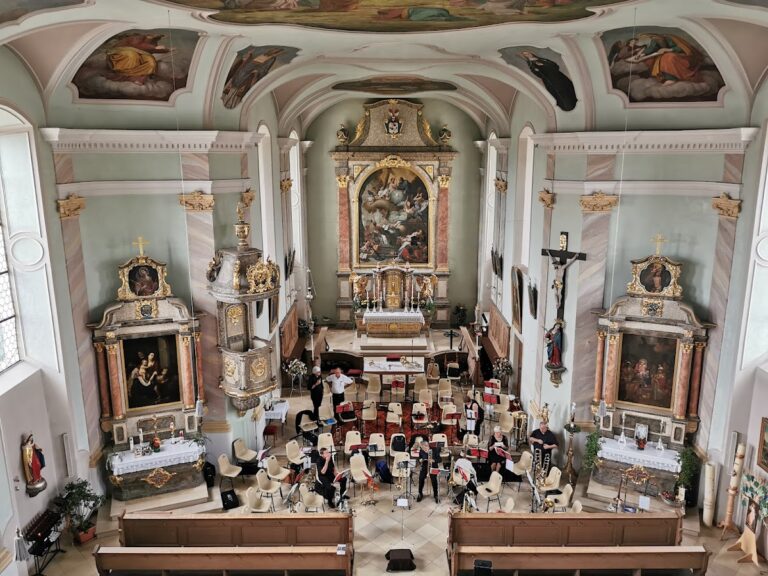
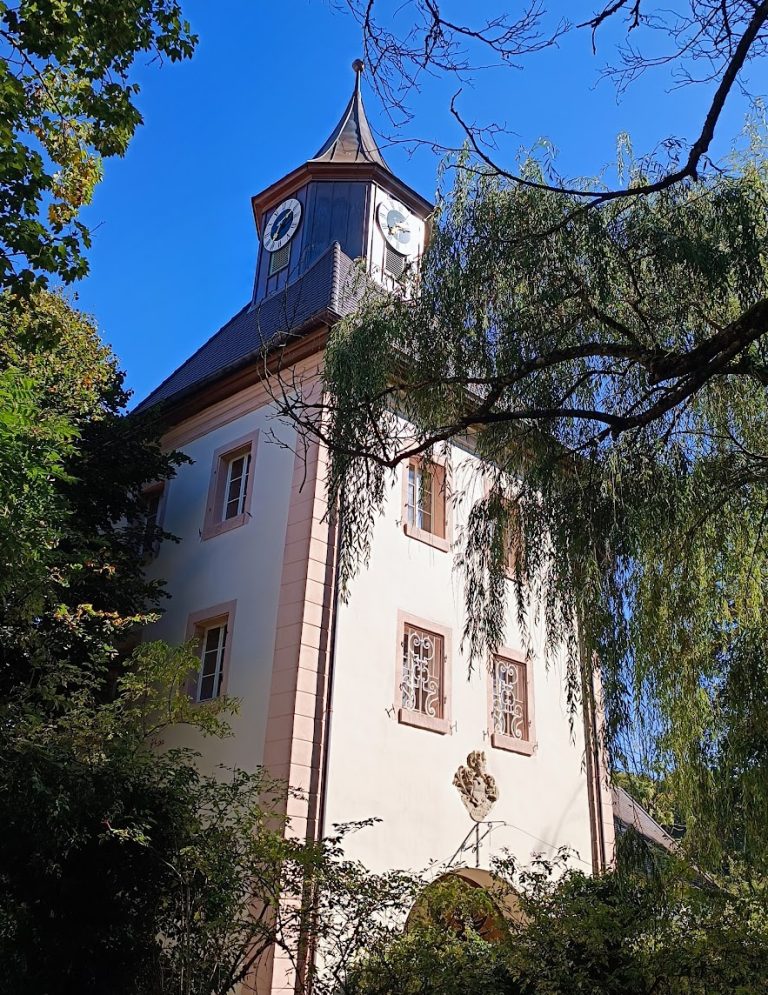
Schlosskirche is a sandstone ashlar building whose medieval core was reshaped by eighteenth-century rebuilding. The surviving church combines a south-facing Baroque facade and tower with a two-bay nave, a three-bay choir, and a five-eighths apse. Inside, stucco, frescoes, altars, an organ gallery, furnishings, and epitaphs create a continuous architectural and commemorative setting.
Facade and Tower
South Facade
The south facade is arranged around large windows framed with stucco and a strongly projecting central portal risalit. Pilasters define the projection, which contains two tall windows and two doors. A niche between the facade windows holds a 1748 sculpture of the Immaculate Mary by Johann Wagner. The gable apex carries a large coat of arms of Clemens August, the Grand and German Master, the supreme leader of the German Order. Beneath the Marian figure is a cartouche bearing a 1748 chronogram that invokes Mary as Queen of Heaven and protectress of the order.
Sculptures of Saint George and Saint Elisabeth flank the portal. Johann Friedrich Maucher created the coat of arms of Landkomtur Franz Sigismund Friedrich Graf von Satzenhofen on the crowning cornice. Five sculptures by Leonhard Meyer stand on the tower roof, representing Christ as Savior of the World and the four Evangelists, Matthew, Mark, Luke, and John.
Nave and Gallery
Nave Structure and Decoration
A broad transverse arch carried on pilasters of gray-yellow stucco marble divides the nave into two bays. The wall piers have Corinthian capitals and support stucco figures of the four Latin Church Fathers: Ambrose of Milan, Augustine of Hippo, Jerome, and Gregory the Great. The nave ceiling paintings, probably executed by Johann Anton Pinck in 1717 and 1718, show the appearance of the Cross to Emperor Constantine at the Battle of the Milvian Bridge and Empress Helena’s adoration of the Cross. The corner medallions depict virtues and saints.
Organ Gallery
A two-level organ gallery occupies the western end of the nave. Three stucco reliefs decorate its lower parapet. The gallery rests on stone columns installed in 1756 in place of wooden columns. The organ probably came from the workshop of Johann Georg Allgeyer the Elder of Hofen, while Franz Joseph Roth designed its case, which was executed in 1718.
Choir and Chancel
Vaults and Stucco
The choir has three bays covered by rib vaults and ends in a five-eighths apse. Its vaults carry elaborate Régence stucco with bandwork, diamond lattices, putti, and floral motifs. Franz Xaver Feuchtmayer, a member of the Wessobrunn school, created the stucco lesenes on the choir walls. The choir ceiling paintings are dedicated to the Trinity and its three divine persons.
Chancel Decoration
Above the chancel arch is the coat of arms of Franz Ludwig of Palatinate-Neuburg, Grand and German Master of the order. It appears beneath a heraldic tent with a baldachin and putti. The gray-and-red stucco-marble high altar was made in 1748 by Franz Xaver Feuchtmayer after a design by Franz Joseph Roth. Its altarpiece represents the Assumption of Mary, bears the signature of the Würzburg court painter Oswald Onghers, and is dated 1684.
An open superstructure crowns the high altar. It contains a bishop figure surrounded by rays, probably representing Saint Ulrich, the church’s second patron. The coat of arms of Clemens August appears above the figure.
Furnishings and Memorials
Altars, Pulpit, and Choir Furnishings
The wooden side altars were carved between 1761 and 1764. They bear the signature of Franz Anton Anwander of Landsberg am Lech and the date 1763. Their altarpieces show the Crucifixion of Christ on the left and Saint Sebastian on the right. Both altars display the coat of arms of Landkomtur Friedrich Carl Freiherr von Eyb, who served from 1749 to 1764.
The pulpit dates from 1748. The choir oratories have gray-and-gold Rococo grilles, and the pews were made in 1718 by the joiner Veit Biber and the sculptor Johann Friedrich Maucher.
Epitaphs of the German Order
The church contains numerous epitaphs of German Order knights. The four oldest, made around 1600, show a kneeling knight before a crucifix in relief, with coats of arms in their upper sections. On the south wall of the nave, epitaphs commemorate Konrad Christoph von Lehrbach, who died in 1767; Franz Joseph Claudius Freiherr von Reinach, 1717; Marsilius Heustein von Eisenheim, 1702; Johann Franz Damian von Brietzke, 1703; Johann Christoph von Fechenbach, 1691; Wolfgang Ferdinand Freiherr von Lammingen auf Albenreiht, 1682; Volpert von Schwalbach, 1602; Franz Adam Zobel von Giebelstadt, 1734; Franz Joseph Reichlin von Meldegg, 1764; and Joseph Casimir Wilhelm Freiherr von Reinach auf Hirzbach, 1795.
The north wall holds epitaphs for Franz Sigismund Friedrich Graf von Satzenhofen auf Pertolzhofen und Bettendorf, 1748; Franz Sigismund Adalbert von Lehrbach, 1787; Johann Konrad Schutzbar genannt Milchling, 1612; Karl Freiherr zu Wolkenstein, Herr zu Trostburg, 1626; Johann Konrad von Lichtenstein, 1656; Georg Wilhelm Klüppel von Elkershausen, 1654; Johann Adolf Loesch von Hilkerthausen, 1663; Johann Wilhelm von Zocha, 1690; Adam Maximilian Freiherr von Ow auf Hierlingen und Sternegg, 1702; Joseph Georg Bero Freiherr von Ulm, 1781; and Anton Christoph Erdmann von Reisach, 1785.
Four further north-wall epitaphs were made retrospectively around 1600. They commemorate Wilhelm von Neuhausen, who died in 1537 but whose epitaph incorrectly gives 1437; Wolfgang von Eisenhofen, who died in 1516; Wilhelm Lochinger, who died in 1558; and Johann Valentin von Trohn, who also died in 1558.