Schloss Weyer: A Moated Castle and Estate in Austria


Site at a Glance
- Rating
- 4.6
- Popularity
- Very Low
- Country
- Austria
- Primary era
- Early Modern
- Eras represented
- Medieval, Early Modern
- Civilizations
- Habsburg, Holy Roman Empire
- Site type
- Military
- Remains
- Castle
On this page12 sections
History
Schloss Weyer is a castle and former aristocratic estate in Austria, at Rothleiten within the municipality of Frohnleiten in Styria. Its history reaches back to the thirteenth century, when it helped protect the road between Frohnleiten and Göss, known as the Diebsweg or Deubsweg. The surviving complex largely reflects rebuilding and alteration between the sixteenth and eighteenth centuries, while its medieval origins remain central to its history.
Medieval Fortress and Noble Administration
The estate originally belonged to the Eppenstein family, a noble dynasty that held land and political power in the medieval Austrian and Central European regions. A first fortress was probably erected at the beginning of the thirteenth century by the Rabenstein family, retainers of the Eppensteins. Around the middle of that century, the counts of Pfannberg substantially enlarged the stronghold and transformed it into a water castle, a fortified residence protected in whole or in part by a surrounding moat. They placed its administration in the hands of a family that soon took the name Weyer.
Weichhardt von Weyer appears in the historical record in the late thirteenth century. In 1292, he joined the revolt of Styrian nobles against Duke Albert I, a Habsburg ruler of Austria. Four years later, he fought the archbishop of Salzburg near Radstadt. These events place Weyer within the political and military conflicts that shaped the region’s medieval noble society.
After the counts of Pfannberg died out, the estate passed to the counts of Cilli and, in 1373, to the counts of Montfort. In 1375, the administration was granted as a fief to Gebhard von Waldstein, who also used the name Weyer. A fief was land or another income-bearing property granted by a superior to a dependent holder in return for obligations. Several further changes of feudal ownership followed before the estate was divided after 1451 between the Eibiswald and Ratmannsdorf families.
Ratmannsdorf Ownership and Early Modern Alterations
Christof von Ratmannsdorf strengthened his position by acquiring surrounding properties in 1489 and purchasing Sigmund von Eibiswald’s share in 1502. This made him the sole owner and enlarged the estate. In 1560, the Protestant Wilhelm von Ratmannsdorf took over the castle and gave it much of the form that survives today. The Ratmannsdorf family retained Weyer until 1647, when the widow of Georg Wilhelm von Ratmannsdorf brought it into her second marriage with Ferdinand Ernst, Count Herberstein.
The castle underwent repeated major alterations during the sixteenth, seventeenth, and eighteenth centuries. Sebastian Hayd zu Haydegg bought it in 1659 and converted it into a family entail, an estate arrangement intended to keep landed property within a family and prevent its ordinary division or sale. His successor, Franz Sebastian Hayd von Haydegg, lost the estate through gambling, and it was placed in receivership in 1721. His son, Franz Joseph, regained control after paying his father’s most urgent debts. In 1750, Ernst von Haydegg renovated the castle chapel and secured the appointment of a priest for it.
From Estate to Institutional Use
Heavy family indebtedness led to the compulsory auction of the castle in 1822. Prince Nikolaus Esterhazy acquired it and incorporated it into the Pfannberg lordship, a territorial estate governed by a lord, thereby tying Weyer to his family’s wider estate.
The Mayr-Melnhof family has owned Schloss Weyer since 1872. Under its ownership, the castle was restored and converted into a retirement home for employees of the family’s enterprises. It continues to serve as an old-age home. The Republic of Austria protects Schloss Weyer as a monument under protection number 48554.
Remains
Layout and Defensive Features
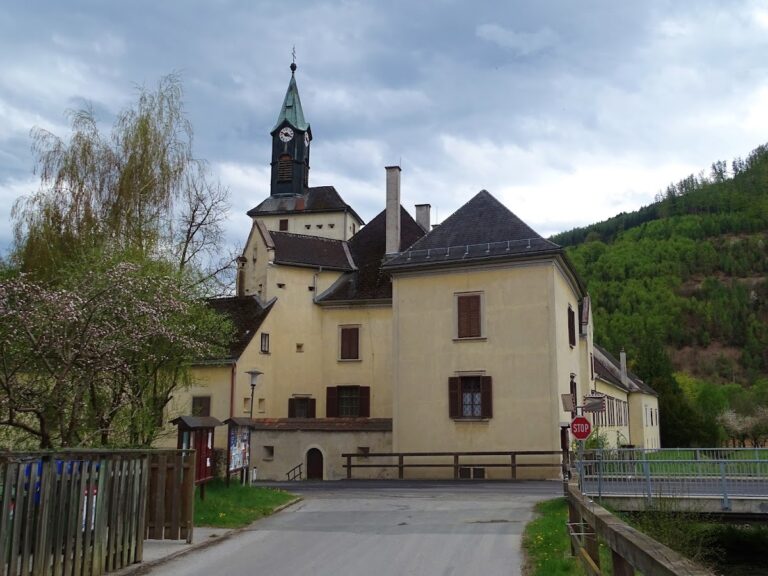
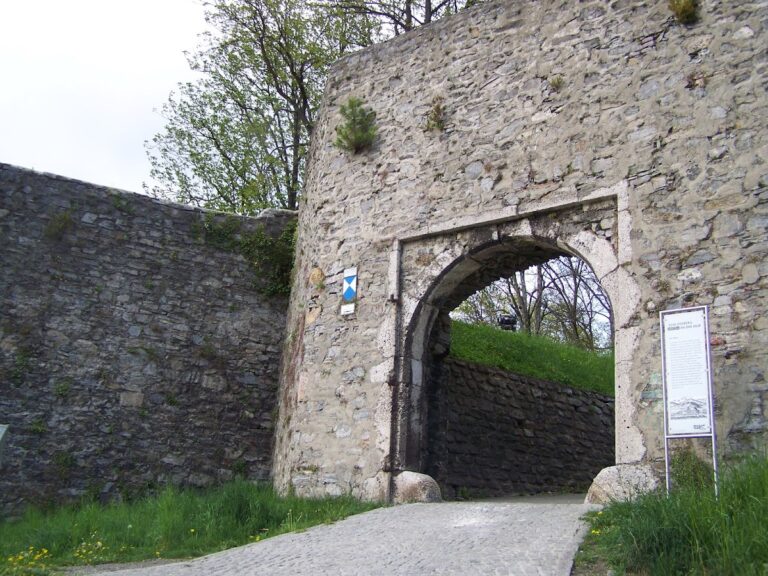
Schloss Weyer stands near the mouth of the Gamsgraben in the Murtal. The former moat enclosed the entire complex, and sections remain on its northern and eastern sides. The eastern side was once crossed by a drawbridge, a bridge that could be raised or lowered to control passage over the moat. A brick bridge on the north now leads to the entrance portal.
The principal residential building has three storeys, while a shorter adjoining wing meets it at a right angle. Together with nearby farm buildings, these wings enclose a large inner courtyard. Most of the surviving structures date from the sixteenth and seventeenth centuries, although their present appearance also includes alterations from the eighteenth century.
Main Buildings
Principal Building
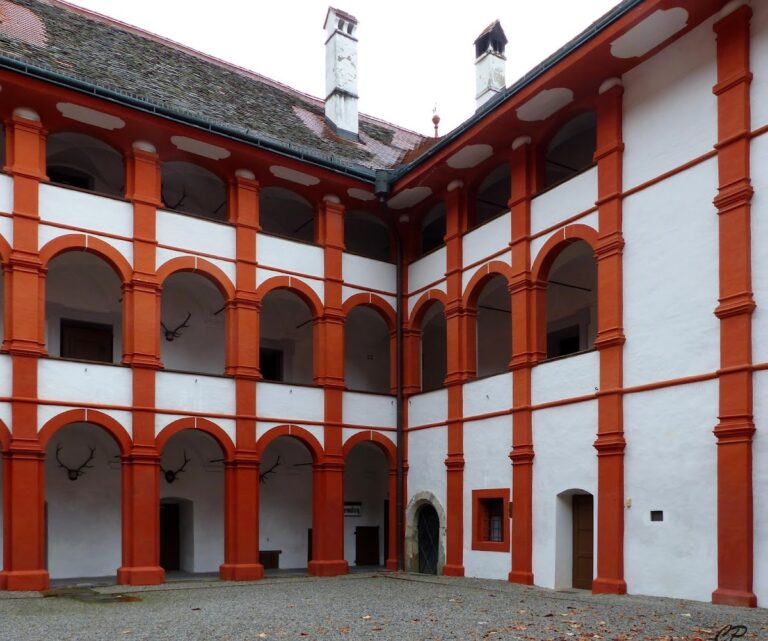
On the courtyard side, the principal building has arcaded galleries rising through three storeys. A clock and a bell tower with a Baroque domed roof and lantern complete the building. The courtyard is also closed by a narrow Baroque tower with an onion-shaped dome and lantern. A lower connecting structure runs from the tower toward the castle chapel.
Castle Chapel
The castle chapel contains an important fourteenth-century crucifix, a cross bearing a representation of Jesus Christ. Its original altar was transferred to Schloss Neu-Pfannberg, also known as Grafendorf-Neupfannberg. The chapel’s present relationship with the adjoining tower and connecting structure forms part of the complex’s surviving arrangement.
East Wing
Two polygonal, tower-like projections flank the exterior of the east wing. Its plastered façades are divided horizontally and vertically by pilasters and painted bands. They are further decorated with sgraffito, a technique in which layers of differently coloured plaster are scratched through to reveal the lower layers and form patterns or designs.
Knights’ Hall
Inside the castle is an octagonal room known as the Knights’ Hall. The date 1590 is inscribed on its principal ceiling beam, linking the hall to the period when Wilhelm von Ratmannsdorf reshaped the castle.
Park and Associated Features
An avenue survives in the castle park and extends eastward toward Rothleiten. South of the avenue is a circular pond with an artificial island. The park formerly also included a zoological garden. A coat-of-arms stone is positioned outside above the courtyard portal, adding a heraldic feature to the entrance.
Nearby sites