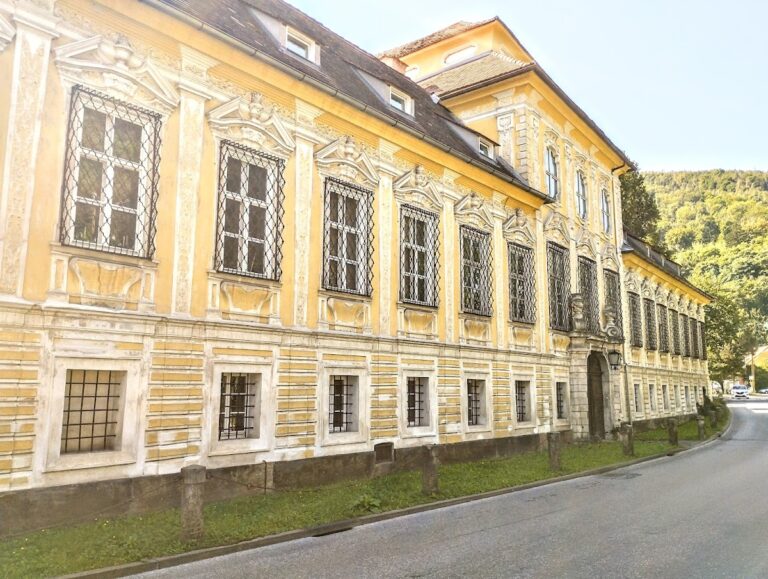
Schloss Waldstein: A Historic Aristocratic Castle Complex in Austria


Site at a Glance
- Rating
- 4.8
- Popularity
- Very Low
- Country
- Austria
- Primary era
- Early Modern
- Eras represented
- Medieval, Early Modern
- Civilizations
- Habsburg, Holy Roman Empire
- Site type
- Domestic
- Remains
- Castle
On this page15 sections
History
Schloss Waldstein is a historic castle complex in Austria, in the Waldstein cadastral community of Deutschfeistritz, Styria. Its surviving form developed from the late medieval period through the eighteenth century and combines Renaissance, Baroque, and Rococo elements. The estate remains associated with major Central European aristocratic families and is currently owned by the Family Foundation of Prince Heinrich Karl von Liechtenstein.
From the medieval fortress to the Windischgraetz estate
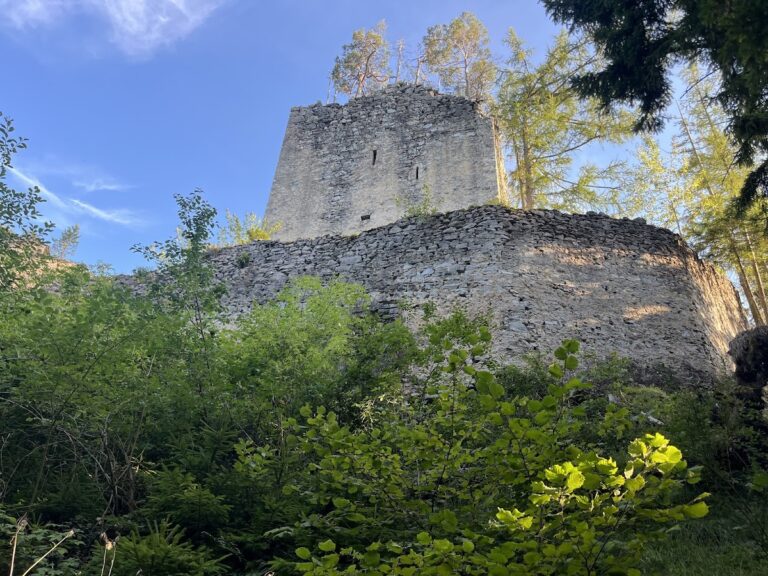
Before the present castle was built, the lords of Waldstein lived in the Veste, a fortified residence or fortress that survives as the Waldstein castle ruin. In the fourteenth century, this fortress belonged to Count Hermann I of Cilli. After 1363, it appears to have passed briefly to the Bishop of Bamberg. Around 1425, the bishop exchanged it for a fortress in the Lavant Valley held by Count Hermann II of Cilli. Waldstein remained with the descendants of the Counts of Cilli until 1436.
Ruprecht von Windischgraetz acquired Waldstein around 1468. His purchase contract does not mention a building on the site of the present castle, so construction of an initial residence probably began after the acquisition. An inscription states that Pankraz von Windischgraetz enlarged the building in 1555. By about 1565, the remainder of the west wing, the north wing, and the northern part of the east wing had been completed.
Confessional conflict and the Eggenberg succession
The Windischgraetz family later faced the religious and political pressures of the Counter-Reformation, the Catholic movement that reinforced Catholic doctrine and institutions in response to the Protestant Reformation. Because the family was Protestant, its members had to leave the country under the rule of a strictly Catholic territorial authority, and employing Protestants was prohibited. The Windischgraetz nevertheless employed the Protestant teacher Paulus Odontius at Waldstein.
In April 1602, a unit of heavy cavalry occupied Waldstein and arrested the brothers Count Christoph and Count Friedrich Windischgraetz together with Odontius. The two owners were permitted to return after paying a fine, while Odontius remained imprisoned. His death sentence was commuted to service as a galley slave. He escaped while being transported to Trieste and fled to Saxony, where he later published his memoirs.
The Windischgraetz seem to have spent most of this period at an estate in Lower Austria, but they retained ownership of Waldstein until selling the lordship in 1630. Prince Johann Ulrich von Eggenberg then acquired it, beginning more than eighty years of Eggenberg ownership. Prince Hans Ulrich von Eggenberg acquired the lordship from the Windischgraetz family, and the Eggenbergs retained Waldstein until 1713. Prince Johann Seyfried von Eggenberg completed the south and east wings and died at Schloss Waldstein in 1713.
Dietrichstein, Oettingen-Wallerstein, and Liechtenstein ownership
After Johann Seyfried von Eggenberg died in 1713, the estate passed through the marriage of his daughter to Count Johann Wilhelm von Sinzendorf. Count Franz Gottfried von Dietrichstein later acquired the lordships of Waldstein, Stübing, and Rabenstein and joined them into a fideicommissum, an inheritable family estate intended to preserve property within a designated lineage. His descendant Countess Julie Dietrichstein carried out a fundamental renovation of the castle.
Countess Julie Dietrichstein married Prince Carl of Oettingen-Wallerstein in 1864. Through their son Moritz, Waldstein passed by inheritance to his only child, Therese Maria. She married Prince Alfred of Liechtenstein in 1910. A son of this marriage later married Archduchess Elisabeth, a daughter of Emperor Charles of Austria, the last emperor of Austria and king of Hungary. Charles’s widow, Zita, frequently stayed at Waldstein during the summer to visit her daughter and her family.
People associated with Waldstein
Viktor Franz Hess was born at the castle in 1883, the son of its forestry official. He later became an Austrian physicist known for demonstrating cosmic rays and received the Nobel Prize in Physics in 1936. The Austrian politician Vincenz Liechtenstein, a member of the Liechtenstein princely family, was born in Graz in 1950 and died at Schloss Waldstein in 2008.
Remains
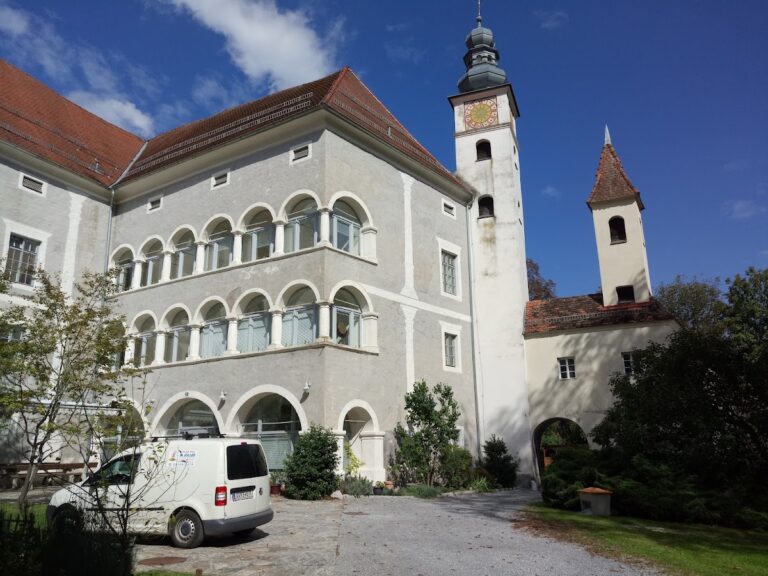
Schloss Waldstein is a two-storey, four-wing complex arranged around a rectangular courtyard. Its corner towers were originally partly freestanding and linked by defensive walls. Later alterations incorporated the towers into the building wings, creating the connected form that survives today. The complex includes medieval and Renaissance fabric, later Baroque additions, a Rococo chapel, and associated agricultural and garden structures.
Castle wings and courtyard
West wing and tower
The oldest surviving part is the building group at the northern end of the west wing. This section rises to two and three storeys and includes a six-storey tower crowned by a hipped roof and a roof turret. The tower roof was originally Baroque and took its present form in 1927. Traces of late Gothic window tracery remain visible in the tower section.
North, east, and courtyard wings
The rest of the west wing, the north wing, and the northern part of the east wing were complete by about 1565. Baroque two-storey column arcades were later added along the courtyard sides. Their columns have Ionic Renaissance capitals, with paired spiral forms at the tops, set into the walls. A fireplace in the north wing bears the date 1667.
The former carriage hall has two aisles and six bays. Its columns stand free beneath a groin vault, a ceiling formed by the crossing of two barrel vaults. Tendril and grotesque paintings decorate the vault, while the west aisle was added during the Baroque period. Only parts of the original interior furnishings survive in a few rooms, chiefly stoves. The monogram of Prince Johann Seyfried von Eggenberg remains on three castle doors.
Southern wings and painted passage
The adjoining southern wing and the south wing were built after 1660. On the courtyard side of the upper storey, a wooden passage is accompanied by large wall-painting fields showing stags. Two full-length portraits depict the foresters Lorenz Gärber, dated 1682, and Martin Danner, dated 1696. Georg Abraham Peichl made the paintings.
Chapel and religious furnishings
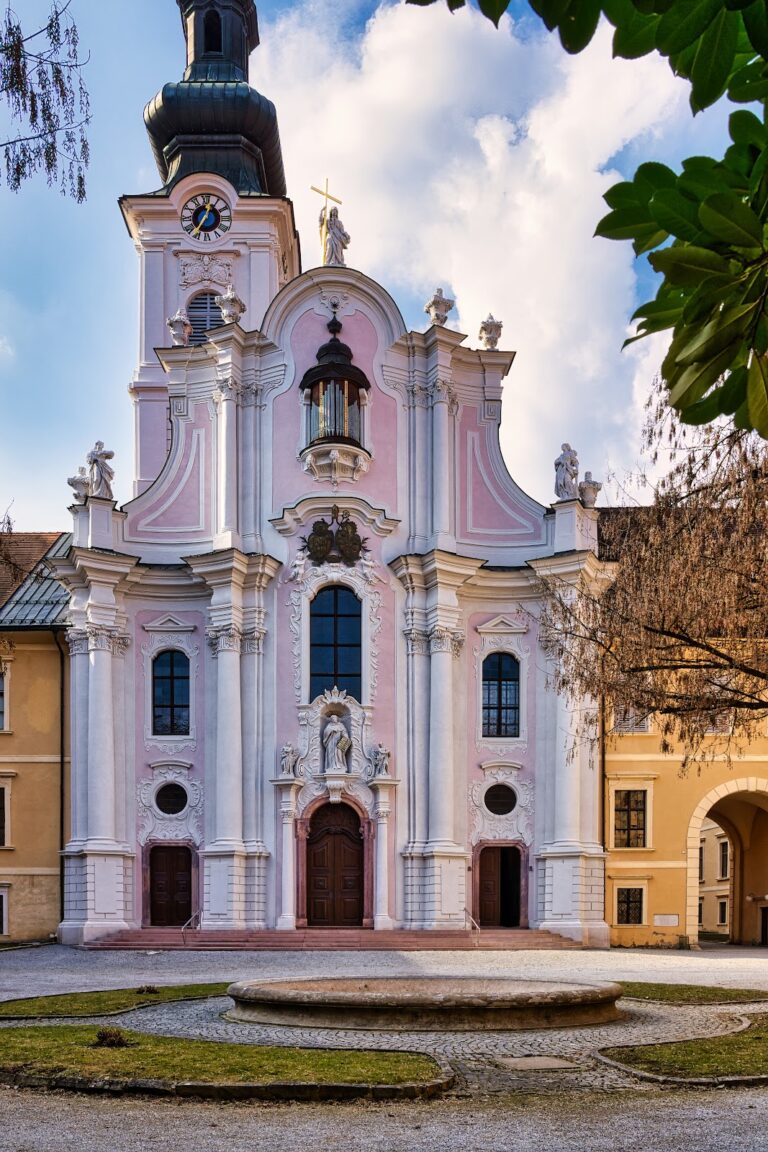
The south wing contains a two-storey chapel with a three-part oratory, a group of private worship spaces associated with the main chapel. Its walls and ceiling carry rich Rococo stucco attributed to the manner of Heinrich Formentini. F. Jos. Reich completed the high altar in 1753. The chapel was refurnished between 1750 and 1756, while its Baroque organ, made in 1712, was restored in 1955.
The high altar carries an altarpiece of the Immaculate Virgin Mary painted by Hans Adam Weissenkircher around 1687. Above it is a painting of the Holy Trinity by Philipp C. Laubmann, who is also credited with the architectural perspective paintings on either side of the altar. The side altars date from the beginning of the eighteenth century and were altered about fifty years later. The southern altar is dedicated to Saint John Nepomuk and bears the inscription “B. Scheit pinx. grecens. 1752”; the northern altar is dedicated to Saint Cajetan and was made by the same painter. Joseph Schokotnigg created the white-painted statues on all the altars.
The organ has folding doors and decorated pipes. A sacristy adjoins the chapel on the east and contains a lavabo niche with a stucco frame dating from around 1700. The chapel bell dates from 1768. A relic of Blessed Emperor Charles I has been kept in the church since 2005.
Inscriptions and courtyard sculpture
A Jewish gravestone dated 1363 is set into the wall beside the stairway leading to the forestry administration. Its inscription commemorates Rabbi Joshua, son of Isaac, who died on 23 August 1363, and expresses the wish that he might dwell among the blessed. The stone forms part of the castle’s surviving historical fabric.
A stone figure of the Virgin and Child from the beginning of the eighteenth century stands in the courtyard. It was transferred from Schloss Rabenstein.
Garden and agricultural buildings
Garden pavilion
A garden pavilion dating from around 1663 stands north of the castle. Its wall paintings depict the Creation and carry the date 1713, linking the small structure with the period in which major parts of the castle complex were completed.
Granary
Farther east is a two-storey granary, or Schüttkasten, used for storing agricultural produce. It has a clipped hipped roof and bears the dates 1608 and 1735, reflecting stages in its history.
Nearby sites