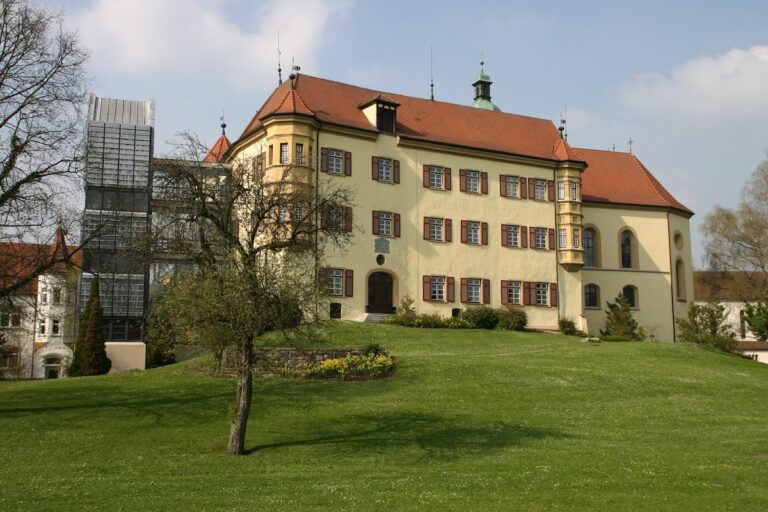
Schloss Montfort: A Neo-Moorish Palace in Langenargen, Germany


Site at a Glance
- Rating
- 4.5
- Popularity
- Medium
- Country
- Germany
- Primary era
- Modern
- External website
- Open
- Eras represented
- Modern
- Civilizations
- German
- Site type
- Domestic
- Remains
- Palace
On this page9 sections
History
Schloss Montfort is a nineteenth-century Neo-Moorish villa in Langenargen, Germany, on the shore of Lake Constance. Planned as a pleasure palace for Wilhelm I, king of Württemberg, it was completed in 1867 on the site of the former Argen Castle. The palace became the municipality’s landmark and remains a protected historic monument.
The Montforts and Argen Castle
The site had belonged at least since the fourteenth century to the Counts of Montfort, a medieval and early-modern noble family whose possessions included the Argen area. During the fourteenth century, they built the water castle of Argen, also known as Veste Burg Argen, on a nearly square rocky island in Lake Constance.
Langenargen and the Montforts’ castle suffered heavy damage during the Thirty Years’ War, the European conflict of 1618 to 1648 that caused widespread destruction in the German lands. Both the town and the castle were later rebuilt. The castle was expanded into a palace in the late seventeenth century, used as a prison around 1800, and abandoned as a castle in 1810. Its walls were demolished in 1861.
Wilhelm I’s palace project
Wilhelm I of Württemberg bought the ruins of the old Argen Castle in 1858 for 3,000 gulden. The Ravensburg building official Gottlieb Pfeilsticker designed a new villa in the Neo-Moorish style, a nineteenth-century European style inspired by architectural forms and ornament associated with Islamic North Africa and Iberia. Construction proceeded slowly because of Wilhelm’s poor health.
Wilhelm died in 1864 before the project was complete. His successor, King Karl of Württemberg, gave the villa the name Schloss Montfort, recalling the earlier noble owners. The palace and its associated service building were completed in 1867. The total cost was 261,000 gulden, including 30,000 gulden for furnishings and 5,800 gulden for chandeliers.
Royal, private, and municipal ownership
In 1864 Karl offered the palace to his mother, Pauline of Württemberg, as a summer residence for her widowhood. An agreement formally regulated its use in 1867, but Pauline relinquished the arrangement in 1868, and Karl then decided to sell the building.
Princess Luise of Prussia purchased Schloss Montfort with its associated real estate and movable property in 1873 for 130,000 gulden. She used it mainly as a summer residence until her death in 1901. In 1902, her heir, Prince Friedrich Karl of Hesse, sold the palace to Wilhelm Oliver von Leube, a physician and university professor. The sale changed the building from a princely residence into an affluent bourgeois home.
The Deutsche Reichsbahn acquired Schloss Montfort in 1940 with plans to convert it into a rest home for railway officials. Wartime conditions prevented that project, and the building passed to the association Gemeinschaft für Volkstum Langenargen, which converted it into a spa house. In 1961, ownership transferred to the municipality of Langenargen, where it has remained. Later alterations and preservation work adapted the building while retaining its historic character.
Schloss Montfort is now used for dining, concerts, private celebrations, and cultural and corporate events. Its historic rooms contain a restaurant, café, and bar, while the building also serves as a nightclub and event venue. The palace and garden form an ensemble with the Kavalierhaus, built in 1866, and a concert shell used for summer promenade concerts. The continued public and commercial use supports preservation of the listed building. The municipality also owns 35 works by Waldemar Grzimek associated with the palace, and restoration of the collection has been under way since 2000.
Remains
Palace and garden ensemble
Schloss Montfort
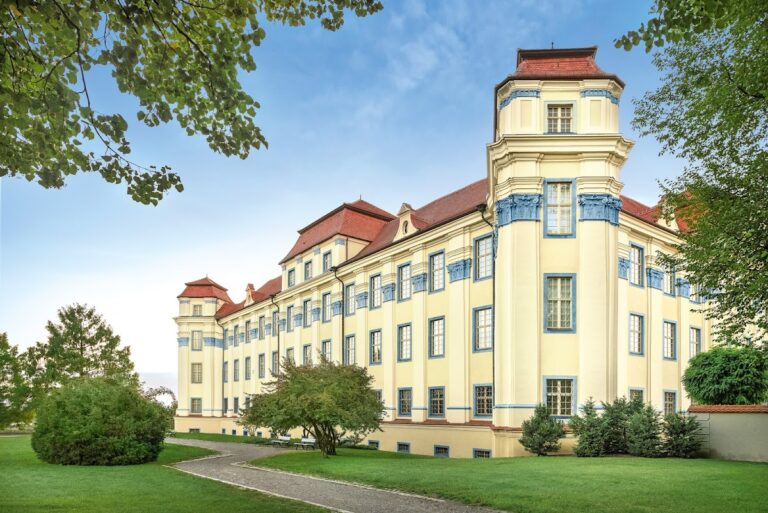
The palace stands on a peninsula beside Lake Constance, at the location of the former Argen Castle ruins. It is a nineteenth-century villa in the Neo-Moorish style, built after the medieval castle walls were demolished. The completed building was accompanied by a service building, and its historic interior rooms now contain a restaurant, café, and bar. An upper-floor hall is used for concerts. Paintings dating from the sixteenth to the eighteenth century are also held within the palace.
Kavalierhaus and concert shell
The Kavalierhaus was built in 1866 at the edge of the palace park as a supplementary building within the ensemble. A concert shell stands in the garden and is used for summer promenade concerts. Together with the palace and its associated service building, these structures form the surviving architectural and performance setting of Schloss Montfort.
The former Argen Castle site
The earlier Argen Castle occupied a nearly square rocky island in Lake Constance and functioned as a water castle. It was abandoned as a castle in 1810. The surviving walls were demolished in 1861, clearing the site for the nineteenth-century palace project. The connection with the former castle is preserved in the palace’s location and in the name Montfort, which recalls the medieval owners of the Argen site.
Nearby sites