Schloss Wackerstein: A Medieval Castle and Palace in Bavaria


Site at a Glance
- Rating
- 4.7
- Popularity
- Very Low
- Country
- Germany
- Primary era
- Early Modern
- External website
- Open
- Eras represented
- Medieval, Early Modern
- Civilizations
- Holy Roman Empire
- Site type
- Domestic
- Remains
- Castle
On this page8 sections
History
Schloss Wackerstein is a historic castle and palace in Germany, in the village of Wackerstein within the market town of Pförring, Bavaria. Its origins reach back to a ninth-century castle on a steep rocky drop above the Danube, and the present residence grew through medieval ownership, territorial conflict, and eighteenth-century rebuilding.
Medieval Lords and Territorial Conflict
In 1206, the local nobleman Conradus Wacherstayn was a canon of Eichstätt Cathedral, a member of the clergy serving the cathedral’s governing body. Members of the Mendorfer family held shares in the castle by 1339, showing that ownership of the estate could be divided among several noble interests.
In 1408, the Bavarian-Munich dukes Ernst and Wilhelm III granted the Wackerstein floodplain to Wilhelm Lautenbeck in recognition of his services. During the First Bavarian War, a fifteenth-century conflict among rival Bavarian duchies, Duke Ludwig VII of Bavaria-Ingolstadt occupied the castle because it stood near his territory’s frontier. Wilhelm Lautenbeck recovered the property after the war and agreed in 1424 to give Duke Ernst access to the castle.
Wilhelm’s heir Veronika Lautenbeck married Stefan von Schmiechen, who later bought Wackerstein from his brothers-in-law. In 1469, Duke Albrecht IV of Bavaria-Munich granted Stefan the Wackerstein floodplain again, together with its hunting and fishing rights. Because Stefan and Veronika had no children, the estate passed to Christoph von Schmiechen, the son of Stefan’s brother Wolfgang, after Wolfgang’s death in 1497. Christoph later pledged the castle to his brother Stefan, who had inherited the neighboring Hofmark of Ettling. A Hofmark was a landed jurisdiction whose holder exercised local manorial and administrative rights.
The Notthafft Family and Early Modern Changes
Stefan’s daughter Anna married Heimeran IV Notthafft von Wernberg zu Aholming in 1534, bringing Wackerstein and Ettling into the Notthafft family. Heimeran’s son Johann Heinrich Notthafft von Wernberg married Amalie von Wisbeck in 1565. After Heimeran died in 1570, Johann Heinrich took over the Pflege office at Vilshofen, a territorial administrative post that his father had held since 1531. From 1583, Johann Heinrich served as Vicedom in Landshut, a senior ducal or princely administrator. He requested release from that office in 1589, retired to Wackerstein, and died there in 1595.
Johann Heinrich’s son Georg Stephan Notthafft von Wernberg inherited the estate. On 10 September 1603, he sold the Hofmarks and noble residences of Wackerstein and Ettling, along with the Pförring provostry, to his brother-in-law Wolf Friedrich von Closen for 33,000 florins. A provostry was an ecclesiastical administrative office or estate. Georg Stephan then entered the service of the archbishopric of Salzburg.
During the Thirty Years’ War, the major European conflict of 1618–1648, Swedish and Imperial troops devastated the castle. Count von Lodron acquired the property from the Glaser family in 1642. The Bavarian field marshal lieutenant Lothar Freiherr von Weickel bought the Hofmark in 1711 and sold it in 1729 to Elector Karl Albrecht of Bavaria. Wackerstein later passed to Count Karl Wilhelm Stanislaus Daun in 1768 and to Ferdinand Anton Freiherr von Wadenspan in 1779.
The Eighteenth-Century Residence and Later Ownership
Ferdinand Anton von Wadenspan commissioned the present two-wing complex around 1780, transforming the long-developed castle site into the residence that largely defines its modern appearance. The estate subsequently passed to his eldest granddaughter, Franziska von Hornstein, who sold the Hofmark in 1811 to the Bavarian major general Wilhelm Friedrich von Jordan.
Wilhelm Friedrich’s son, Max Freiherr von Jordan, sold the castle in 1841 to Franz Michael and Therese Forstner of Geiselhöring. They sold it in 1850 to Johann Nepomuk Ritter von Kreittmayr auf Offenstetten. The estate was broken up in 1871, and Alexander Cantacuzene, a Romanian prince, acquired the castle in 1872. It entered bourgeois ownership in 1902.
Schloss Wackerstein is protected as a listed architectural monument and is also treated as an archaeological monument comprising a medieval castle site and a modern-era palace. Renovation in 1989 was followed by conversion into privately owned apartments, giving the complex a residential use while preserving its place in the historical development of Wackerstein.
Remains
Overall Layout
Schloss Wackerstein occupies a steep rocky site above the Danube. Its plan is hook-shaped and consists of two wings, with a small tower attached to the east wing. The principal building has two storeys and a hipped roof, which slopes on all sides instead of ending in vertical gable walls. Sixteenth- and seventeenth-century remodeling altered the earlier castle, while the complex acquired its present appearance in the late eighteenth or early nineteenth century.
Medieval Defences
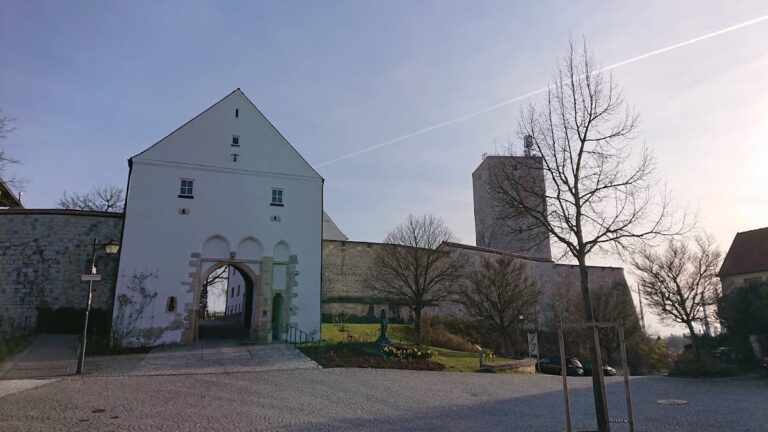
Parts of the medieval ring walls survive around the complex, together with a medieval tower belonging to that defensive circuit. These remains preserve the fortified character of the earlier castle within the later residential building. The archaeological site is classified as both a medieval castle site and a modern-era palace.
Former Castle Chapel
The former Castle Chapel of Our Lady is a small medieval hall building that was later converted from religious use. It has a roof turret, a small tower rising from the roof, and was remodeled in 1781. The chapel remains a distinct part of the castle complex and connects the medieval foundation with the later period of architectural change.
Nearby sites