Schloss Schwanberg: A Former Aristocratic Residence in Bavaria


Site at a Glance
- Rating
- 4.5
- Popularity
- Low
- Country
- Germany
- Primary era
- Medieval
- External website
- Open
- Eras represented
- Bronze Age, Iron Age, Classical, Medieval, Early Modern
- Civilizations
- Celtic, Holy Roman Empire
- Site type
- Domestic
- Remains
- Castle
On this page9 sections
History
Schloss Schwanberg is a former aristocratic residence in Germany, on Schwanberg in the municipality of Rödelsee, Bavaria. Its history developed from prehistoric refuge use and Celtic fortifications into a medieval castle, an early modern residence, and a complex later adapted for institutional and religious purposes.
Prehistoric and Frankish Schwanberg
The earliest settlement traces on Schwanberg date to the Mesolithic. Communities from nearby settlements used the densely wooded mountain as a place of refuge, aided by its steeply falling slopes. Around 1200 BC, Celtic earthworks formed the mountain’s first known fortification. Around 400 BC, Celtic communities renewed defensive works created by earlier cultures.
During the fifth century AD, the Franks reached the Steigerwald and recognized the mountain’s strategic value. They fortified Schwanberg and turned it into a fortress intended to secure their advance. Its strategic role was comparable to that of the fortified sites on the Staffelberg, Vogelsberg, and Marienberg. As Christianization advanced in the Steigerwald under Frankish influence, a church dedicated to Saint Walburga, an eighth-century Anglo-Saxon missionary and abbess, was established on the mountain.
Medieval Castle and Pilgrimage Site
During the Middle Ages, Schwanberg lost its earlier strategic importance and was reduced to a simpler castle. The castle is documented from about 1250, when the Fuchs family occupied it, probably as a fief from the prince-bishops of Würzburg. Several associated farms and residences were recorded during the fourteenth century. In 1303, Konrad Fuchs received a garden and farm at Schwanberg as a fief; in 1317–1318, Friedrich Zollner of Willanzheim held a residence in Schwanberg Castle; and in 1322, a small settlement was recorded in front of the castle. These properties were last recorded in 1510.
During the fourteenth-century shift in power in Franconia, Burgrave Friedrich IV of Nuremberg acquired Schwanberg. His family retained the castle until 1344, when the Lords of Seinsheim received the property. By the mid-fifteenth century, the Lords of Wenkheim had become its owners. Throughout these changes, the mountain chapel remained a popular pilgrimage destination.
Destruction and Rebuilding
The Peasants’ War of 1525 completely destroyed the buildings on Schwanberg and permanently ended the pilgrimage. Prince-Bishop Julius Echter of Würzburg, who held office from 1573 to 1617, acquired the castle ruins in 1605 and rebuilt them. Much of the surviving complex belongs to this rebuilding phase.
The castle was damaged again during the Thirty Years’ War, the European conflict fought from 1618 to 1648, and was burned in 1633. During attacks, inhabitants of nearby settlements regularly sought refuge behind the old Celtic earthworks. The damaged complex then remained in decline for more than a century before rebuilding began in the eighteenth century.
Private Ownership and Twentieth-Century Uses
After the secularization of the Würzburg ecclesiastical state in 1803, the castle was transferred to private ownership. Secularization involved the transfer of church territories and properties to secular political control. The first purchaser was the banker von Hirsch. After further changes of ownership, the ceramics entrepreneur Jean Dern acquired the castle in 1897 and converted it into a destination for excursions.
New purchasers acquired the complex in 1911. Between 1919 and 1921, Alexander zu Castell-Rüdenhausen commissioned a large garden on the mountain that combined elements of a Baroque palace garden with those of an English landscape park.
During the Second World War, Nazi authorities confiscated the castle and planned to establish a cadre school there. Those plans were abandoned after the American occupation, and American forces used Schloss Schwanberg as a barracks until 1949. After the founding of the Federal Republic of Germany, the complex was converted into an old-age home.
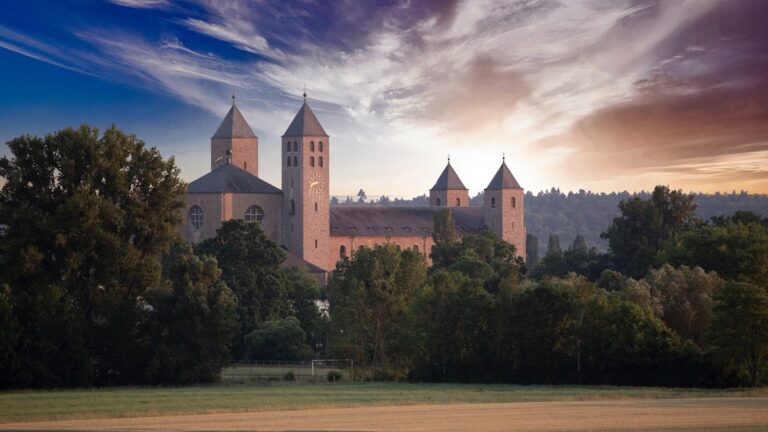
When the home was relocated, members of the Communität Casteller Ring moved into the buildings in 1957 under the leadership of Prioress Christel Felizitas Schmid. The Communität Casteller Ring is a Protestant religious community whose members live according to a shared spiritual rule. The community purchased the complex in 2004. A church dedicated to Saint Michael was built near the castle in the 1980s as the community’s spiritual center. The Bavarian State Office classifies Schloss Schwanberg as a listed monument.
Remains
Castle Layout
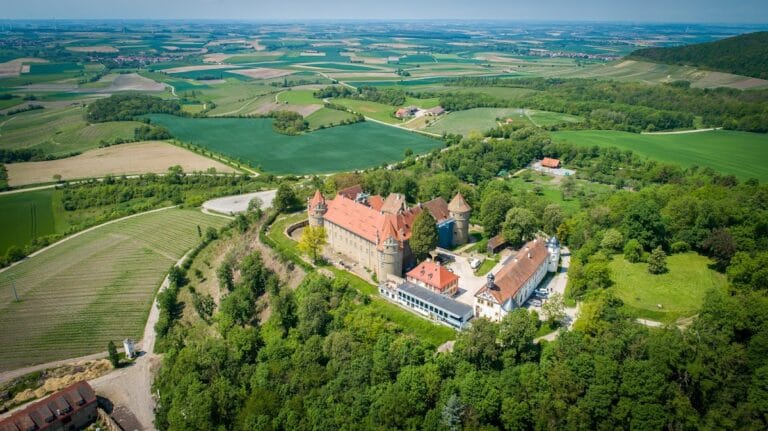
The surviving castle forms an irregular pentagon enclosed by two- and three-storey building wings. An inner courtyard occupies the center, while a polygonal stair tower is built into the southeastern corner. A spacious cellar with a continuous barrel vault lies beneath the complex. A barrel vault is a continuous semicircular or similarly curved ceiling structure.
Early Fabric and Exterior Features
Remains of early medieval buildings that escaped the destruction of 1525 were incorporated into new wings at the beginning of the sixteenth century. These earlier elements can still be traced on parts of the exterior surfaces. The windows have simple surrounds, and string courses divide the storeys in the northeastern and northwestern sections.
Two round towers on the northeastern side are among the complex’s characteristic features. Their walls use rusticated bossage masonry, in which stones project outward or retain deliberately rough outer faces, producing a strongly textured surface. The repeated changes of ownership and use have left several architectural periods and styles visible within the surviving complex.
Garden and Religious Buildings
The large garden created between 1919 and 1921 combines elements associated with a Baroque palace garden and an English landscape park. Near the castle, the church of Saint Michael, built in the 1980s, serves as the spiritual center of the Communität Casteller Ring.