Münsterschwarzach Abbey: A Benedictine Missionary Abbey in Germany


Site at a Glance
- Rating
- 4.6
- Popularity
- Medium
- Country
- Germany
- Primary era
- Modern
- External website
- Open
- Eras represented
- Early Modern, Modern
- Civilizations
- German, Holy Roman Empire
- Site type
- Religious
- Remains
- Monastery
On this page18 sections
History
Münsterschwarzach Abbey is a Benedictine monastery in Germany, at Schwarzach am Main in Bavaria, whose institutional history grew from a late-eighth-century Carolingian nunnery and a ninth-century Benedictine men’s monastery. Its development at the meeting point of the Schwarzach and Main reflects successive periods of monastic reform, political conflict, destruction, secularisation, and missionary renewal.
Carolingian and Benedictine Foundations
A women’s monastery was established at Schwarzach in the late eighth century, probably around 788. Known in early records as Monasterium Suuarzaha or Suarizaha, it was associated with the Carolingian ruling house and the Mattonen, a powerful Frankish aristocratic family that founded religious institutions. Its dedication included the Holy Saviour, the Virgin Mary, and Saint Felicity. The abbesses included members of the Carolingian family, among them Theodrada, a daughter of Charlemagne.
In 816, Count Megingaud and his wife Imma founded Megingaudshausen as a men’s Benedictine monastery. Benedictines follow the Rule of Saint Benedict, a monastic guide governing communal religious life. During the ninth century, the monastery came under the influence of the Bishop of Würzburg. Bishop Arn ordered its monks to occupy the abandoned buildings of the women’s monastery at Schwarzach, creating the institutional and geographical continuity that led to Münsterschwarzach Abbey.
The women’s monastery ended by 877, when its nuns moved to the Fraumünster in Zurich. The monks of Megingaudshausen then occupied the former buildings. The abbey’s later coat of arms continued to recall both predecessor communities through its two crossed pastoral staffs.
Medieval Rule and Reform
The Mattonen initially retained influence over the new monastery, and Dracholf governed it as a commendatory abbot, an officeholder who could rule an abbey without belonging to its community and often received its revenues. After a period of economic decline, Bishop Bernward of Würzburg secured recognition of Würzburg’s overlordship in 993. The abbey remained within the territorial sphere of the Würzburg bishops until its dissolution in 1803, although disputes over control continued. During the High Middle Ages, Würzburg repeatedly appointed reform abbots from outside the monastery.
Under Abbot Wolfher, who was linked to the reform movement of Gorze, Münsterschwarzach became a centre of art, culture, and stricter monastic observance. His successor, Egbert of Gorze, renewed monasteries from Münsterschwarzach, extending his reform work from northern Germany to Melk and Lambach in the south. Bishop Adalbero of Würzburg supported this partnership, and the abbey gained a wider influence through its reforming activities.
That influence weakened during the transition to the Late Middle Ages. In the fourteenth century, internal divisions sharply restricted the abbey’s external activity. Three disputed elections of abbots became contests between rival factions within the community.
Reformation, War, and Baroque Renewal
At the end of the fifteenth century, the rule that limited admission to men of high aristocratic birth was abolished. Münsterschwarzach joined the Bursfeld Congregation in 1480, a Benedictine federation that sought to renew and standardise monastic observance. The German Peasants’ War soon disrupted the abbey’s connections with Bursfeld, when financial aid to the impoverished monastery ceased.
After 1517, the Protestant Reformation reduced the number of new entrants. The monastery school helped preserve the community by attracting young novices. During the second half of the sixteenth century, Abbot Johannes IV Burckhardt introduced the Counter-Reformation, the Catholic response to Protestant reform, within the abbey’s sphere of influence. The community then began to grow again.
The Thirty Years’ War interrupted this recovery. From 1631 to 1634, the abbey was largely deserted, its abbot lived in exile in Tyrol, and Protestant administrators managed the monastic economy. Much of the building complex remained intact, so reconstruction could proceed quickly after the Peace of Westphalia in 1648.
During the later seventeenth and eighteenth centuries, Münsterschwarzach experienced renewed prosperity. Viticulture formed an important part of its economy, and income from wine production financed the Baroque remodelling of the complex and the construction of a new church. The rebuilding included work by Valentino Pezani and Josef Greising, while the later basilica was commissioned from Balthasar Neumann and dedicated in 1743 by Bishop Friedrich Karl von Schönborn.
Dissolution and Refoundation
Bavarian secularisation, the state confiscation and dissolution of many ecclesiastical institutions, dissolved the abbey on 7 May 1803. Most buildings were sold, and the abbey church was sold and profaned in 1805. A lightning strike and fire in 1810 caused severe damage. During the nineteenth century, the old church and much of the monastic complex were demolished, and the former abbey estate was converted into a farm.
Missionary Benedictines of Saint Ottilien reacquired the surviving remains and adjoining agricultural land in 1913. Münsterschwarzach was restored to abbey status on 1 April 1914, with Abbot Placidus Vogel as its first abbot after the refoundation. The monks moved into the surviving buildings in September 1914. At first, the site served as an agricultural estate for the growing community of Saint Ludwig near Wipfeld.
The refounded abbey trained monks chiefly for missionary work overseas. It now belongs to the Congregation of Saint Ottilien, a Benedictine congregation associated with missionary communities, and has roughly 100 Benedictines working at Münsterschwarzach, in dependent houses, and in missions worldwide. Its missionary links extend across Africa, Asia, the Americas, and Europe.
Twentieth-Century Disruption and Renewal
A new church was constructed between 1935 and 1938 and inaugurated on 11 September 1938. From 1933 onward, National Socialist authorities targeted the abbey’s training institutions. The monastic community was expelled on 9 May 1941, and most buildings were confiscated and converted into a military hospital. American forces occupied the abbey on 10 April 1945. Abbot Burkhard Utz returned soon afterward, and reconstruction began rapidly.
A higher school has operated on the grounds since 1946. It later became the state-recognised Egbert-Gymnasium Münsterschwarzach, where monks take part in teaching and pastoral supervision. Reforms associated with the Second Vatican Council changed the community during the 1960s, including the abolition of centuries-old unequal treatment between academically trained monks and brothers engaged in manual labour.
The community continued to develop its educational, agricultural, publishing, craft, and missionary work. Its Priory of Christ the King in Nebraska was established in 1935. The Priory of Damme, founded in 1962, closed on 31 December 2016, and its monks returned to Münsterschwarzach. Since 2009, an energy programme incorporating biomass heating, biogas, photovoltaic and solar-thermal systems, and hydroelectric power has made the abbey carbon-neutral. The community has also taken part in refugee work since December 2014.
Remains
Churches and Baroque Complex
Baroque Abbey Church
The abbey complex occupies the area where the Schwarzach meets the Main and contains layers from the Carolingian nunnery, the Megingaudshausen community, the medieval abbey, the Baroque rebuilding, and the twentieth-century refoundation. The Baroque remodelling culminated in a basilica commissioned from Balthasar Neumann. Holzer decorated its cupolas with frescoes, and Bishop Friedrich Karl von Schönborn dedicated the church in 1743.
Guest House
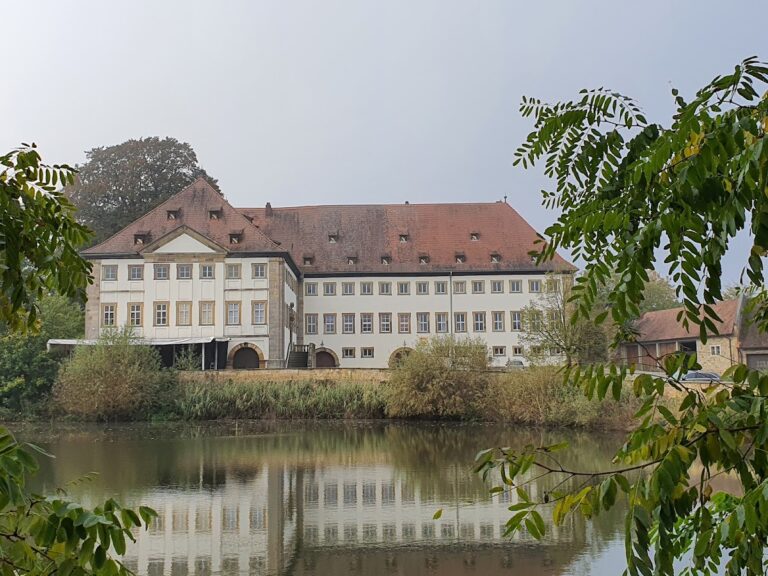
Late seventeenth-century rebuilding included work by Valentino Pezani and Josef Greising. Pezani’s guest house, constructed in 1696 and 1697, survives in part. The former Baroque church was used as a quarry after the 1810 fire and gradually decayed before its demolition during the nineteenth century.
Present Abbey Church
The present church, designed by Albert Boßlet and built between 1935 and 1938, stands on the site of three predecessor churches. It is approximately 289 feet long, 102 feet wide, and 85 feet high. Four towers define the building, with the eastern pair rising to 171 feet and the western pair to 125 feet.
Inside, clearly defined forms organise a dark monks’ choir and a brightly illuminated sanctuary. A statue of Jesus Christ stands above the altar. Beside the cross, one medallion shows the sacrifice of a lamb and another shows two loaves with a cup. Twelve side altars line the church and are dedicated to saints connected with Münsterschwarzach. Except for the organ, the monastic community made the interior furnishings itself.
A statue of the Virgin Mary beside the altar was made by Brother Franz Blaser, who died in 1930. Abbot Placidus Vogel, who directed construction of the church and died in 1943, lies in a high tomb before the crypt.
Community, Learning, and Productive Grounds
Information Centre and Library
An information centre established in 2016 took over the role of the former mission museum and presents the abbey’s history and the everyday life of its community. The library contains more than 300,000 publications, including collections on Schwarzach am Main and Franconia, liturgy, mission studies, and asceticism. Since 2006, its formerly paper-only holdings have increasingly been entered into an electronic catalogue.
School and Guest Facilities
The complex includes the state-recognised Egbert-Gymnasium Münsterschwarzach and facilities for retreats, courses, and spiritual counselling. These functions continue the abbey’s educational and pastoral activities within the refounded Benedictine community.
Workshops and Agriculture
Workshops and productive installations on the grounds include goldsmithing, metalworking, electrical work, painting, printing, book and art retail, baking, butchery, carpentry, distilling, fair-trade commerce, and agricultural facilities. The agricultural operations cultivate approximately 330 hectares of grain, maize, potatoes, and sugar beet.
Observatory and Institutional Identity
Monastery Observatory
A dedicated observatory building was established on the grounds during the 1990s. It conducts research on the positional determination of asteroids, comets, and near-Earth objects and participates in the Minor Planet Center network under code K74. A new observatory was inaugurated in 2019.
Heraldic Memory
The abbey’s coat of arms preserves the memory of its origins. Two crossed pastoral staffs represent the predecessor monasteries. The lion refers to the Mattonen, while the eagle refers to Bishop Adalbero of Würzburg, whose partnership with Abbot Egbert helped bring the medieval abbey to prominence.