Schloss Schieritz: A Renaissance Castle in Saxony, Germany
Site at a Glance
- Rating
- 4.2
- Popularity
- Very Low
- Country
- Germany
- Primary era
- Early Modern
- Eras represented
- Early Modern, Modern
- Civilizations
- Electorate of Saxony, Holy Roman Empire
- Site type
- Domestic
- Remains
- Castle
On this page15 sections
History
Schloss Schieritz is a Renaissance castle in Germany, located in Schieritz within the municipality of Diera-Zehren in Saxony’s Meissen district. The present castle was built between 1556 and 1601, during the Renaissance, and stands in the Ketzerbach valley between Lommatzsch and Meissen. Its history is connected with medieval fortifications, the Saxon Schleinitz family, and the changing institutional uses of a manor estate.
Early settlement and medieval fortifications
The name Schieritz is generally traced to a Sorbian field name of Old Slavic origin, probably dating from the sixth or seventh century and meaning “breadth.” Other interpretations connect it with words for an apron or protective leather apron, with the latter reading suggesting a metaphorical association with protection by the castle. Schieritz lies about one kilometre from Zehren, a settlement of comparable age.
In 1003, Bolesław Chrobry Wielki, a medieval Polish ruler, destroyed Glomuci, the central sanctuary of the local Wends, from this area. Schieritz later formed part of frontier defenses along the Elbe. A medieval motte castle, a fortification built around a raised earthen mound, stood on the Dragonerberg. It had a section bank, an outer bailey, a second section bank, and a neck ditch. This site was not the same as the possible predecessor of Schloss Schieritz. Its often suggested date of about 1200 to 1250 remains uncertain, while documents assignable to it begin only in 1260. Its use had ended by the beginning of the thirteenth century.
A possible predecessor on the present castle site has been associated with Dominus Conradus, with Dominus meaning “lord” in medieval Latin records. He was buried at the Seußlitz convent in September 1288. A sandstone slab found near the church altar at Seußlitz in 1902 depicts a thirteenth-century knight whose shield bears three five-petalled roses. The design corresponds to the arms of the Schleinitz family recorded in 1350, leading to the hypothesis that the buried man was Konrad von Schleinitz. He may have held the Zehren castle district mentioned in 1003, but a connection with a predecessor fortification at the present castle site remains unconfirmed. The possible predecessor may also have controlled the more important route through the valley from the Rauhe Fuhrt toward Lommatzsch, although that interpretation is unverified.
Manor ownership before the Renaissance castle
Ulrich von Gorenzk is recorded as owner of the Schieritz manor in 1360, together with his wife Agnes and their five sons. Hannes von Slinicz was mentioned as a knight at Schiricz in 1416. The Rosenhain family, also known as Rosenberg and originally from Upper Lusatia, held the estate during a period from 1411 to 1457. Members of the Miltitz family held it from 1457 to 1460, followed by the Rechenberg family from 1460 to 1490. The Sahlhausen family is recorded as holding it between 1409 and 1513, and Friedrich von Sahlhausen was named as an owner in 1480. The Arras family then held Schieritz from 1513 to 1549.
George von Schleinitz of Seerhausen purchased the Schieritz manor in 1549 and built the west wing. His successor, Hannß von Schleinitz, commissioned the present castle between 1556 and 1601, possibly on the foundations of an earlier building. The unusually deep cellar vaults beneath the older part support that possibility. Hannß von Schleinitz was married to Maria von Sunthausen.
The Schleinitz estate and its jurisdiction
The Schleinitz family was an old Saxon noble family first documented in 1255, with estates extending into northern Bohemia. The Schieritz manor exercised jurisdiction over Kaisitz, Kleinkagen, Obermuschütz, Seylitz, Zscheylitz, Zehren with Keilbusch, Ickowitz, and part of Klappendorf. It belonged to the Meissen administrative district and held patronage over the church, parish offices, and school of Zehren. The manor also awarded six scholarships to the St. Afra state school in Meissen, a historic Saxon school for advanced education.
In 1841, Georg von Schleinitz, the last Schleinitz owner, sold the castle. He was a Royal Prussian senior government forestry officer, and the Schleinitz family became extinct with him. Christian F. Kunert owned the property from 1841 to 1862. He had begun as a poor soap-boiler’s apprentice from Liebenwerda, later established a successful soapworks in Odessa, returned wealthy to his homeland, and became a castle owner in Saxony. Prince Georg of Saxony owned the castle during the 1860s, followed by Fedor von Kiel from 1868 to 1891. Dr. phil. Emil Franz Günther owned the complex from 1891, operated a lily-of-the-valley nursery there, and was buried in Schieritz after his death in 1944.
Manor administration and twentieth-century change
On 1 April 1923, the 153-hectare Schieritz manor was merged with the municipality of Schieritz. During the period of increasingly severe air raids, the Dresden city administration’s cultural-history museum, the Saxon Post Room, was moved to Schloss Schleinitz. After the Second World War, its collections were transferred to Schloss Schieritz.
Several Soviet military companies and a commander were quartered in the castle on 6 June 1945. The troops had left by 12 July, and an inspection on 19 July found the castle uninhabited and completely looted. Records were disordered, while furnishings had been destroyed or dispersed. Objects from the former post museum, paintings transferred from the picture gallery, and antique books from the state library were destroyed or looted by Soviet troops and local inhabitants. Some manuscripts were torn up, historical maps were used as bedding padding, and models of postal vehicles became toys for village children.
After the Soviet withdrawal, displaced people from Silesia, East Prussia, and the Sudetenland moved into the castle. From 1945 to 1953, it operated as the Philipp Müller children’s holiday camp of the Meissen cable works. In September 1953, it became the district school for agricultural production cooperatives in the German Democratic Republic. These cooperatives, known as LPGs, were collective farms, and the specialized school trained personnel to manage them. The Meissen agricultural college took over the institution in 1956, using the castle as a boarding facility for distance-learning students. The Free State of Saxony decided to dissolve the college on 11 December 1990, and the Dresden University of Technology completed its winding-up by 30 September 1992.
Ownership and later damage
After German reunification, ownership passed to the Free State of Saxony under the Unification Treaty. The State Office for Assets and Construction in Radeberg administered the property. It was offered for one Deutsche Mark in June 1993, subject to renovation conditions, but attempts to sell it failed. By 2000, estimated renovation costs had reached 1.5 million Deutsche Mark.
Heavy rain caused fifteen metres of retaining wall and eighteen cubic metres of slope between the castle grounds and the bypass road of Federal Highway 6 to collapse on 13 August 2002. Hannes Graf of Austria acquired the castle at auction in 2005, but his plan for a sanatorium for obese children failed when financing could not be secured. By 2008, the required financing had risen above two million euros. Conversion into luxury condominiums using heritage tax incentives was planned in November 2012.
Remains
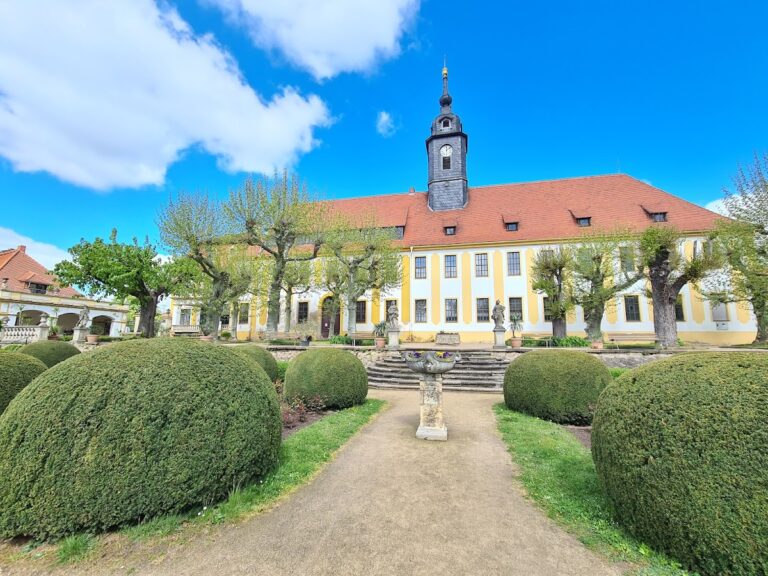
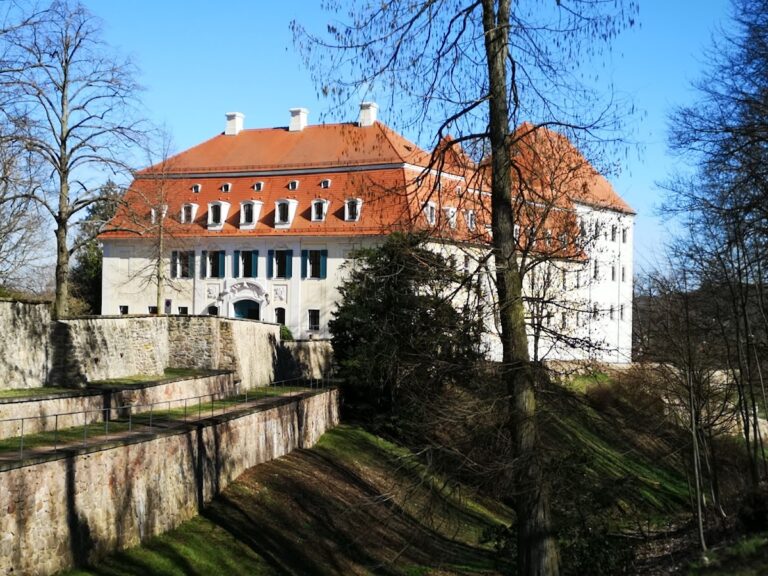
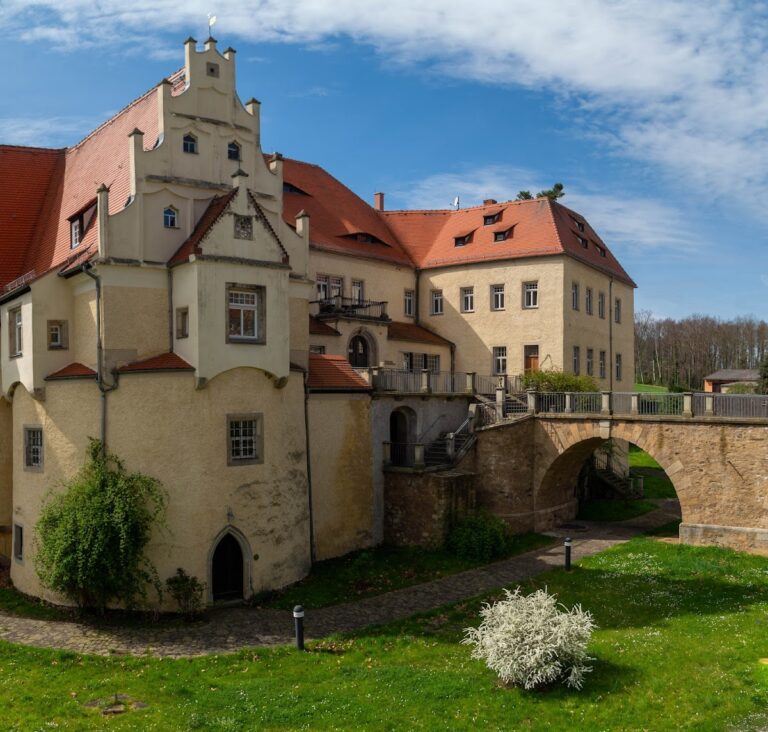
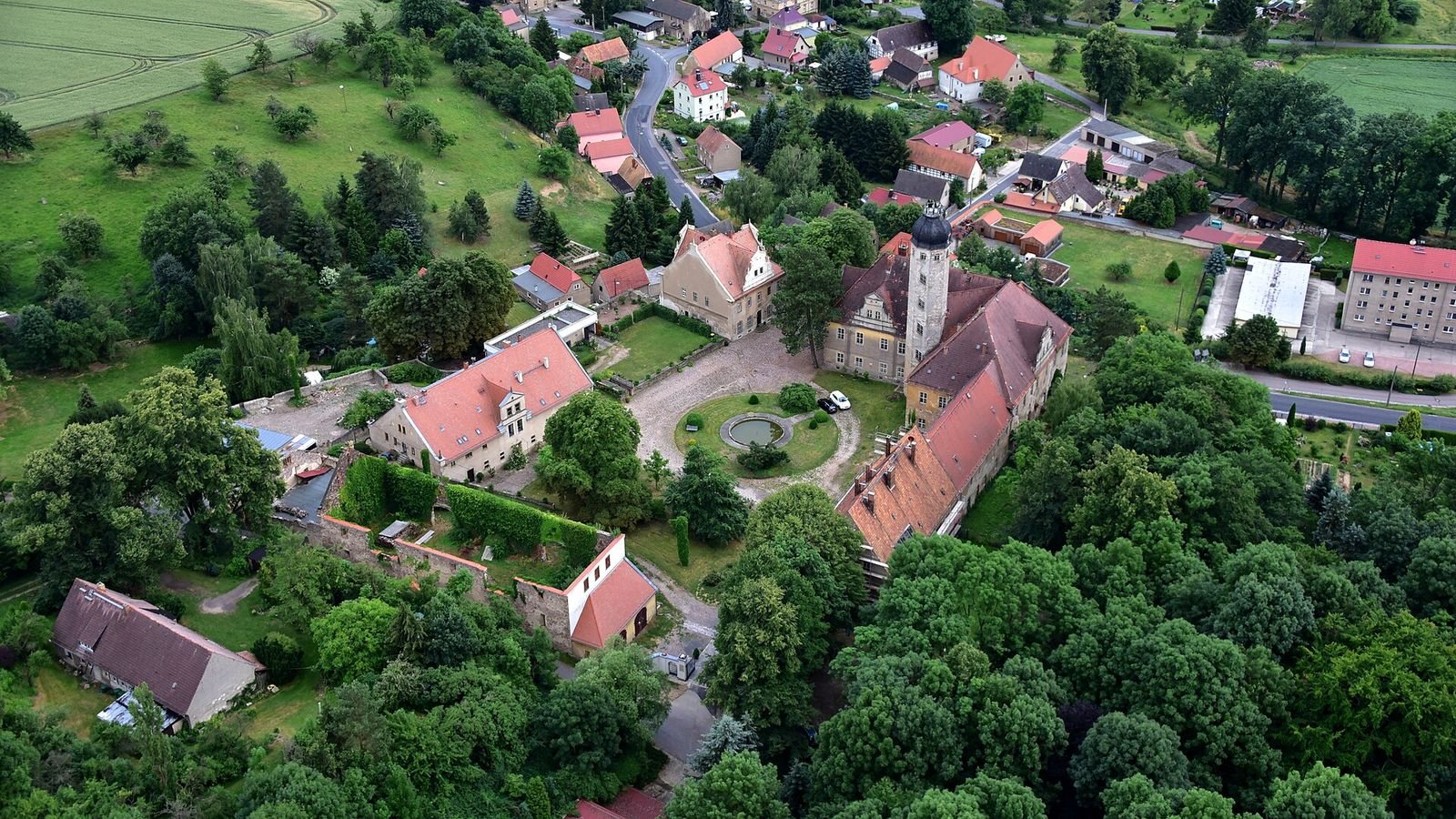
Schloss Schieritz rises above the Ketzerbach valley as a group of buildings centered on the former manor house. The main building has a cellar and two upper storeys beneath a steep hipped roof. Projecting gabled dormers carry Renaissance-style gables, while later alterations have affected the appearance of the windows and some of the highly visible gables. The castle stands beside the Eckhardsberg, which had a vineyard until 1945. The Ketzerbach valley broadens toward the Elbe and reaches the river at Zehren.
Main castle buildings
Main building and entrance
The tower portal is an ashlar sandstone structure from the building period around 1555. Its courtyard entrance has a round-arched doorway, and the keystone bears the arms of the Schleinitz and Sunthausen families together with the year 1556. The window surrounds throughout the castle lack the profiles usually associated with Renaissance architecture. They may result from a seventeenth-century enlargement of the windows, while the prominent display gables may be nineteenth-century additions reflecting historicist taste.
Tower
The castle tower reaches 42.6 metres in height. It was reconstructed in 1882 and again in 1919. Its lantern became dilapidated during the 1970s and was severely damaged by a storm on 31 December 1977. Mountaineers helped secure it in 1987, but the lantern was completely dismantled in 1993.
South wing and service building
The nineteenth-century service building contains groin-vaulted ceilings, formed where two barrel vaults intersect. The adjoining south wing housed a brandy distillery. One column stands in the distillery, while two further Tuscan columns are located in the former kitchen. The Tuscan order is a restrained classical column form with an undecorated shaft. Each column has an octagonal base plate, a transition to a cylindrical shaft 67 centimetres thick, a slight rounded moulding, and a slightly projecting upper plate supporting the vault directly. The castle chapel occupied the second upper storey of the south wing. The southeastern section, dating from the sixteenth century, was the former steward’s residence.
Courtyard and associated buildings
Gateposts and barn
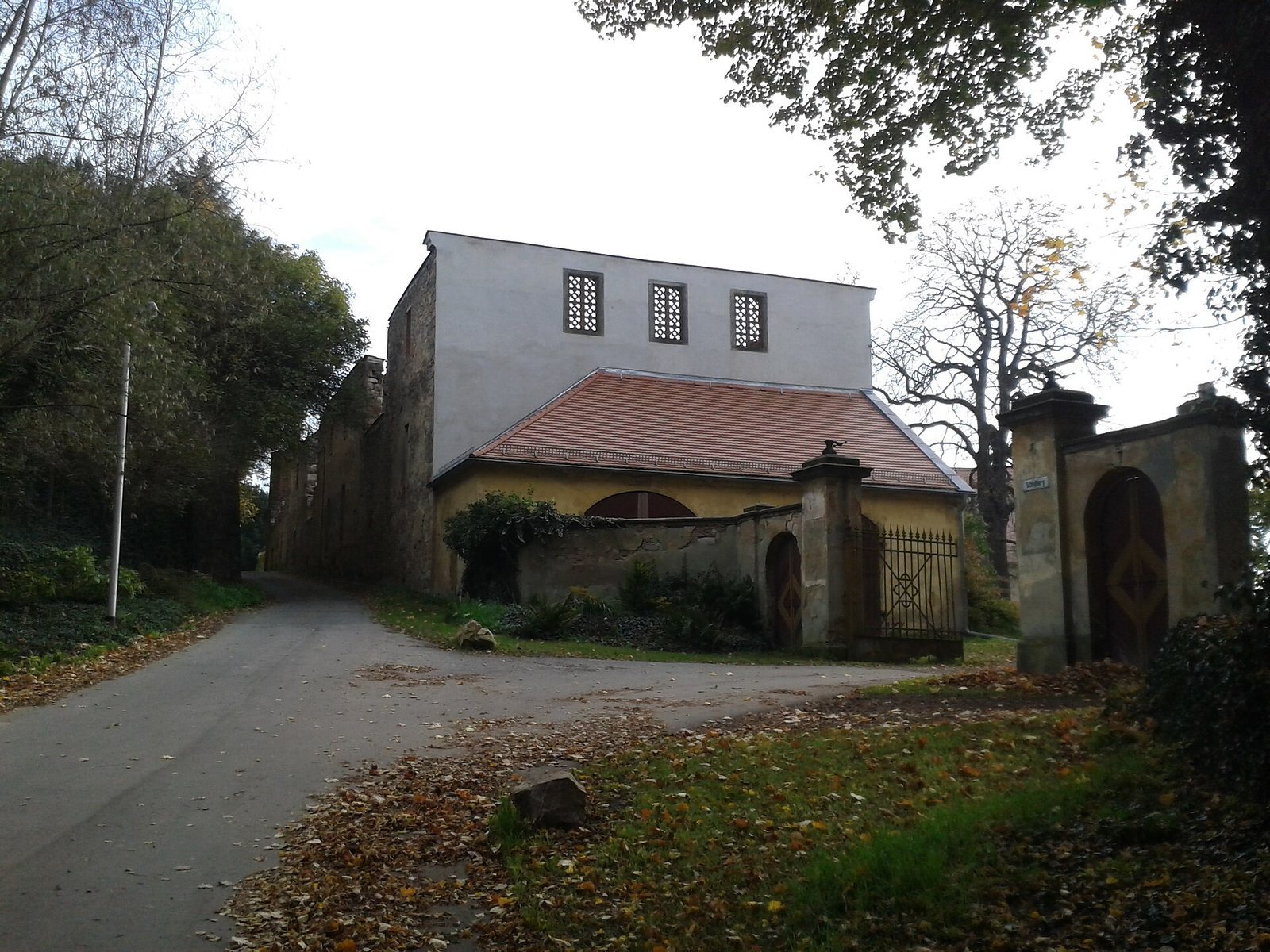
At the northwestern entrance, sandstone gateposts bear the Royal Saxon arms and the monogram “P.G.H.S.” The initials refer to Prince Georg, Duke of Saxony, who owned the castle during the 1860s. A large barn stood in the northeastern part of the manor courtyard. Dating from 1600, it could be reached on its rear side by a bridge and was enlarged in the nineteenth century. A major fire destroyed it in 1971.
Schlossmühle
The Schlossmühle is driven by the Ketzerbach. Its waterwheel measures 3.9 metres in diameter and 2.25 metres in width. The mill site appears on the Ur-Oeder map of 1589 to 1602 and was probably older. It first operated as a wood and sawmill, later became chiefly a grain mill, and then served as a hydropower installation supplying electricity to Schloss Schieritz and the municipality. From 1905 to 1917, its spiral turbine produced five kilowatts for the village, manor, brewery, smithy, and inn.
Surrounding geological and agricultural features
Kaolin deposits occur in the Kirschberg beside the castle site. The vineyard on the Eckhardsberg formed part of the surrounding agricultural landscape until 1945, while the widening Ketzerbach valley connects the castle’s setting with the Elbe at Zehren.