Schloss Rosenegg, Steyr: A Castle and Former Monastic Residence in Austria
Site at a Glance
- Rating
- 4.4
- Popularity
- Very Low
- Country
- Austria
- Primary era
- Early Modern
- External website
- Open
- Eras represented
- Early Modern, Modern
- Civilizations
- Habsburg, Holy Roman Empire
- Site type
- Domestic
- Remains
- Castle
On this page14 sections
History
Schloss Rosenegg, Steyr, is a castle in Austria whose present structure began in 1572, while the estate itself reaches back to the Middle Ages. Located in Pergern within the municipality of Garsten, it developed from a substantial manorial farm into an independent lordship, then an early-Baroque residence of Garsten Abbey and later a privately owned country estate.
Medieval estate and Garsten Abbey
The property was originally a farm called the Baumannsgütl in the Weng, also known as Weng on the Aettgraben. It belonged to the Losensteiner family, medieval ministeriales, or noble officials serving the Ottakar counts of Steyr. Because the holding was treated as free property rather than as a dependent peasant farm, it operated as an important manorial estate. The Losensteiners did not reside there themselves, instead granting its use to citizens of Steyr. The Velber family held it until 1384.
On 21 December 1383, Hartneid and Peter Losensteiner gave the estate and its farmyard to Garsten Abbey for the salvation of their souls and those of their ancestors. The donation was connected with the foundation of the Losensteiner Chapel in the abbey church. Garsten Abbey then retained ultimate ownership and continued to grant the property as a feudal holding, or enfeoffment, to citizens of Steyr. Hans Lörlein assumed the holding in 1384.
Creation of the Rosenegg lordship
During the first half of the sixteenth century, Achaz Höhenfelder of Aistersheim, keeper of Steyr Castle, held the estate. Around 1537 he sold it to Hanns von der Pruckhen, also recorded as de Ponte. Von der Pruckhen sought to convert the holding into free property, but an exchange ordered by Emperor Ferdinand I failed after Garsten Abbey successfully resisted.
Von der Pruckhen transferred Rosenegg to Georg Fenzl in 1565, and Fenzl’s son Andreas inherited it in 1567. Andreas, a physician and imperial valet to Emperor Maximilian II, used his connection with the imperial court to free the estate from Garsten’s feudal authority. On 20 April 1568, Maximilian II issued a charter making it an independent lordship and giving it the name Schloss Rosenegg.
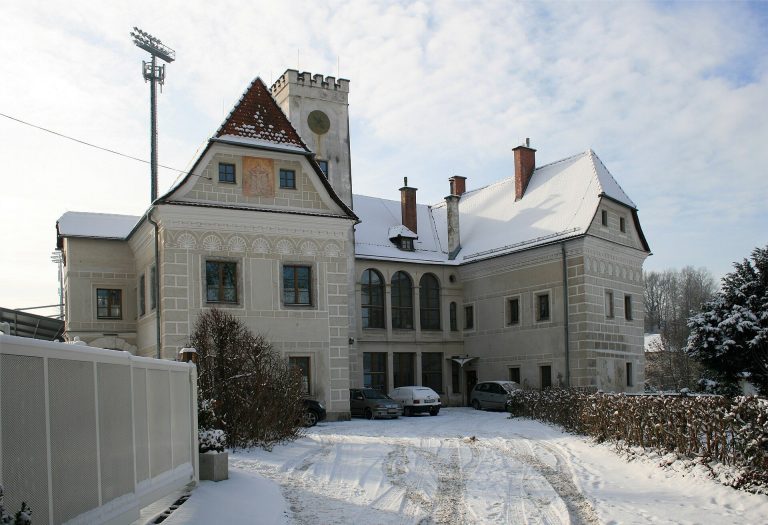
Andreas von der Pruckhen had the old farm demolished in 1572 and began the present castle. Construction proceeded slowly during the period of his family’s ownership, which lasted from 1537 to 1625. After Andreas died in 1584, his widow Barbara Klara de Ponte, born Eisengreinin von Richtenfels, continued to administer the lordship. She later married Wolf Christoph Seepacher von Seebach and Melchior Ster. On 4 November 1597, Emperor Rudolf II confirmed the charter that had established Rosenegg’s independent status.
Disputed ownership and return to the abbey
Barbara and Melchior Ster sold Rosenegg to Dr. Veit Spindler von Hofegg on 28 April 1608. Spindler resold it that same year to Hans Rossner, an imperial court and war paymaster, but disputes over ownership followed. After further litigation, the estate passed in 1615 to Wolf Christoph Seepacher von Seebach, Barbara’s son from her second marriage.
Seepacher’s debts led him to sell Rosenegg to Garsten Abbey on 7 October 1621. Maria Elisabeth, Barbara’s daughter from her third marriage and the wife of Captain and Colonel-Sergeant Albrecht Sokolowsky of Sokolaw, challenged the transaction in 1622. The Sokolowskys continued to possess and occupy Rosenegg until 1625, when they abandoned their claims in exchange for compensation. Garsten Abbey thereby recovered the estate and its unfinished castle, ending Rosenegg’s period as an independent noble seat.
Baroque completion and monastic use
The castle remained incomplete through much of the seventeenth century. The Thirty Years’ War, a prolonged European conflict from 1618 to 1648, and the continuing Ottoman threat limited Garsten Abbey’s capacity for building. After the Ottoman danger receded in 1683, the abbey developed Rosenegg as an early-Baroque residence. Abbot Anselm Angerer completed the castle between 1691 and 1693 and refitted its chapel.
In 1691, Angerer planned a theological study center at Rosenegg. The complex included what was probably a school, a dormitory, and a conference room for professors. The institution was intended to become an academy shaped by the thought of Aristotle and Thomas Aquinas, the Dominican theologian whose combination of Christian theology and Aristotelian philosophy influenced Catholic education. Professors, many summoned from the University of Salzburg, taught the students. The project was eventually abandoned when the professors had to return to the Salzburg or Linz lyceum, advanced schools below university level. Rosenegg then served as a country retreat for the monks of Garsten.
The castle received further Baroque alterations during the eighteenth century. After the 1727 fire in Steyr, thirty-four nuns from the Steyr Celestine convent lived in six rooms at Rosenegg for fourteen months. They returned to their rebuilt convent on 17 October 1728. Abbot Ambros von Freudenpichl, who had provided their refuge and supported the rebuilding, spent his final days at Rosenegg and died there on 22 October 1729. From 1785, the tower room served as a school, which moved to Christkindl in 1787.
Private ownership and later transformation
Garsten Abbey was dissolved on 1 May 1787, following the death of its last abbot, Maurus Gordon, in 1786. Rosenegg consequently passed to the Religious Fund. The paper manufacturer Michael Würz bought it in 1792, after which the estate changed hands several times, including to the Hofmann and Barth families. The jurist and poet Alexander Julius Schindler wrote poetry at Rosenegg in the late 1840s and published it as the Rosenegg Romances, also called the Rosenegg Sonnets.
Countess Waldstein, born Khevenhüller, owned Rosenegg during the 1860s and transformed it in the Historicist style, a nineteenth-century approach that revived forms from earlier architectural periods. The Prague bankers Schlesinger owned the estate from 1878 and had Rosenegg spring water bottled and transported to Prague.
Anna Schlesinger sold Rosenegg in 1908 for 80,000 kronen to the children of Franz Werndl, the brother of Josef Werndl. Descendants of Franz Werndl’s eldest daughter, Leopoldine Hofmann, remain the owners. Descendants of Leopoldine’s daughter Friederike occupy the former farm and service wing, while descendants of her daughter Anna Beringer live in the castle. Both the castle interior and the former farmyard have undergone revitalization.
Remains
Castle and grounds
Castle form
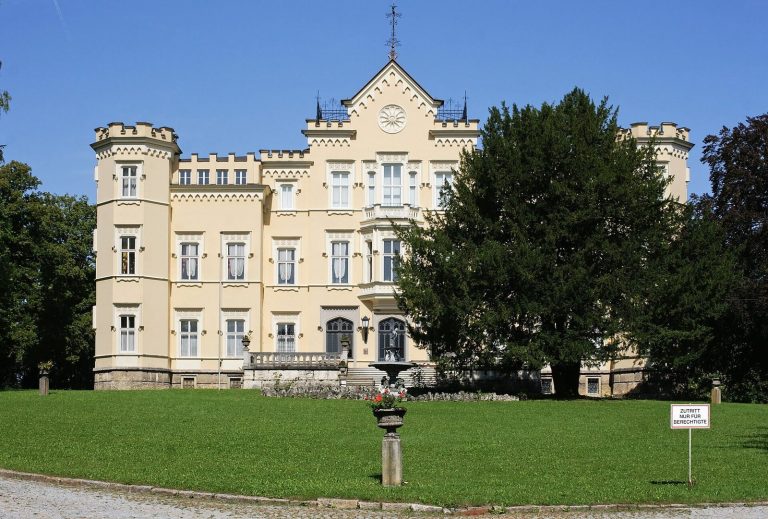
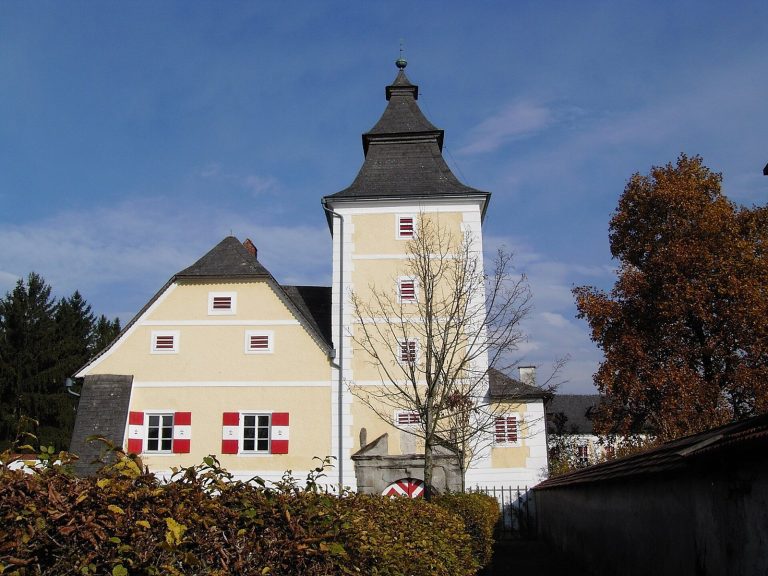
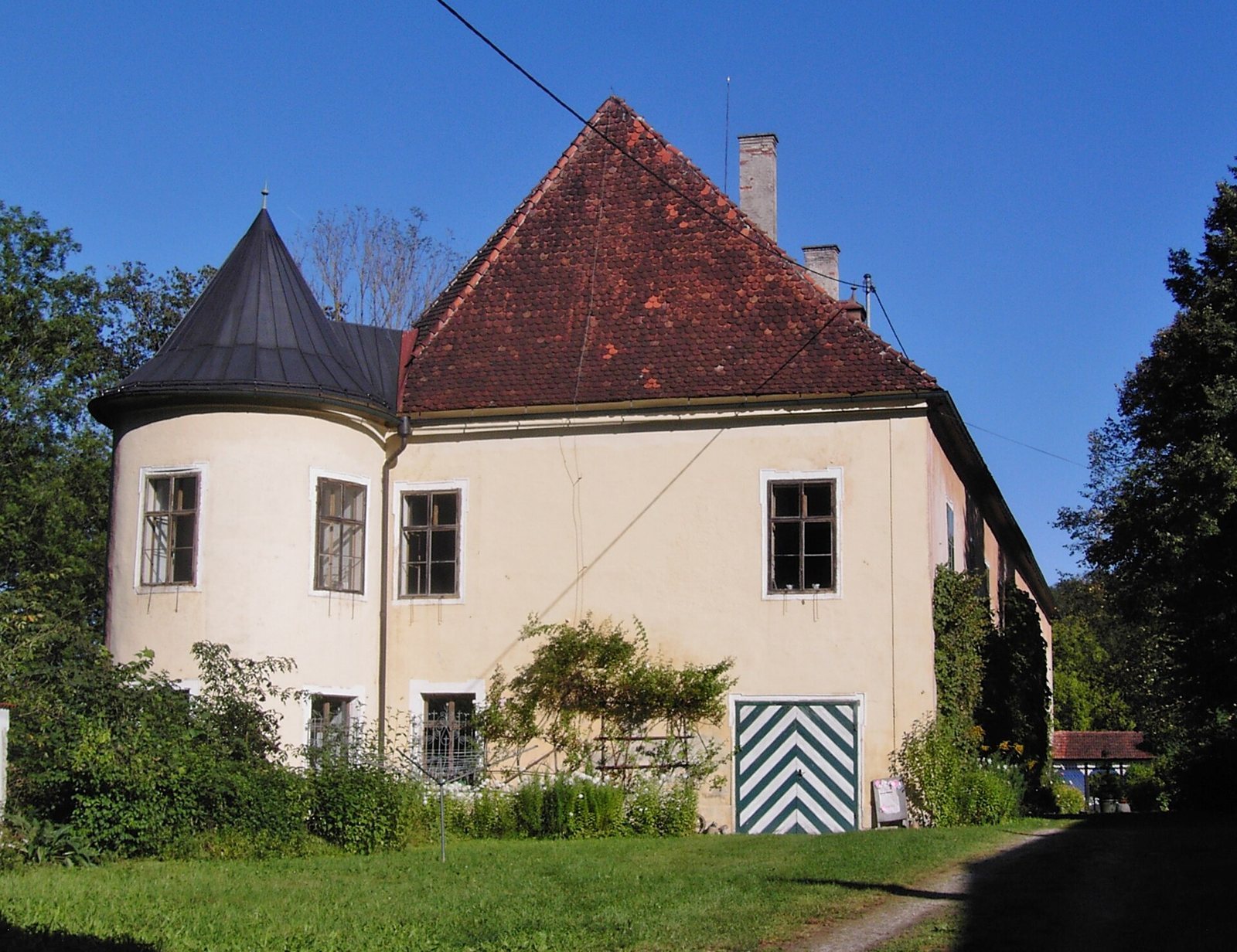
Rosenegg stands on the outer edge of the highest river terrace above the Steyr. Its narrow, elongated plan reflects the limited space at the terrace edge. The castle has a hipped roof and two round corner towers with conical roofs. Positioned on the park or rear side rather than beside the entrance or courtyard, the towers give the building an unusual arrangement. They were intended for residential use rather than defense, while their form supplied the architectural character of a castle.
The outer wall rests on foundations carried down to the lower terrace to reduce the danger of landslides. The round towers also rise from this lower level, so the building appears more imposing from the river than from the courtyard. The former farm and service wing, or Meierhof, stands opposite the castle. This agricultural complex has been revitalized and is occupied by descendants of Leopoldine Hofmann.
Park and spring
A park extends westward along the north side of the castle and contains an old avenue. The estate was also associated with the Rosenegg spring, whose water was bottled and transported to Prague during the late nineteenth century.
Chapel and interior decoration
Baroque chapel
The Baroque chapel completed under Abbot Anselm Angerer extends through both floors and is unusually large in proportion to the castle. It had a public entrance, while windows from adjoining sleeping rooms opened into its oratory from the upper gallery. Its floor was paved with hexagonal marble slabs made by the Linz stonemason Christoph. An altar installed in 1691 carried a painting of the Holy Family by Johann Carl von Resslfeld, the painter associated with Garsten Abbey. Resslfeld may also have decorated the chapel vault with frescoes.
The chapel was secularized during the nineteenth-century Historicist remodeling. A floor was inserted at mid-height, only remnants of the stucco survived, and the interior furnishings, including Resslfeld’s altar painting, were lost.
Prelate’s Room
The so-called Prelate’s Room retains wall paintings in the style of the Austrian High Baroque. The paintings date from the 1730s and preserve part of the interior decoration associated with Rosenegg’s period as a residence of Garsten Abbey.
Historicist alterations
The nineteenth-century remodeling applied Schönbrunn yellow to the exterior walls, replacing the gray-pink coloration associated with Austrian Baroque architecture. The windows were rearranged in an English style, and numerous doorways were inserted throughout the first-floor rooms.