Schloss Ronneburg: Castle and Administrative Seat in Germany


Site at a Glance
- Rating
- 4.3
- Popularity
- Very Low
- Country
- Germany
- Primary era
- Medieval
- Eras represented
- Medieval, Early Modern, Modern
- Civilizations
- German, Holy Roman Empire
- Site type
- Military
- Remains
- Castle
On this page10 sections
History
Schloss Ronneburg is a historic castle complex in Ronneburg, Germany, whose development began with a late Sorbian settlement and a fortified post before 900. Expanded by the Vögte of Weida before 1200, the site became a regional seat of power and later the administrative center of the Wettin Amt Ronneburg. Its surviving buildings represent architectural periods from the Romanesque era to nineteenth-century Historicism, a style that revived and recombined forms from earlier historical periods.
Early settlement and the Vögte
A late Sorbian settlement occupied the present-day urban area before 900. After that date, a military post enclosed by a palisade was established on the castle hill. Before 1200, the Vögte of Weida expanded the castle complex, creating a suburb and settlement farms around it. A Vogt was a medieval administrative and judicial official, and the Vögte of Weida belonged to regional ruling houses whose territories later entered the political sphere of the Wettins.
German settlers began arriving from the eleventh century onward. The Vögte of Weida were appointed ministeriales of the German emperor, meaning service nobles who carried out administrative and military duties for higher-ranking lords. They administered the surrounding territory as the Lords of Ronneburg. The town was first mentioned in 1209 and received town rights in 1304.
Changing lordship
In 1244, Ronneburg passed from the Vögte of Weida to the Vögte of Plauen. In 1327, the Vögte of Weida, Gera, and Plauen joined the Lords of Elsterberg of the Lobdeburg family in the Ronneburg Defensive and Offensive Alliance. The agreement, concluded in the castle’s Rittersaal, was intended to protect the allied territories against the Wettins, a major German ruling dynasty whose possessions included Saxony and several Ernestine duchies.
The Vogtland War of 1354 to 1357 changed the castle’s political status. After the conflict, the Vögte of Plauen lost Schloss Ronneburg, which became a Wettin fief. A fief was a lordship held by a vassal in return for service or allegiance. By the end of the fifteenth century, the rear castle belonged to the von Ende family. In 1517, ownership passed to the Lords of Wildenfels, while the front castle was leased for 400 years as a free castle fief to the Lords of Liebschwitz.
Wettin administration and later alterations
Following the Capitulation of Wittenberg in 1548, Schloss Ronneburg passed to the Ernestine Duchy of Saxony and became the administrative seat of the Wettin Amt Ronneburg. An Amt was a territorial office and district under a German ruler. From the sixteenth century, the office successively belonged to the Ernestine duchies of Saxony, Saxony-Weimar, Saxony-Altenburg, Saxony-Gotha-Altenburg, Saxony-Eisenberg, and again Saxony-Gotha-Altenburg.
The complex continued to be enlarged and altered during the fifteenth century and afterward. Around 1520, Anarg zu Wildenfels commissioned a building at the southwest corner. The former castle church was used until the Reformation in 1529. This sixteenth-century religious movement challenged established Western Christian institutions and practices, and the church later became St. George’s Chapel.
After the Thirty Years’ War, Duke Friedrich Wilhelm II of Saxe-Altenburg ordered the manor house and castle wall to be renewed in 1651. The keep was renewed between 1651 and 1666, and a half-timbered upper storey was added in 1662. During the eighteenth century, the rear castle deteriorated, and its round keep was demolished in 1772. The rear section was then reduced to the manor house and Rittersaal.
Administrative complex and modern uses
The front castle acquired an administrative building and an official residence during the seventeenth century. These structures later served as a district court and revenue office. A new district-court building was erected on the earlier outer walls in 1889. In 1896, the front castle was remodeled into the present new castle, including the tower that became the residence of the district judge.
In 1826, Schloss Ronneburg, the administrative district, and the town returned to the Duchy of Saxony-Altenburg. Following administrative reform, they belonged to the Ostkreis until 1900 and then to the Ronneburg district office. After the Second World War, the new castle housed a Pioneer House, classrooms for the castle school, an after-school center, and a creative arts group. A Pioneer House was a youth institution associated with the organized children’s movement in the former German Democratic Republic. Later uses included the town library, the town and school museum, rooms for the local-history association, and a youth club.
Schloss Ronneburg is now used as a museum. The castle courtyard and garden were redesigned in connection with the 2007 Federal Horticultural Show.
Remains
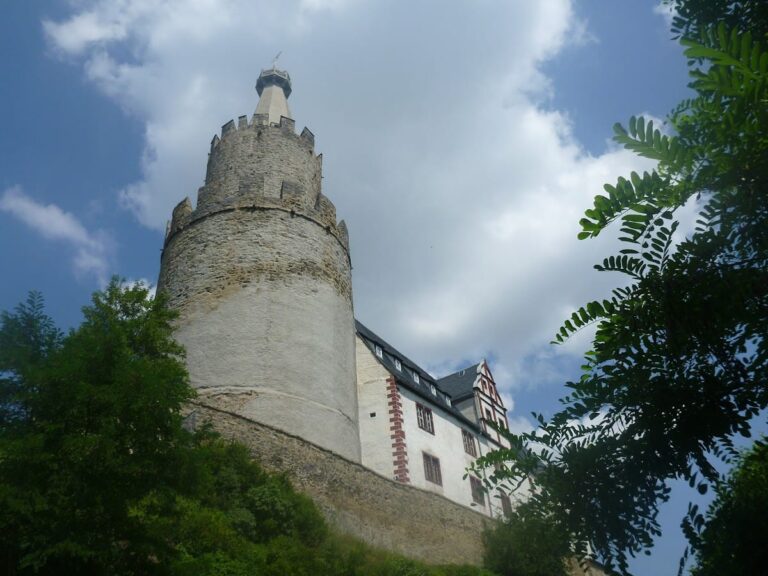
Schloss Ronneburg occupies an approximately triangular area on a rock that falls steeply toward the west. The complex is divided into a front castle and a rear castle, and its buildings bring together forms from the Romanesque period through Historicism. The principal entrance is on the east side, facing the town, where a ditch formerly separated the castle from the settlement. The oldest part of the front area is a Romanesque arched gateway, which remains the castle’s only entrance.
Rear castle
The older rear castle consisted of the Rittersaal, a keep, and service buildings. Its surviving elements now include the Rittersaal, a historically inspired new building, and several old vaulted cellars. The Rittersaal is the last surviving remnant of the old castle and continues to serve for municipal events and civil weddings. The rear-castle remains also include the manor house. The round keep, renewed between 1651 and 1666, was demolished in 1772, while the upper storey added in 1662 survives as a half-timbered element of the complex.
Front castle
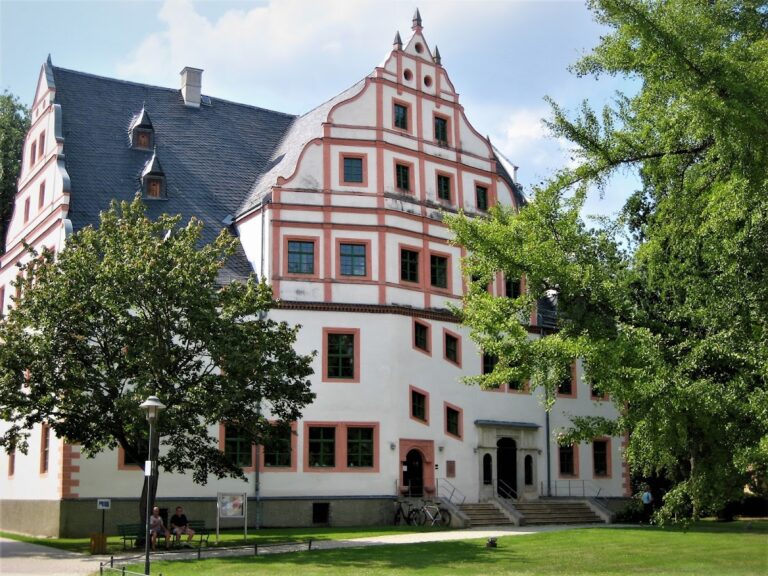
The front castle is dominated by a Historicist building with a tower structure. Constructed at the end of the nineteenth century for administrative officials, it incorporates the district-court building erected in 1889. That building has an elaborate stucco facade and is the most ornate structure in the complex. The castle tower that shapes Ronneburg’s townscape was created in 1896 during the remodeling of the front castle and served as the district judge’s residence. The seventeenth-century administrative building and official residence formed part of this upper section before their later institutional uses.
Chapel
St. George’s Chapel stands beside the district-court building in the former castle church. It is a vaulted room with cross vaults and is the oldest of Ronneburg’s three chapels. The building preserves the religious function of an early part of the complex, whose use as the castle church continued until the Reformation in 1529.
Town fortifications
Ronneburg’s former town defenses included the Upper or Stone Gate toward Großenstein, the Lower or Raitzhain Gate toward Raitzhain, and the Castle Gate. Sections of the town wall survive at Kirchplatz, Rödergasse, and Bergkellergasse, providing physical evidence of the fortified settlement that developed around the castle.
Nearby sites