Schweinsburg Castle: A Medieval Water Castle in Saxony


Site at a Glance
- Rating
- 4.1
- Popularity
- Medium
- Country
- Germany
- Primary era
- Early Modern
- External website
- Open
- Eras represented
- Medieval, Early Modern, Modern
- Civilizations
- German, Holy Roman Empire
- Site type
- Domestic
- Remains
- Elite Residence
On this page8 sections
History
Schweinsburg Castle is a medieval water castle in Neukirchen, Germany, whose surviving complex incorporates the history of the former Crimmitschau lordship. Built in the thirteenth century during the medieval development of the region, it later became a Baroque palace and was rebuilt in the Neo-Baroque style. The castle stands within a settlement that grew during the eastward expansion of German colonization, on the site of an older Slavic settlement.
Origins of Crimmitschau Castle
The settlement and castle of Crimmitschau emerged during the second half of the twelfth century. Regional development during this period is also reflected by nearby Waldenburg, mentioned between 1165 and 1172, and Meerane, first mentioned in 1174. Crimmitschau lay where colonization routes from Thuringia crossed the Pleißenland toward the Ore Mountains, while another route led eastward from Weida into the forest zone.
The medieval water castle was built in the thirteenth century and appears in a 1222 record as “vest huz cremascowe.” The Lords of Crimmitschau, a noble family whose origins are uncertain, are first documented in 1212. In that year, Henricus de Crematzove acted as guarantor for Otto IV, the German king crowned Holy Roman Emperor in 1209. The family held Crimmitschau as an imperial fief, meaning a lordship granted by the emperor or Empire, and ranked among the leading families of the Pleißenland. Members of the family also supplied the regional judge on several occasions.
Schönburg and Wettin rule
The Crimmitschau lordship developed between the territories of Starkenberg to the northwest, the holdings of the Weida bailiffs, and Schönburg possessions to the southeast. The Lords of Crimmitschau died out during the thirteenth century. Günther von Crimmitschau entered the Teutonic Order between 1270 and 1273, while the Schönburgs assumed control of the lordship and established a collateral line there.
In 1307, the Schönburgs acknowledged Wettin feudal overlordship over Crimmitschau. The Wettins were a long-established German ruling dynasty whose possessions included Saxony. Friedrich von Schönburg issued a document at Crimmitschau Castle in 1322, showing that the castle remained an active centre of authority. Under Schönburg rule, it administered the landed lordship and housed ministerial families, service nobles who carried out administrative and military duties for higher-ranking lords. The castle men included members of the von Orla, von der Gabelentz, von Trützschler, von Ölsen, von Kowitz, von Tunzold, von Vogel, von Triebes, and von Knappe families.
When the Schönburg line of Crimmitschau died out at the end of the fourteenth century, the lordship passed to the Wettins. The name Schweinsburg was first applied to the castle in 1486. Schweinsburg and Crimmitschau later passed to the Lords of Einsiedel in 1583, although they sold the properties in 1606.
Palace transformation and modern use
By 1743, the castle had decayed, and the von Berbisdorf family transformed it into a Baroque palace. During the nineteenth century, its owners Christian Friedrich Meinhold and Friedrich Emil Robert Meinhold served as members of the Saxon Landtag. The complex underwent another major rebuilding for the manufacturer Carl Wolf between 1908 and 1911, when Neo-Baroque elements were added. A wing also contained a factory producing pottery goods from 1900 to 1908.
The estate was expropriated in 1945. During the same year, the tower of the lower castle was demolished, and a historically valuable bell from the chapel at Harthau, now Lauenhain, subsequently went missing. From 1946 to 1989, the palace served as a party school for the KPD, the Communist Party of Germany, and the SED, the socialist ruling party of East Germany. This period caused extensive damage to the building fabric. The house chapel was converted into a gymnasium, and its historic altar was lost.
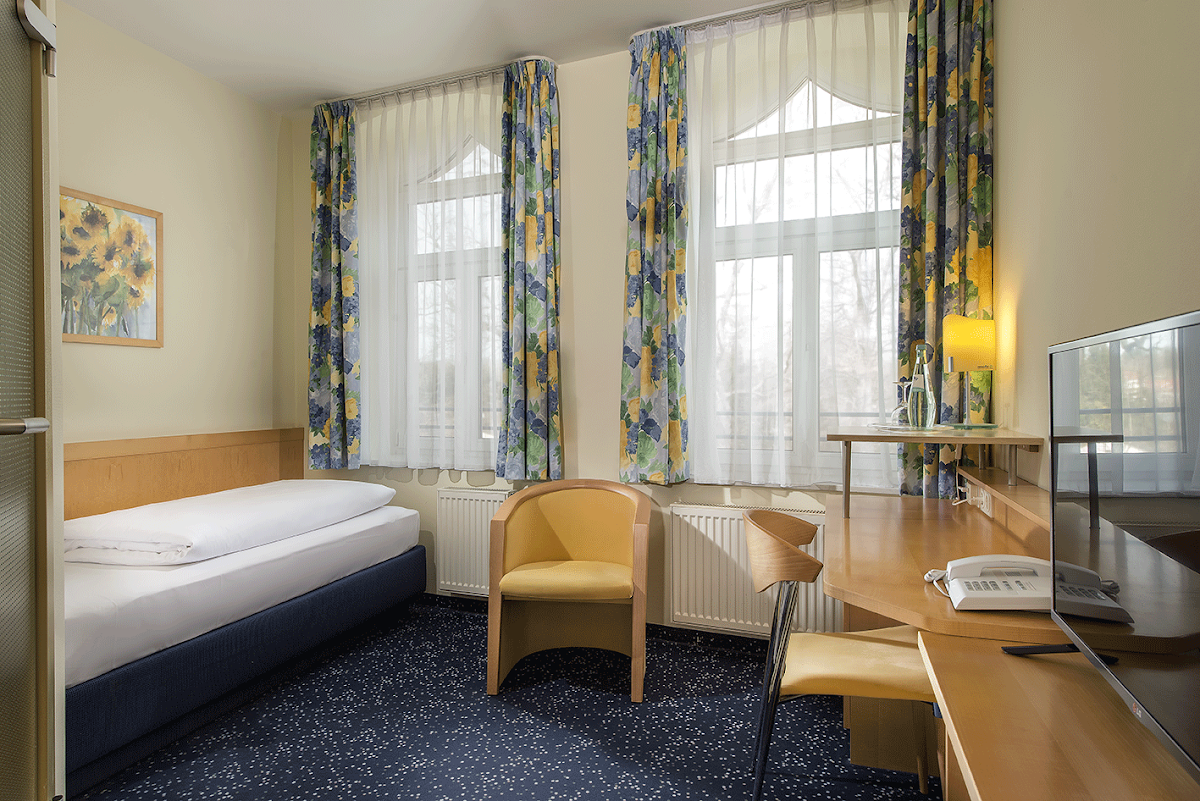
In 1994, the complex was converted into a conference centre and renovated in 1998. The lower castle was adapted to include a hotel. The complex is now operated as a hotel by the GCH Hotel Group, continuing the building’s modern institutional use while retaining elements of the earlier castle and palace.
Remains
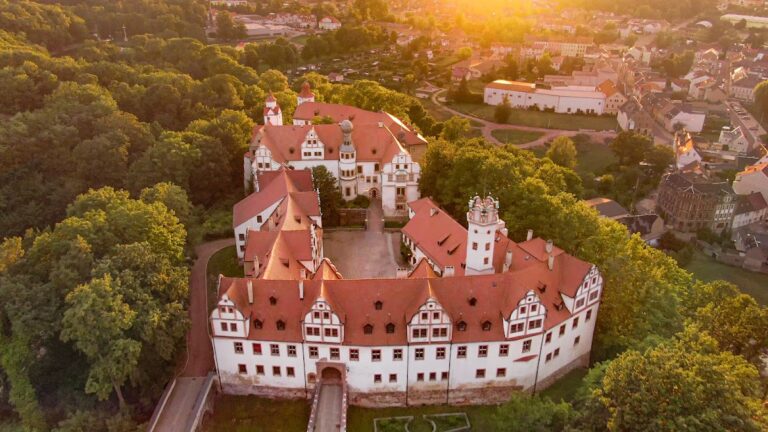
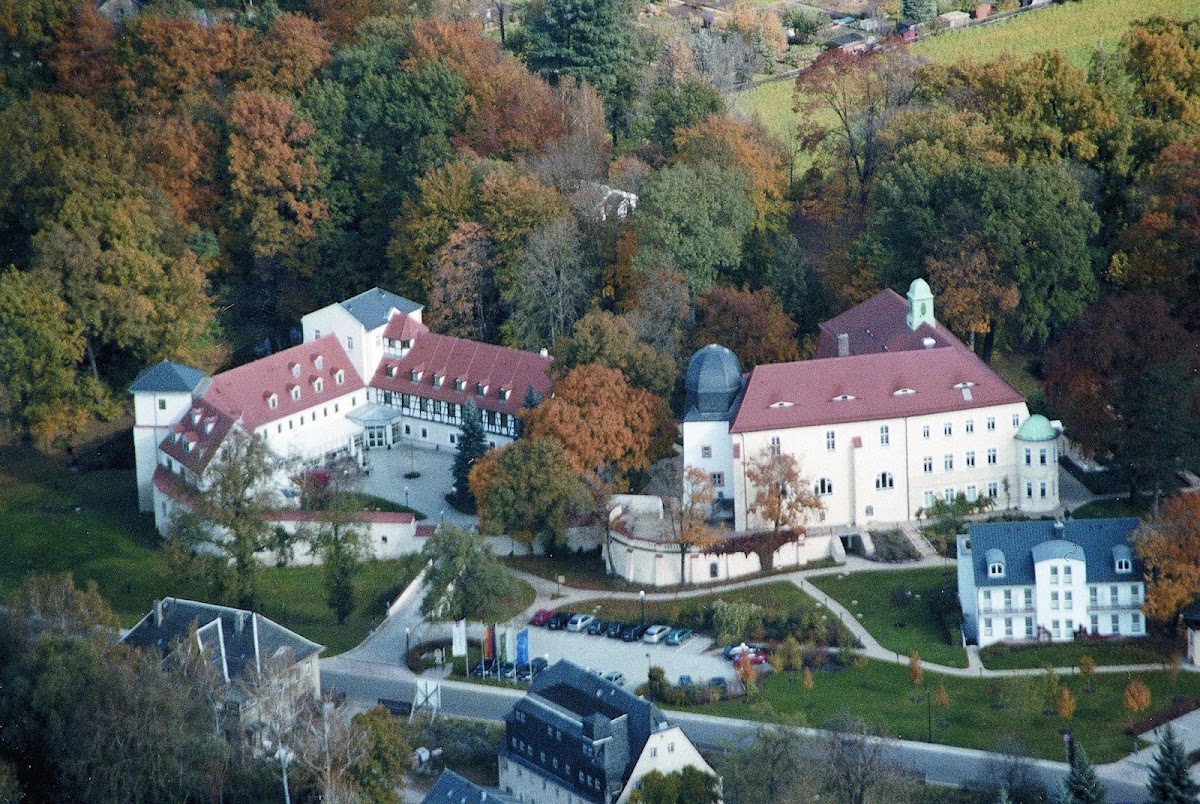
Schweinsburg is a lowland water castle in the Pleiße floodplain, north of Schweinsburg and near the former manor estate. The surviving complex is arranged around an inner courtyard and combines partly preserved medieval castle fabric with the later Baroque palace and Neo-Baroque rebuilding. A Baroque garden is associated with the palace, while the lower castle forms part of the present conference and hotel complex.
Medieval and lower castle remains
Recognisable remains of medieval Castle Crimmitschau survive within the later buildings. The thirteenth-century water-castle fabric is partly incorporated into the palace and conference-centre complex, linking the present structure to the medieval administrative centre of the lordship. The lower castle formerly included a tower that served as a bell tower. That tower was demolished in 1945, leaving the later complex without this element of its historic form.
Baroque palace and later buildings
The rebuilding of 1743 reshaped the medieval castle as a Baroque palace. Its inner courtyard and associated Baroque garden belong to the palace landscape, while the rebuilding undertaken between 1908 and 1911 added Neo-Baroque features for Carl Wolf. One wing had previously accommodated a pottery-products factory from 1900 to 1908, demonstrating the complex’s adaptation to industrial use before the later rebuilding.
Chapel and present complex
The house chapel was physically converted into a gymnasium during the palace’s use as a party school between 1946 and 1989. The conversion resulted in the loss of the historic altar. Since the conversion into a conference centre in 1994 and the renovation of 1998, the buildings have accommodated conference facilities and hotel rooms, including a hotel established in the lower castle.
Nearby sites