Schloss Roith, Gmunden: A Noble Residence and Lakeside Castle


Site at a Glance
- Rating
- 4.3
- Popularity
- Very Low
- Country
- Austria
- Primary era
- Early Modern
- Eras represented
- Early Modern
- Civilizations
- Habsburg, Holy Roman Empire
- Site type
- Domestic
- Remains
- Castle
On this page7 sections
History
Schloss Roith, also called Freisitz Roith, is a small castle in Gmunden, Austria, probably built around 1596 as a noble residence. Emperor Rudolf II elevated Roith to a Freisitz, a residence whose holder enjoyed special social and legal privileges in the Habsburg lands. The estate stood within the changing network of noble and civic properties around Gmunden.
From estate to noble residence
The estate known as “in der Reuth” belonged to the Polheimer family during the sixteenth century, while Hans Paumgartner owned it in 1587. In 1597, Friedrich von Pollheim transferred Roith to Siegmund Jäger and his wife, Margaretha. The property later passed to the Seeauer family of Hallstatt.
The Seeauers transferred Roith to Georg Albert Plaß von Mühlleiten, either through a sale or through a life-interest arrangement. After Plaß, the Seeauers, who had by then been raised to the rank of counts, again became owners. A heraldic stone dated 1659 indicates that Plaß probably commissioned structural changes to the building during his ownership.
Changes of ownership in the eighteenth and nineteenth centuries
In 1719, Count Josef Ehrenreich von Seeau, parish priest of Gmunden, sold Roith to Johann Adam Aigner, a citizen of Gmunden. Through Aigner’s daughter, the estate passed by marriage to Johann Paul Lichtenauer, an imperial customs-office clerk.
After Lichtenauer died, his widow sold Roith in 1753 to the cavalry officer Jakob von Holzofen. Holzofen sold it in 1770 to Franz Xaver Gangl, who died without heirs. The estate was then auctioned publicly and acquired by Johann Nepomuk Hörner, another citizen of Gmunden. Hörner was ennobled in 1814 and adopted the name “Edler von Roith.” His heirs sold the property in 1843 to the Viennese notary Gustav Faber, whose wife was Hörner’s great-granddaughter.
Twentieth-century uses
Freiherr Geza von Sardagna owned Roith from 1914 to 1942. Because of him, the small castle was formerly known as Sardagna. During the Second World War, the building housed a youth hostel, while the grounds were used as a nursery garden.
Franz and Rosi Prechtl acquired Roith in 1968 and converted it into a castle hotel. The hotel later passed to the Asamer Group. It was renovated in 2008, separated from the holding in 2013, and taken over personally by Hans Asamer. The hotel closed in 2015, and the property was sold in 2016 to an agricultural trading company from the Innviertel region.
Remains
Building and lakeside facade
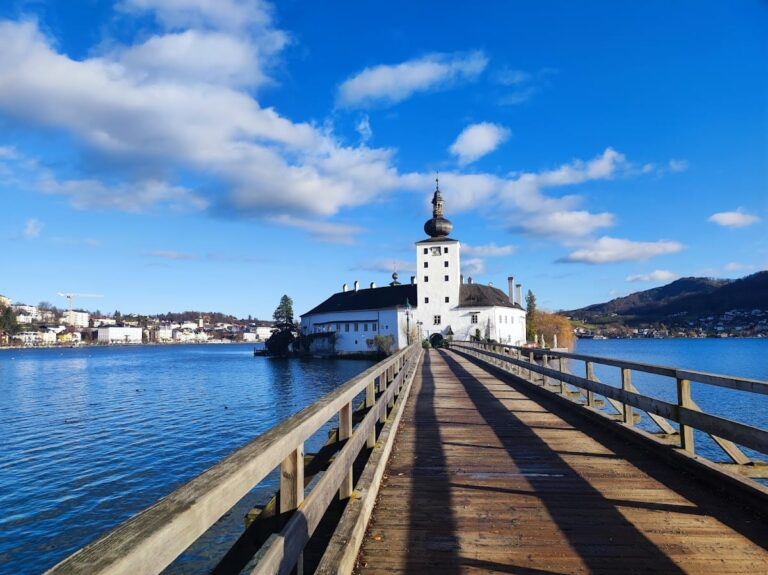
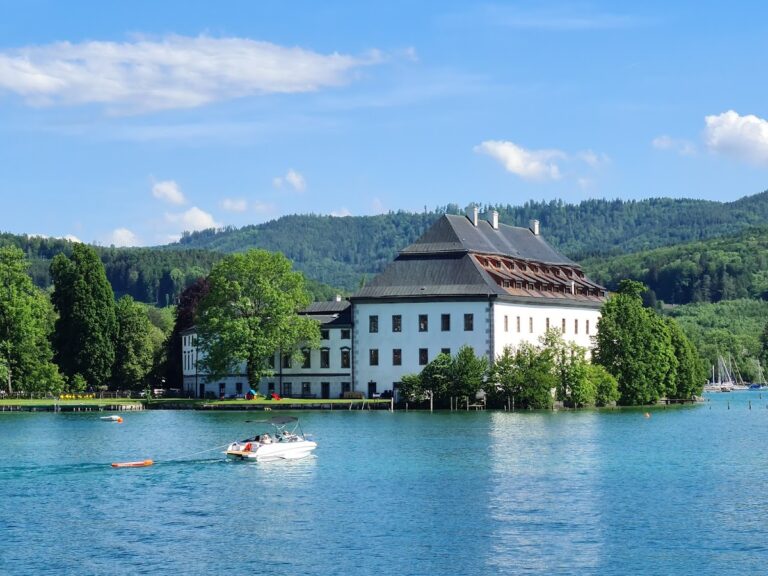
Schloss Roith stands at the edge of Gmunden Bay, opposite Schloss Ort. The three-storey building has a hipped roof, which slopes on all sides rather than ending in vertical gables. A projecting seven-sided tower rises slightly above the roofline. On the lakeside, two curved mansard gables, shaped in the broken profile associated with a mansard roof, form prominent elements of the facade.
Entrance and courtyard
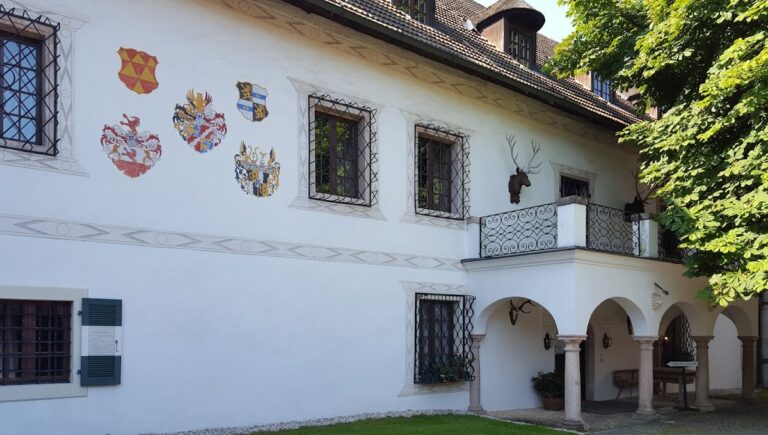
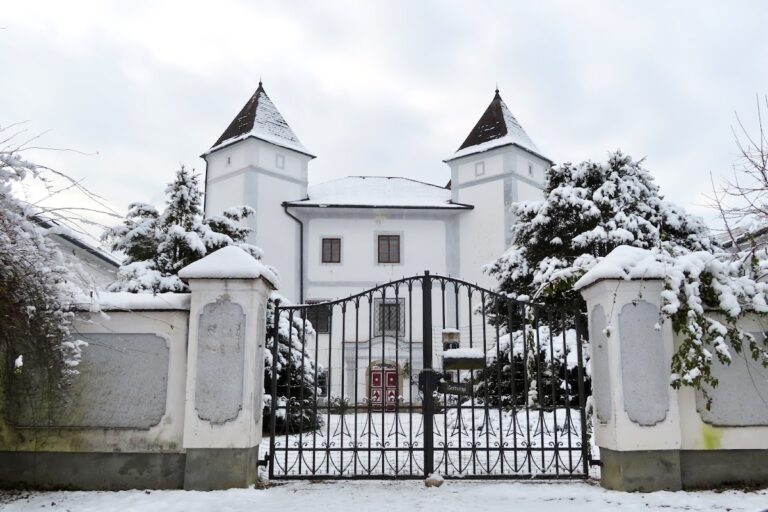
An entrance hall leads into a courtyard that is open at the rear. Three sides of the building enclose the courtyard in a horseshoe-shaped arrangement. Above the entrance gate, a heraldic stone bears the coats of arms of Georg Albert Plaß and his wife, Regina, with the date 1659. The courtyard gives access to a terrace with a notable view over Lake Traunsee.
Nearby sites