Schloss Reichstädt: A Renaissance and Baroque Castle in Germany


Site at a Glance
- Rating
- 4.1
- Popularity
- Very Low
- Country
- Germany
- Primary era
- Early Modern
- External website
- Open
- Eras represented
- Early Modern
- Civilizations
- Electorate of Saxony, Holy Roman Empire
- Site type
- Domestic
- Remains
- Castle
On this page10 sections
History
Schloss Reichstädt is a historic castle in Germany, now located in Reichstädt, a district of Dippoldiswalde. Its origins reach back to a knightly estate probably established in the thirteenth century, while its surviving character reflects a Renaissance rebuilding in 1535 and a Baroque transformation carried out between 1765 and 1776.
Medieval estate and Renaissance rebuilding
A manor belonging to the lords of Reichenstadt was mentioned in 1336. Sigismund von Maltitz, a mining official, acquired the estate in 1503. His fortune grew after 1507 through the invention of the wet-stamp mill, a water-powered machine used to crush and process ore. Under his descendant Heinrich von Maltitz, the estate was rebuilt in 1535 as a moated Renaissance castle, a form surrounded wholly or partly by water-filled defensive or ornamental ditches.
The Saxon Elector August I acquired Reichstädt in 1569 and used it as a hunting lodge. August I was an elector, one of the rulers of Saxony within the Holy Roman Empire. A surveying map from 1570 records the castle as a group of two-storey buildings enclosed by a water-filled moat.
War damage and changing ownership
Castle and estate were partly destroyed in 1632 during the Thirty Years’ War, the major European conflict fought from 1618 to 1648. The damage was inflicted by troops commanded by Heinrich von Holk, a military leader active in that war. Reconstruction began in 1639 under Heinrich von Taube, a court marshal and district governor. Johann Georg I, the Saxon elector, had awarded Reichstädt to von Taube in recognition of his service.
The von Nostitz family purchased the castle in 1682. In 1717, Gottlob von Nostitz sold it to his sister Charlotte Christiane von Nostitz, who was married to Caspar Abraham von Schönberg (1680–1763). Reichstädt consequently entered the possession of the Saxon noble family of von Schönberg, which retained it until expropriation in 1945 and recovered ownership in 1998.
Baroque transformation and aristocratic residence
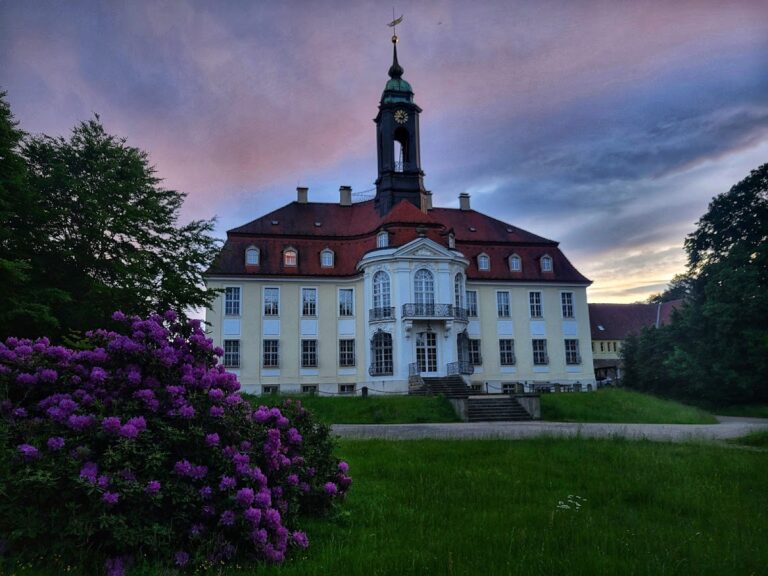
The castle sustained further major damage during the Seven Years’ War, fought mainly from 1756 to 1763. In the year the war ended, Adam Rudolph von Schönberg (1712–1795), Saxony’s postmaster general, became owner of Reichstädt. A postmaster general was the senior official responsible for postal administration. Between 1765 and 1776, Adam Rudolph transformed the separate parts of the castle into a four-wing Baroque complex and created an associated park. Baroque architecture favored monumental compositions and richly decorated interiors.
Adam Rudolph’s successors inherited Reichstädt within the family. After he received Schloss Purschenstein as an inheritance in 1772, he and his descendants lived at Reichstädt only intermittently. The castle nevertheless accommodated several prominent figures. Prince Heinrich of Prussia used it as quarters in 1748. Prince Karl of Saxony lived there for a period after his forced abdication as Duke of Courland and Semigallia in 1763, and the interiors were elaborately furnished for him from 1765.
In August 1813, during the Wars of Liberation, Tsar Alexander I occupied quarters at Reichstädt with his adjutant general Jean-Victor Moreau. The Wars of Liberation were the campaigns of 1813–1815 in which European powers fought against Napoleon’s rule.
Landscape park and twentieth-century upheaval
Under Caspar Hugo von Schönberg (1833–1890), part of the Baroque park was redesigned as a rural landscape park. In 1858 he erected a memorial stone to Adam Rudolph von Schönberg. The memorial was later removed.
During the Second World War, Reichstädt was used to store evacuated works of art, including parts of Heinrich von Brühl’s Swan Service. In May 1945, Soviet soldiers devastated the valuable interior furnishings. Later that year, the last owners, Hans and Margarete von Schönberg, were expropriated by the Soviet occupation authorities during the land reform. They left for the western occupation zones in October 1945, abandoning the entire property.
After 1945, the castle served a succession of cultural and residential purposes. It was used as a kindergarten, school, Pioneer and cultural house, and housing. These functions brought substantial changes to the interiors, while the basic external substance remained intact. After German reunification, the complex stood empty for a period.
Return and restoration
Dr Ilse von Schönberg acquired the castle in 1998 for 30,000 Deutsche Mark, returning it to the von Schönberg family. The purchase initiated a gradual restoration of the architecturally valuable complex. By spring 2015, approximately 60 percent had been restored after an investment of about 2 million euros, although the work remained unfinished. Parts of the castle continue to be used for public events and overnight accommodation.
Remains
Castle layout and surviving Renaissance fabric
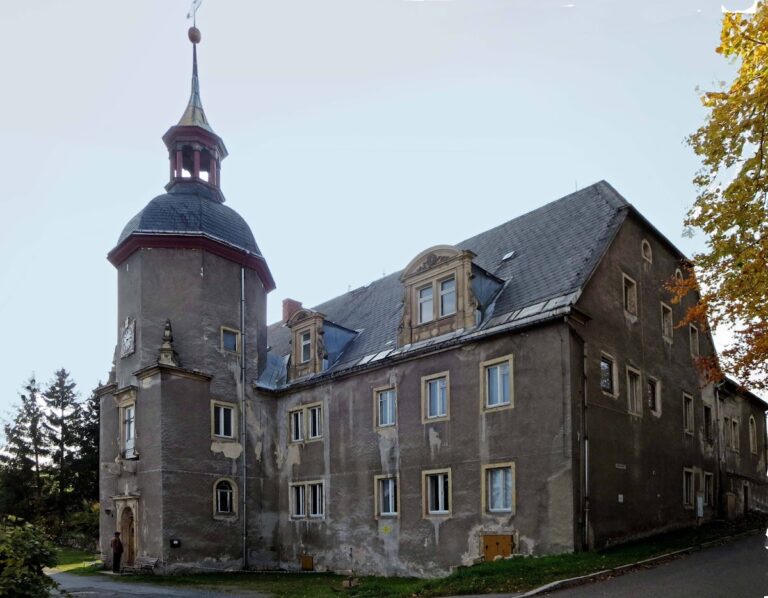
Schloss Reichstädt stands in the centre of Reichstädt, about 20 kilometres south of Dresden. The present complex combines the earlier Renaissance castle with the later Baroque enlargement. The east wing and its round tower preserve visible elements of the 1535 rebuilding. The 1570 survey map shows the earlier arrangement as an accumulation of two-storey buildings surrounded by a water-filled moat.
Between 1765 and 1776, the separate building sections were joined to form a four-wing complex. The castle includes a courtyard, an entrance drive, side wings, an axial approach toward the building, and a garden hall. The western section of the moat was filled in, creating a flowing transition between the castle and the park.
Interiors and courtyard features
The Baroque rebuilding brought elaborate Rococo furnishings and decoration to the interior. Rococo was an eighteenth-century style known for lighter and more ornamental decoration. Restoration work later uncovered valuable Baroque secco paintings, which were painted on dry plaster, together with painted Renaissance wooden-beam ceilings. These discoveries reveal decorative layers from both the Renaissance and Baroque phases of the castle.
A bronze bust of Adam Rudolph von Schönberg stands in the courtyard. It provides a surviving memorial feature associated with the owner responsible for the eighteenth-century transformation of the complex. The stone memorial erected for him in 1858 was removed at a later date.
Park and service grounds
The grounds include the park created during the Baroque transformation, a later section arranged as a rural landscape park, and a service garden southwest of the castle. The filled western moat connects the castle side of the complex with the park, while the entrance drive and axial approach organize the relationship between the building and its grounds.
Nearby sites