Schloss Pyrbaum: A Medieval Castle and Later Palace in Germany


Site at a Glance
- Rating
- 4.8
- Popularity
- Very Low
- Country
- Germany
- Primary era
- Medieval
- Eras represented
- Medieval
- Civilizations
- Holy Roman Empire
- Site type
- Domestic
- Remains
- Palace
On this page7 sections
History
Schloss Pyrbaum is a former medieval castle and palace in Germany, whose surviving remains mark the ancestral seat of the Pyrbaum family and later the Wolfstein family. The palace was built in 1493 on the site of the earlier castle, placing its principal construction in the late medieval period.
Medieval origins
Pyrbaum entered written history in 1130, when the imperial ministerial Durinhard de Birboum appeared in a charter of Weihenstephan Monastery. An imperial ministerial was a member of the medieval service nobility who served the king or emperor in administrative or military roles. The name Pyrbaum derives from the Middle High German word birboum, meaning “pear tree.”
From 1278, Pyrbaum belonged to Albert Rindsmaul de Nurnberch von Grünsberg, who later adopted a name associated with his new possession. In 1292, he donated his patronage rights over the Willibald Chapel at Pyrbaum to Abbess Adelhaid of Seligenporten Monastery. Through the marriage of a Rindsmaul daughter, the estate passed to Albrecht von Wolfstein in 1354.
The Wolfstein lordship
Pyrbaum, together with Niedersulzbürg and Obersulzbürg, remained with the Wolfstein family for approximately four centuries. The imperial immediacy of the Wolfstein lordship was recognized in 1353. This status meant that the territory stood directly under the Holy Roman Empire rather than under an intermediate territorial ruler. In 1354, the lords of Wolfstein were exempted from the jurisdiction of the imperial land court.
In 1493, Wilhelm II von Wolfstein, an imperial court councillor and baron, erected a palace on the site of the earlier castle. The complex retained a fortified character, including a substantial keep shown on Philipp Apian’s 1568 map of Bavaria. In 1602, the Wolfstein lordship was divided. Johann Albrecht received the imperial fief of Pyrbaum, while Hans Adam received Sulzbürg. An imperial fief was territory held from the Empire rather than owned as hereditary property.
Transfer to Bavaria and destruction
The Wolfstein family became extinct in 1740 with the death of Imperial Count Christian Albrecht. Under a right of succession to the fief established in 1562, Pyrbaum passed to the Electorate of Bavaria. After the death of Elector Maximilian III Joseph of Bavaria, who had acquired the Wolfsteins’ immediate imperial fief in 1769, Sulzbürg and Pyrbaum reverted to the Empire.
In 1779, the two territories were placed under the government of Bavaria. In 1806, the Pyrbaum allod was assigned to the Neumarkt district court. An allod was hereditary property held as ownership rather than as a feudal grant. The palace itself was destroyed by arson on 17 August 1853. Michael Flier and his wife, who lived in the palace, were arrested during the fire and taken to Neumarkt as suspected arsonists.
After the fire, the palace was dismantled, and its sandstone blocks were reused in surrounding houses. The former palace is now protected as an architectural monument under Bavarian heritage law. Archaeological findings in the area of the early-modern palace ruins, which had earlier been occupied by a medieval castle, are separately protected as a ground monument.
Remains
Moat and palace foundations
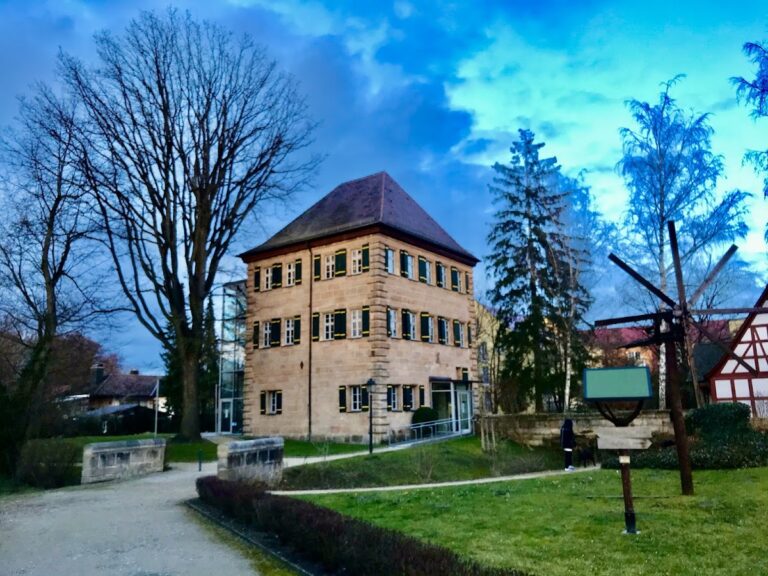
The surviving site preserves the entire moat and its retaining wall, together with remains of the palace foundations. A pond once protected the complex, and a footbridge crossed the water to reach the palace and the church beside it. The main building erected in 1493 had three storeys, a high hipped roof, and four round towers.
A round sandstone foundation belongs to one of the palace’s double-towered gates. A replica of the palace’s foundation inscription also stands at the site, providing physical evidence of the former building and its construction.
Church and later use of the site
The Catholic church Mater Dolorosa, Latin for “Sorrowful Mother,” was built in 1886 on the foundations of the former palace church. It now occupies the Schlossplatz, preserving the religious use of part of the former palace area while the moat, retaining wall, gate foundation, and palace foundations mark the earlier complex.
Nearby sites