Pfinzingschloss: A Nuremberg Patrician Manor House in Feucht, Germany


Site at a Glance
- Rating
- 4.2
- Popularity
- Very Low
- Country
- Germany
- Primary era
- Early Modern
- Eras represented
- Medieval, Early Modern
- Civilizations
- Holy Roman Empire
- Site type
- Domestic
- Remains
- Castle
On this page9 sections
History
Pfinzingschloss, also known as Mornek Castle, is a historic manor house in Feucht, Germany, associated with the patriciate, the hereditary governing elite of Nuremberg. It is one of three surviving castles of the Nuremberg patriciate in Feucht, together with Tucherschloss and Zeidlerschloss. A ministerial seat, meaning the residence and administrative center of a medieval official serving a ruler or ecclesiastical lord, may have stood here as early as the thirteenth century, but the castle is securely known from fifteenth-century records.
The Pfinzing and Waldstromer estates
The Waldstromer family had acquired several Feucht estates during the fourteenth century. For a period, its members held the office of imperial chief forester, an official responsible for administering forests under imperial authority. In 1455, the Nuremberg patrician Ludwig Pfinzing obtained the Feucht properties through his marriage to a member of the Waldstromer family. His estate was recorded in 1469, when he sold his Feucht holdings to Nuremberg, an imperial city with direct political status within the Holy Roman Empire rather than subordination to a territorial prince.
After acquiring the estate, the Nuremberg council sold the manor house to Dr. Sebald Müller, a council consul, or legally trained adviser to the city council. Müller retained the property until his death in 1495. The estate therefore moved quickly between private patrician ownership and the control of the imperial city.
Fire, reconstruction, and the Tetzel building
In 1504, during the War of the Succession of Landshut, a dynastic conflict fought in 1504 and 1505 that affected territories in and around Bavaria, the manor house and the village of Feucht were destroyed by fire. Shortly before 1520, Gabriel Nützel acquired the burnt ruins. He had also inherited the Castle in the Carthusian Pond, but transferred the Pfinzingschloss ruins to Bernhard Glotz.
Rebuilding was underway by 1521, when the property was described as Glotz’s newly built house and manor. In 1530 it passed to the Nuremberg citizen Hanns Pfann and his stepson Christof Mordeisen, and soon afterward to Kaspar Koberger. Koberger experienced a second destruction of the manor on 16 May 1552 during the Second Margrave War, a conflict in the German lands that lasted from 1552 to 1555. In 1557, he asked the Nuremberg council for permission to sell the castle site and its fire-damaged ruins.
The Nuremberg patrician Georg Tetzel, born in 1529, then acquired the property. Following his marriage in 1558, he apparently rebuilt the castle during the next decade. Two coats of arms above the entrance carry the date 1568 and commemorate Tetzel, his first wife Barbara Fütterer, and his second wife Magdalena Pfinzing. The date probably marks the completion of this rebuilding campaign.
Ownership and wartime damage
Tetzel sold the rebuilt castle in 1585 to Anton Pfann and Alexander Rosenthaler, who apparently bought it as a property investment. They sold it the following year to the merchant Eustachius Unterholzer. Unterholzer later bequeathed the castle to his son of the same name. From 1616, ownership passed to his grandson Tobias Unterholzer.
During the Thirty Years’ War, the European conflict of 1618 to 1648, the manor house was repeatedly occupied and looted. Its furnishings were demolished. After Tobias Unterholzer died, guardians acting for his minor son sold the estate in 1650 to Friedrich Otto Freiherr von Herberstein. Herberstein was a Protestant refugee who had been forced to leave his native Carinthia, and his financial position was so difficult that most of the purchase price remained unpaid. Legal disputes followed, and the estate eventually returned to the Unterholzer family.
The imperial city of Nuremberg bought the manor again in 1677, after Eustachius Karl Unterholzer had been unable to find a Nuremberg purchaser. In 1682, the council consul Dr. Christoph Gottlieb Scheurl von Defersdorf took over the property. He remained connected with the estate through a succession of family owners. After his death, ownership passed to Christoph Gottlieb Scheurl the Younger in 1713, to Karl Wilhelm in 1764, and to another Christoph Gottlieb Scheurl von Defersdorf in 1793.
The name Mornek and later private owners
The name Mornek Castle was in use by the eighteenth century, although its origin is uncertain. One tradition attributes it to Georg Tetzel, who supposedly gave the name to his new building. Another holds that a Bohemian merchant named Morne once lived in the castle.
The estate remained with the Scheurl family until Christoph Gottlieb Scheurl died in 1823. It then passed to his daughter, the wife of post-office expeditor David Friedrich Wild, and shortly afterward to their grandson Gottlieb Friedrich Wild. Wild sold the manor to Magdalena Schwemmer in 1847. After several speculative transfers, Georg Konrad and Barbara Elise Schmidt acquired it in 1876.
Their daughter Helena and her husband, Friedrich Scherrbacher, took over the property in 1887 and established a small factory in the castle. Scherrbacher declared bankruptcy around 1900, after which the Nuremberg stucco firm Otto Schier acquired the estate through a forced sale. The firm soon exchanged the manor house for a property in Nuremberg, and numerous further changes of ownership followed.
Hermann Oberth and municipal ownership
The spaceflight pioneer Hermann Oberth acquired Pfinzingschloss in 1943. The castle remained with the Oberth family until 1988. During Hermann Oberth’s lifetime, the ground floor housed a Hermann Oberth Space Museum. In 1988, the market town of Feucht purchased the castle, has owned and used it since then, and immediately began renovation work.
Remains
The manor house
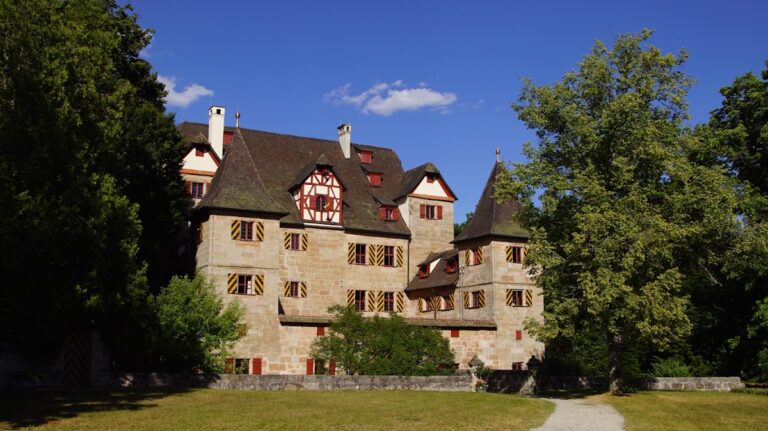
The surviving manor house is the building reconstructed under Georg Tetzel after the mid-sixteenth-century destruction. Its outer walls are made of sandstone ashlar, consisting of regularly dressed blocks laid in courses. The entrance on the inner side of the house carries two coats of arms dated 1568, linking the building to Tetzel and to both of his marriages.
The early modern interior was arranged over several levels. The ground floor contained a large paved hall, a dairy vault, and a fruit vault. Two parlors, two chambers, and a kitchen occupied the first upper floor. The second upper floor held another hall, a large Soller, or upper-floor landing and forecourt giving access to rooms, and two further chambers.
The enclosed courtyard and service buildings
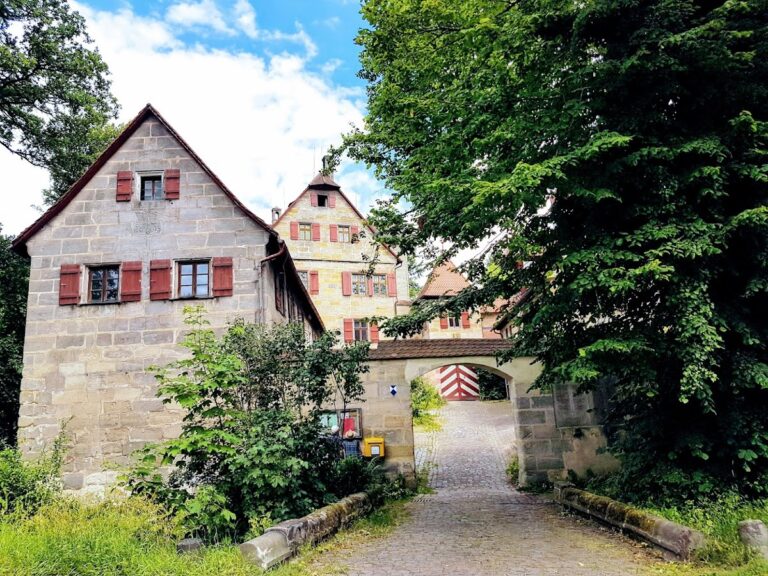
In 1682, the enclosed courtyard contained a one-story gatekeeper’s house, a draw well, a two-story ancillary building with rental apartments, a garden house, the castle barn, and stables. The wider estate also included a gardener’s house, a gatehouse, and various agricultural outbuildings. Together, these structures formed the working setting of the manor around the principal residence.
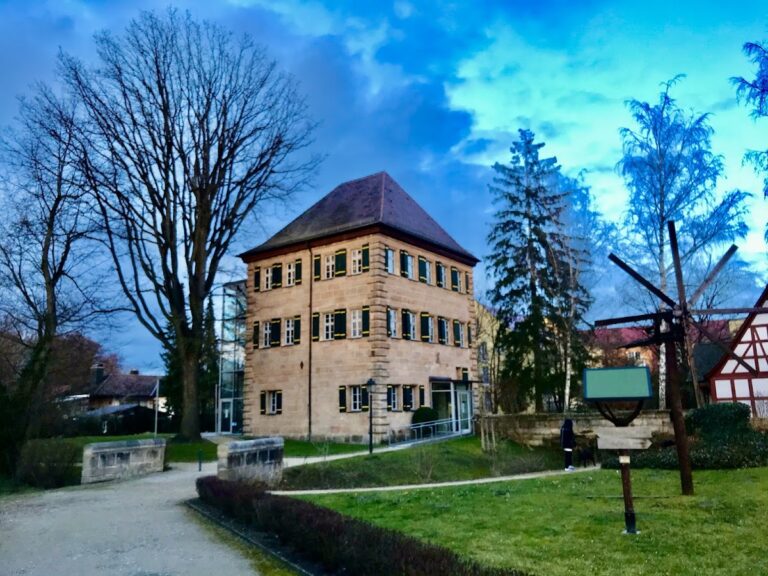
The defensive wall once had a tower beside Steingasse and another at the rear beside the castle meadow. Both towers were demolished in 1682. Two small sheds were erected on their sites in 1712 for storing tobacco and fodder. The ground floor of the castle later accommodated the Hermann Oberth Space Museum before the museum was moved to an outbuilding.
Nearby sites