Schloss Neuhaus: A Medieval Castle and Former Court Seat in Salzburg
Site at a Glance
- Rating
- 4.8
- Popularity
- Very Low
- Country
- Austria
- Primary era
- Medieval
- Eras represented
- Medieval, Modern
- Civilizations
- Holy Roman Empire
- Site type
- Military
- Remains
- Castle
On this page6 sections
History
Schloss Neuhaus is a medieval castle in Salzburg, Austria, probably built at the end of the twelfth or the beginning of the thirteenth century. Its early history is associated with Chunradus de nova domo, identified as Konrad of Neuhaus, who was first recorded in 1219. The castle later became part of the Salzburg archbishopric, an ecclesiastical territorial state ruled by prince-archbishops.
Archiepiscopal possession and administration
Schloss Neuhaus entered the property of the Salzburg archbishopric at the beginning of the fourteenth century. In 1424, during the rule of Archbishop Eberhard III of Neuhaus, it was enlarged into a fortified summer residence. Its role later expanded beyond residence and defense. In 1508, Neuhaus became the seat of a Pfleggericht, a regional administrative and judicial office, and it subsequently also housed a Landgericht, or territorial court.
The castle’s condition affected the operation of these offices. By 1599, the building was so dilapidated that the judge moved to Gnigl. After 1650, Schloss Neuhaus was made usable for the Pfleggericht again. During the Thirty Years’ War, the European conflict fought from 1618 to 1648 through religious, dynastic, and territorial struggles, the castle helped defend Salzburg and its surrounding area together with the Gnigl redoubt, a fortified defensive position, and the Franziskischlössl.
Fire, jurisdiction, and private ownership
In 1695, lightning caused a fire that severely damaged the castle, forcing the court to relocate once more. Shortly before the end of the Salzburg archbishopric, the Neuhaus administrative and territorial court district included the Hofmark of Gnigl, the districts of Heuberg, Bergheim, Hallwang, and Eugendorf, the Chiemsee princely free court of Koppel, and the Reling baronial estate of Ursprung. Its jurisdiction extended over the parish of Bergheim, the Gnigl parish curacy, and the vicariates of Eugendorf, Hallwang, and Koppel.
Oswald Count Thun first rented Schloss Neuhaus in 1796 and acquired it in 1811. From 1851, additions in a neo-Gothic historicist style were made during his ownership. In 1921, Wolfgang Baron von Thienen-Adlerflycht received the castle as a wedding gift when he married Anna Countess von Thun. The property was soon purchased by his relative Adolf Count Dubsky, the half-brother of the Austrian writer Marie von Ebner-Eschenbach, born Countess Dubsky, who was frequently a guest at Schloss Neuhaus.
The painter and collector Ante Topić Mimara acquired the castle in 1963. During the Topić Mimara family’s private ownership, its gallery housed contemporary art. Schloss Neuhaus is now privately owned by the German industrialist Hubertus Benteler and serves as a private residence. It is protected as a historic monument.
Remains
Defensive setting and enclosure
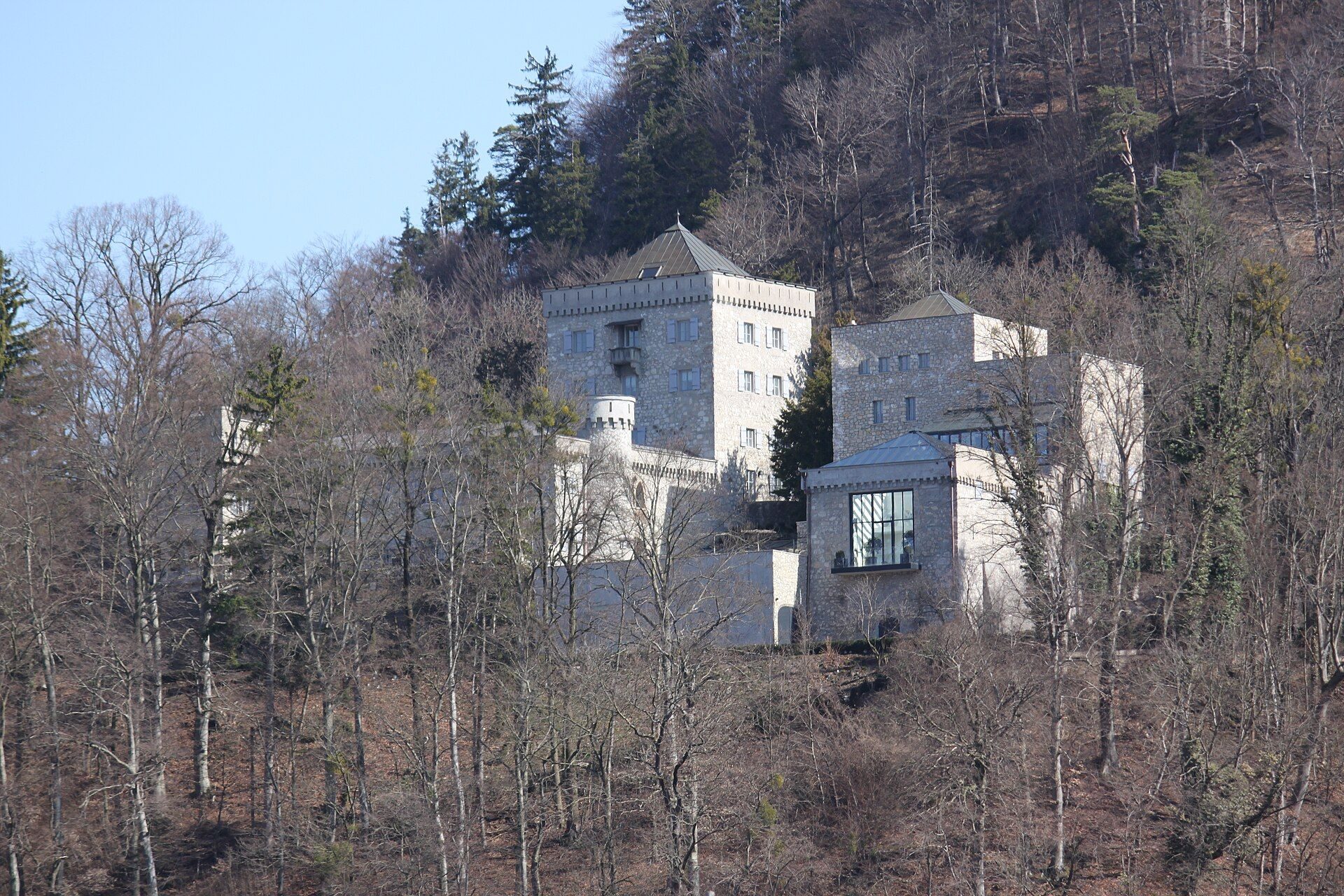
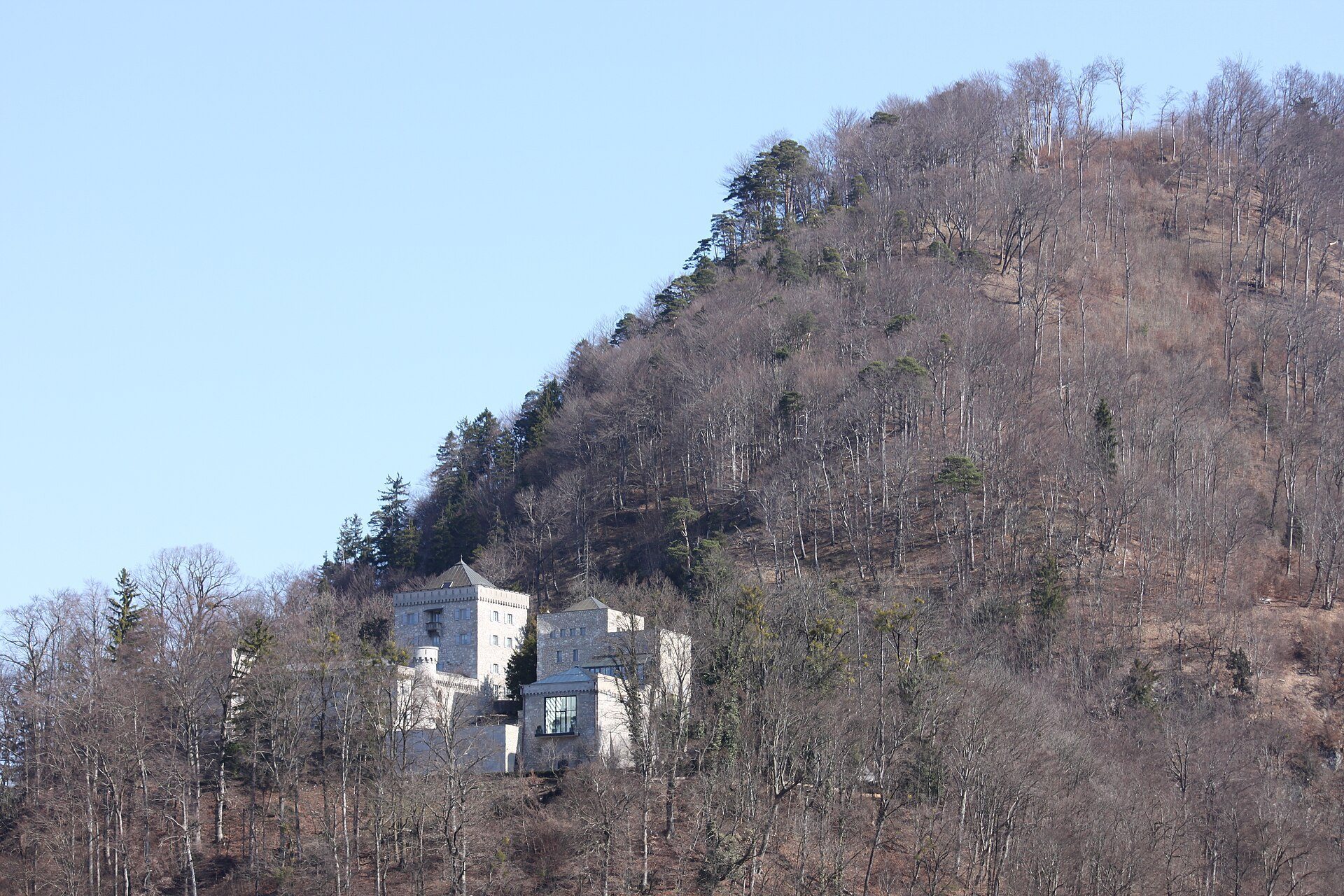
Schloss Neuhaus stands on the Kühberg in Salzburg’s Gnigl district. Together with the Gnigl redoubt, it once formed part of a defensive system extending along the line of the present Neuhauserstrasse toward the Kapuzinerberg and the city of Salzburg. The complex is entered from the south and consists of a massive residential tower, an elongated residential building, and a former servants’ wing enclosed by a fortified perimeter wall. Oswald Count Thun gave the enclosure a crenellated crown in the nineteenth century, a parapet formed by regularly spaced raised sections and openings.
Medieval tower and later fabric
The old residential tower dates from the thirteenth century and was raised to five storeys after 1400. Its nineteenth-century crenellated crown complements that of the surrounding enclosure. The five-storey medieval tower remains the central element of the complex, alongside an ancillary building, a modern new building, and a utility building. Many of the historicist additions made in the nineteenth century were removed several decades ago.
A marble slab in the courtyard, positioned above the door to the stairwell, came from the former Einöd farmstead in Morzg. It depicts an angel holding the coat of arms of Count Johann Ernst von Thun, linking a surviving architectural detail with the later history of the castle’s owners.