Schloss Moos: A Moated Renaissance Castle in Germany


Site at a Glance
- Rating
- 4.3
- Popularity
- Very Low
- Country
- Germany
- Primary era
- Early Modern
- Eras represented
- Medieval, Early Modern
- Civilizations
- Duchy of Bavaria, Holy Roman Empire
- Site type
- Domestic
- Remains
- Castle
On this page8 sections
History
Schloss Moos is a moated castle in the village of Moos, Germany, whose present form is a substantial four-wing Renaissance building. The site was first documented in 1207, when Ebo de Palude appeared in the retinue of the Counts of Bogen, a medieval Bavarian comital dynasty. The brothers Ebo were recorded again in 1209. Altmann of Helingersperge, identified with Hengersberg, appeared alongside them in both documents, and the recurrence of the name Altmann among the knights of Moos has been understood as possible evidence of a family connection.
Medieval ownership and rebuilding
In 1270, Abbot Hermann of Niederaltaich Abbey acquired the Moos property through an exchange with Heinrich Gestl of Moos. Niederaltaich Abbey was a Benedictine monastery that held the property as a feudal lord during the medieval period. The abbot demolished the castle then standing at Moos. Ebo and Marquard of Moos received the property back as a fief in 1273, but did not plan to rebuild the castle.
The property later passed to Berthold of Kallenberg, whose family belonged to the ministerials of the Counts of Bogen. Ministerials were high-status dependants who served rulers or ecclesiastical lords in military and administrative roles. In 1340, Berthold sold Moos to his cousin Dietrich of Aichberg. The Aichbergs held the property as vassals of the monastery and rebuilt the castle in 1377. Their rule at Moos continued until 1511.
War, fire, and the Preysing lordship
In early summer 1504, Palatine troops devastated the castle and village during the War of the Landshut Succession, a conflict of 1504 to 1505 over the inheritance of the Duchy of Bavaria-Landshut. When Hans of Aichberg, the last of his family at Moos, died heavily indebted in 1511, his son-in-law Ulrich II of Ortenburg inherited the property. Ulrich sold it in 1520 to his principal creditor, Katharina of Knöring of Adldorf, a burgher’s daughter from Braunau.
Katharina rebuilt the complex and gave the castle four towers. The property then passed to her cousin Stephan Trainer, a member of a Regensburg patrician family who served as a ducal chamber councillor and rentmaster of Landshut. After his death, his daughter Anna inherited Moos. Her marriage to Johann Albrecht of Preysing brought the property to the Preysing family in 1567. After Johann Albrecht died, his widow administered the lordship until her death in 1606. In the preceding year, she had transferred the estate to her younger son, Johann Warmund.
Johann Warmund studied at the University of Dillingen and at Italian universities before becoming chief court steward to Duke Maximilian of Bavaria. A chief court steward oversaw a ruler’s household and court. In 1606, the duke appointed Johann Warmund administrator of the Vilshofen district court, and in 1628 he made him Vitztum in Straubing, a senior territorial official acting on behalf of a ruler. Emperor Ferdinand III raised him to the rank of Imperial Count in 1645.
On 15 May 1619, fire destroyed half of the complex, including St. George’s Chapel. Johann Warmund of Preysing, who lived from 1567 to 1648, had the castle rebuilt by 1635 and added another storey. The surrounding service and agricultural buildings were newly constructed during the same rebuilding phase. Swedish forces devastated the property again in 1648 during the Thirty Years’ War, the major European conflict fought from 1618 to 1648. Afterward, the formerly fortified complex was converted into a manorial residence. Moos was also seriously affected during the War of the Austrian Succession.
Estate expansion and later inheritance
Under Count Ernst Kaspar, who lived from 1767 to 1836, the estate was rebuilt and expanded. A horse stud was established, the Preysing brewery was moved from Aholming to Moos, and a new farm building was erected. After Ernst Kaspar’s death, his brother Count Maximilian of Preysing-Moos inherited the property, but died 23 days after taking possession. Moos then passed to Count Maximilian of Preysing from the Lichtenegg line.
The estate’s agricultural operations and brewery were leased out and returned to direct management only in 1881, after the property had passed to Count Konrad, the son of the Lichtenegg heir. Kaspar, Count of Preysing-Lichtenegg-Moos, the last male member of the Preysing family and heir to the estate, died in 1940 at the age of 21. His sister, Countess Theresia of Preysing-Lichtenegg-Moos, married Count Ludwig of Arco-Zinneberg in the same year. Schloss Moos has belonged to his family since then.
Schloss Moos is protected as an architectural monument. It is also recognized as an archaeological monument because medieval and early-modern remains survive underground in the area of the castle and St. George’s Chapel.
Remains
Castle complex
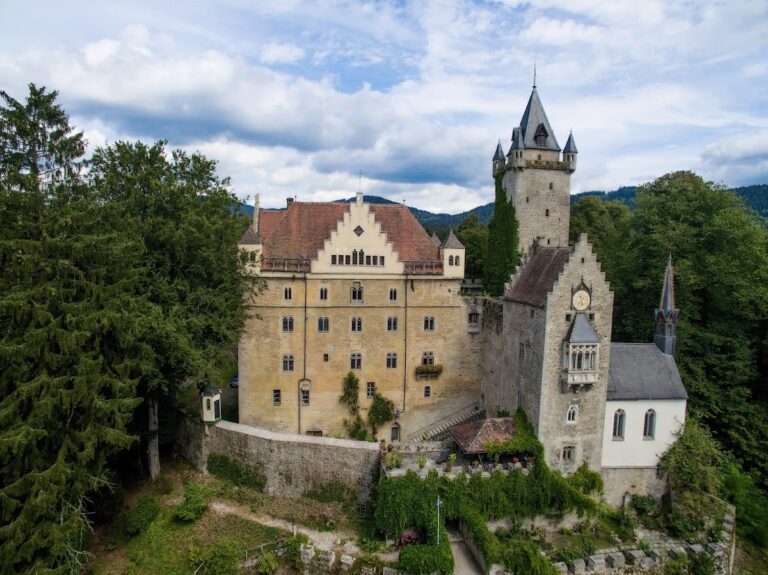
Schloss Moos is a moated complex formed by four wings arranged around an arcaded courtyard. An arcaded courtyard is enclosed by a series of arches carried on columns or piers. The four towers belong to the rebuilding associated with Katharina of Knöring, while the castle’s later form reflects Johann Warmund of Preysing’s reconstruction, completed by 1635, when another storey was added. The complex therefore preserves the physical development of a fortified medieval property into a Renaissance manorial residence.
Chapel and estate buildings
St. George’s Chapel is associated with the castle and formed part of the section destroyed by the fire of 1619. The surrounding service and agricultural buildings were newly constructed during Johann Warmund’s rebuilding of the estate, which was completed by 1635. A later farm building was added during the rebuilding and expansion carried out under Count Ernst Kaspar.
Garden and archaeological remains
An English landscape garden was laid out beside the castle around 1789. Beneath the ground in the area of Schloss Moos and St. George’s Chapel are archaeological remains from the medieval and early-modern periods, preserving evidence of the site’s earlier phases and successive transformations.
Nearby sites