Château d’Uzès: A Fortified Ducal Castle in France


Site at a Glance
- Rating
- 4.2
- Popularity
- Medium
- Country
- France
- Primary era
- Medieval
- External website
- Open
- Eras represented
- Medieval, Early Modern
- Civilizations
- French
- Site type
- Military
- Remains
- Castle
On this page12 sections
History
Roman and feudal foundations
Château d’Uzès is a fortified castle in Uzès, France, whose medieval development began in the eleventh century on the site of a Roman military camp. The Roman castrum, a fortified military settlement, stood on the highest point of Uzès, then known as Ucetia, in the territory of the Gallic Volcae Arecomici, whose lands lay in the region later associated with southern France.
The lordship of Uzès was established in the eleventh century, at the beginning of feudalism, by Elzéart d’Uzès, regarded as its first lord. The fortified town and castle were built over the earlier Roman site. Construction and remodelling continued from the eleventh through the sixteenth century, while the castle initially served a military purpose.
The medieval keep and ducal transformation
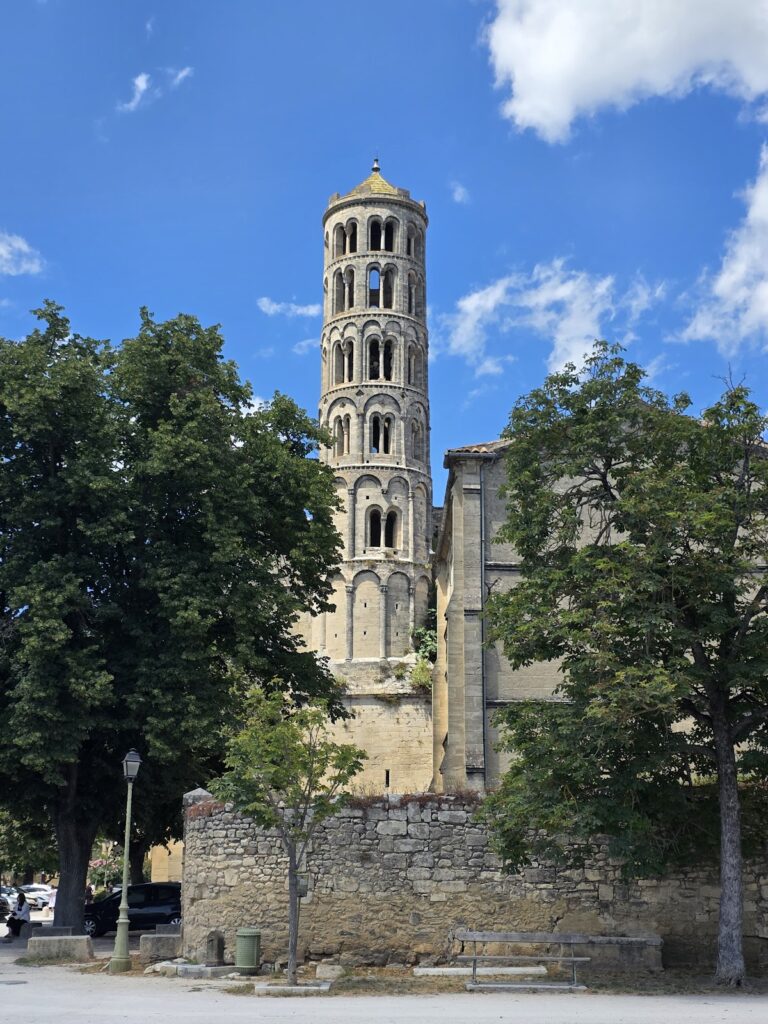
In the twelfth century, Bermond I of Uzès built the 42-metre keep known as the Bermonde Tower, or Duchy Tower. It represents the ducal power in Uzès’ alignment of three medieval tower-strongholds associated with royal, episcopal, and ducal authority.
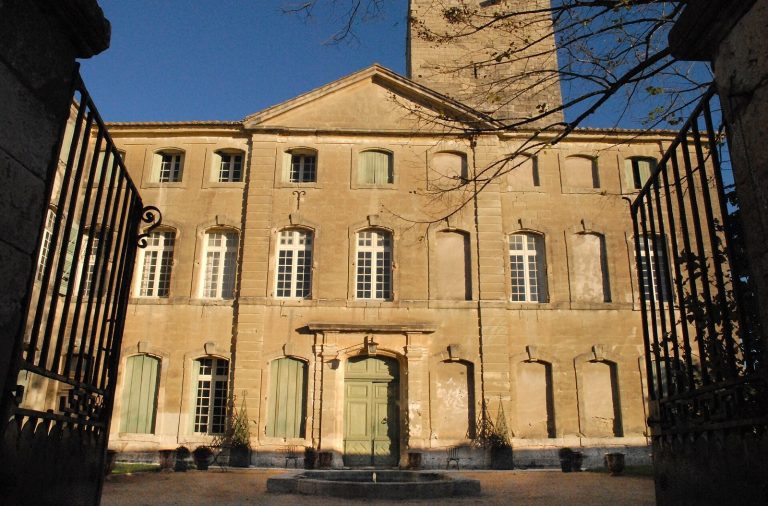
The complex later changed from a primarily military stronghold into a seigneurial and ducal residence. Its residence acquired a sixteenth-century Renaissance façade, while a chapel was added in the flamboyant Gothic style, a late Gothic form known for elaborate ornament and flame-like tracery.
Religion and the Duchy of Uzès
In 1565, King Charles IX raised Uzès to a duchy and appointed the Protestant viscount Antoine de Crussol as its first duke. A duke and peer of France held a high-ranking noble title, while a peer belonged to the kingdom’s senior hereditary nobility. Antoine de Crussol, of the House of Crussol, sought to reconcile Catholics and Protestants in southern France. He became Duke and Peer of France in February 1572 and later converted to Catholicism.
Religious conflict strongly affected Uzès. In 1566, Jehan II de Saint-Gelais, Bishop of Uzès, converted the Diocese of Uzès, the territory governed by the bishop, to Protestantism. The largely Protestant city supported the Reformation and was severely affected by the French Wars of Religion.
Revolution, recovery, and restoration
During the French Revolution, the castle was sold as national property and converted into a college. Marie-François-Emmanuel de Crussol, the tenth Duke of Uzès, bought it back in 1824 during the Second Restoration, the period from 1815 to 1830 when the Bourbon monarchy returned after Napoleon’s defeat. Financial difficulties among his successors led to the castle being converted into a college again.
The Marquise de Crussol began major restoration work in 1951 and bought the castle from her nephew Emmanuel Jacques, the fifteenth Duke of Uzès, in 1957. In the early 1960s, she appealed to André Malraux, then Minister of Cultural Affairs. The 1962 Malraux Law, a French heritage measure that enabled specially protected historic urban sectors, led to the creation of a protected sector around the castle and in Uzès in 1965.
Château d’Uzès is privately owned by Jacques-Emmanuel de Crussol d’Uzès, the seventeenth Duke of Uzès, and Alessandra de Crussol d’Uzès. Part of the castle has held the French monument historique designation, a legal protection for historic buildings and sites, since 1889, and the property has also been listed under that designation since 1934. Together with the medieval town, it forms part of a protected area established in 1978. Uzès received Town of Art and History designation in 2008.
Remains
Fortified complex
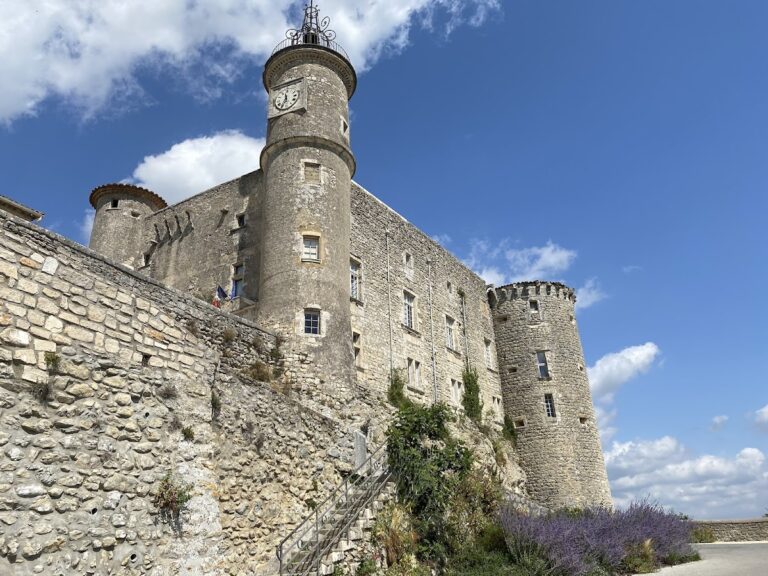
Château d’Uzès survives as a medieval fortified complex with ramparts, corner towers, the Bermonde Tower, a seigneurial residence, cellars, and a chapel. These elements belong to a site that was repeatedly remodelled from its eleventh-century foundation through later medieval and Renaissance phases.
Principal buildings
Bermonde Tower
The Bermonde Tower is a 42-metre-high keep built in the twelfth century. Also called the Duchy Tower, it is the ducal tower within Uzès’ group of three medieval tower-strongholds representing royal, episcopal, and ducal power.
Seigneurial residence
The seigneurial residence has a Renaissance façade dating from the sixteenth century. It expresses the transformation of the complex from a military stronghold into a residence for the lord and, later, the duke of Uzès.
Castle chapel
The chapel was built in the sixteenth century in the flamboyant Gothic style. Its roof is covered with glazed Burgundy tiles carrying the coat of arms of Antoine de Crussol, the first Duke of Uzès and a member of the House of Crussol.
Cellars
The castle also contains cellars described as a thousand years old. They form part of the surviving architectural complex alongside the ramparts, corner towers, residence, keep, and chapel.