Schloss Leonsberg: A Medieval Castle and Bavarian Palace in Germany


Site at a Glance
- Rating
- 4.6
- Popularity
- Low
- Country
- Germany
- Primary era
- Early Modern
- External website
- Open
- Eras represented
- Medieval, Early Modern
- Civilizations
- Duchy of Bavaria, Holy Roman Empire
- Site type
- Military
- Remains
- Castle
On this page8 sections
History
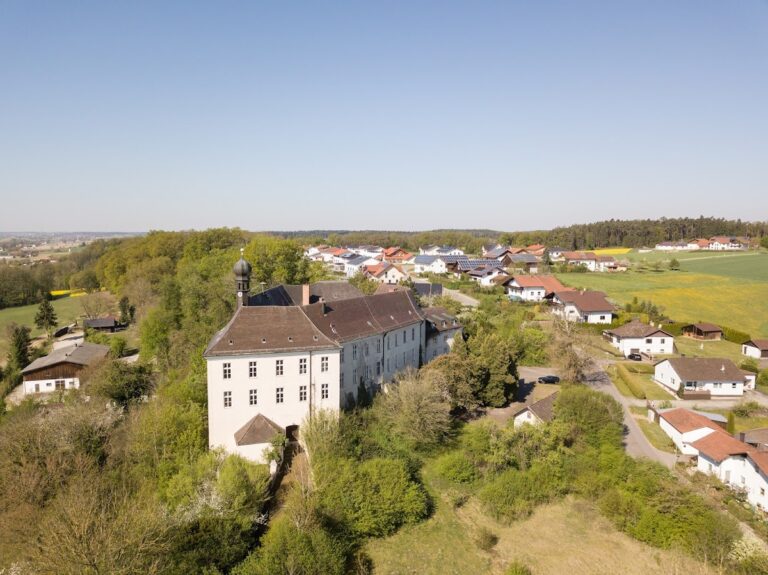
Schloss Leonsberg is a former castle and palace complex in Germany, located at Leonsberg in the market town of Pilsting, Lower Bavaria. Established by the Counts of Leonberg as the centre of their county, the site developed from the medieval period into a Bavarian administrative residence, hunting palace, and church complex. Its surviving structures and buried remains preserve evidence of the site’s medieval and early-modern history.
The Counts of Leonberg
During the eleventh and twelfth centuries, the Lords of Zulling controlled extensive possessions in the Dungau region. After the family died out in 1202, much of this property passed to the Counts of Altendorfer, who later adopted the name Counts of Leonberg. Their ancestral seat was Leonberg Castle near Marktl, while their holdings also included Altendorf in the Upper Palatinate.
The Counts of Leonberg established Leonsberg Castle on the northern edge of the Isar lowlands as the administrative centre of the County of Leonberg. The family also supported important religious foundations. Count Wernhard of Leonsberg founded a Teutonic Order commandery at Gangkofen in 1278. This was an administrative and religious establishment of the Catholic military-religious Teutonic Order. In 1296, Count Berengar of Leonsberg founded Niederviehbach Abbey, a monastery governed by an abbot or abbess.
The Counts of Leonberg became extinct in 1329 after the death of Count Heinrich VII. Their possessions then passed to the Counts of Hals and to the Wittelsbachs, the ruling dynasty of Bavaria.
Administrative seat and destruction in war
In 1437, Dukes Ernst and Albrecht III acquired the castle. They initially used it as an official and residential seat for judges and administrative officials of the Leonsberg district court. The site was burned in 1504 by Palatine and Bohemian mercenaries during the Landshut War of Succession, a Bavarian dynastic conflict fought in 1504 and 1505 against the forces of Duke Albrecht IV.
Duke Ludwig X of Lower Bavaria ordered the castle’s reconstruction in 1535 and 1536. The Church of the Assumption of Mary was established on the site of the former St. Pancratius Chapel. The rebuilt palace later served the Bavarian dukes as a pleasure and hunting residence, particularly for heron, deer, and wild-boar hunting in the Königsauer Moos of the lower Isar valley. Duke Maximilian I hunted herons there in 1597, and Elector Maximilian II Emanuel returned for the same purpose in 1683 and on later occasions.
Swedish and French troops severely damaged and plundered the castle in 1632 and 1648 during the Thirty Years’ War, the major European conflict of 1618 to 1648. The complex was provisionally rebuilt in 1654 and had regained its earlier fabric by the beginning of the eighteenth century. Its appearance at that time is shown in an engraving by Michael Wening, a Bavarian engraver known for depicting towns, castles, and landscapes.
Demolition and later preservation
After a fire badly affected the citizens of Pilsting in 1789, they were allowed to dismantle the castle for building materials. The Church of the Assumption of Mary was excluded from this permission. The former castle and palace complex was therefore largely demolished during the eighteenth century.
The castle and palace site is now protected as both an architectural monument and an archaeological monument, with underground medieval and early-modern remains forming part of its historical record. The surviving tower was restored between 1994 and 1997. A present-day inn on Castle Hill, the Leonsberg Castle Inn, uses the former palace’s cellar vaults.
Remains
The former castle and palace complex occupied a pear-shaped plateau measuring about 20 by 25 metres, with a terrace of approximately 40 by 30 metres below it. Most of the complex survives as an archaeological site, while several structural elements remain above ground. These include parts of the late-medieval fortifications, the church and integrated tower, the cellar complex beneath the palace, and a well.
Church and castle tower
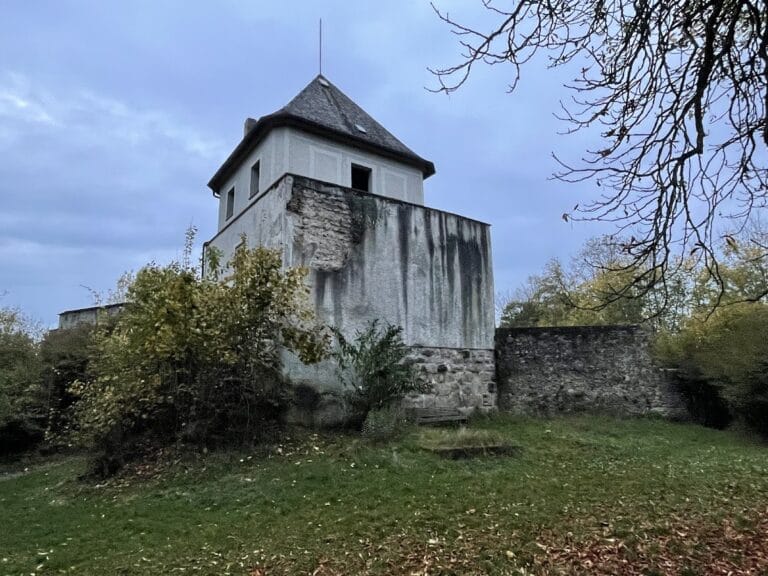
On the eastern side of the site, a late-medieval castle tower remains integrated into the Church of the Assumption of Mary. The tower is capped by an onion dome, a rounded roof form that narrows toward its apex. The church was built in 1535 and 1536, replacing the earlier St. Pancratius Chapel established on the castle site. The tower was restored between 1994 and 1997.
Fortifications and water supply
Sections of the late-medieval perimeter walls survive at the site. A well, also dated to the late Middle Ages, remains as part of the castle’s physical fabric. Together with the tower, these elements preserve parts of the defensive and practical infrastructure associated with the earlier castle.
Palace cellar and hunting buildings
A multi-part cellar complex survives beneath the former palace. Its chambers contain brick-built barrel vaults, which are continuous curved ceilings extending over the rooms. The vaults remain in use by the Leonsberg Castle Inn. The rebuilding of the castle used 500,000 bricks supplied by the Munich rent office, an early-modern Bavarian administrative and financial office. The sixteenth-century cartographer and topographer Philipp Apian recorded that some of these bricks came from Wolfstein.
The complex also included a hunting house, a dog stable, and a dog yard constructed around 1580. These buildings belonged to the palace’s later use as a Bavarian hunting residence in the lower Isar valley.
Nearby sites