Schloss Kirchberg an der Raab: A Baroque Palace in Austria


Site at a Glance
- Rating
- 4.3
- Popularity
- Very Low
- Country
- Austria
- Primary era
- Early Modern
- Eras represented
- Early Modern
- Civilizations
- Habsburg
- Site type
- Domestic
- Remains
- Palace
On this page8 sections
History
Medieval Estate and Fortification
Schloss Kirchberg an der Raab is a historic palace in Austria that developed from a free estate first mentioned in a foundation charter of 1394. The charter does not name its owner. Between 1414 and 1426, the property belonged to Count Hans von Steinpeiss, a member of a Lower Austrian noble family.
An earlier small fortification was destroyed during fifteenth-century feuds and wars involving Ottoman and Hungarian forces. In the late sixteenth century, the Zöbinger family expanded the site. Under Christoph Zöbinger, a larger defensive complex was built and linked to the church’s Tabor, a fortified refuge intended to protect local inhabitants during attacks.
The Zöbinger and Steinpeiss Periods
In 1605, during an incursion by the Hajduks into eastern Styria, the castle was plundered by poorly paid imperial troops who had been deployed against them. The Hajduks were irregular military forces active in east-central Europe, and their incursions formed part of the regional conflict affecting the area.
Seventeenth-century references connect the property with Burg Oberkirchberg and Stock Unterkirchberg. Financial difficulties led the Zöbingers to permit the upper seat at Kirchperg to be pawned in 1640. Georg Christof von Steinpeiss bought it back in 1669.
The Baroque Palace
Field Marshal Count Sigbert Heister acquired the lordship of Kirchberg an der Raab from the Steinpeiss family in 1696. A manorial lordship was an estate whose holder exercised landholding and jurisdictional rights. In 1704, Heister commissioned Italian builders to erect the present palace on the site of the former Tabor. The building belongs to the Baroque period, a European artistic and architectural style that flourished especially during the seventeenth and eighteenth centuries.
After the property passed to the Counts of Katzianer, it was auctioned in 1821 and acquired by Prince Johann I Josef of Liechtenstein. The House of Liechtenstein was the princely dynasty that ruled the principality of Liechtenstein and held extensive estates in the Habsburg lands.
Twentieth-Century Changes
Alois Lenz bought the palace in 1921 and planned to establish a sanatorium there, but the project was not realized. The property later entered municipal ownership and was used as a school. Wolfgang Fikentscher purchased the building in 1955.
In 1967, Elisabeth Haugeneder-Koschatzky acquired the severely neglected palace and carried out a comprehensive renovation. A further renovation followed in 1972, and the property is now owned by her daughter, Marie Therese Herberstein. The Austrian author and monument conservator Georg Clam Martinic described Schloss Kirchberg as one of the most beautiful Baroque palaces in Styria.
Remains
Palace Layout
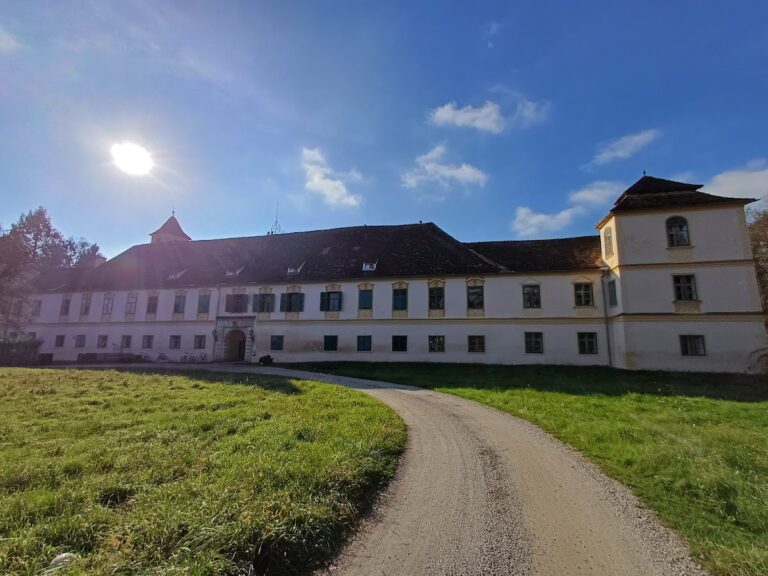
The surviving palace is an elongated, two-storey building arranged in a horseshoe shape, with projecting sections at the centre. Its original layout was considerably more extensive. A reception courtyard was enclosed by two side wings and the main residential block, while the wider complex contained four towers, bastions, gardens, and ponds. Only the central tract now conveys the scale of this former arrangement.
Interior Decoration
Inside the palace, frescoes and stucco decoration survive as elements of its Baroque character. The principal hall contains paintings on stucco and decorated ceilings. The paintings were overpainted during the twentieth century, altering the appearance of the interior while leaving the decorative scheme as part of the building’s surviving fabric.