Schloss Kewenig: A Moated Castle and Manor House in Germany


Site at a Glance
- Rating
- 4.7
- Popularity
- Low
- Country
- Germany
- Primary era
- Modern
- External website
- Open
- Eras represented
- Early Modern, Modern
- Civilizations
- Duchy of Luxembourg, German, Holy Roman Empire, Kingdom of Prussia
- Site type
- Domestic
- Remains
- Castle
On this page8 sections
History
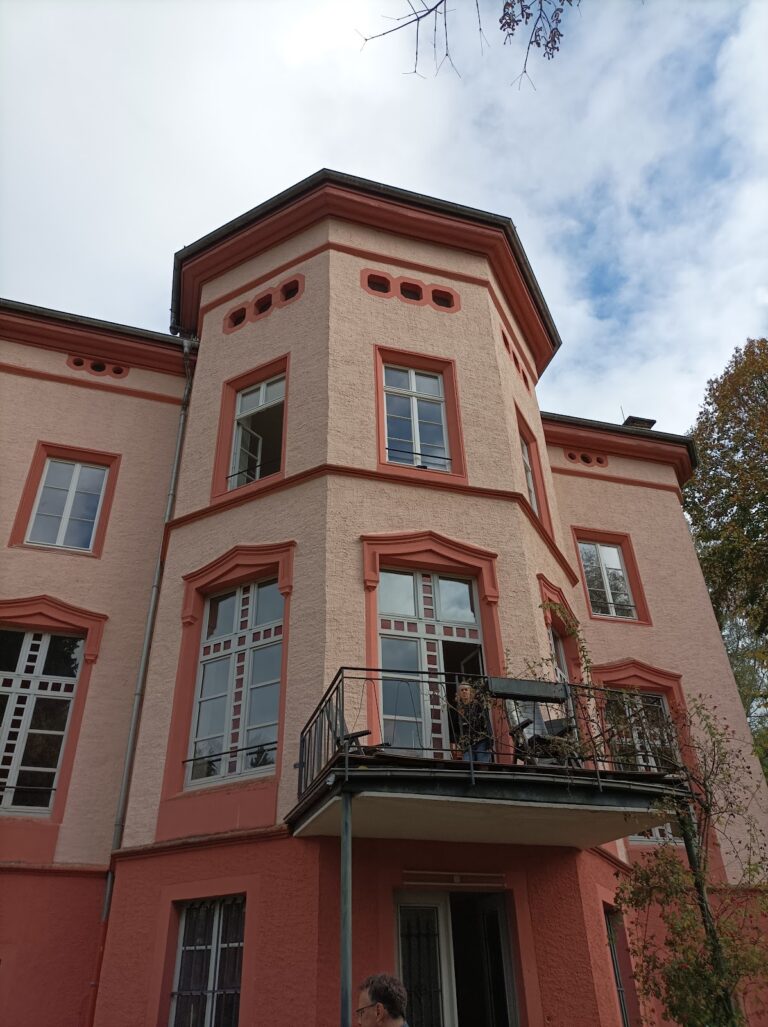
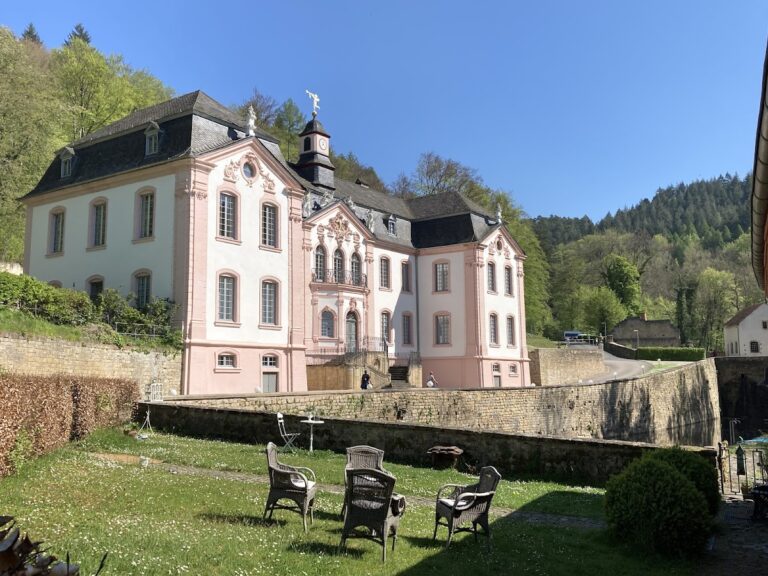
Schloss Kewenig is a manor house in Germany that incorporates a sixteenth-century moated castle and was transformed into its present château during the nineteenth century. The settlement was first mentioned in 1231 as “Chewingen,” when vassals of Theoderich, Lord of Malberg, received permission to sell land to Echternach Abbey, a historic Benedictine abbey in present-day Luxembourg.
Ownership before the nineteenth century
Kewenig Castle was largely spared the wars and destruction that affected many estates in the surrounding region. Friedrich von Herverdingen was recorded as an owner in 1556, after which the estate remained for several centuries with the aristocratic von Stein family.
The last von Stein heiress had no children with her husband, Peter Franz Hagen. She named the lord of d’Olimart of Bettendorf on the Sauer as her heir. His son later sold Kewenig Castle to Jean Joseph Richard, Lord of Niedersgegen and Falkenstein, for 29,000 francs, a sum also given as 7,733 thalers.
The estate had formerly included a chapel. By 1738, however, the building had deteriorated so badly that Mass could no longer be celebrated there. Around 1850, the castle itself was no longer inhabited and was threatened by decay.
Transformation into a château
After the Richard family acquired Kewenig, the original moated castle was expanded into the château seen today. Adolf Richard added a short Neo-Gothic wing in 1848. Neo-Gothic, also called Gothic Revival, was a nineteenth-century style that revived medieval forms such as towers, pointed openings, and crenellations.
In 1880, M. G. August Flamm acquired the estate. Between 1890 and 1891, he extensively rebuilt the older section, enlarged it toward the west, added a second upper storey, and laid out a surrounding park. The Flamm family continued to live at Kewenig into the twentieth century. The grave of the last Flamm owner is in the cemetery at Kruchten.
Legal status and modern preservation
In 1830, Kewenig was entered in the register of knightly estates as a landed aristocratic estate whose owner held specified political and tax privileges, including representation in the provincial assembly. Its principal land tax was recorded as 72 thalers.
Since 2012, the Weyrich family has carried out renovation and continuing maintenance at the castle. A fire in an adjoining building during the night of 11 August 2013 caused extensive property damage. The restored castle and parts of its ancillary buildings are now available for rental for various events.
Remains
Castle core and nineteenth-century additions
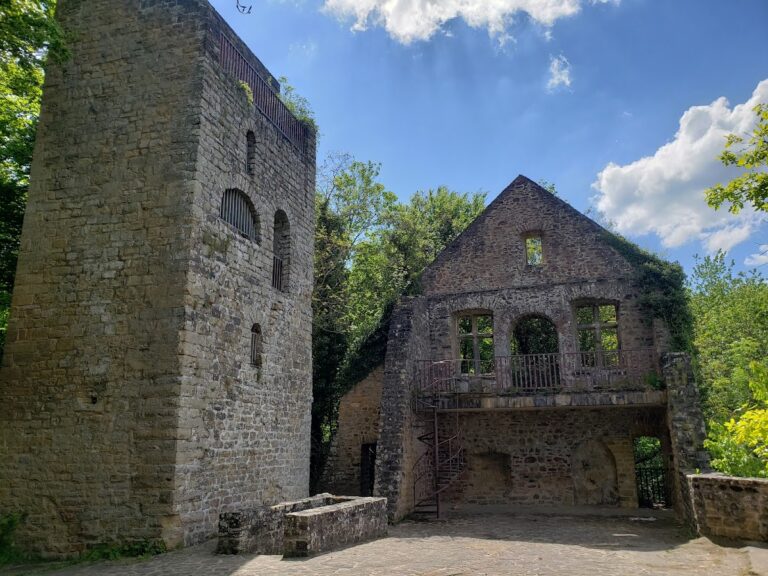
The surviving complex is organized around a nearly square sixteenth-century core. At its center is a donjon, the principal fortified tower or keep, with four round corner towers. The basic ground plan has remained unchanged. The older section retains corner towers and a round-arched frieze, while the second upper storey, the finish along the wall tops, and the tower crenellations belong to the nineteenth-century rebuilding.
Two Gothic-style wings extend the complex. The eastern wing began in 1848, and a second, larger section was constructed from 1890. This later addition received two further round towers. The flat hipped roof and the windows also date from the nineteenth century, as do the adjoining service yard and the open grounds around the main building.
Interior and surviving furnishings
Few nineteenth-century interior elements survive, although the castle retains a Neo-Gothic stair hall. Until 1927, it housed a small collection of eighteenth-century furniture and wooden figures. The collection included a 50-centimetre figure of a holy priest, a 90-centimetre figure of Christ as the Man of Sorrows from the private chapel at Daudistel near Neuerburg, a 78-centimetre figure of a holy knight carrying an eagle and lance from the old church at Kruchten, and a carefully executed figure of the Immaculate Madonna from Paschel. The Man of Sorrows is a Christian image of Christ focused on his suffering, while the Immaculate Madonna represents the Virgin Mary in connection with the doctrine of her Immaculate Conception.
Sixteenth-century fireplace
A stone fireplace dated 1559 came from Neuerburg Castle and was moved to Kewenig in 1912. Its supports have a simple hollow-moulded profile and large stylized flowers on their straight-cut fronts. The 14-centimetre-thick fireplace front rests on the supports with notched corners and carries a large double coat of arms. The painted shields are no longer legible.
The fireplace retained decoration in black, green, yellow, and red until 1927. Beside the heraldic alliance shield, which combines the arms of two related or allied families, an inscription gives the date 1559. A second inscription on the mantelpiece reflects on the transience of ashes and the divinity of virtue.
Nearby sites