Schloss Hohenwarth: A Former Hofmark Seat in Bavaria

Site at a Glance
- Rating
- 4.8
- Popularity
- Very Low
- Country
- Germany
- Primary era
- Early Modern
- Eras represented
- Medieval, Early Modern
- Civilizations
- Holy Roman Empire
- Site type
- Domestic
- Remains
- Castle
On this page9 sections
History
Schloss Hohenwarth is a historic castle complex in Hohenwarth, Germany, whose present form dates chiefly from the seventeenth century. It developed within a medieval lordship associated with the Hohenwarth family and later became the seat of a Hofmark, a territorial lordship whose holder exercised specified local administrative and judicial rights under a superior authority. Earlier structures and building phases occupied the former castle area.
Medieval Lords of Hohenwarth
The name Hohenwarth appears in the late twelfth century among the ministeriales of the Margraves of Cham. These were members of the medieval service nobility who served higher-ranking lords or ecclesiastical institutions in administrative, military, or courtly roles. Around 1180, Meginhard and his brother Konrad of Hohenwarth were named in a charter of Reichenbach Monastery concerning an exchange of property. A family with the same name appearing in Kötzting at that time was probably a branch of the Hohenwarth family. Meginhard and Konrad also sometimes used the names Kötzting and Dangelsdorf.
Pertoldus de Hohenwarte appears in records from 1205 and 1221 and was related to the family of Grafenwiesen. Members of the Hohenwarth family later became provosts of Rott Monastery. The family held Hohenwarth until the first half of the fifteenth century. Hans Hohenwarter, regarded as its last member, died in 1418. Andre Zennger was already associated with Hohenwarth in 1409, while members of the Hohenwarth family were present at Schloss Grafenwiesen in the early fifteenth century, suggesting that they had lost their ancestral castle at Hohenwarth by then.
Fief and Hofmark
In 1414, the abbot of Rott granted the fortress of Hohenwarth as a fief to Wigileis von Hoff, who died in 1455. Hans Poyßl of Miltach held the fief in 1432, and Barbara Lämmlin received it in 1455. By the late fifteenth century, Hohenwarth was a Hofmark held by the Notthafft von Wernberg family of Runding. The Notthafft family freed Hohenwarth from Rott’s feudal authority and obtained it as free property.
Ludwig von Eyb acquired the indebted Hofmark and additional Notthafft properties in 1549. During his ownership, the old church serving as the castle chapel was built in 1589. The Eyb period also preceded the construction of a later castle near the older fortress site.
Seventeenth-Century Rebuilding
On 8 October 1612, Rott’s abbot granted Hohenwarth as a fief to Hans Sigmund Kädinger of Schönhöring, who had purchased it from the Eybs. A legal dispute led Rott Monastery to restore its feudal authority, a development that may have contributed to the Eybs’ sale. Hans Georg Reittorner of Schöllnach acquired the lordship in 1615. The Gembel family held it by inheritance from 1686 to 1689, after which the Poyßl family purchased the Hofmark and again contested Rott’s feudal authority.
Friedrich Wilhelm von Pelkoven succeeded to ownership in 1693, but the Poyßl family bought the Hofmark back in 1694. Marianne von Poißl transferred it in 1807 to her nephew, Emanuel Freiherr von Hafenbrädl. The older castle had already been destroyed by fire in 1647. The present Schloss Hohenwarth was built afterward, around 1650 to 1655, by Johann Franz Reittorner. The date 1763 on the building indicates alterations during that period.
Secularization and Later Ownership
During secularization, the former male and female fiefs of Hohenwarth became allodial property, meaning land held as free ownership rather than as a feudal grant. In 1820, Hafenbrädl received permission to establish a second-class patrimonial court, a lower local court operated by a landowner exercising inherited or granted judicial authority. The government withdrew this jurisdiction in 1829.
After 1848, the castle passed into bourgeois ownership by the Schrank family, brewers from Kötzting. The Vogl family now owns the property, which is used as the Schlossbräu restaurant. The brewery ceased operating in 1969. The castle is protected as a built monument, while archaeological remains from the former castle area have separate protection as archaeological monuments.
Remains
The Wachstein Castle Site
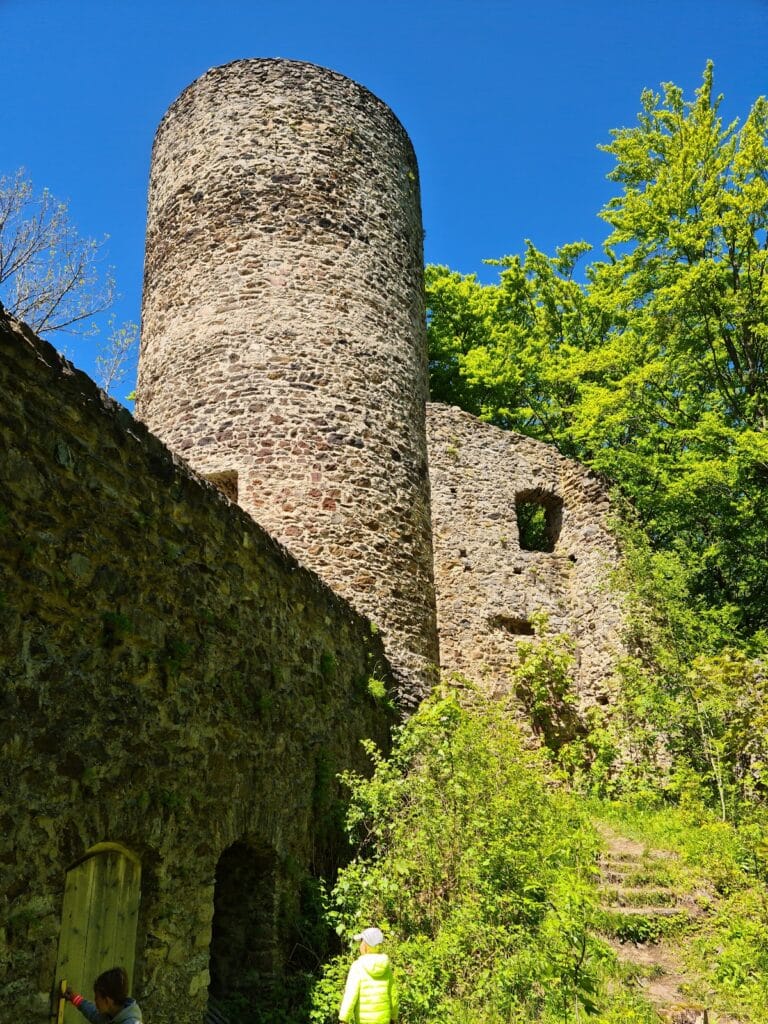
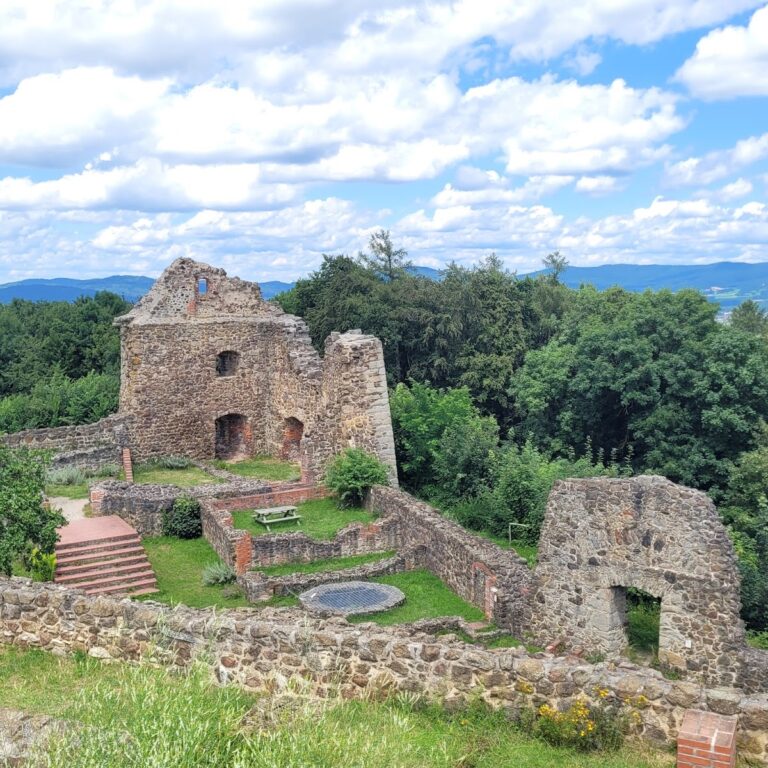
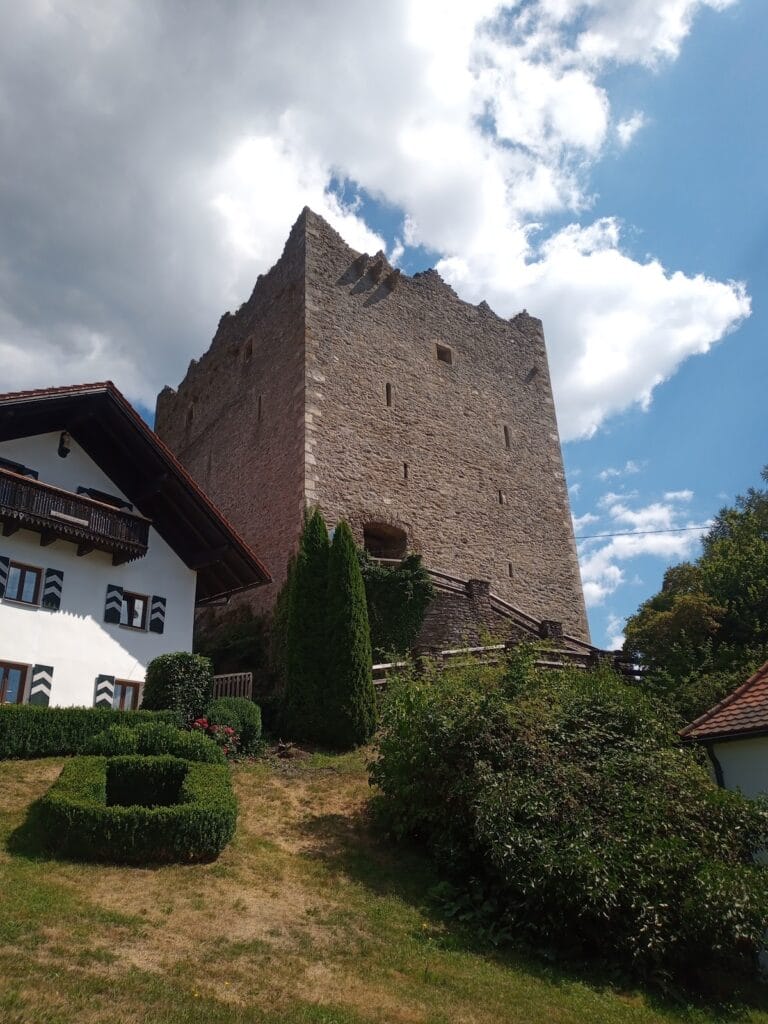
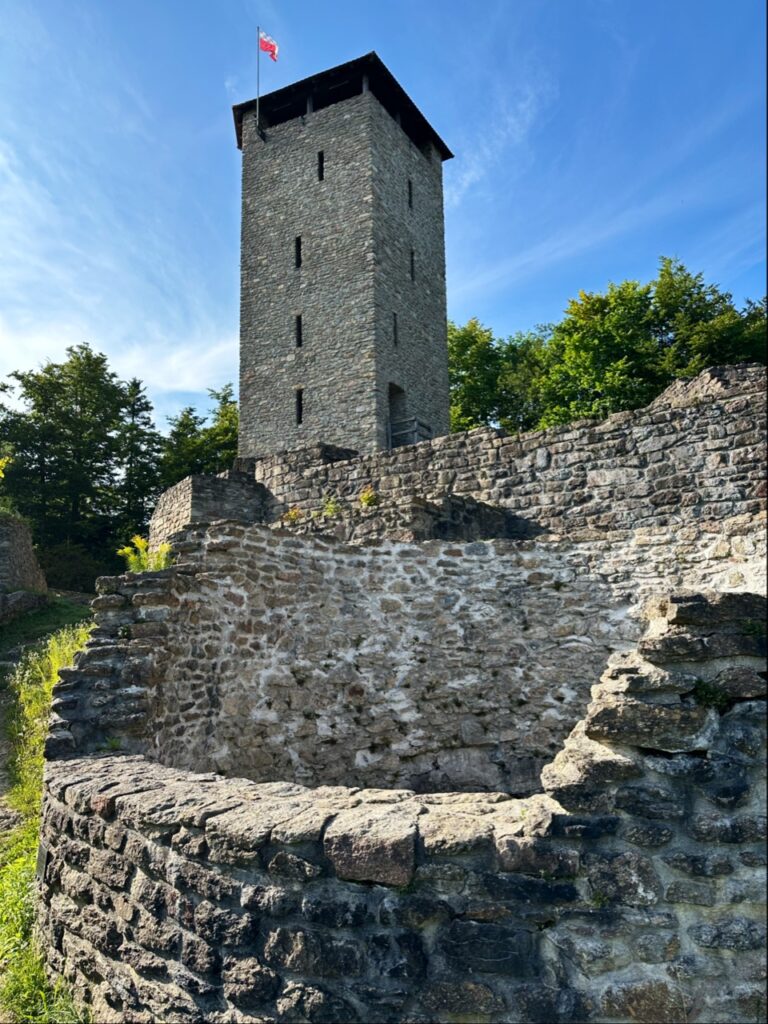
The name Hohenwarth derives from a watchtower on the Wachstein rock, which monitored the valley of the White Regen east of Kötzting. The rocky outcrop slopes down on all sides and commands extensive views. A ditch cut into the rock protects the site to the south, while a cut entrance survives on its western side. Medieval and early-modern archaeological remains include traces of predecessor buildings and earlier construction phases.
A new construction at Wachstein is conjectured for the fourteenth century. In the mid-fifteenth century, the watchtower was transformed into a castle, which had apparently become a ruin by about 1550. The 1558 Hofmark register described the place as an abandoned castle site. Philipp Apian’s 1568 map, made by the sixteenth-century Bavarian cartographer, showed Hohenwarth as a complex with stepped gables, a ring wall, and a tower. His accompanying description referred to the ruins of a castle on a hill.
The Present Castle
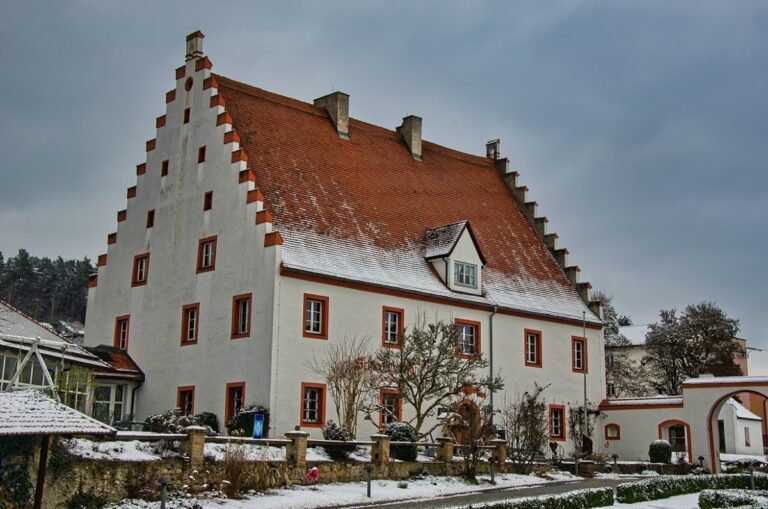
A new castle was built near the older one in 1570, probably on the area now occupied by the cemetery and parish church. It survived the Thirty Years’ War without damage, but the fire of 1647 destroyed the Eyb castle. The replacement constructed around 1650 to 1655 forms the core of the present complex. Later alterations affected the building in the eighteenth century, as indicated by the date 1763, and further changes were made during the modern period.
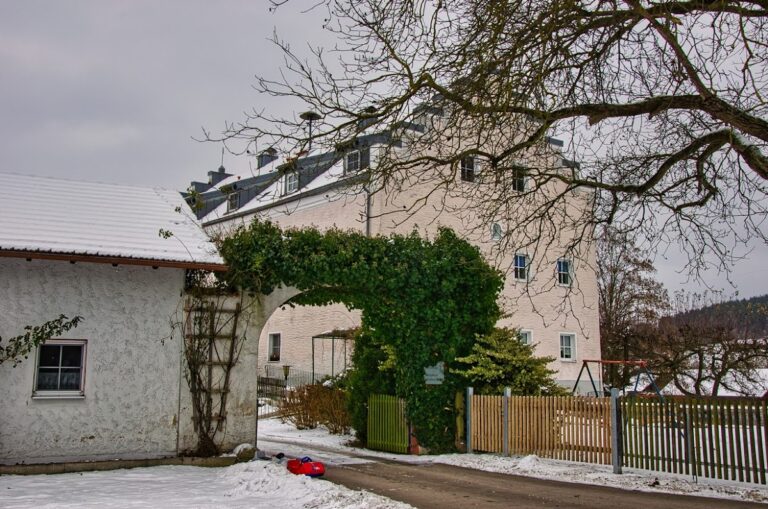
The former castle is a two- to three-storey complex of four wings arranged on an irregular ground plan. Hipped roofs cover the buildings, and round-arched gateways open through the west and east wings. The middle portion of the north wing projects prominently. A medieval core survives within the structure, although its interior has been extensively altered by later uses.
Castle Chapel
The old church built in 1589 served as the castle chapel. It was largely demolished during the nineteenth century, and its choir is the surviving part of that building. Its remains belong to the earlier architectural history of the castle complex and preserve a physical connection with the period of Ludwig von Eyb’s ownership.
Nearby sites