Schloss Rohrau: A Historic Castle and Harrach Residence in Austria


Site at a Glance
- Rating
- 4.4
- Popularity
- Low
- Country
- Austria
- Primary era
- Early Modern
- External website
- Open
- Eras represented
- Medieval, Early Modern
- Civilizations
- Habsburg, Holy Roman Empire
- Site type
- Domestic
- Remains
- Castle
On this page8 sections
History
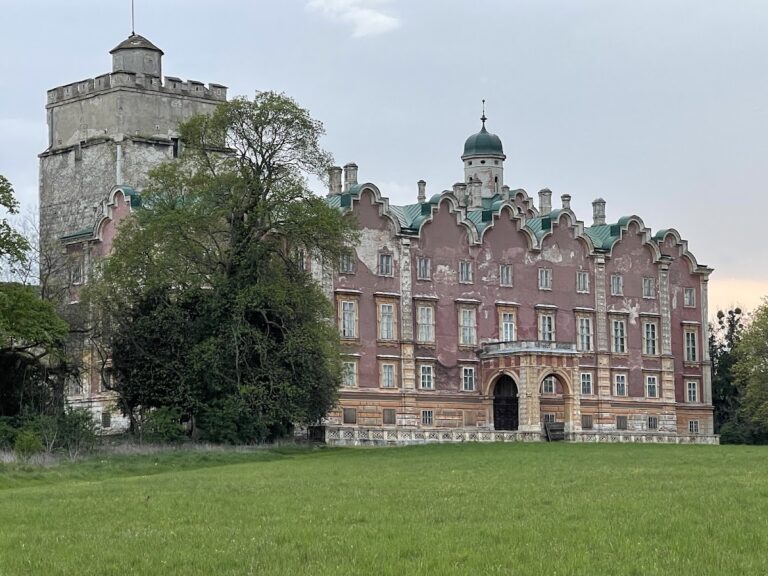
Schloss Rohrau is a historic castle in Rohrau, Austria, whose surviving complex is late Baroque and developed from fortifications probably built before the twelfth century. Located near the border with Burgenland, it became a major seat of several noble families before passing to the Harrachs in 1524.
Medieval Lordship and the Liechtensteins
In the eleventh and early twelfth centuries, Rohrau and the neighboring lordship of Petronell belonged to lands associated with the Counts of Vohburg and the Margraves of Cham. Agnes of Poitou, widow of Emperor Henry III, granted these lands as a fief to Count Palatine Rapoto V of Bavaria, who died in 1099. His descendant Diepold III, Margrave of Vohburg, later granted Petronell and Rohrau to his follower Hugo.
From about 1136, Hugo was known as Hugo von Liechtenstein and is regarded as the progenitor of the House of Liechtenstein, the Central European dynasty that later became the ruling family of the Principality of Liechtenstein. Petronell and Rohrau became important Liechtenstein seats during the High Middle Ages. Rohrau is first recorded as an independent knightly seat in 1240, in connection with Dietrich de Rorow.
The Rohrau branch of the Liechtensteins ended with Dietrich III in 1278. His daughter Diemut transferred the lordship through marriage to Leutold I von Stadeck. After the death of the last Stadecker, Johann, in 1399, Duke Wilhelm claimed Rohrau for his brother Ernst. Hermann II, Count of Celje and guardian of the Stadeck heiress Guta, instead secured it as an imperial fief from King Wenceslaus in 1400. An imperial fief was land held directly from imperial authority rather than from an intermediate local lord.
Rohrau passed to Ulrich von Montfort-Pfannberg in 1402, and King Ruprecht formally granted the castle and lordship to the Counts of Montfort in 1404. They retained it for approximately 120 years.
The Harrach Era
The Harrach family had emerged in southern Bohemia in the thirteenth century and later acquired estates in Upper Austria, Styria, and Carinthia. As its principal interests shifted toward Vienna and Lower Austria, Leonhard III von Harrach acquired Rohrau in 1524. The family was subsequently permitted to use the designation “von Rohrau.”
During the Counter-Reformation, the Catholic Church’s response to the Protestant Reformation, Leonhard IV von Harrach adopted a strongly Catholic position. King Ferdinand I made him an Imperial Baron in 1552, while King Philip II of Spain admitted him to the Order of the Golden Fleece in 1584. After 55 years at the Viennese court, Leonhard IV retired to Rohrau in 1586 and died there in 1590.
Ottoman forces attacked the castle in 1593, causing severe damage to the fortress and its surrounding area. Repairs and rebuilding followed between 1599 and 1605. This campaign included a new building, with the mason Leonhard Pall of Sommerein recording 552 days of work on the building and its vaults. The former medieval moated fortress was transformed during the Harrach period into a Renaissance-style castle.
Karl Freiherr von Harrach became an Imperial Count under Emperor Ferdinand II in 1627. The castle was later neglected and was nearly ruined by the middle of the seventeenth century. Count Ferdinand Bonaventura von Harrach restored it in 1668, largely preserving its existing appearance. About two decades later, Count Leonhard Ulrich von Harrach chose Rohrau as the family’s principal residence.
Count Leonhard IX von Harrach commissioned the final major structural intervention in 1776 and 1777. These later changes produced the late-Baroque complex that survives today. Schloss Rohrau remained a Harrach residence until the end of the Second World War, when occupation by the Red Army caused extensive damage.
Restoration, Collections, and Ownership
A comprehensive postwar restoration was required. For several years the complex functioned only as an agricultural enterprise, and its interiors were renewed in 1966. In 1970, Countess Stéphanie von Harrach established the Harrach picture gallery in the castle. Large rooms formed from formerly open spaces were later used for exhibitions and conferences.
The castle houses the Graf Harrach family collection, described as one of Austria’s largest and most important private picture collections. The Harrachs brought paintings to Rohrau from Naples, Madrid, Rome, Paris, and the Netherlands. In April 2006, unidentified thieves entered the castle and stole 16 paintings, including works by Rembrandt, Anthony van Dyck, Peter Paul Rubens, and Pieter Snayers.
The Schloss, estate, and picture collection later passed by inheritance to the Waldburg-Zeil family. Eberhard von Waldburg-Zeil, the youngest son of Erich von Waldburg-Zeil, married a great-granddaughter of Count Johann Nepomuk von Harrach in 1966. Schloss Rohrau is protected as a monument in Austria and is listed as an artistic monument under protection number 11663.
Remains
Schloss Rohrau stands at the southern edge of Rohrau in a park near the Leitha River, where the grounds merge with the river’s alluvial forest, woodland formed on periodically deposited river sediments. The plan of the former moated castle remains perceptible. The late-Baroque complex consists of the residential palace and a three-winged building positioned in front of it.
Palace and Courtyard
The palace is formed by four two-storey wings enclosing a large, almost square inner courtyard. Its principal facade has a monumental portal approached by a stone bridge. A balustraded balcony rises above the entrance, and the balcony door carries the Harrach coat of arms above its architrave, the horizontal frame at the top of a doorway. A clock is set in the center of the large facade pediment.
Stonework from the 1599–1605 rebuilding campaign survives in several parts of the complex. Stonecutter Antonius Tencalla supplied durable Kaiserstein limestone, quarried near the Leitha Hills, for door and window surrounds, spiral-staircase steps, terrace cornices, five stone window heads, ashlar blocks, and a cornice for the New Gate in the outer castle. He also made a draw well in the inner castle and a stone pillory for the market of Rohrau.
Interiors and Gallery
A formal staircase leads from the entrance hall to the first floor, where numerous large-format portraits of important Harrach family members are displayed. The castle gallery occupies ten rooms on the raised ground floor. Their carefully maintained furnishings retain the character of an aristocratic residence rather than presenting the rooms solely as museum interiors.
Chapel and Commemorative Rooms
The chapel contains the Rohrau Altarpiece, a sixteenth-century work by an unidentified artist from Antwerp. Its small dome is decorated with stucco. The Haydn Room contains a bust of the composer made by Antonio Grassi, adding a dedicated commemorative space to the castle’s historic interiors.