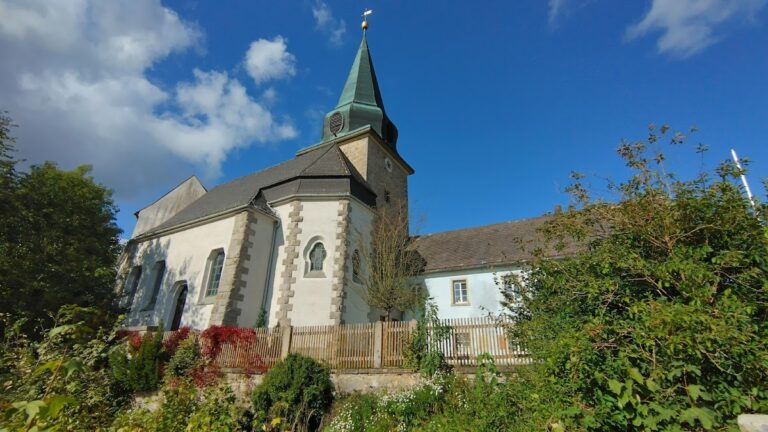
Schloss Fuchsmühl: A Historic Castle Estate in Germany
Site at a Glance
- Rating
- 4.3
- Popularity
- Low
- Country
- Germany
- Primary era
- Early Modern
- External website
- Open
- Eras represented
- Medieval, Early Modern, Modern
- Civilizations
- Electorate of Bavaria, Holy Roman Empire
- Site type
- Domestic
- Remains
- Castle
On this page11 sections
History
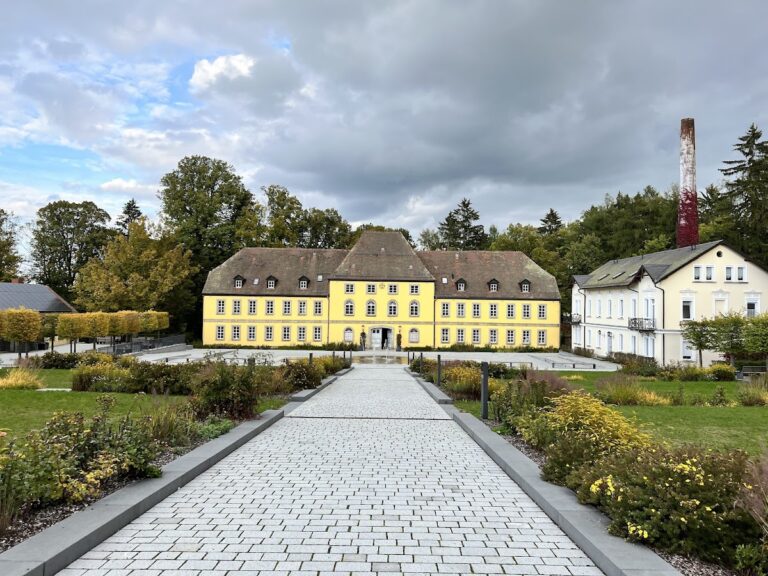
Schloss Fuchsmühl is a historic castle estate in Fuchsmühl, Germany, whose history reaches back to the twelfth century and whose present main building is Classicist, a style based on the forms and proportions of ancient Greece and Rome. The estate stands in the Tirschenreuth district of the Upper Palatinate, on the eastern edge of the Steinwald. Medieval records connect it with noble ownership, while later centuries brought changes in allegiance, administration, religious use, forestry, and hospitality.
Medieval estate and fief
Fourteenth-century documents identify the site as the knightly estate and fief of “Fossenmühl.” A knightly fief was land granted by a higher lord in return for service, with the holder retaining it under feudal obligations. The name came from the Lords of Fossenhofen, who owned the estate at that time.
In 1363, Hans Heckel, a retainer of the Lords of Leuchtenberg, was named as its owner. He sold Fuchsmühl in 1394 to Landgrave Johann I of Leuchtenberg. A landgrave was a high-ranking territorial ruler, broadly comparable to a major prince. The estate later passed as a fief to the knight Konz von Wirsberg, before being held by the Lords of Trautenberg.
Sixteenth and seventeenth centuries
In 1587, the Trautenbergs combined Fuchsmühl with the Bohemian land-table estate of Nacketsdörfel. Such an estate was property entered in the land registers of the Kingdom of Bohemia.
The Thirty Years’ War, the major European conflict of 1618 to 1648, brought dynastic, territorial, and religious struggles across the German lands. During the war, Fuchsmühl was associated with Johann Philipp Cratz von Scharffenstein, commander of the Upper Palatinate in Bavarian service. He defected to the Swedish side, was captured at the Battle of Nördlingen in 1635, and was beheaded in Vienna. A colonel named Kaspar Snetter was subsequently recorded as the castle’s owner. The Trautenbergs held the estate again until 1657, although their Swedish alignment led them to abandon it and flee during the conflict.
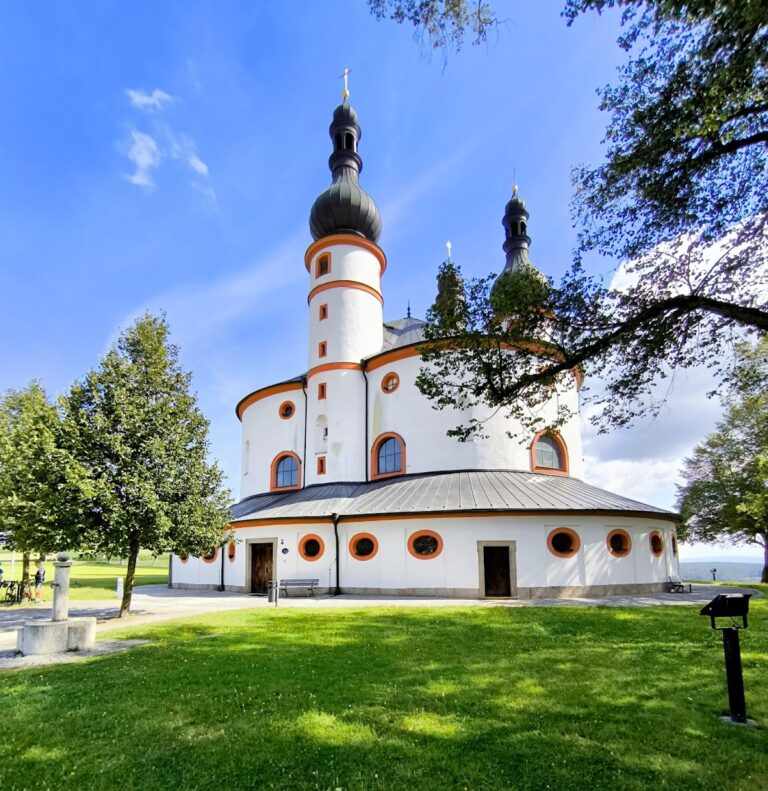
Daniel von Froschheim acquired Schloss Fuchsmühl in 1657. His son, Franz Heinrich Daniel, succeeded him in 1685. At his father’s request, Franz Heinrich Daniel built a pilgrimage chapel on the Hahnenberg near Fuchsmühl in 1688. That chapel became the origin of the present pilgrimage church of Maria Hilf, a Catholic devotional title meaning “Mary, Help of Christians.”
Fuchsmühl also gained an administrative and commercial role in the seventeenth century. In 1672, an Electoral auxiliary customs station belonging to the main station at Kemnath was established there. It served traffic moving between Leipzig and the Vogtland and Regensburg, in both directions, placing the estate on an important long-distance trade route.
Froschheim and Zoller ownership
The Froschheim line ended with Josef Daniel von Froschheim, a Royal Bavarian chamberlain, government councillor, and court-of-appeal councillor in Amberg. He was raised to the rank of baron on 1 May 1786 and died childless at Fuchsmühl on 16 October 1820.
Soon afterward, King Maximilian I of Bavaria granted Schloss Fuchsmühl as a knightly fief to his justice minister, State Minister Friedrich Freiherr von Zentner. General Lieutenant Karl Freiherr von Zoller received the estate in 1843, followed by his son Maximilian Freiherr von Zoller. The line of the first Karl von Zoller ended with Maximilian. In 1889, the property passed to Ludwig von Zoller, a member of a collateral branch of the family.
During Ludwig von Zoller’s ownership, the Fuchsmühl Woodcutters’ Battle took place on 29 and 30 October 1894. His son Alexander von Zoller sold Schloss Fuchsmühl and its lands to the city of Augsburg in 1937 for 600,000 Reichsmarks. Augsburg continues to operate the Fuchsmühl forestry district, which covers approximately 900 hectares of forest.
Religious, residential, and hotel uses
From 1946, the Sisters of the Holy Cross from Eger in the Sudetenland made the castle their new home and established an orphanage there. In 1949, the municipality of Fuchsmühl acquired the estate and converted the outbuildings into apartments.
From the 1950s, the main building operated as a guesthouse. After that use ended for economic reasons, the Seltmann Weiden porcelain factory used the building to accommodate employees. The castle was sold in 1968 and operated again as a hotel.
In 1987, the owners bequeathed the property to the Berlin branch of the Workers’ Welfare Association, a German social-welfare organization commonly known as AWO. Between 1987 and 2010, the castle served as an educational and recreational facility as well as a hotel. It returned to private ownership in December 2011 and has operated again as a hotel since 2015.
The castle complex is protected both as an archaeological monument and as an architectural monument of Fuchsmühl. The archaeological designation covers medieval and early-modern evidence, traces of predecessor buildings and earlier construction phases, and remains of demolished buildings and structural elements. The architectural monument is listed under file number D-3-77-119-3, while the archaeological monument is recorded under file number D-3-6038-0011.
Remains
The surviving complex is organized around the main Classicist castle building, the manor house, and the castle chapel. A service courtyard lies to the west, with agricultural and service buildings and a brewhouse. To the east and south, a landscape park contains ponds and a gardener’s house. The buildings and grounds preserve evidence of repeated changes over several centuries, including additions constructed around 1980.
Castle buildings and service courtyard
Main castle and manor house
The present complex includes the principal Classicist castle building and the manor house. Their current form belongs to a long sequence of alterations that changed the estate over the centuries. Additions made around 1980 form part of the later architectural development of the complex.
Service courtyard
West of the principal buildings, the service courtyard contains agricultural and service structures together with a brewhouse. These buildings formed part of the estate’s practical working area and remain linked to the main castle complex.
Landscape park
The landscape park extends east and south of the buildings. Its features include ponds and a gardener’s house, adding a distinct landscaped element to the castle estate.
Gate tower and castle chapel
In the fourteenth century, simple buildings formed a closed perimeter around the castle area. Entry was provided by a gate tower capped by a pyramidal roof. South of this tower, the castle chapel of the Presentation of Mary was added in 1752 and restored in 1820.
The chapel is a rectangular room divided into five bays, or repeated spatial sections. It has no separate choir. A barrel vault, a continuous curved ceiling, spans the room and is shaped with lunettes, curved sections formed where smaller vaults meet the main ceiling. Wall pilasters, shallow attached supports that also serve as decoration, divide and articulate the interior. The ceiling painting and altar probably date from 1752 and belong to the Rococo, an eighteenth-century style known for delicate ornament, curved forms, and decorative lightness.
On the chapel’s south side are the graves of Daniel von Froschheim, who died in 1645, and his wife Eva Susanne, née Nothaft von Weißenstein, who died in 1660. Their marital coat of arms is displayed with the graves, preserving a direct memorial connection between the chapel and the family that later acquired Schloss Fuchsmühl.