Schloss Ernstbrunn: A Medieval Castle and Baroque Palace in Austria


Site at a Glance
- Rating
- 4.5
- Popularity
- Low
- Country
- Austria
- Primary era
- Medieval
- External website
- Open
- Eras represented
- Medieval, Early Modern, Modern
- Civilizations
- Habsburg, Holy Roman Empire
- Site type
- Domestic
- Remains
- Palace
On this page9 sections
History
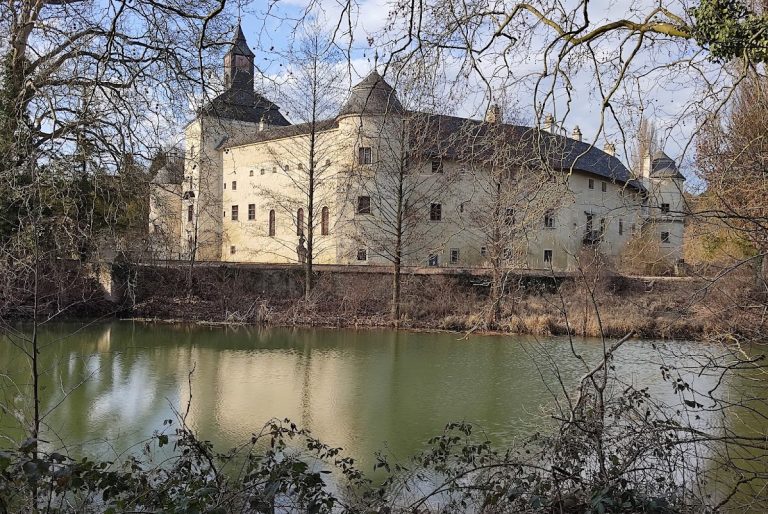
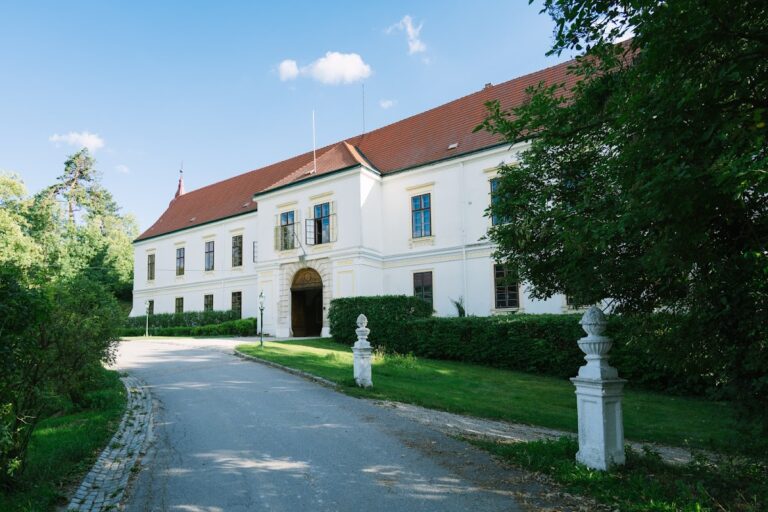
Schloss Ernstbrunn is a castle and palace complex in Dörfles, Austria, developed from a medieval fortified core and expanded in the Baroque and Neoclassical periods. It stands within the market municipality of Ernstbrunn in Lower Austria and has been owned by the Princes Reuss since the nineteenth century, with the family still residing there.
Medieval lordship and early modern ownership
The history of Ernstbrunn reaches back to the twelfth century. Heinrich de Ernstbrunne appeared as a witness in a Klosterneuburg document around 1180. In 1254, Ebran von Ernstbrunn was beheaded after supporting Bertold von Ernstbrunn in a dispute that also placed them against King Ottokar.
Ulrich von Maissau inherited the lordship from Konrad I von Schaunberg in 1313, while the Gneusen family held Ernstbrunn as a fief. In 1430, the territorial ruler took control and pawned the lordship to the Doss family, who held it until 1480. An exchange brought Ernstbrunn to the Lords of Ebersdorf in 1499, and they retained it until their line became extinct in 1556.
Leonhard von Harrach sold the lordship to Joachim von Sinzendorf in 1592. Joachim had served as a special ambassador at the Ottoman court in Istanbul and had thirteen children. His son Lorenz established the Ernstbrunn branch of the Sinzendorf family. In 1650, Sigmund Friedrich Freiherr von Sinzendorf also acquired nearby Schloss Haggenberg.
Baroque and Neoclassical transformation
After 1654, Rudolf Count von Sinzendorf commissioned extensive alterations and new construction in the Baroque style, an architectural tradition known for monumental forms and rich decoration. From the last quarter of the eighteenth century into the early nineteenth century, Reich Prince Prosper von Sinzendorf transformed the castle into a palace on a large scale. Benedict Henrici worked as architect and sculptor, while Jacobus Wanderl carried out interior work. Prosper revised the garden in 1775 as a Baroque-Neoclassical ensemble, combining formal decoration with the ordered forms associated with classical antiquity.
Prosper’s death in 1822 brought the Sinzendorf line to an end. A prolonged inheritance dispute was settled in 1828, when Prince Heinrich LXIV of Reuss-Köstritz assumed control of the lordship. The inheritance later passed through his cousin Heinrich LXIX to Heinrich IV of Reuss-Köstritz, who lived at Schloss Ernstbrunn and made the property part of a family fideicommissum, an inherited estate arrangement intended to keep specified property together within a family.
The Reuss estate and twentieth-century losses
At the end of the Second World War, Schloss Ernstbrunn stood for several weeks in the middle of fighting. During the following ten years of Soviet occupation, it was administered by USIA, the Soviet organization that managed Austrian enterprises and properties in the occupation zone. The castle was severely despoiled and lost much of its inventory. After the Austrian State Treaty, it returned to its former owners and has since been progressively restored.
A library assembled between 1910 and 1945 contained more than 40,000 volumes, chiefly from the family’s own holdings. Most of the library disappeared after the wartime fighting and the period of USIA administration. Traces of the Ernstbrunn archives reappeared in Moscow during the 1990s in negotiations over Austrian archival material held there, but efforts to secure their return had not succeeded.
Heinrich IV, Prince Reuss, who owned the castle from 1919 until his death in 2012, served from 1986 as Commander of the Order of St John in Austria, a Christian chivalric order whose Austrian branch uses that title for a senior officeholder. Schloss Ernstbrunn remains privately owned. Its park is protected under Austria’s monument-protection legislation and forms part of the Leiserberge Nature Park and its associated landscape-protection area.
In 1975, the northern part of the palace park became Wildpark Ernstbrunn. Since 2001, the Wolf Science Center has also been located there; before its permanent completion, it operated from the kitchen garden near the castle.
Remains
Medieval core and courtyard complex
The complex stands in woodland northwest of the center of Ernstbrunn, on the northern slope of the Semmelberg above Dörfles. It forms a long, ascending arrangement around four courtyards. The medieval core castle, dating from the twelfth and thirteenth centuries, surrounds the innermost courtyard and occupies a limestone crag that is free-standing on three sides, with steep ground falling toward Dörfles. Its plan forms an elongated octagon.
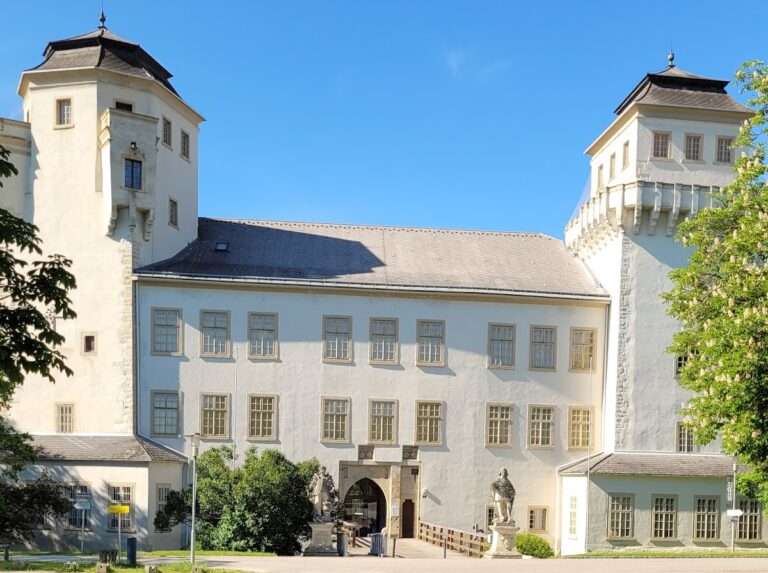
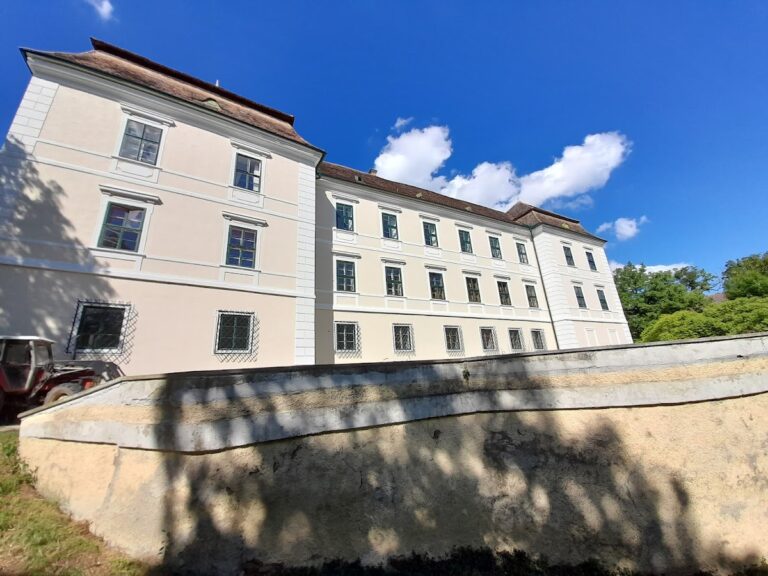
The core castle’s surrounding wall reaches up to three meters in thickness. A square keep, the strongly fortified principal tower of a medieval castle, strengthens the southeast side. It originally had three storeys and gained an additional storey during the sixteenth or seventeenth century. Successive groups of buildings were attached to the medieval core during the late Renaissance, Baroque, and Neoclassical periods. The main exterior is the sixteen-axis south front, which encloses the fore-castle on its outer side.
Courtyards and chapels
The second courtyard contains a clock tower and a Protestant chapel erected around 1863. The third courtyard holds the high castle. The fourth includes a Catholic chapel, a knights’ hall, and the keep. Together, these courtyards preserve the complex’s successive expansion from a fortified medieval nucleus into a large residential and ceremonial estate.
Fore-castle and ancillary buildings
The fore-castle was expanded in the Baroque style between 1672 and 1677. Its round-arched portal carries the coat of arms of Rudolf Count von Sinzendorf, supported by two lions. The heraldic composition includes the principal Sinzendorf shield, subsidiary shields for the Rheineck and Lappitz lineages, and a cup between the horns of the principal helmet. The cup represents the office of hereditary cupbearer in Austria above the Enns. The facade was redesigned in the Neoclassical style at the end of the eighteenth century.
In front of the gate stands an Early Baroque fountain with sixteen heraldic representations. Four shields appear on the shaft below the bowl, while twelve are arranged in pairs around the outer edge of the hexagonal basin. The ensemble forms an ancestral display for Rudolf Count von Sinzendorf, Burgrave of Rheineck, and Eva Susanna Countess of Zinzendorf and Pottendorf. The shaft bears the arms of Leonhard von Sinzendorf, Anna von Harrach, Alexander von Zinzendorf and Pottendorf, and Susanna von Volkra. The basin presents six further great-grandparent couples, including the Rueber, Welsperg, Trauttmansdorff, Kuzal von Lappitz, Lindeck, Liechtenstein, Ortenburg, Zelking, Prager, and Hardegg families and related lineages.
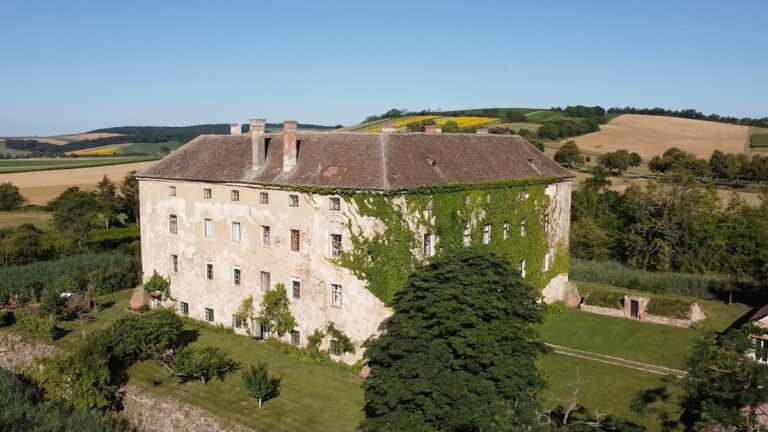
A large three-storey granary, a substantial storage building used chiefly for grain and other agricultural produce, is among the many ancillary buildings around the palace.
Park, garden furnishings, and archaeological remains
The garden was laid out in the second half of the seventeenth century under Prosper von Sinzendorf as a Baroque ornamental and landscape garden. In the 1860s, Prince Reuss converted the grounds into an English landscape park of approximately 60 hectares. This style uses naturalistic arrangements of lawns, trees, water, and winding views rather than the rigid geometry of a formal garden. Numerous specimen trees were planted, and some remain part of the park’s tree stock.
Several garden furnishings remain installed, although not in their original positions. They include the Temple Fountain, also called Neubrunn; a column dedicated to Nike and known as the Peace or Victory Column, the “Black Gretl”; an obelisk honoring Field Marshal Gideon von Loudon; and a monument to Chancellor Franz Josef von Saurau.
Earthworks near the granary in 1984 and 1985 uncovered approximately 100 original life-size Baroque stone figures, probably dating from around 1700. Their original arrangement remains uncertain, but the discovery added surviving sculptural material to the evidence for the palace garden’s Baroque design.
Nearby sites