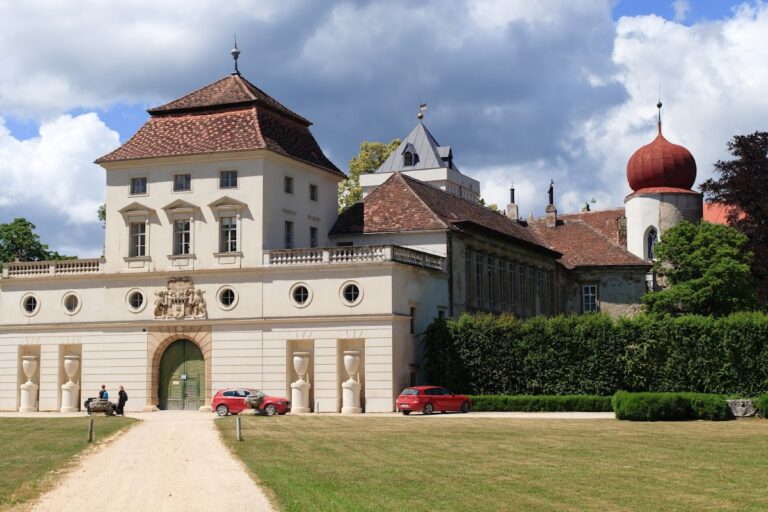
Schloss Asparn/Zaya: Medieval Castle and Prehistory Museum in Austria


Site at a Glance
- Rating
- 4.7
- Popularity
- Medium
- Country
- Austria
- Primary era
- Medieval
- External website
- Open
- Eras represented
- Medieval, Early Modern, Modern
- Civilizations
- Duchy of Austria, Habsburg, Holy Roman Empire
- Site type
- Military
- Remains
- Castle
On this page8 sections
History
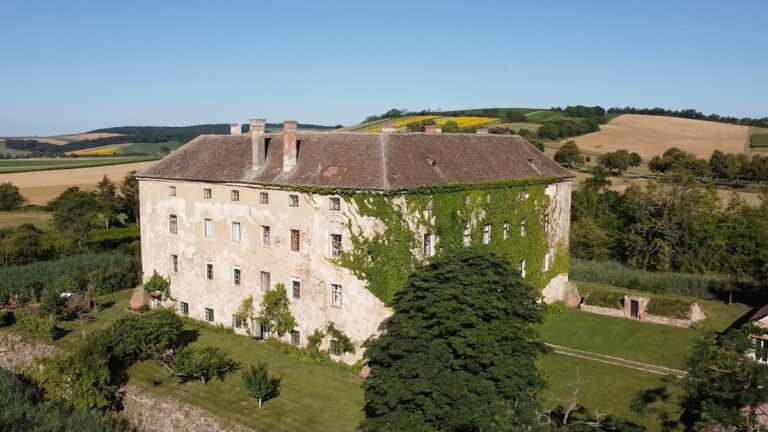
Schloss Asparn/Zaya is a medieval castle in Austria, located in Asparn an der Zaya in the Weinviertel region of Lower Austria. A castle at the site was mentioned in 1121, while the present medieval foundation began during the second half of the thirteenth century, when Hadmar von Sonnberg built a new castle over an earlier fortification. Together with former economic buildings, the parish church, and the adjoining Minorite monastery, a branch of the Franciscan order, it forms the historic area known as Stättl.
Medieval Lords and Rebuilding
The Sonnberg family held the castle until 1348. It then passed to the Tursen von Rauheneck-Asparn. In 1397, Asparn became a fief of the territorial prince, meaning that the property was held under feudal obligations, and it passed to the Lords of Walsee. The Walsee family began rebuilding the castle in 1421, creating the major medieval structures that still shape its appearance.
In 1443, Asparn passed to Ulrich von Eyczing, an Austrian nobleman of the fifteenth century. Emperor Friedrich III acquired it in 1463. During the sixteenth century, several families held the lordship in pledge, including the Gall von Loosdorf, as control of the estate moved through changing arrangements of ownership and tenure.
The Breuner Residence
Count Seyfried Christoph von Breuner acquired the lordship outright in 1610 and enlarged the castle as his principal residence. Swedish forces devastated the building in 1645 during the Thirty Years’ War, the wider European conflict that involved religious and dynastic struggles across central Europe. Restoration began in 1651 and gave the castle much of the appearance associated with its later history.
The male line of the Counts of Breuner became extinct, and in 1894 the property passed to a daughter married to Victor II Amadeus, Duke of Ratibor and Prince of Corvey. The Asparn estate, Schloss Grafenegg, and Schloss Neuaigen consequently passed to the House of Ratibor, a collateral branch of the House of Hohenlohe-Schillingsfürst that later adopted the name Metternich-Sandor.
Alteration, Damage, and Museum Use
The northern wing was demolished in 1820 because its structure had become unsafe. Repeated alterations followed, so the present form of the castle dates largely from the period after that demolition. Soviet occupying forces caused extensive interior damage in 1945, adding another major disruption to the building’s fabric.
The castle entered a new phase when it housed the Weinland Museum from 1955. Lower Austria’s prehistoric collection moved there in 1967, and the Museum of Prehistory occupied the building from 1970. Since 2014, the castle has also presented exhibitions devoted to early history and medieval archaeology. Its museum display was reorganized in 2014 as a chronological sequence across three floors, beginning in the attic and treating the themes of habitat, metal, and writing.
The museum’s archaeological work developed from the late 1960s, when restoration workshops and research workplaces were established during the conversion of the renovated castle. In 2008, the museum became part of Niederösterreich Kulturwirtschaft GmbH. After the lease expired in 2010, the State of Lower Austria purchased the property, and at the end of 2011 it was incorporated into the NÖKU subsidiary MAMUZ Museumszentrum Betriebs GmbH.
Preparations for the 2013 Lower Austrian State Exhibition led to structural adaptations in the castle and the reorganization of the adjoining archaeological open-air area. Schloss Asparn served as one of the venues for the “Bread & Wine” exhibition, held jointly in Asparn and Poysdorf. Schloss Asparn and the MAMUZ complex in Mistelbach now form the Centre for Prehistory and Early History of Lower Austria.
Remains
The Castle Building
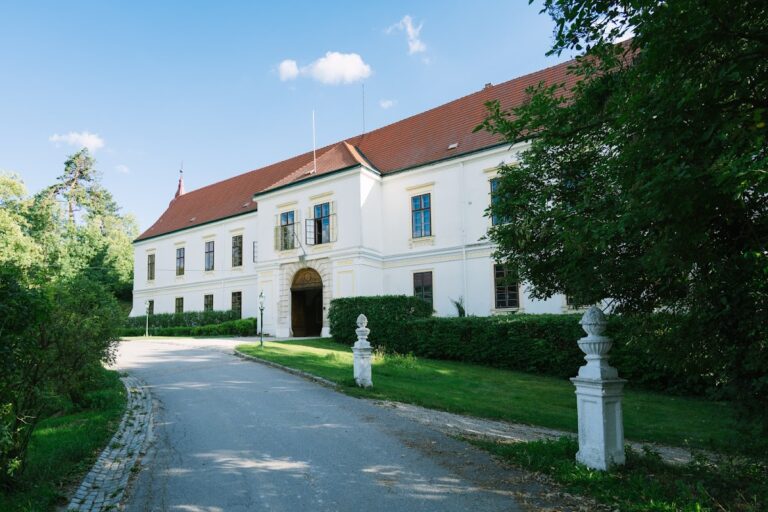
Schloss Asparn/Zaya survives as a medieval castle whose fabric combines the thirteenth-century foundation with major fifteenth-century rebuilding, seventeenth-century expansion and restoration, and later alterations. Two massive corner towers belong to the rebuilding associated with the Walsee family in the early fifteenth century. One tower has two oriels, while the other is surrounded by a walkway. Two sandstone figures stand before the castle gate and date from Count Seyfried Christoph von Breuner’s expansion after 1610.
The removal of the northern wing in 1820 changed the castle’s plan, and later work adapted the building for museum use. An exhibition level was added in the attic, while a glass elevator was installed in the courtyard to improve access between the floors. The museum occupies all three floors, with the chronological presentation beginning in the attic and continuing through the second and first upper floors.
The Archaeological Open-Air Area
The archaeological open-air area adjoining the castle covers nearly 19,000 square metres and presents approximately 40,000 years of European settlement history, from the Paleolithic, or Old Stone Age, to the beginning of the Common Era. Full-scale reconstructions of Stone Age, Bronze Age, and Iron Age residential and economic buildings occupy the grounds. Their forms and furnishings derive from archaeological excavation findings.
The reconstructed buildings were progressively expanded into village-like ensembles. Arranged in this way, they present the settlement patterns of different prehistoric periods through their spatial organization. Since 1982, the area has also served as a centre and training facility for experimental archaeology associated with the University of Vienna’s Institute of Prehistory and Historical Archaeology. Experimental archaeology tests ancient technologies, buildings, and lifeways through practical reconstruction. The area supports teaching, demonstrations, seminars, and workshops focused on historical craft techniques.
Collections and Research Spaces
The west-wing ground floor contains a research laboratory with researchers’ tables, a restoration table, and archaeological tools. The space forms part of the castle’s continuing archaeological function, linking exhibition work with the practical examination and conservation of finds.
The regional collection includes the medieval Wiener Neustadt treasure, a hoard of jewellery displayed in specially designed rooms resembling a treasury. Its presentation occupies a dedicated part of the museum and adds a medieval group of movable remains to the castle’s broader sequence of prehistoric, early historical, and archaeological material.
Nearby sites