Ehrenhausen Castle: A Renaissance Castle in Austria
Site at a Glance
- Popularity
- Medium
- Country
- Austria
- Primary era
- Early Modern
- Eras represented
- Medieval, Early Modern
- Civilizations
- Habsburg, Habsburg Austria, Holy Roman Empire
- Site type
- Military
- Remains
- Castle
On this page9 sections
History
Ehrenhausen Castle is a fortified castle in Ehrenhausen, Austria. Tradition holds that the Counts of Sponheim built a stronghold here in the 11th century. The castle first appears in a document dated 27 August 1240, and the Eggenbergs later developed it into a Renaissance castle.
Early records and abbey tenure
Before its first written mention, the site may have been a fief of St. Paul’s Abbey in the Lavant Valley. A fief was land held under an obligation of service or loyalty. In 1240, Duke Frederick II confirmed Heinrich von Grafenstein’s donation to Seckau Abbey, naming the place as Ernhus. From about 1260, the Lords of Pettau held the castle as a fief from the abbey; the Counts of Schaunberg held it on the same terms from 1441.
The Eggenberg period
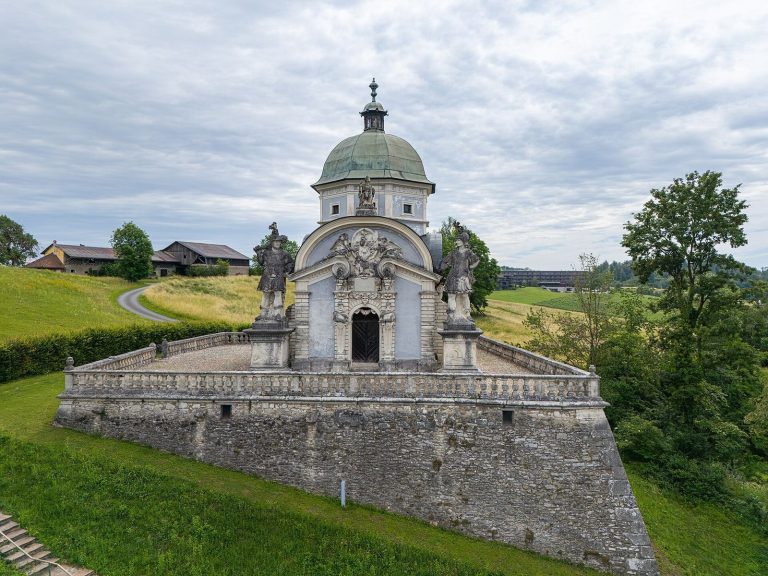
In 1542/43, Count Georg von Schaunberg sold the castle and its manor farm to Christoph von Eggenberg of the family’s Radkersburg branch. Christoph and his son Ruprecht strengthened the defenses amid the continuing Ottoman threat. Ruprecht, a commander in the wars against the Ottomans who was raised to baron, also built a mausoleum nearby.
The Eggenbergs owned the castle from 1543 to 1755 and transformed it into a Renaissance residence. After the Ehrenhausen branch ended in 1646, the castle and market town passed to the family’s Graz branch. The wider family died out after Johann Christian II von Eggenberg died of appendicitis in 1717, aged 13, and ownership then shifted among heirs.
Later owners
In 1727 the estate passed to Maria Charlotte, Princess of Eggenberg. She left it in 1755 to Maria Theresa, Countess Leslie, née Princess of Eggenberg. Maria Theresa’s son, Count Anton Leslie, received the estate in 1776. After his death in 1802, it passed in 1804 to his sister, Countess Rosalia Attems; her family held it until 1889.
Ownership from 1889
Adéle Kosztolányi acquired the estate in 1889. After her marriage to Paul Clemens Salvi in 1897, he had become a co-owner by 1898 at the latest. Salvi sold the estate in 1904 in return for a lifelong pension. That year, Theodor Kohn, the former Prince-Archbishop of Olomouc, bought the castle and lived there until his death in 1915. A prince-archbishop held both an archbishop’s office and princely rank. Kohn was buried in the mausoleum and bequeathed it to Styria, which has owned it since 1920.
Kohn’s heirs held the estate from 1915 to 1918. It apparently then passed into joint ownership of the Haberhauer and Richter families, with the Weiß family also sharing ownership until 1922. The castle remained privately owned, later passed to the Barons von Salvi, and is now owned by Ingrid Csicsaky.
Remains
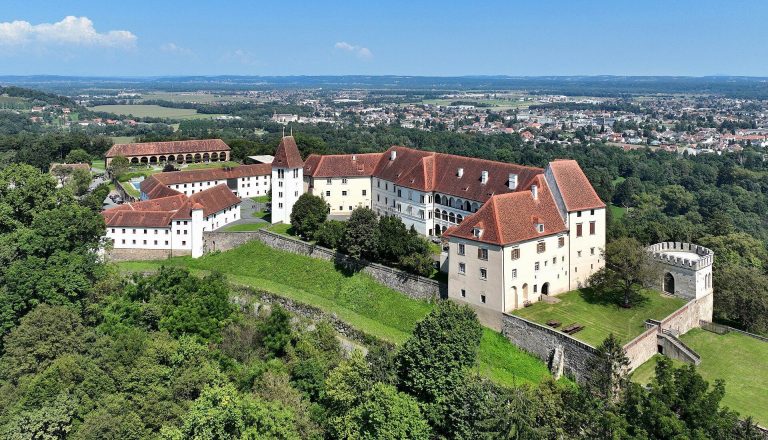
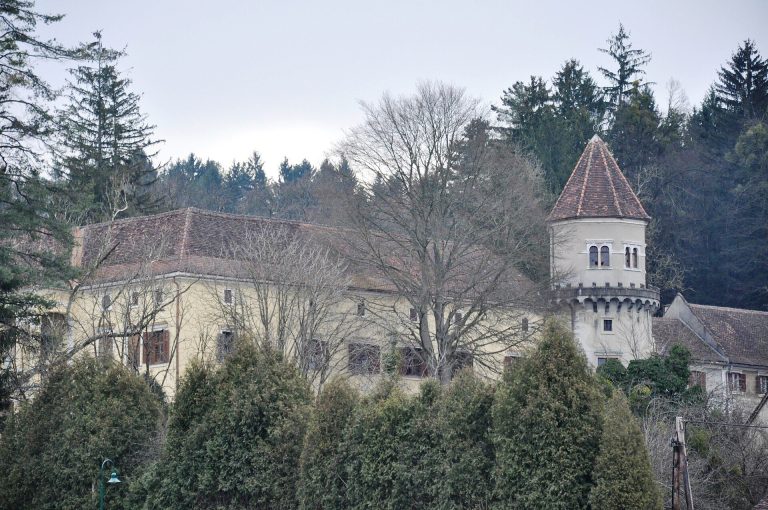
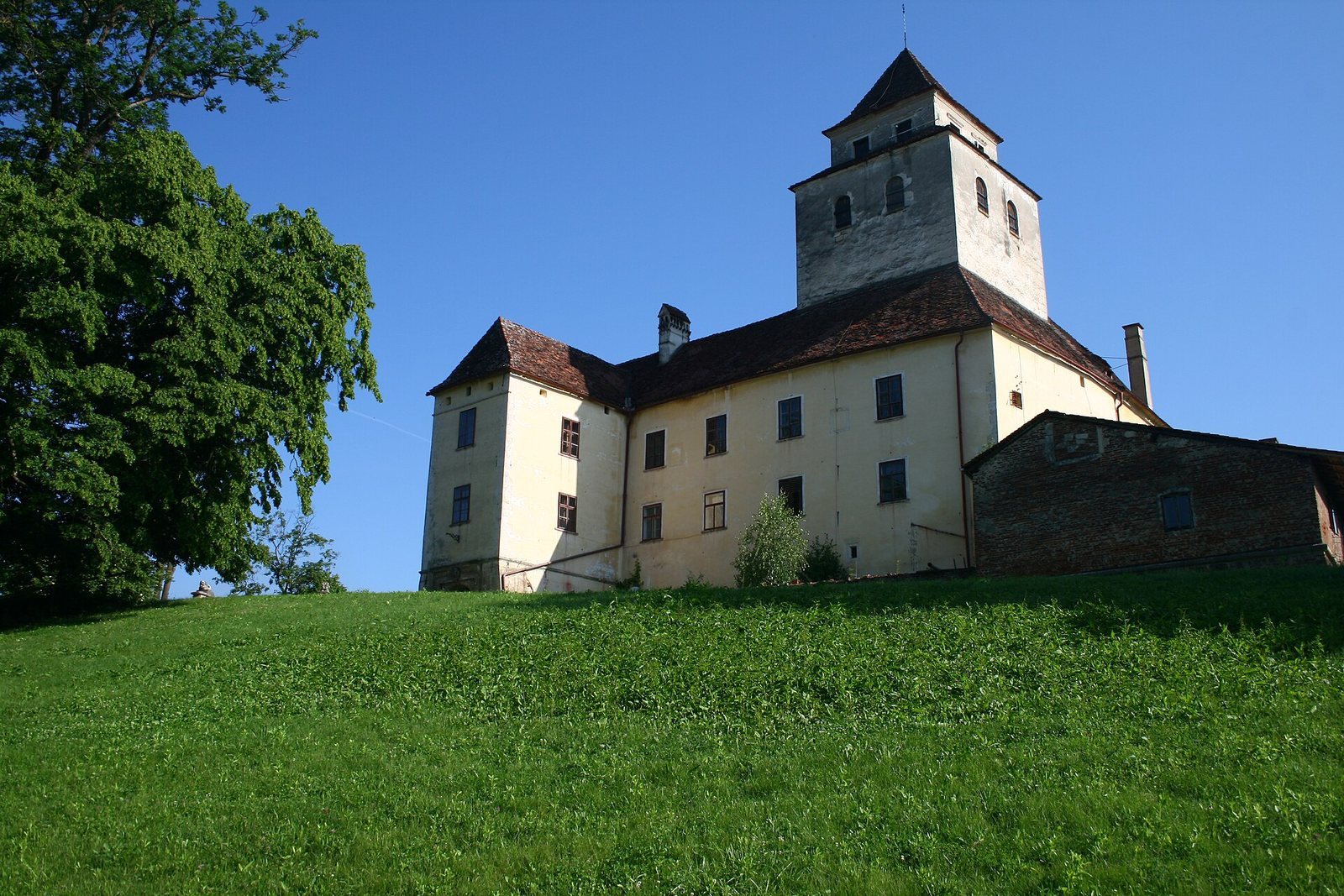
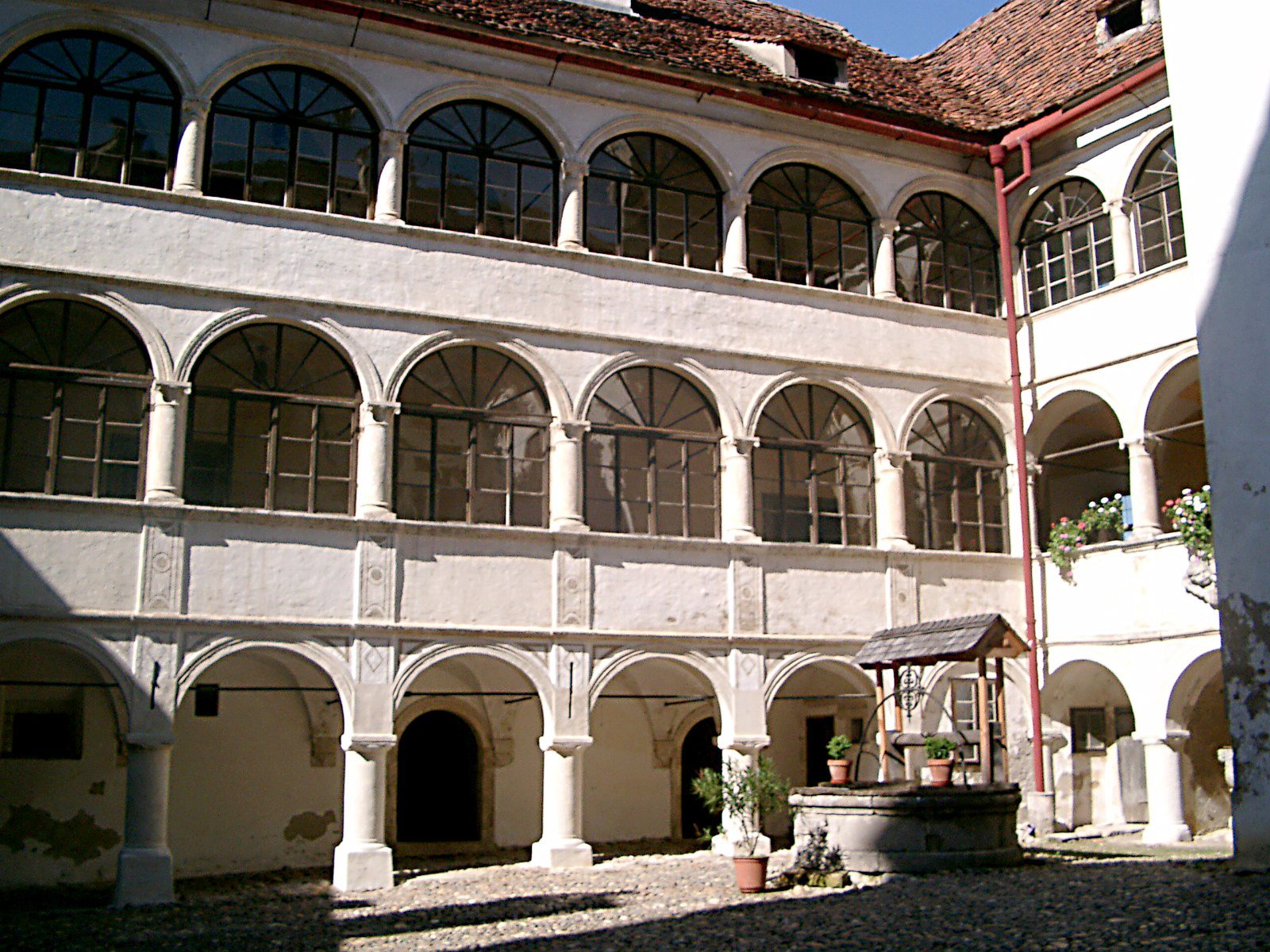
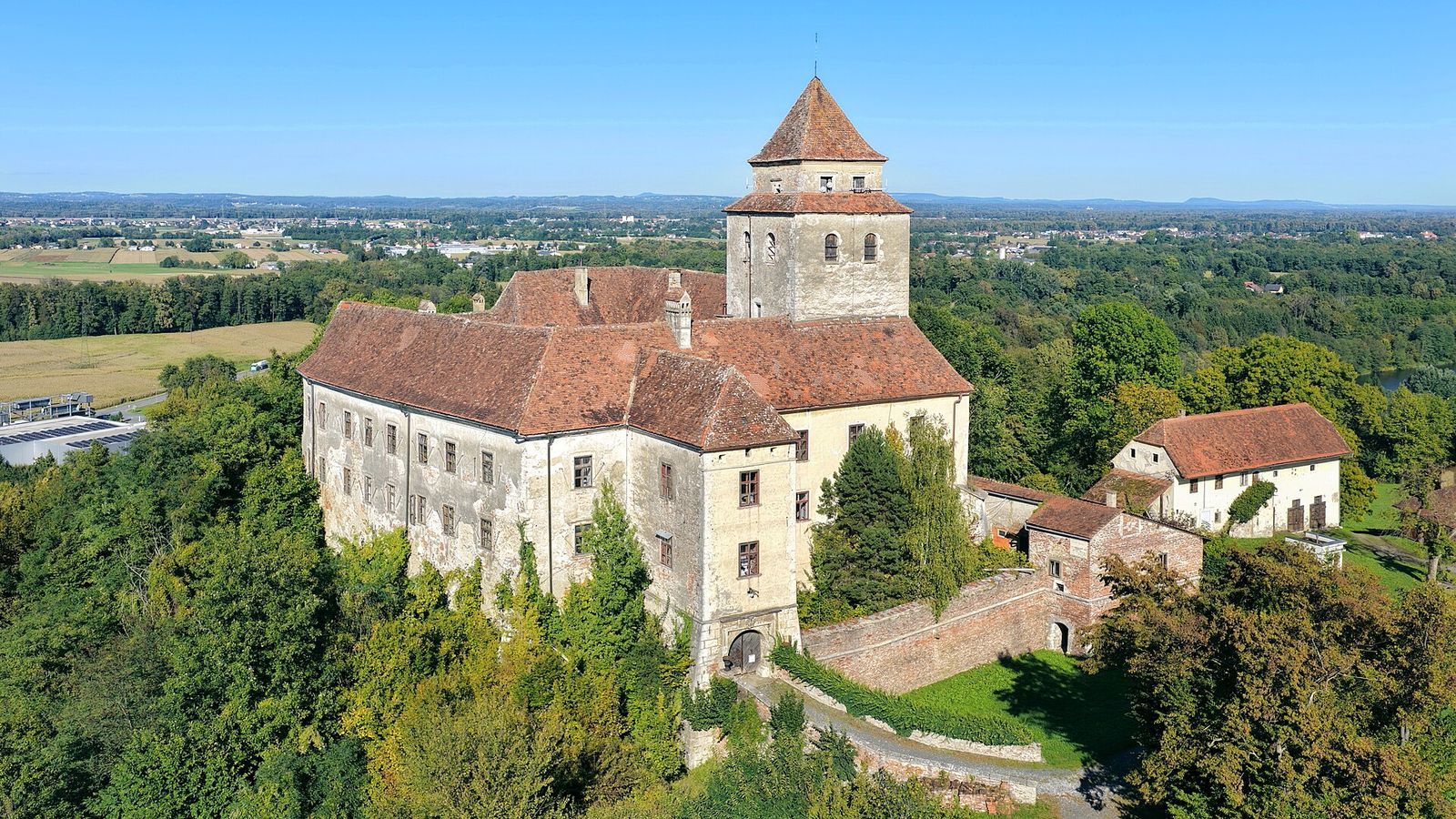
The castle occupies a steep-sided rise, 297 metres above the Mur River and the town. Its surviving structure is an irregular Renaissance building of three storeys, arranged in four wings around an inner courtyard.
Buildings on the rise
Castle
The four wings enclose an arcaded courtyard, an inner court bordered by arcades. The complex includes a 12th-century keep, a fortified tower within a castle. Its fortifications remain well preserved.
Mausoleum
Ruprecht von Eggenberg’s mausoleum stands on the same rise, not far from the castle.