Mausoleum of Ruprecht von Eggenberg: A Counter-Reformation Memorial in Austria


Site at a Glance
- Rating
- 4.3
- Popularity
- Very Low
- Country
- Austria
- Primary era
- Early Modern
- Eras represented
- Early Modern, Modern
- Civilizations
- Habsburg, Holy Roman Empire
- Site type
- Religious
- Remains
- Tomb
On this page17 sections
History
The Mausoleum of Ruprecht von Eggenberg is a Baroque burial chapel at Ehrenhausen in Austria, commissioned by the imperial officer Ruprecht von Eggenberg and completed in 1693. It stands on the Schlossberg, where its founder intended to create a dynastic burial place shaped by Catholic belief and the military ideals of the Eggenberg family.
Ruprecht von Eggenberg and the planned burial place
Ruprecht von Eggenberg was the son of Christoph von Eggenberg and Helene von Fieger. His military career advanced through Habsburg service during conflicts with the Ottoman Empire. He commanded at the Battle of Sisak in 1593, took part in the capture of the Ottoman fortress of Petrinia in 1595, and commanded Austrian troops on the Croatian Military Frontier from 1594. This frontier was a Habsburg-administered border zone organized for defence against the Ottoman Empire. Ruprecht became field colonel in Upper Hungary in 1596 and general field colonel and master of ordnance in 1597. His achievements helped promote the later rise of the Eggenberg family.
Ruprecht may have decided in 1595 to establish a burial site beside his castle. In his testament of 1609, he ordered that he be buried there and intended the mausoleum for himself and the male descendants of his family who had served as Catholic officers at the rank of general or colonel. The project therefore combined a personal memorial with a family institution and a statement of Catholic military service.
Construction and interruption
Construction is generally dated to 1609–1614, although work had begun several years earlier. A report of 4 June 1603 stated that the wall and bastion had already reached the cornice. The stone balustrade carries the date 1610, and the recorded cost was approximately 10,000 florins.
Johann Waldter was probably the builder. He may have been an immigrant from northern Europe, and his sculptural work shows the influence of the Netherlandish Baroque. The first design has been tentatively associated with the imperial court artist Giovanni Pietro de Pomis, while a proposed connection with Johann Bernhard Fischer von Erlach lacks documentary support.
Ruprecht died unmarried and childless in 1611. He had made the lordship of Ehrenhausen a family entail and adopted his nephew Wolf von Eggenberg as his son. Wolf, who served as a general-colonel on the Croatian frontier, continued the building work. His death in 1615, combined with financial difficulties and the extinction of the Ehrenhausen branch, brought construction to a long halt.
Completion under the Graz branch
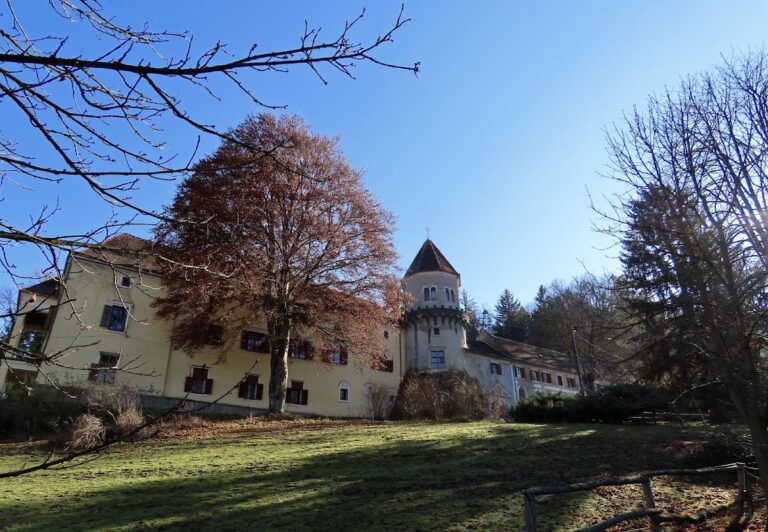
In 1624 Emperor Ferdinand II raised Ehrenhausen to market-town status, while the former castle was remodelled as a palace. When the Ehrenhausen branch of the Eggenbergs died out in 1646, the market and palace passed to the family’s Graz branch. Work on the mausoleum resumed in 1680 under Johann Christian von Eggenberg of that branch.
Johann Christian oversaw the completion of the monument in 1693. Artists and craftsmen who had previously worked for the Eggenbergs in Graz took part, including the sculptor Andreas Marx, the stonemason Johann Baptist Carlone, the stucco artists Joseph and Alexander Serenio, and the painter Hans Adam Weissenkircher. The mausoleum was consecrated on 19 April 1693, eighty-four years after construction began. Ruprecht and Wolf von Eggenberg, his nephew and universal heir, were buried there.
Later ownership and Catholic memorial meaning
After the early death of Johann Christian II von Eggenberg in 1717, the Eggenberg family became extinct. Ownership of Ehrenhausen Palace and the adjacent mausoleum then changed repeatedly, passing through Maria Charlotte Fürstin Eggenberg, Maria Theresia Gräfin Leslie, Anton Graf Leslie, Rosalia Gräfin Attems, Adéle Kosztolányi, and Paul Clemens Salvi before the estate was sold in 1904.
The former Prince-Archbishop Theodor Kohn of Olomouc acquired the palace in 1904, lived there until his death in 1915, and was buried in the mausoleum. He bequeathed the building to the state of Styria, which has owned it since 1920. The mausoleum is protected as a historic monument.
The building’s Catholic programme reflects the Counter-Reformation, the Catholic Church’s institutional and religious response to the Protestant Reformation. In the Habsburg lands, that response reinforced Catholic worship, patronage, and political identity. The mausoleum also commemorates Ruprecht’s military and political achievements and helped distinguish his burial place from the Eggenberg tomb in the parish church of Ehrenhausen, which was associated with the Protestant Graz branch until its conversion to Catholicism under Prince Ulrich von Eggenberg. The mausoleum is regarded as one of the three major Counter-Reformation mausoleums in Styria, together with those of Archduke Charles II in Seckau Basilica and Emperor Ferdinand II in Graz.
Remains
The monument occupies an artificially constructed terrace high above the wooded western slope of the Schlossberg. Stone balustrades enclose the terrace. The building itself is a plain rectangle with a barrel vault and side buttresses, while an octagonal tambour, a raised drum supporting a dome, rises above the centre. A bell-shaped dome and delicate lantern complete the upper structure.
Exterior sculpture and memorial additions
West facade
The west facade, directed toward the valley, is the principal display front. Its Mannerist treatment, produced between 1682 and 1688, combines late-Renaissance artificiality and elongated forms with dramatic Baroque display. Two monumental ancient warrior figures act as tomb guardians. They wear lion skins, carry clubs, and stand with bare legs. The northern figure carries a club over his shoulder. Carved from Aflenz sandstone, the figures are attributed to Andreas Marx and measure approximately 9 metres in height including their plinths. They replaced obelisks planned in the original design.
Military and dynastic imagery
The facade also includes a contemporary representation of a Renaissance condottiere, a professional military commander shown here in martial form. Helmets, armour details, morning stars, and swords reinforce the attribution of the sculpture to Andreas Marx. Marx also created the statue of Saint Rupert on the roof ridge. The plinths show victories over Ottoman forces on land and at sea, including a galley representing the naval Battle of Lepanto in 1571. Male herms, sculpted figures with heads or busts above tapering bodies, stand at the entrance wearing headgear described as Turkish. Construction was financed from booty taken in the Ottoman wars.
Coat of arms and the north exterior
Above the portal, the Eggenberg coat of arms is surrounded by a laurel wreath and carries the motto “POST ONVS HONOS,” meaning “After the burden, honour.” Two angels support the shield. The angel on the right holds an upright Bosnian flag, whose shield shows an arm carrying a handschar, or curved Oriental sabre. After Theodor Kohn’s burial in 1915, the north exterior received a mourning marble angel made in Paris and bearing Kohn’s coat of arms. His episcopal shield is surmounted by a galero, a broad-brimmed ecclesiastical hat whose tassels indicate clerical rank, together with a mitre and a crown set diagonally outward.
Chapel interior
Baroque architectural setting
The interior is predominantly Baroque. Four vine-covered columns were inserted into the rectangular, barrel-vaulted space to support the octagonal dome and its lantern. The chapel is entirely white and has elaborate stucco decoration by Alexander and Joseph Serenio. Four large seated figures extend through the space, each carrying an emblem of death such as an hourglass, a skull, or a smoking or extinguished torch.
Altar and paintings
The altarpiece in the Chapel of the Saviour was painted by Hans Adam Weissenkircher and signed “A. Weissenkircher” in 1691. It shows Mary and Saint Rupert asking the Holy Trinity to grant victory to the Christian armies in their struggle against the Ottoman forces. Two large Baroque portraits, now represented by copies, show Ruprecht and Wolf von Eggenberg in military dress. The painter is unknown. Reliefs of Ottoman battles on land and sea once occupied the portraits’ plinths; they were already no longer recognizable in the 1930s and are now painted over in white.
Crypt and sarcophagi
Access and burial chamber
A wrought-iron trapdoor at the centre of the chapel’s chequerboard floor opens into the small vaulted crypt. The chamber provides space for three sarcophagi. Ruprecht’s stone sarcophagus stands against the north wall and is decorated with a skull. Its inscriptions read “TE NUNQUAM TIMUI,” or “I never feared you,” “DUCUM EST PUGNARE,” or “Leaders must fight,” and “HIC SUIT, HIC SECIT, PUGNAVIT, VICIT, AMAVIT,” translated as “Here he lived, acted, fought, conquered, and loved.”
Wolf von Eggenberg’s sarcophagus
Wolf von Eggenberg’s stone sarcophagus stands against the south wall. It too bears a skull, together with the inscriptions “Besser dich,” meaning “Improve yourself,” and “MORS RAPUIT DUCES,” meaning “Death carried off the leaders.”
Theodor Kohn’s burial
Theodor Kohn rests in the crypt in a triple sarcophagus made of glass, metal, and marble. His pontifical insignia form part of the burial ensemble, linking the later interment to his ecclesiastical office and to the mausoleum’s continuing use as a family and commemorative burial place.