Schloss Bruck: A Medieval Castle and Museum in Lienz, Austria

Site at a Glance
- Rating
- 4.3
- Popularity
- Medium
- Country
- Austria
- Primary era
- Medieval
- External website
- Open
- Eras represented
- Medieval, Early Modern
- Civilizations
- Habsburg, Holy Roman Empire
- Site type
- Military
- Remains
- Castle
On this page8 sections
History
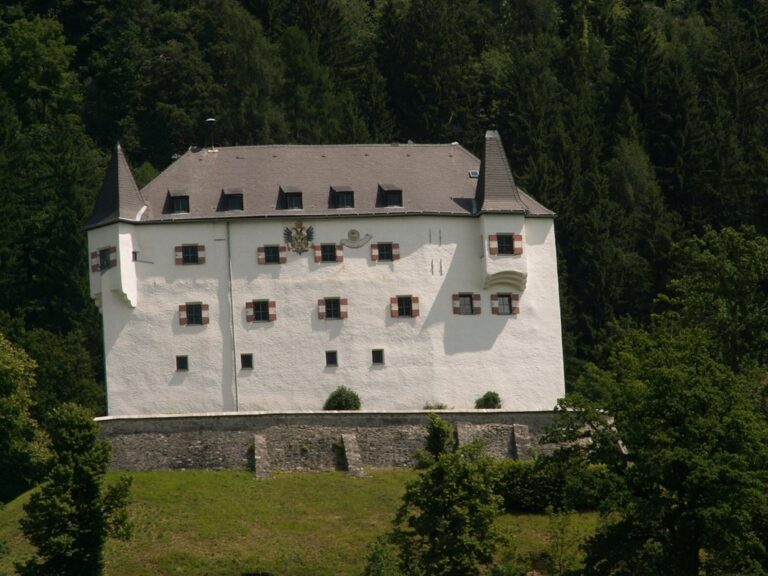
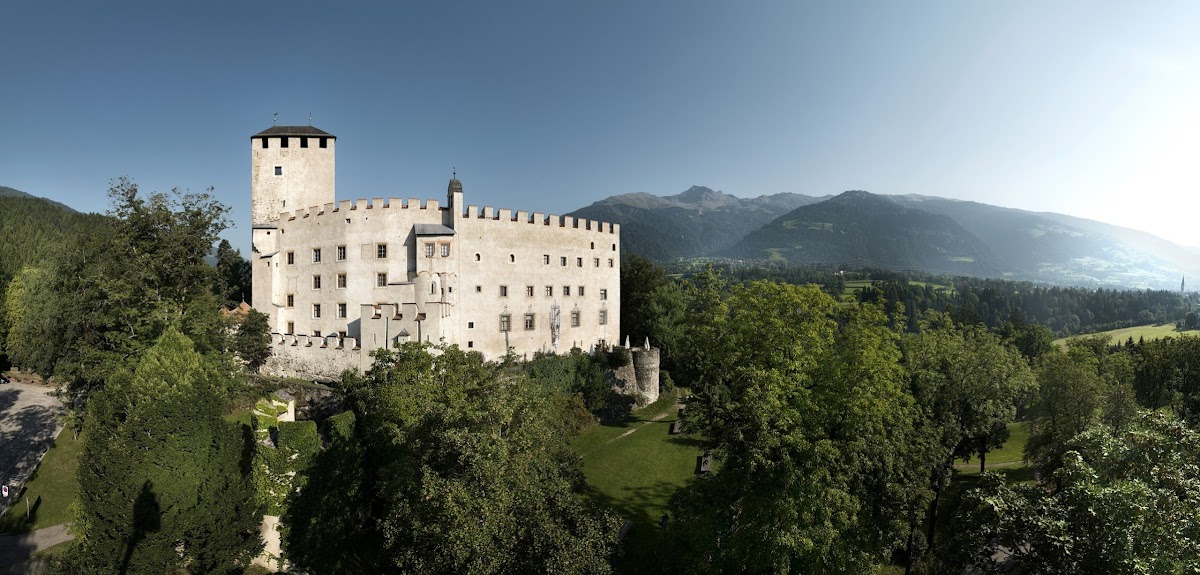
Schloss Bruck is a medieval castle in Austria, located within the city of Lienz in southern East Tyrol. The Counts of Gorizia commissioned it between 1252 and 1277, and it became their residence from about 1278 until 1500. Built on a hill adjoining Hochstein, Lienz’s local mountain, the castle occupied an important position in the territory ruled by this medieval dynasty.
Before and during Gorizian rule
Archaeological finds near the Schlossberg, including two copper or bronze axes, indicate settlement in the surrounding area approximately 3,000 years ago. The castle itself belongs to the period of Gorizian control, when the Counts of Gorizia held territories around Lienz.
Leonhard, the last Count of Gorizia, died childless in 1500. His possessions, including Schloss Bruck, passed to Maximilian I, the Habsburg ruler who was King of the Romans and later Holy Roman Emperor. Maximilian incorporated the former Gorizian territories into the County of Tyrol, bringing the castle into the Habsburg sphere.
The Wolkenstein-Rodenegg residence
After a short period under Virgil von Graben, Maximilian I sold the lordship of Lienz, including Schloss Bruck, to Baron Michael von Wolkenstein-Rodenegg on 10 August 1501 for 22,000 gulden, subject to a perpetual right of redemption. The Wolkenstein-Rodenegg family retained the castle and lived there until about 1608.
The castle was considered too cold for residence. For that reason, the brothers Sigmund and Christoph von Wolkenstein-Rodenegg built the Liebburg as a new residential palace on Lienz’s present main square between 1606 and 1608. This change ended Schloss Bruck’s role as the family’s principal home.
Barracks, commercial use, and museum
Schloss Bruck served as a barracks from 1796 until French Republican troops occupied Lienz in 1797 under General Barthélemy Joubert during the French Revolutionary Wars. In later years, the castle passed into private ownership and was used as an inn, a brewery, and premises for a forwarding company.
A local-history museum for the East Tyrol district opened in the castle on 13 June 1943. The building has since housed the Museum of the City of Lienz, whose collections include many paintings by the Lienz-born Tyrolean painter Albin Egger-Lienz. The museum has also presented changing art and thematic exhibitions, including the 2000 state exhibition on East Tyrol, Brixen, and Trentino. It received the Tyrolean Museum Prize in 2007.
Remains
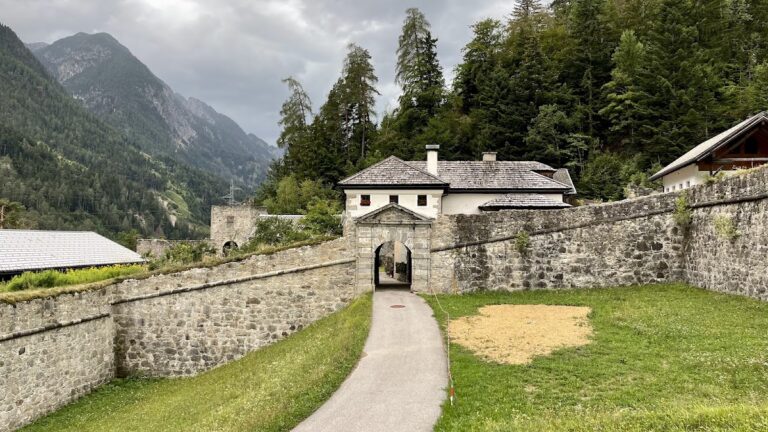
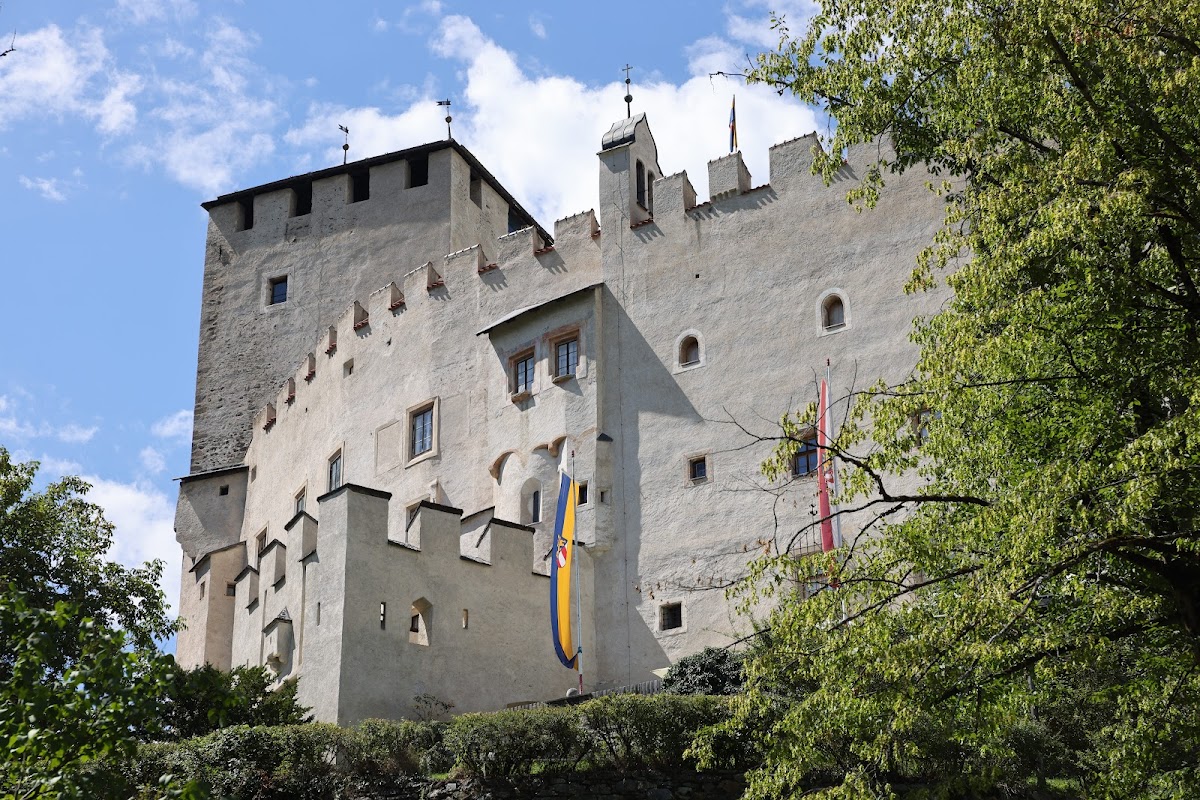
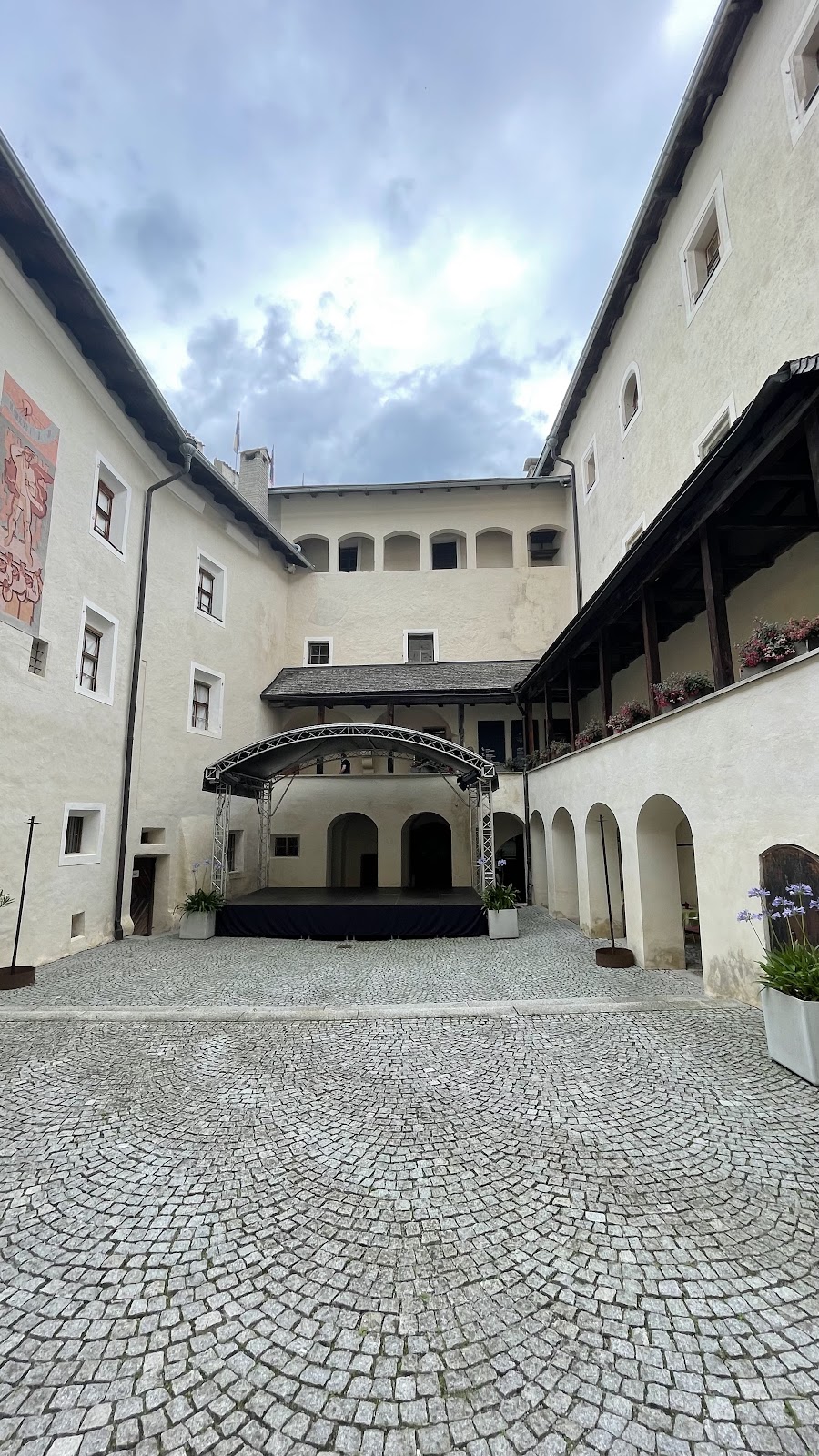
Schloss Bruck is arranged around an elongated inner courtyard reached through a main gate and a diagonally rising stone bridge. The surviving complex combines defensive elements with a richly decorated chapel. A small pond and woodland near the gate form part of the immediate surroundings.
Gate and courtyard
The main entrance leads across the stone bridge into the inner courtyard. A sundial made by Rudolf Szyszkowitz in 1944 stands within this space. The castle also retains an external garderobe, a projecting latrine, as part of its medieval fabric.
The bergfried
On the southwest side of the courtyard rises a six-storey bergfried, the principal defensive tower of a medieval German-speaking castle. It is approximately 37 metres high, and a wooden stairway provides access to its interior. A Romanesque double-arched window from the castle’s construction period survives in the tower. Its two arched openings are divided by a central support with a carved bud capital, a capital decorated with stylized budding forms.
The uppermost level of the tower has a continuous viewing gallery, with a roof structure associated with the gallery. Together, the tower, gallery, and roof preserve the defensive character of the castle’s principal vertical element.
The castle chapel
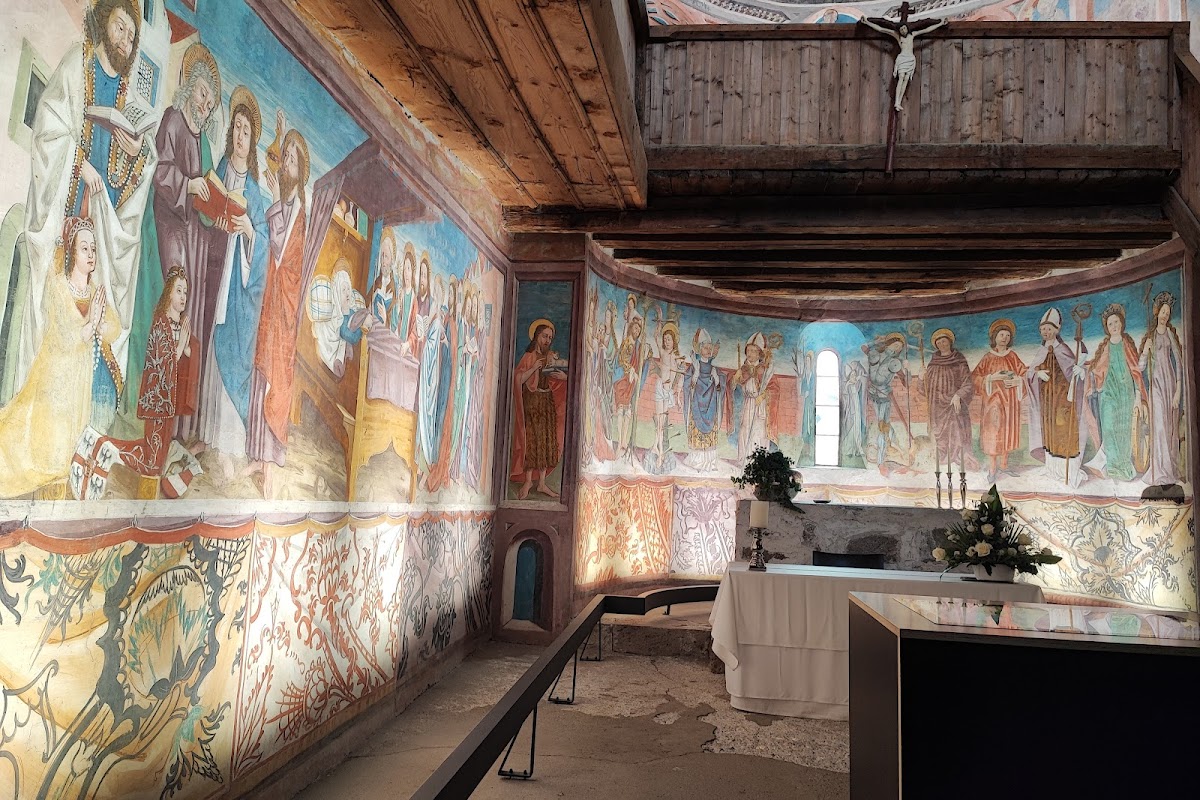
The chapel occupies the southeast side of the courtyard. It is a two-storey building with a square ground plan and a rounded apse, the curved end of the chapel. Its walls are richly decorated with Late Gothic paintings, a later medieval style known for elaborate line work, expressive figures, and detailed ornament.
The apse contains scenes of the Fourteen Holy Helpers, saints traditionally invoked together for protection against illness and danger, and the Death of the Virgin. Simon von Taisten created these works around 1495. In 1452, Nikolaus Kenntner painted the Throne of Mercy in the vault of the rounded apse, showing God the Father presenting the crucified Christ with the Holy Spirit between them.
Andrä Peuerweg painted the Passion of Christ and the Last Judgment on the south wall in the middle of the sixteenth century. These works add a later layer of religious decoration to the chapel and preserve evidence of the castle’s continued use as a place of worship after its medieval construction.
Nearby sites