Bouzov Castle: A Medieval Fortress and Neo-Gothic Reconstruction


Site at a Glance
- Rating
- 4.8
- Popularity
- High
- Country
- Czechia
- Primary era
- Modern
- External website
- Open
- Eras represented
- Medieval, Modern
- Civilizations
- Holy Roman Empire, Teutonic Order
- Site type
- Military
- Remains
- Castle
On this page10 sections
History
Bouzov Castle is a medieval fortress in Czechia, standing above the village of Bouzov in central-western Moravia. It was probably established at the turn of the thirteenth and fourteenth centuries to watch the trade route between Olomouc and Loštice, and its present appearance largely reflects a Romantic and Neo-Gothic reconstruction carried out between 1895 and 1910.
Medieval foundation and noble ownership
The castle’s first recorded owner was Búz, a member of the Búz family mentioned between 1317 and 1339. The castle took its name from this family. From the middle of the fourteenth century, Bouzov belonged to the Lords of Vildenberk, who sold it to Margrave Jobst of Moravia in 1382. Jobst transferred the castle to the Lords of Kunštát in 1396, and they held and strengthened it for about seventy years.
Ownership later passed among several noble families, including the Haugwitz and Podstatsky families. Jan Haugvic of Biskupice bought Bouzov in 1494. King Vladislaus Jagiellon raised him to the Bohemian lords’ estate in 1502 in recognition of loyal service. Haugvic died at the castle at the end of 1524, after which his heirs retained it.
A tradition connects Bouzov with George of Poděbrady, a fifteenth-century Bohemian nobleman and king. He was reportedly born at the castle in 1420 and became King of Bohemia in 1458, but the connection with Bouzov remains a tradition associated with his Kunštát lineage.
Fortress, fire, and changing use
During the first half of the fifteenth century, Bouzov became a Hussite stronghold. The Hussites were a religious and political movement that challenged the authority of the Catholic Church in Bohemia and Moravia. During the Thirty Years’ War, a major European conflict of the seventeenth century, the castle served as an imperial fortress and held captured Swedish soldiers as prisoners.
Bouzov burned in 1558, and financial difficulties delayed its complete restoration until 1620. It continued as a noble residence almost until the end of the seventeenth century, although it had lost its defensive role and was increasingly used chiefly for residential purposes.
Eugenie Podstatsky of Prusinowitz acquired the castle in 1649. Her son sold it to the Teutonic Order in 1696. This medieval Catholic religious and military order later developed important charitable and institutional functions. The Order did not reside at Bouzov, and parts of the castle deteriorated. During the eighteenth century, the complex ceased to function as a residence apart from a building in the outer settlement. By the end of the nineteenth century, its deteriorating condition had made it a target for vandals.
Teutonic Order reconstruction and twentieth-century ownership
Between 1895 and 1910, Archduke Eugen of Austria-Teschen, Grand Master of the Teutonic Order from 1894 to 1923, initiated a major rebuilding campaign. Funds from the Order’s estates were used with the consent of its chapter. The project recreated the castle in a Romantic historicist and predominantly Neo-Gothic manner, while also preparing part of it for public access.
After the First World War and the dissolution of Austria-Hungary, the newly established Czechoslovak Republic confiscated Bouzov from the Teutonic Order. Czechoslovak troops occupied it on 4 November 1918 because the interior furnishings belonged to Archduke Eugen and were treated as Habsburg property subject to confiscation. The troops withdrew in 1923 after Eugen voluntarily surrendered his office as Grand Master and the International Court at The Hague ruled that the Order was an international spiritual and charitable institution whose property was not subject to confiscation.
The Teutonic Order later bought Eugen’s property and inventory back from the Czechoslovak state, allowing the collections to remain together. It retained the castle until 1939 and used it partly as a museum of the Order, except during the Second World War. In 1939, Nazi authorities confiscated Bouzov. SS units occupied it as a base for operations in the surrounding area. Their final recorded operation from the base was the burning of Javoříčko and the killing of 38 men aged between 15 and 76.
After the Second World War, the Czechoslovak state confiscated Bouzov, and the castle remained under state administration. The Czech Republic is its owner, while the National Heritage Institute administers it. Later efforts by the Teutonic Order to recover the castle, including action in 2016, had not succeeded. Bouzov has been protected as a cultural monument since 1964 and was added to the Czech national cultural monuments list in 1999.
Remains
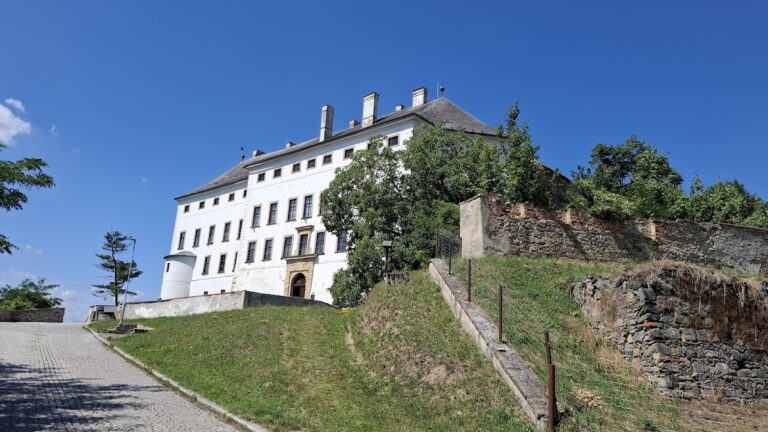
Bouzov’s present complex combines surviving medieval fabric with extensive construction from the late nineteenth and early twentieth centuries. The buildings form a horseshoe around a dominant watchtower, while additional towers, bastions, battlements, oriel windows, and loopholes reinforce the castle’s historicist appearance. Two long bridges cross the deep dry moat and lead to a short drawbridge.
Medieval fortifications
The early castle probably consisted of a fortified tower, a rampart, and wooden residential buildings. Its arrangement followed a bergfried-type plan, centered on a defensive tower rather than a tower intended as a permanent residence, together with a single-storey palace.
The Lords of Vildenberk built a stone manor on the western side, raising it above the existing rampart. During the fourteenth century, the castle expanded to include an outer settlement, service buildings, a ditch, a surrounding defensive wall, and a 61-metre-high watchtower. Under the Lords of Kunštát, a new connected rampart strengthened the manor, and two bastions were added. The wall around the moat was later rebuilt with five round bastions, followed by the addition of a round gun bastion and repairs to the tallest watchtower.
Residential and defensive additions
An outer bailey, or fortified area beyond the main castle, was added at the end of the fourteenth century. In 1499, the Haugwitz family began building a palace on the eastern side and connected the northern and southern residential buildings. The southern wing was remodelled after the fire of 1558, when Bouzov was increasingly serving as a residence rather than as an active defensive stronghold.
Romantic reconstruction
Most of the medieval castle was demolished in 1895. A new castle was erected over the following two years in a Romantic historicist style that imitated southern German castles, while the wider reconstruction continued until 1910. Georg von Hauberrisser prepared the design. The resulting complex is dominated by an eight-storey watchtower approximately 58 metres high, around which the buildings are arranged.
Towers, bridges, and defensive features
The reconstructed exterior incorporates additional towers, bastions, battlements, oriel windows, and loopholes. The deep dry moat is crossed by two long bridges that terminate at a short drawbridge. These features form the principal approach and defensive elements of the present castle.
Central rooms and collections
The central section contains a knights’ hall, an armoury, bedrooms for knights, and a Neo-Gothic chapel. The chapel has a Gothic altar and tombs. The armoury is among the few original rooms that retain Gothic vaulting. Running water and central heating were introduced during the reconstruction.
Furniture came from Archduke Eugen’s private collection and from the Teutonic Order. Medieval artefacts associated with the Order were brought to Bouzov, and replicas of medieval furniture were used to furnish the interiors. The castle therefore presents medieval elements alongside substantial late nineteenth- and early twentieth-century construction.