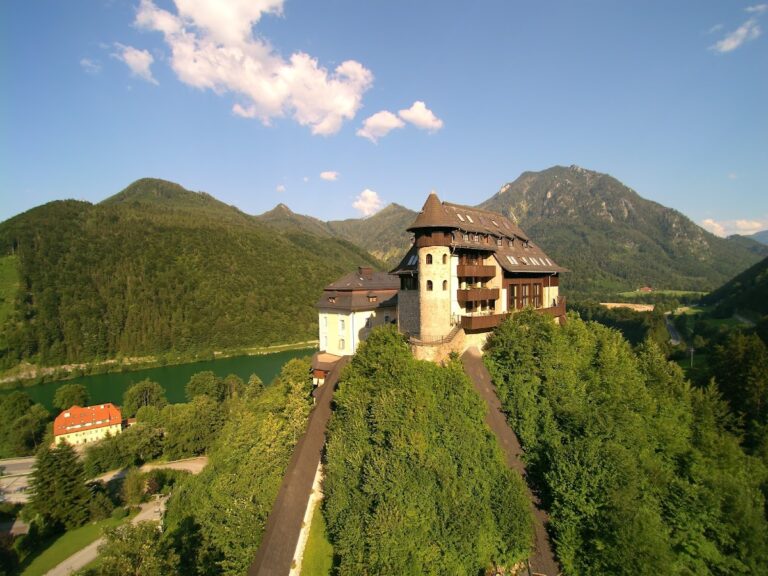
Schlierbach Abbey: A Cistercian Monastery in Austria


Site at a Glance
- Rating
- 4.6
- Popularity
- Low
- Country
- Austria
- Primary era
- Early Modern
- External website
- Open
- Eras represented
- Early Modern
- Civilizations
- Holy Roman Empire
- Site type
- Religious
- Remains
- Monastery
On this page13 sections
History
Schlierbach Abbey is a Cistercian abbey in Austria, substantially rebuilt in Baroque style between the late seventeenth century and 1712 on the site of a medieval castle. It stands in Schlierbach, Upper Austria, within the Diocese of Linz. The community belongs to the Austrian Cistercian Congregation, traces its monastic lineage to Morimond, and has Rein Abbey as its mother house. It later established the daughter abbey of Jequitiba in Bahia, Brazil.
Castle and medieval nunnery
The name Schlierbach appears in a Salzburg document of 927 and again in a donation charter issued by King Henry II in 1006 for the archbishopric of Salzburg. A castle occupied the site by the tenth century, with its construction also dated specifically to 903. Around 1352 or 1353, Eberhard V of Wallsee, a late-medieval Austrian nobleman and governor of Upper Austria, acquired the property. In 1355 he founded a Cistercian nunnery there.
The convent was formally incorporated under the name Aula beatae Mariae Virginis, meaning Hall of the Blessed Virgin Mary. It was also called Mariensaal or Frauensaal. Elisabeth of Gundelfingen became its first prioress and later its abbess, leading a community of twelve sisters. Over time, the convent enlarged its holdings through purchases, donations, and endowments. Eberhard of Wallsee transferred Steyrstein Castle, later the pilgrimage church of Frauenstein, as well as revenues from the lordship of Pernstein. The nunnery also held Altpernstein and estates at Mühlgrub. Eighteen abbesses governed the women’s monastery during its approximately two centuries of existence.
Dissolution and Cistercian restoration
The nunnery was dissolved around 1556 during the Protestant Reformation, the sixteenth-century movement that divided Western Christianity and brought the spread of Protestant churches through the surrounding region. The conventual community became increasingly secular, while the buildings remained neglected for about sixty-four years. Successive secular and monastic officials administered the property during this period.
Habsburg rulers prevented the former convent from passing into secular ownership. Kremsmünster Abbey administered it from 1609 to 1620, and during the Counter-Reformation, the Catholic reform movement that sought to restore Catholic institutions after the spread of Protestantism, Emperor Ferdinand II authorized its resettlement by Cistercian monks from Rein Abbey near Graz. In 1620, Rein’s abbot Matthias Gülger sent Prior Wolfgang Sommer and several monks to Schlierbach. Sommer became the first abbot of the re-established monastery. The community’s initial task was to restore pastoral care in the upper Kremstal, although peasant revolts temporarily hindered this work.
Abbot Franz Keller, who governed from 1627 to 1644, received a seat and vote in the Upper Austrian Estates. In 1654, under Abbot Balthasar Rauch, the abbot and his successors received the right to use episcopal insignia, including the mitre, pectoral cross, and crozier. These symbols expressed the institutional standing of the monastery’s abbot.
Baroque rebuilding
By the seventeenth century, the former castle had fallen into extremely poor condition. Abbot Nivard I Geyregger, who led the community from 1660 to 1679, therefore began a complete rebuilding of the complex. His successor, Abbot Benedikt Rieger, commissioned the new abbey church and continued work on its tower and the conventual buildings between 1679 and 1695. Under Abbot Nivard II Dierer, who governed from 1696 to 1715, the main abbey building and its two northern wings were completed, including the summer prelature, the abbot’s official residence or suite, and the Bernardisaal. The resulting complex became a major work of Austrian Baroque architecture around 1700.
During the rule of Abbot Christian Stadler, from 1715 to 1740, the abbey’s economic recovery continued. A mill, sawmill, and bakery were established, and the community grew to about thirty monks. The monastery thus combined religious life with the practical agricultural and craft activities traditionally associated with Cistercian practice, summarized in the principle ora et labora, or “pray and work.”
Reform, war, and nineteenth-century difficulties
The Josephinian reforms, the ecclesiastical and administrative measures associated with Emperor Joseph II, brought renewed restrictions and changes to monastic organization. The Napoleonic Wars added further pressure. Choral prayer was temporarily suspended in 1809, the manorial system was abolished, and the abbey had to reorganize its economy. A fire destroyed the farmyard in 1825. Financial and institutional difficulties continued through much of the nineteenth century, although the monastery’s situation improved toward the end of the century.
Twentieth-century renewal
Abbot Alois Wiesinger, who governed from 1917 to 1955, directed a major renewal of monastic and economic life, influenced in part by Trappist practice. He restored the lay-brother institute in 1923. A lay brother traditionally undertakes practical work within a monastic community rather than belonging to the ordained choir clergy. By 1940, Schlierbach had twenty-seven lay brothers, fourteen of whom worked in the Brazilian mission monastery.
Under Wiesinger, the abbey renovated or re-equipped its metalworking shop, carpentry, and gardening operations. It established a monastery cheese dairy, opened an agricultural school, and founded a gymnasium, an academically oriented Austrian secondary school, in 1925. The school received public status in 1932, closed in 1938, reopened in 1946, and regained public status in 1947. Girls have also attended since 1977.
Mission work became an important part of the abbey’s activity in 1938, when it founded the Jequitiba mission abbey in Bahia, Brazil. During the twentieth century, the community’s economic basis also included cheese production, glasswork, agriculture, schooling, and other enterprises. The abbey library, whose collection originated in the early eighteenth century, was reorganized after periods of storage and loss. Its rooms were restored and the collection arranged again in 1974 and 1975.
The community today
Abbot Altmann Hofinger led the community from 1998 to 2008. Martin Spernbauer served as administrator from 2008 to 2013, followed by Josef Riegler from 2013 to 2016. Nikolaus Thiel was elected the nineteenth abbot in 2016 and blessed by General Abbot Mauro-Giuseppe Lepori on 15 May of that year. The community numbered about twenty-four or twenty-five members in the late 2000s and early 2020s. The monks provide pastoral care in nine parishes, a chaplaincy, and a deanery, an administrative grouping of neighboring parishes, serving approximately 18,000 Catholics in the surrounding region.
Schlierbach remains an economically active monastic institution. Its enterprises include a cheese dairy, glass and stained-glass workshops, forestry, agriculture, schooling, and the Genusszentrum, which combines events, the presentation and sale of abbey products, a restaurant, store, and gallery.
Remains
The surviving abbey complex occupies the former castle site and consists of the church, conventual buildings, the prelature courtyard, northern wings, the summer prelature, the Bernardisaal, and the library. Most of the present fabric belongs to the large Baroque rebuilding carried out from the late seventeenth century through 1712. The west front was completed in 1674, while the north and east fronts of the prelature courtyard and the abbey tower followed in 1678.
Abbey church
The abbey church was built between 1680 and 1683. Pietro Francesco Carlone supplied the plans, and construction was carried out by his sons, including Carlo Antonio Carlone. Members of the Carlone family also shaped the interior: Giovanni Battista Carlone worked as a sculptor and stucco artist, while Giovanni Carlone painted frescoes. The church contains abundant Baroque stucco decoration and fresco painting. Its high altarpiece presents the Assumption of the Virgin Mary and was painted by Franz Werner Tamm. Johann Baptist Wanscher of Linz created the elaborate gold-leaf foliage and floral paintings on the pilasters.
The church organ retains a Baroque case dating from 1770. Manfred Mathis renovated the organ in 1985, preserving the instrument’s later history within the older church interior.
Library and ceremonial rooms
Added in 1712, the library is a Baroque ceremonial room with a cruciform plan and suspended domes. Its gallery rests on Corinthian wooden columns attributed to Johann Michael Prunner, a master builder from Linz. The Bernardisaal is another Baroque ceremonial hall, distinguished by extensive stucco decoration across both its ceiling and walls. Together, these rooms form part of the representative spaces created during the completion of the early eighteenth-century abbey.
Cloister statue
The cloister, a covered walkway enclosing a monastery courtyard, contains the Schlierbacher Madonna, a wooden Gothic statue of the Virgin Mary dated to around 1320. Monastic tradition holds that the first nuns brought the statue from their Swabian homeland. Its presence connects the later Baroque monastery with the earlier Cistercian women’s community founded on the site.
Cheese dairy and workshops
The monastery cheese dairy was established in 1924 and includes a demonstration dairy. It produces fourteen types of cheese, including St. Severin. Brother Leonhard brought the recipe for St. Severin to the abbey in 1920. The Schlierbach glass and stained-glass workshop, founded in 1884, has produced works by artists including Margret Bilger, Josef Mikl, Hans Plank, Rudolf Szyszkowitz, Georg Meistermann, and Adi Holzer. The Margret Bilger Gallery provides space for temporary exhibitions of contemporary art.
Economic grounds
The abbey’s economic grounds include approximately 230 hectares of woodland and about 70 hectares of agricultural land. These lands remain connected with the monastery’s continuing agricultural and forestry activity, alongside its educational, pastoral, craft, and food-production enterprises.
Nearby sites