Savona Cathedral: The Episcopal Church of Savona, Italy
Site at a Glance
- Rating
- 4.7
- Popularity
- Very Low
- Country
- Italy
- Primary era
- Early Modern
- Eras represented
- Medieval, Early Modern, Modern
- Civilizations
- Genoese, Italian, Kingdom of Sardinia
- Site type
- Religious
- Remains
- Cathedral
On this page20 sections
History
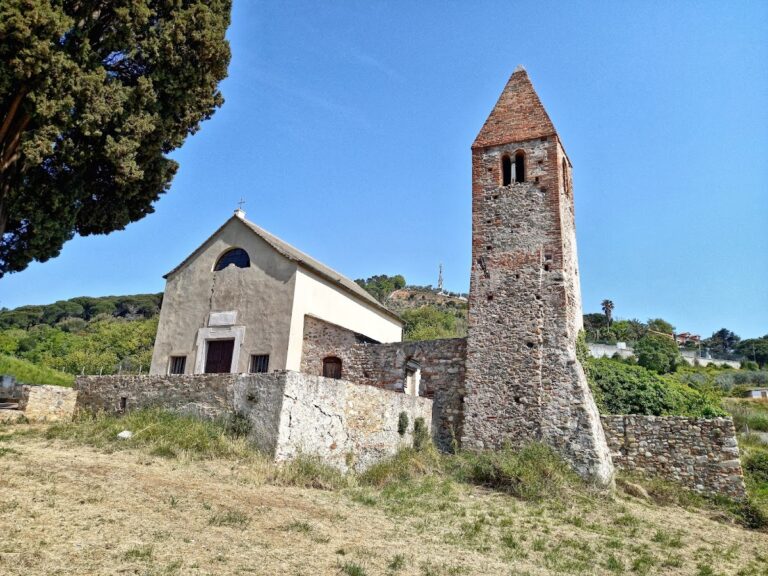
Savona Cathedral is the principal Catholic church of Savona, Italy, and the episcopal seat of the Diocese of Savona-Noli. Built during the 1580s and completed in 1605 in the Baroque period, it replaced an older cathedral destroyed after Savona came under Genoese control. The building later became a minor basilica and an Italian national monument.
From the Priamar cathedral to the Franciscan church
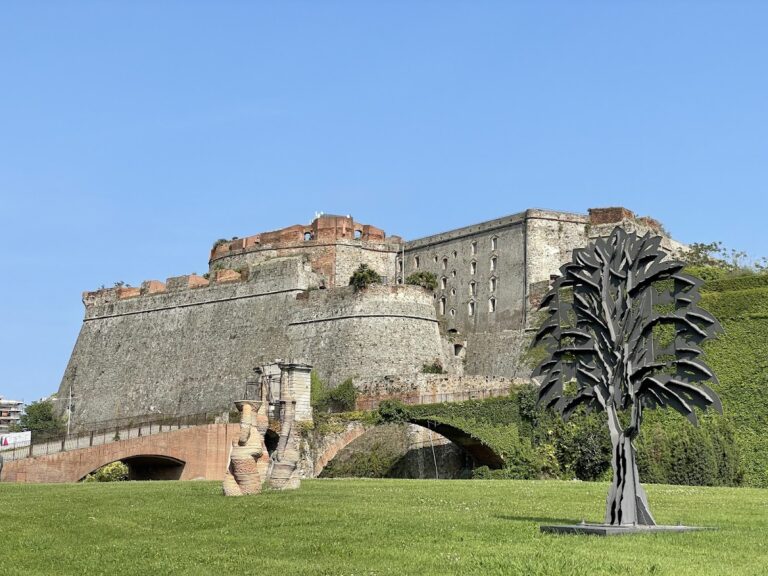
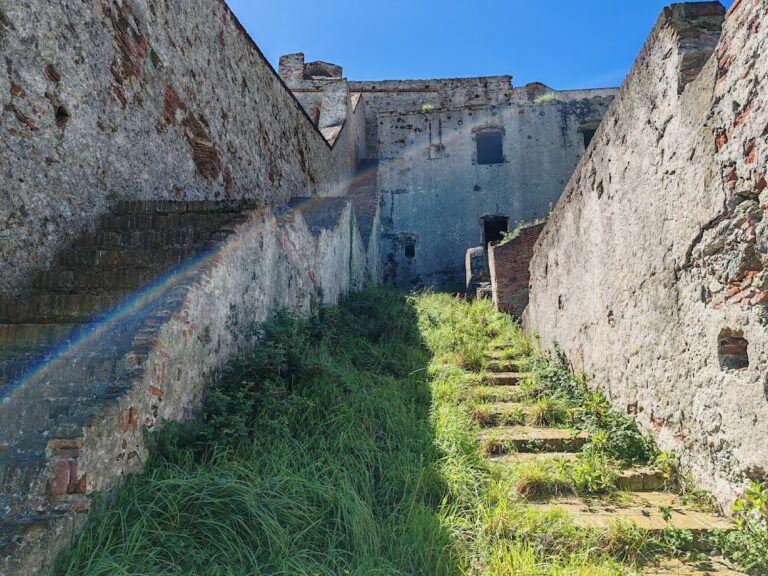
Savona’s earlier cathedral stood on Priamar hill from the ninth century. After the city surrendered to Genoese forces in 1528, the Genoese constructed a fortress on the hill and demolished the older buildings. The cathedral was first deconsecrated and was finally destroyed in 1595, although important furnishings were saved and later transferred elsewhere.
In 1559, Pope Paul IV transferred the cathedral title to the nearby Franciscan church of San Francesco. The present cathedral was built on that site during the 1580s and was completed in 1605. It was originally dedicated to Saint Francis, but its dedication was later changed to the Assumption of the Virgin Mary.
Later religious and civic history
The cathedral’s furnishings preserve several links with the earlier church on Priamar. Among them are the choir stalls, commissioned for the former Gothic cathedral between 1500 and 1521, and later adapted to the present building. Their patron was Giuliano della Rovere, then bishop of Savona and cardinal of San Pietro in Vincoli. He later became Pope Julius II, a major Renaissance patron of the arts, and appears in one of the inlaid panels.
Pope Pius VII followed religious services from a gilded wooden gallery during his imprisonment in Savona from 1809 to 1812. Napoleon had detained the pope during the Napoleonic period, and the gallery remains associated with this episode in the cathedral’s history.
The church was elevated to the rank of minor basilica in June 1816. This is an honorific Catholic designation for a church of particular religious or historical importance. In December 2024, the cathedral complex and the adjacent Sistine Chapel became part of Savona’s new museum complex.
Relics, images, and local traditions
The cathedral preserves relics of Saint Valentine the Martyr. Its chapel of the Blessed Sacrament contains the remains of Blessed Octavian, bishop of Savona, who was credited with saving the population from plague and with predicting an apparition of Mary.
The Madonna della Colonna is associated with a local miracle. Tradition holds that the medieval fresco detached itself from a column of the old Franciscan church in 1601, while that building was being demolished. The image was later incorporated into the present cathedral.
Remains
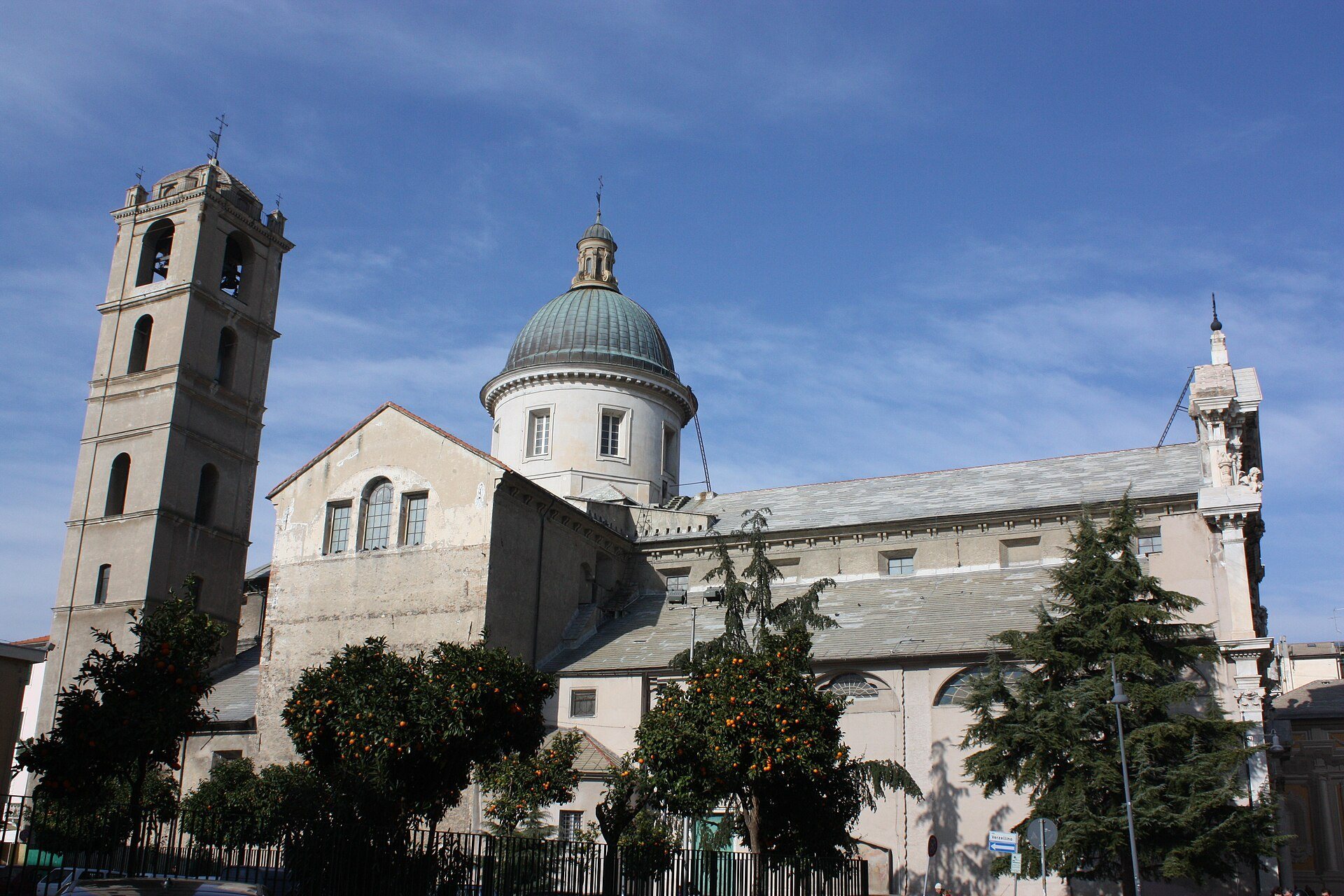
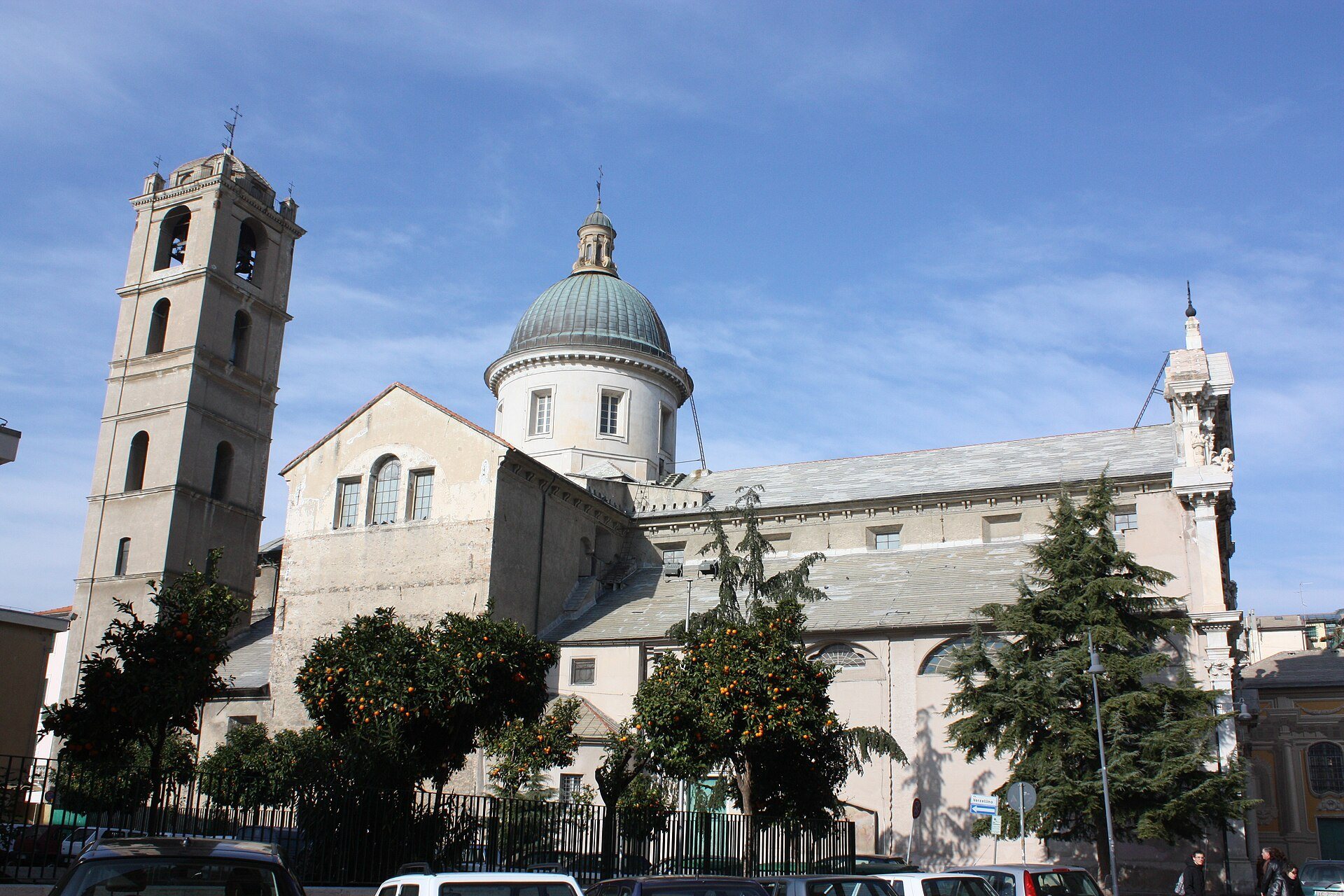
Savona Cathedral is a Baroque church measuring 61 metres long and 39 metres wide. Its Latin-cross plan has a long central axis crossed by a shorter transept, with three aisles inside. The central nave and transept are covered by barrel vaults, while the side aisles use groin vaults formed by the intersection of two vaults. Above the crossing, a dome rises on a windowed drum, the architectural section that supports a dome and contains its windows.
Exterior and former Franciscan complex
West facade and bell tower
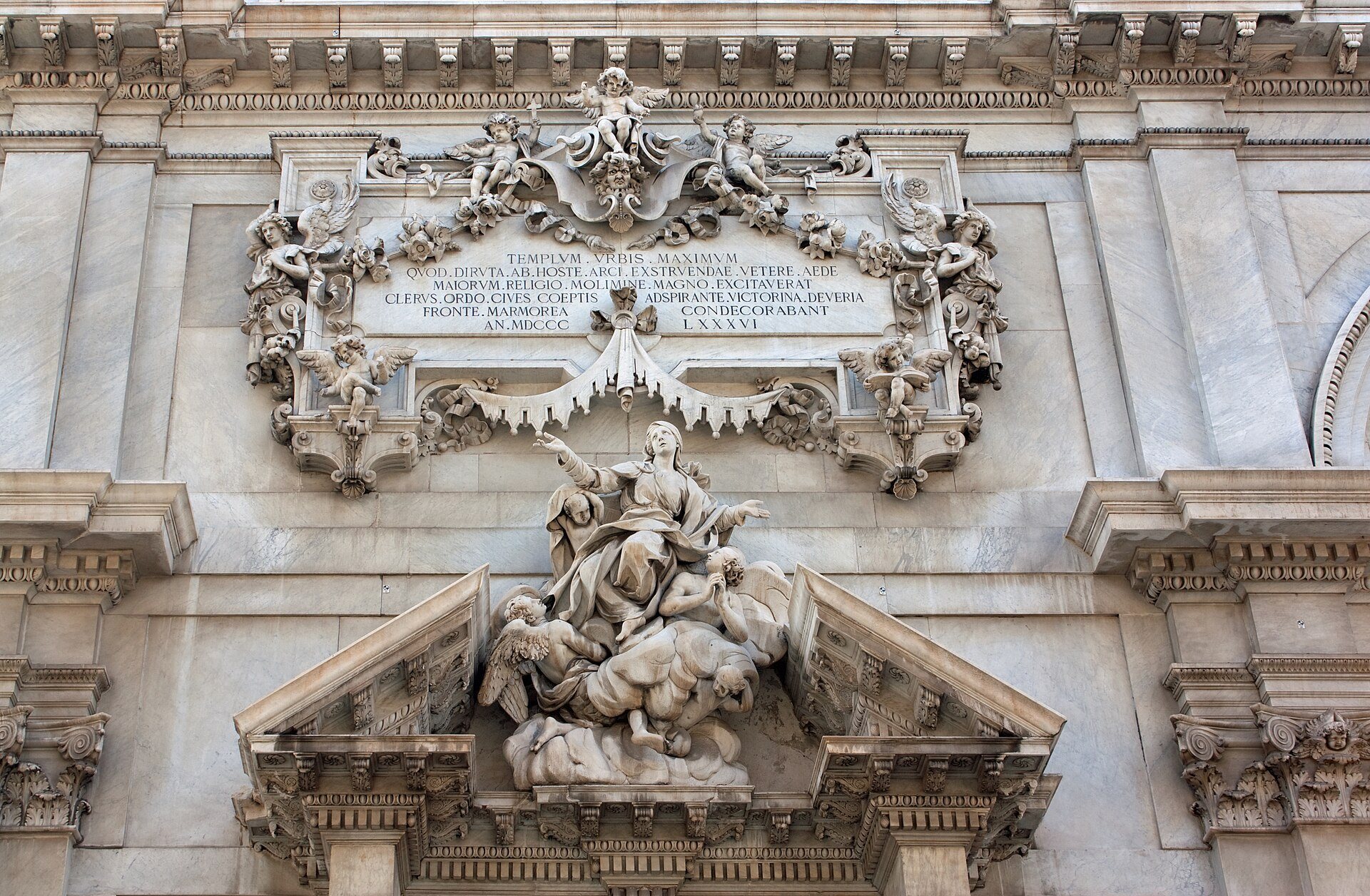
The Neo-Baroque west facade was designed by Guglielmo Calderini and built between 1881 and 1886. It is arranged in three vertical divisions containing three portals and three horizontal registers. The external portal dates from 1776 and was incorporated into the later facade. Its sculptural group of the Assumption was made by the abbot Giovanni Antonio Cybei.
A bell tower stands on the right side of the cathedral. Its construction took place in stages. The tower is dated to 1613, while its lantern was raised in 1929.
Cloister and papal gallery
The surviving cloister of the former Franciscan complex adjoins the cathedral. A doorway from the right aisle leads to it, and the doorway is surmounted by the gilded wooden gallery from which Pius VII followed services during his imprisonment in Savona.
Nave, entrance, and crossing
Frescoes and early furnishings
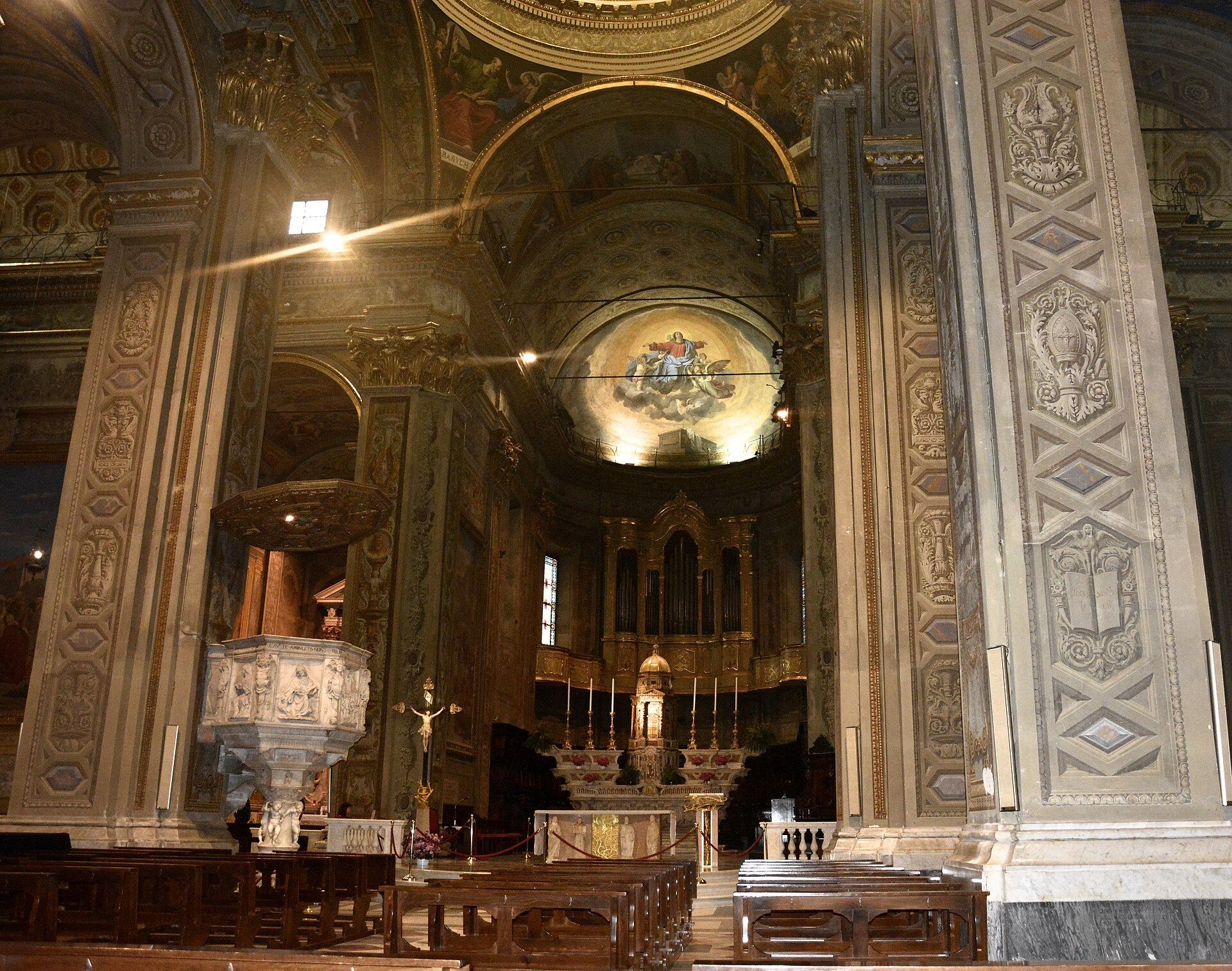
The entrance wall carries Francesco Coghetti’s fresco of Christ driving the merchants from the Temple. Coghetti, a nineteenth-century Italian painter, also decorated the central vault, the presbytery, and the dome. His works include the Stories of the Virgin from 1847, four prophets in the dome pendentives, and angels within the dome.
Near the entrance is a marble crucifix of uncertain authorship, sometimes attributed to Giacomo Molinari. A Madonna and Child appears on its reverse. Nearby stands a baptismal font made around the twelfth century from a sixth-century Byzantine capital in Cypriot marble. Both objects came from the former cathedral on Priamar hill.
Opposite the crucifix is an imposing Renaissance holy-water stoup donated by Julius II in the sixteenth century to the earlier Franciscan church. The marble pulpit from the former cathedral stands at the head of the nave against the left pier. Antonio Maria Aprile and Giovanni Angelo Molinari made it between 1521 and 1525. Its chalice-like, hexagonal body contains five relief panels showing the four Evangelists and Saint Paul preaching. Smaller reliefs depict Saints Peter, John the Baptist, Jerome, Gregory the Great, Augustine, and Ambrose. Three winged sirens and four putti decorate its triangular base.
High altar and paintings
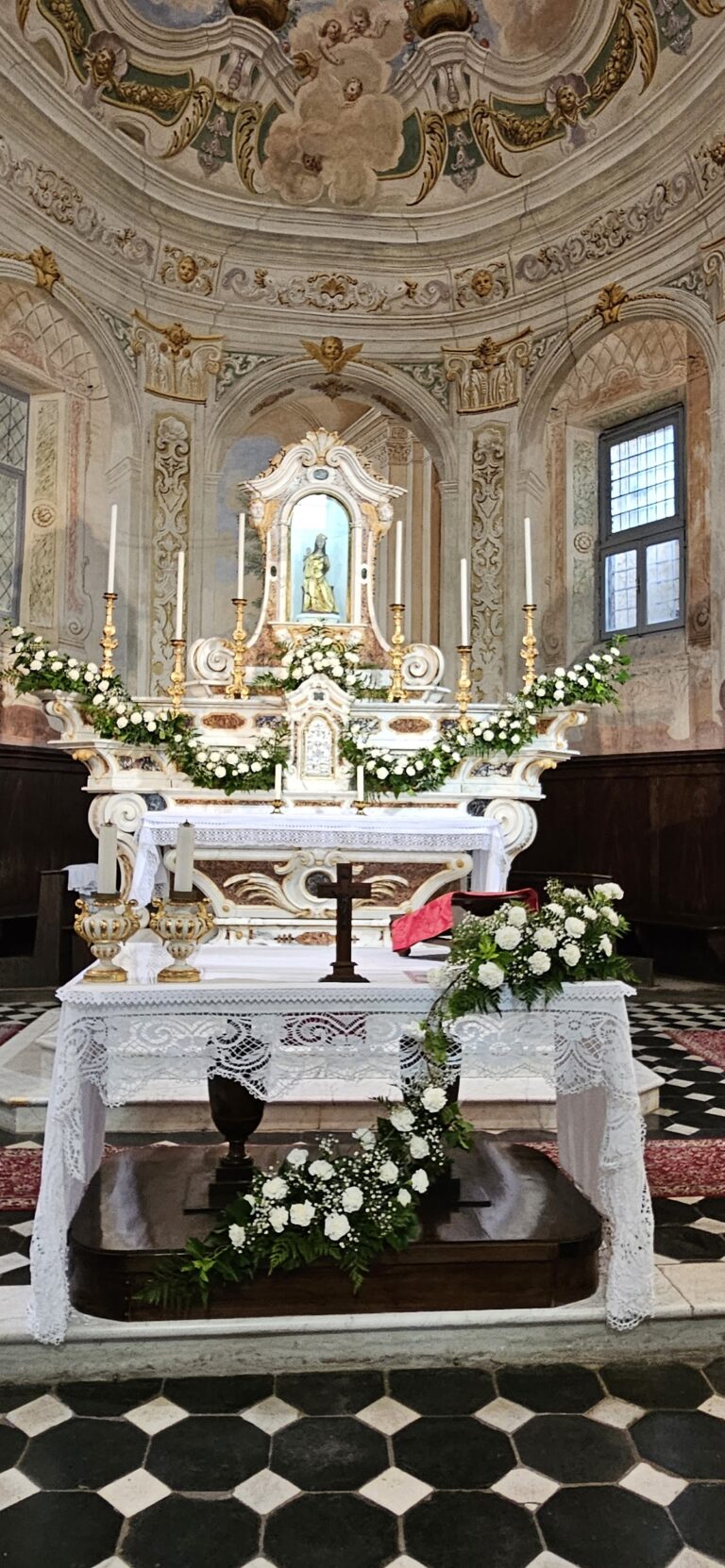
The high altar dates from 1765 and is surmounted by an octagonal ciborium, a canopy over an altar, made by Orazio Grassi in the first half of the seventeenth century. The apse basin contains Coghetti’s 1847 image of the Assumption.
Two large paintings by Coghetti, both dated 1847, hang on the walls. One depicts Julius II beginning the construction of Saint Peter’s Basilica, while the other shows Sixtus IV blessing a fleet against the Turks.
Choir and Renaissance inlays
Construction and restoration
The wooden inlaid choir consists of 37 upper stalls and 21 front stalls. It was commissioned on 30 January 1500 for an initial payment of 1,132 gold ducats, divided equally between the Republic of Savona and Giuliano della Rovere. Anselmo de Fornari of Castelnuovo Scrivia and Elia Rocchi completed the main work by 1514 under Fornari’s direction. Gian Michele Pantaleoni later added panels, doors, a lectern dated 1517, and the large inlaid base.
The upper stalls contain figures of saints, lunette canopies, decorated backs and seats, and elaborate candelabra pilasters. The front stalls contain images of still lifes with sacred furnishings, liturgical books, animals, and fruit. The choir was restored by the Garassino brothers in 1862 and underwent a complete restoration in 2002 and 2003.
Pantaleoni’s panels
Pantaleoni’s additions include panels used as stall backs, doors showing the Nativity for the Chapel of the Madonna della Colonna, and the 1517 lectern. The lectern contains images of putti holding the arms of Savona and the della Rovere family. A large base panel shows the Adoration of the Magi, Christ among the Doctors, Saint Peter, and Saint Paul.
The later work uses pyrographed wood, in which heat creates darkened lines and pictorial effects, and was probably based on designs by Albertino Piazza of Lodi. Two choir back panels are attributed to Pantaleoni. One shows Saint Barnabas seated with a book and sword. The central panel depicts the Madonna holding the Christ Child while a kneeling Julius II receives keys symbolizing papal authority. The figure and drapery recall the art of Raphael.
Chapels and transepts
Right aisle and transept
The four chapels of the right aisle contain a range of paintings and monuments. Their works include Ratti’s Apparition of the Virgin at Savona, Paolo Gerolamo Brusco’s Sacred Heart, a Madonna and Child with Angels, Giovanni Baglione’s Dream of Jacob, Giovanni Lanfranco’s Abraham with the Angels, and a monument to Bishop Righetti by Renata Cuneo.
The right transept contains a seventeenth-century altar dedicated to the dead. The chapel to the right of the presbytery has a sixteenth-century altarpiece and funerary monuments to prelates.
Left aisle and Madonna della Colonna
The first chapel of the left aisle contains a seventeenth-century altarpiece of Saint Francis of Paola and frescoes by Brusco. The second has Bernardo Castello’s Adoration of the Magi, and the third contains Giovanni Battista Paggi’s Martyrdom of Saint Ursula. The side doorway of the left aisle is surmounted by the fourteenth-century tympanum from the former cathedral.
The fourth chapel contains the Madonna della Colonna, a medieval fresco dating approximately from 1430 to 1440. Other works in the chapel include seventeenth-century altarpieces of the Presentation of Mary in the Temple, the Annunciation, Saint Ambrose, and Saint Bernard. Scenes from the life of Mary cover the vault.
Chapel of the Madonna of Mercy
The fifth chapel of the transept contains the Baroque altar of the Madonna of Mercy, dated 1663. It was transferred there in 1870 from the demolished Convent of the Discalced Carmelites of Saint Teresa. Its central statue, made by Stefano Sormano in 1625, shows the Virgin of Mercy with the farmer Antonio Botta kneeling at her feet. The statue commemorates the Virgin’s reported apparition to Botta in the hills above Savona in 1536.
The statue reached the cathedral only in the twentieth century, having previously stood at the Bellaria city gate. The chapel’s ceiling frescoes date from the seventeenth century. Its statues of Saint Joseph with the Christ Child and Saint John the Evangelist, together with wall paintings of the Redeemer blessing children and the adulterous woman, were added in the nineteenth century.
Chapel of the Blessed Sacrament
The chapel to the left of the presbytery is dedicated to the Blessed Sacrament. It contains an urn with the skeleton of Blessed Octavian and seventeenth- and eighteenth-century paintings, including a Roman-school Martyrdom of Saint Stephen.
Organ
Behind the high altar, above the choir stalls, is the Mascioni pipe organ opus 476. Built in 1935 inside the case of an earlier eighteenth-century instrument, it has electric transmission, three 61-note keyboards, and a 32-note concave-radial pedalboard.