Priamar Fortress: Savona’s Coastal Stronghold in Italy


Site at a Glance
- Rating
- 4.4
- Popularity
- Medium
- Country
- Italy
- Primary era
- Early Modern
- External website
- Open
- Eras represented
- Medieval, Early Modern, Modern
- Civilizations
- Genoese, German, Italian
- Site type
- Military
- Remains
- Fort
On this page15 sections
History
Priamar Fortress occupies a promontory above the port of Savona, Italy. The hill was settled during the Bronze Age from around 1600 BC, and its elevated position gave it a natural defensive value. Over the centuries, Priamar became a Carthaginian ally, a Byzantine stronghold, a bishop’s citadel, and finally the large artillery fortress built by the Republic of Genoa in the sixteenth century.
Ancient and Byzantine Priamar
The first historical reference to the settlement comes from the Roman historian Titus Livy, who identified it as an ally of Carthage. In 205 BC, during the Second Punic War, Mago, the Carthaginian commander and brother of Hannibal, left ten warships at the site to guard booty taken from the Roman settlement of Genoa. Under Roman rule, Priamar declined as Vada Sabatia, now Vado Ligure, gained importance through better road connections and a larger port.
Priamar regained strategic value during the Byzantine period, when it served as a stronghold controlling the Provincia Maritima Italorum, a Byzantine administrative and military district in Italy. In 641, the Lombard king Rothari destroyed the Byzantine settlement during the Lombard conquest of Italy. The hill was later occupied and fortified again, becoming a regional strategic centre during the ninth and tenth centuries and helping defend the coast against Saracen raids.
The bishop’s citadel and Genoese control
As civil authority became concentrated on the opposite hill of Monticello, Priamar developed into a bishop’s citadel. In 998, the Holy Roman Emperor Otto III confirmed the bishop’s possession of the religious buildings on the promontory, then referred to as the castellum saonensis. The hill combined religious and military functions from the later thirteenth century, after Genoa established new fortifications there.
Genoa built Santa Maria Castle in 1215 and San Giorgio Castle in 1253. The Marquis of Montferrat besieged and captured the stronghold in 1413. Genoa later strengthened its walls between 1469 and 1477 under Pietro Antelamo, an architect and military engineer. In 1488, Milanese forces commanded by Boccalino da Osimo, acting for Ludovico il Moro, Duke of Milan, besieged and captured Priamar.
The sixteenth-century fortress
The present fortress arose from Genoa’s conflict with Savona and from wider fears of attack along the Ligurian coast. During the long struggle between Spain and France for European supremacy, Genoa supported Charles V, the Habsburg ruler who was also king of Spain and Holy Roman Emperor, while Savona supported Francis I of France. After the French defeat at Pavia, Genoa punished Savona in 1528 by blocking its port and imposing measures that reduced the city’s population from 18,000 to 6,000.
The Franco-Ottoman alliance of 1536 increased Genoese fears of attacks on the coast. The Republic therefore planned a new fortress on Priamar. The Grand Council approved the project on 12 July 1542, rejecting Savona’s request that the fortress be built on Monticello with less destruction. Giovanni Maria Olgiati, who had designed military works for Spain in Lombardy, directed the construction. Work began on 2 August 1542 and continued until 1544, forming part of Genoa’s effort to secure its final subjugation of Savona.
The building project destroyed much of medieval Savona, including religious and residential structures, and gave residents little time to relocate. The cathedral of Santa Maria di Castello initially survived, but Genoa deconsecrated it and converted it into a barracks for the garrison. The fortress held as many as 4,000 soldiers in 1558. In 1595, Genoa demolished the cathedral to make room for further defensive works and built the Palazzo del Commissario in its place. Changes in artillery technology led to additional internal works and a second line of bastions between 1595 and 1610.
Explosions, enlargement, and siege
On the night of 6 to 7 July 1648, lightning struck the powder magazine in the incorporated Castello Nuovo during a storm. More than 1,000 barrels of black powder exploded. The blast destroyed 209 houses, killed 850 people, injured 663, temporarily emptied the dock, and threw large vessels into the air. The destruction prompted another expansion of the fortress.
In 1683, Genoa’s War Magistracy commissioned the Milanese state engineer Domenico Sirena to carry out a major enlargement. Some officials, including the engineer Carlo Tasso, had proposed abandoning Priamar because they considered it difficult to defend without extremely high costs. Further works took place during the eighteenth century, including outer siege defences that later disappeared as Savona and its industries expanded. The Palazzo della Sibilla was built inside the fortress in 1729. Bassignani subsequently criticized the complex’s defensive weaknesses, especially on the side facing the port.
Priamar was besieged in 1746 during the War of the Austrian Succession, an eighteenth-century European conflict involving Savoyard forces. Troops of Charles Emmanuel III of Savoy, commanded by General Della Rocca, brought 40 cannons and 24 mortars and fired more than 20,000 projectiles. Genoa attempted to aid the garrison during the revolt associated with Balilla, but the English fleet blocked the effort. After an 18-day siege and the opening of a breach in the San Bernardo Bastion, the garrison commander Agostino Adorno capitulated on 18 December with approximately 900 soldiers.
The fortress returned to Genoa in 1750 after the Peace of Aachen. Further works in 1774 increased its artillery to more than 200 guns. French troops under Bonaparte, later known as Napoleon Bonaparte, occupied Priamar during the Italian campaign in 1797. The fortress remained under French control until 1815, apart from a brief Austrian occupation in 1800 before the Austrian defeat at Marengo.
Prison, military decline, and threatened demolition
After the Congress of Vienna ended the Republic of Genoa and transferred its territory to the Kingdom of Sardinia, Priamar passed to the Piedmontese. Its military importance had declined, and only a small garrison remained. The complex became a prison in 1820. Giuseppe Mazzini, a leading republican activist and theorist of the Risorgimento, the movement that led to Italian political unification, was held in cell 54 from November 1830 to March 1831 after his arrest for conspiratorial activity.
Austrian prisoners captured during the First War of Independence were held at Priamar in 1848. The fortress became a military prison in 1849, a function that continued until its transfer to Gaeta in 1901. It had already been removed from the register of military fortifications in 1878. Urban growth and the expansion of the steel industry destroyed parts of the external works, and ownership of the no-longer-military complex passed to the City of Savona in 1909.
A municipal ideas competition in 1932 attracted eight proposals for the site, but none was implemented. In 1940, an agreement between Savona’s mayor and Ilva, an Italian steel company, threatened the fortress with demolition for industrial expansion. The only specified exception was Mazzini’s cell, which was to be recovered for reconstruction in the Civic Museum. Wartime developments halted the plan.
During the Second World War, Priamar again served military purposes, first for Italian forces and later for German occupiers. Anti-aircraft artillery, stores of military material, and bunkers were installed. A bombing raid in 1943 damaged the southern outlying areas and destroyed the fascist Casa del Balilla, while the historic fortifications remained almost intact.
Restoration and public use
After the war, the abandoned complex was repeatedly stripped of timber and iron. Rubble was cleared and dangerous structures were demolished in 1954. The municipality carried out a partial intervention in 1965, completing about one-third of the planned work. Permission granted in the early 1960s for a covered swimming pool beside the southern bastions also substantially affected the fortress’s appearance.
Public interest in preserving Priamar revived after a municipal conference in 1979. Planning began in 1981, followed by the assembly of funding for a restoration project divided into six phases. The work continued for almost twenty years and included numerous archaeological excavations. Administrative difficulties, contractor bankruptcies, and bureaucratic obstacles repeatedly modified and delayed the project, which ended in May 1999. The complex was then returned to public use and now accommodates cultural activities, including operatic and theatrical events, as well as museums and municipal offices. Since 2001, two halls have also been used for civil marriages.
Remains
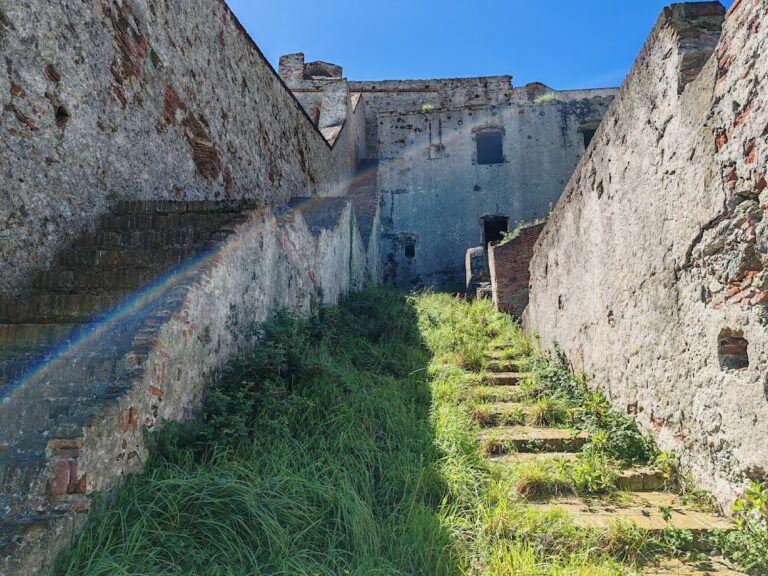
Priamar Fortress occupies the promontory immediately above Savona’s port and centre. Its irregular, highly articulated form reflects successive construction and enlargement between 1542 and 1750. Built of stone, the complex is organized around a broad access ramp, two principal squares, bastions, internal routes, gardens, buildings, and subterranean passages, some of which remain sealed or impassable. One former tunnel connected the summit with the port. The surviving fortifications also include a sea-facing rampart, an access bridge, and a circular medieval tower incorporated into the sixteenth-century structures.
Summit and defensive works
Piazza del Maschio
Piazza del Maschio forms the highest point of the complex, approximately 30 metres above sea level. Buildings enclose the square, which is used for operatic and theatrical performances. It also contains a theatre with seating for 600 people. Municipal offices are entered from the adjoining Piazzale del Maschio.
Piazza della Sibilla
Piazza della Sibilla occupies the area of the former cathedral of Santa Maria di Castello. Archaeological excavation has exposed remains associated with the demolished church and has revealed the foundations of the earlier religious complex beneath the later fortress works. The excavated area includes views toward the city and the sea, while the Palazzo della Sibilla, built in 1729, now functions as a congress centre.
Bastions and underground passages
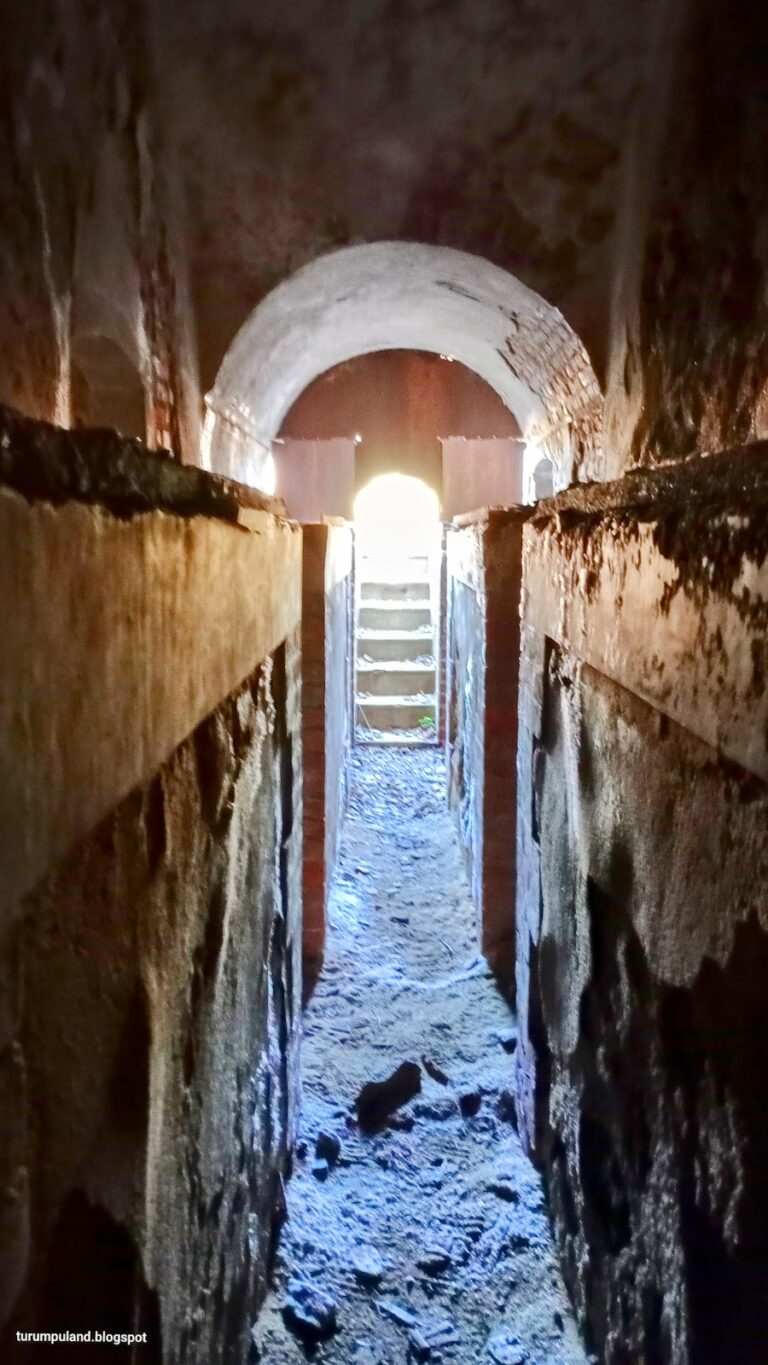
The bastions are projecting fortifications designed to allow defensive fire along the faces of adjoining walls. Priamar retains these structures, internal paths, public gardens, the access bridge, and the sea-facing rampart. Excavated areas outside the fortress have revealed foundations of the external earthworks. A medieval paved road laid in a herringbone pattern is intersected by a later counter-mine gallery, an underground defensive passage intended to detect, obstruct, or attack tunnels dug by besiegers.
Archaeological remains
Archaeological excavations have revealed traces of pre-Roman, Roman, and Byzantine occupation on the promontory. These discoveries are displayed in Savona’s Archaeological Museum. Another excavated area contains the foundations of the church and monastery of San Domenico il Vecchio, which were demolished to make room for the fortress’s earthworks.
Medieval cathedral
The original cathedral, first called Santa Maria Maggiore and later Santa Maria di Castello, was built between 825 and 887 over the remains of an earlier pagan temple. Excavation has made it possible to reconstruct aspects of its former layout. The forecourt reportedly had a black-and-white marble chequered pavement, and its three principal entrances stood at the top of eight steps. Inside, a similarly patterned floor accompanied richly decorated side chapels with marble inlays and statues. The apse had accessible galleries facing directly toward the sea, and the cathedral also possessed a bell tower and baptistery.
The cathedral probably had a Romanesque gabled facade decorated with horizontal bands of white and black marble. Its inlaid wooden choir, inspired by the choirs of the Certosa di Pavia and the Basilica of San Francesco in Assisi, was removed before the building was destroyed and reconstructed in the apse of Savona’s new cathedral. The former cathedral is now almost entirely lost. Its marble baptismal font was moved to the new cathedral, while sculptures and other works are preserved in Savona’s museums. The cathedral’s foundations are represented archaeologically in Piazza della Sibilla.
Restored buildings and museums
The restored complex includes the Palazzo del Capitano, the Palazzo del Commissario, and the Palazzo della Loggia del Castello Nuovo. Together with the other recovered buildings, these structures represent approximately 50,000 cubic metres of volume. The Palazzo della Loggia del Castello Nuovo is the only surviving medieval building on the promontory that predates the sixteenth-century fortress, and it now houses the Archaeological Museum.
Priamar also contains the Sandro Pertini and Renata Cuneo Museum. It displays works from Sandro Pertini’s private collection and sculptures donated to Savona by Renata Cuneo, a sculptor from the city. These museums, together with the excavated remains and restored military buildings, occupy a complex whose present form preserves evidence of its ancient settlement, medieval religious centre, and successive Genoese defensive phases.
Nearby sites