Forte Madonna del Monte: A Coastal Artillery Battery in Savona


Site at a Glance
- Rating
- 4.2
- Popularity
- Very Low
- Country
- Italy
- Primary era
- Modern
- Eras represented
- Modern
- Civilizations
- Italian
- Site type
- Military
- Remains
- Fort
On this page5 sections
History
Forte Madonna del Monte is a nineteenth-century fortress battery in Savona, Italy, built under the House of Savoy, the dynasty that ruled the Kingdom of Italy during its construction. Work began around 1881, and the Kingdom of Italy was its first owner. The battery formed part of the defensive system protecting the coast, the Savona-Vado roadstead, and the Savona-Vado Ligure roadstead, alongside the slightly larger twin fortress of Madonna degli Angeli and the more inland Forte Ciuto.
Military service and later abandonment
The fort remained in military service until the end of the Second World War. Its strategic function ended in 1947, after which it was abandoned. Although no longer used for defence, the fort is described as well preserved, allowing its role within the coastal artillery system to remain legible.
Remains
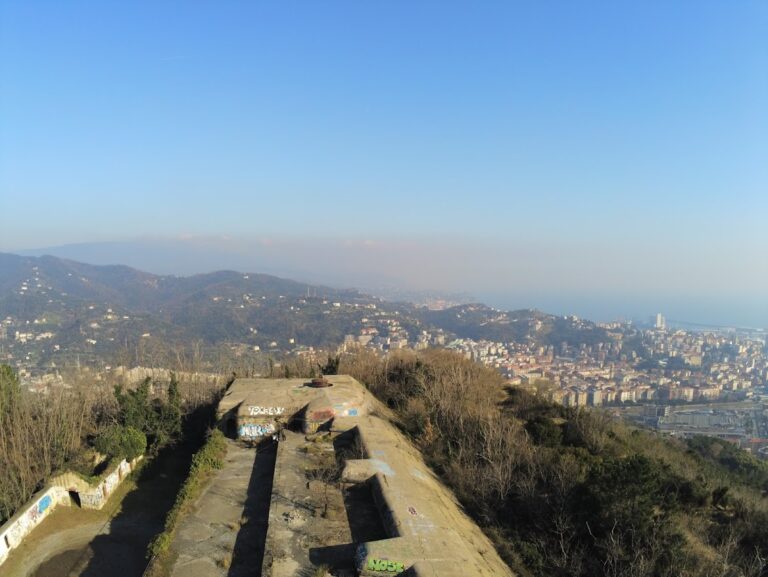
Forte Madonna del Monte stands on a hill immediately behind the Savona-Vado motorway toll station, at an elevation of 135 metres above sea level. The fort has two floors and a reinforced-concrete roof. The roof may belong to the original construction or may have been added later to respond to the increasing firepower of modern artillery.
Internal artillery layout
The first floor contained stables and ammunition magazines. On the second floor, two artillery positions held four 280 mm howitzers, guns designed to fire shells on relatively high, curved trajectories. After the First World War, these weapons were replaced by four 149/23 guns. The same level also included range-finding stations, used to measure the distance to a target so artillery fire could be aimed more accurately.
Side and outer positions
Four further emplacements stand on the western and eastern sides of the fort. They were initially armed with 87B guns and later with 75/27 Model 1911 pieces intended to defend the bordering valleys. Mortar positions remain attached to these four side emplacements. Two additional artillery positions lie beyond the ditch, just outside the fort, and are poorly preserved.
Nearby sites