Sassetti Chapel: A Renaissance Family Chapel in Florence
Site at a Glance
- Popularity
- High
- Country
- Italy
- Primary era
- Medieval
- Eras represented
- Medieval
- Civilizations
- Republic of Florence
- Site type
- Religious
- Remains
- Chapel
On this page17 sections
History
The Sassetti Chapel is a Catholic family chapel dedicated to Saint Francis of Assisi in the church of Santa Trinita in Florence, Italy. The church belonged to the Vallombrosans, a monastic congregation within the Benedictine tradition. Florentine banker Francesco Sassetti commissioned the chapel’s Renaissance decoration in the 1480s, bringing a new pictorial program into an older Gothic structure. Saint Francis, a thirteenth-century Italian friar whose teachings inspired the Franciscan order, was the subject of the cycle.
From Ficozzi Chapel to Sassetti Commission
A chapel belonging to the Ficozzi family stood on the site by 1371. Francesco Sassetti acquired it in the late 1470s. His family had maintained a chapel at the Dominican church of Santa Maria Novella since the fourteenth century, and he first sought permission there to commission scenes from the life of his patron saint. When the friars rejected his proposal, he turned to Santa Trinita, which was close to both his home and his banking office.
Sassetti hired the Florentine painter Domenico Ghirlandaio to decorate the chapel. Their contract is dated 25 December 1480, and work on the decoration began on 17 June 1483. The project was carried out during the 1480s.
A Program of Franciscan and Florentine Themes
The commission’s original plan included an episode at Arles, but the Resurrection of the Boy took its place. The miracle held a personal association for the Sassetti family: Francesco’s firstborn son, Teodoro, had died, and another son was later given the same name. The scenes of Francis were connected with the Christian story of Christ’s coming, death, and renewal.
The decoration also drew on Renaissance humanism, a renewed study of classical learning, and Neoplatonism, a Renaissance adaptation of ideas associated with Plato. These references placed religious themes alongside a celebration of civic peace and a new golden age under Lorenzo de’ Medici. The political setting included the Peace of Lodi, a 1454 treaty among Italian states that helped establish a period of political balance.
Rediscovery and Restoration
Paintings above the chapel entrance were covered with plaster around 1740 and uncovered again in 1895. The chapel underwent restoration in 2004.
Remains
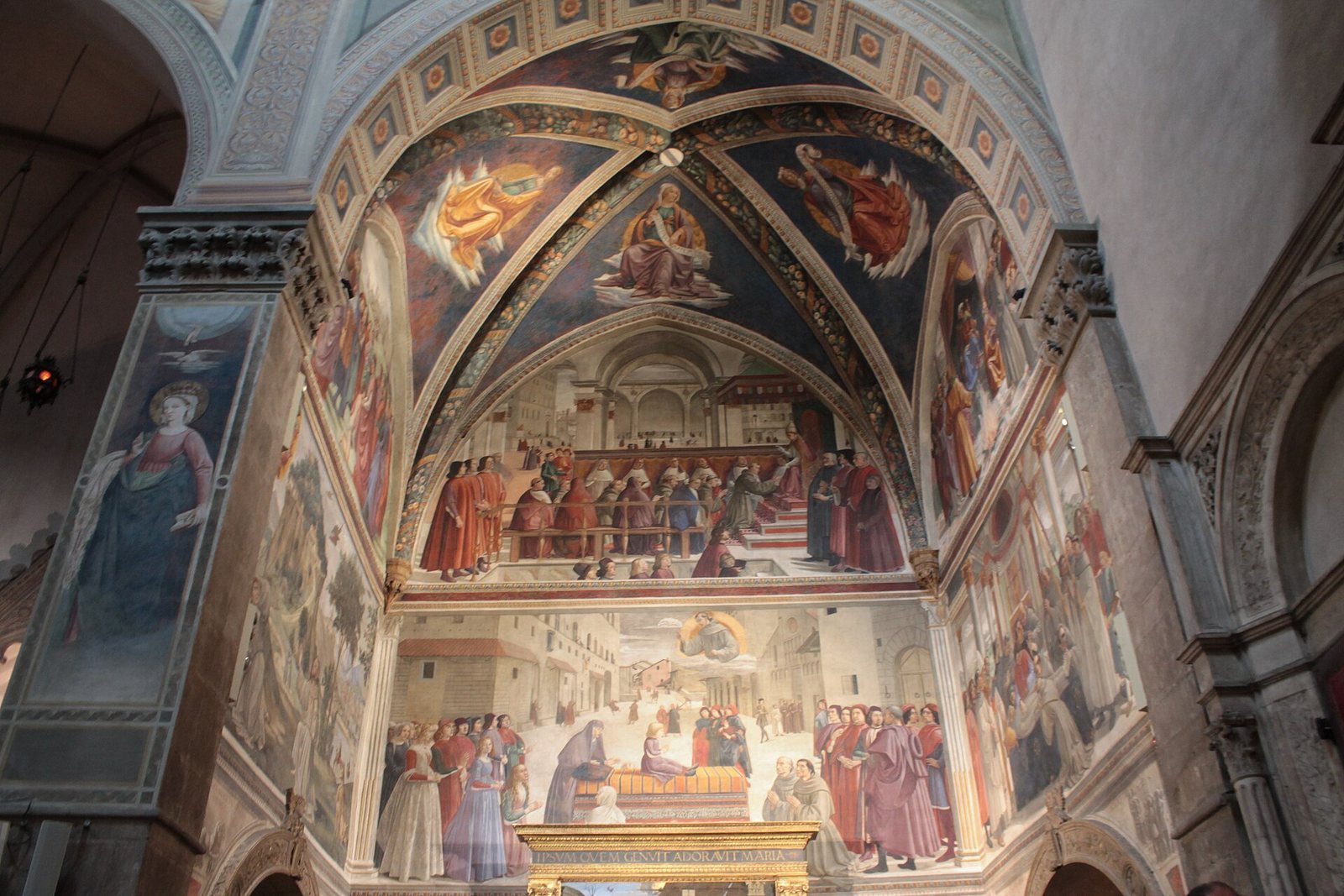
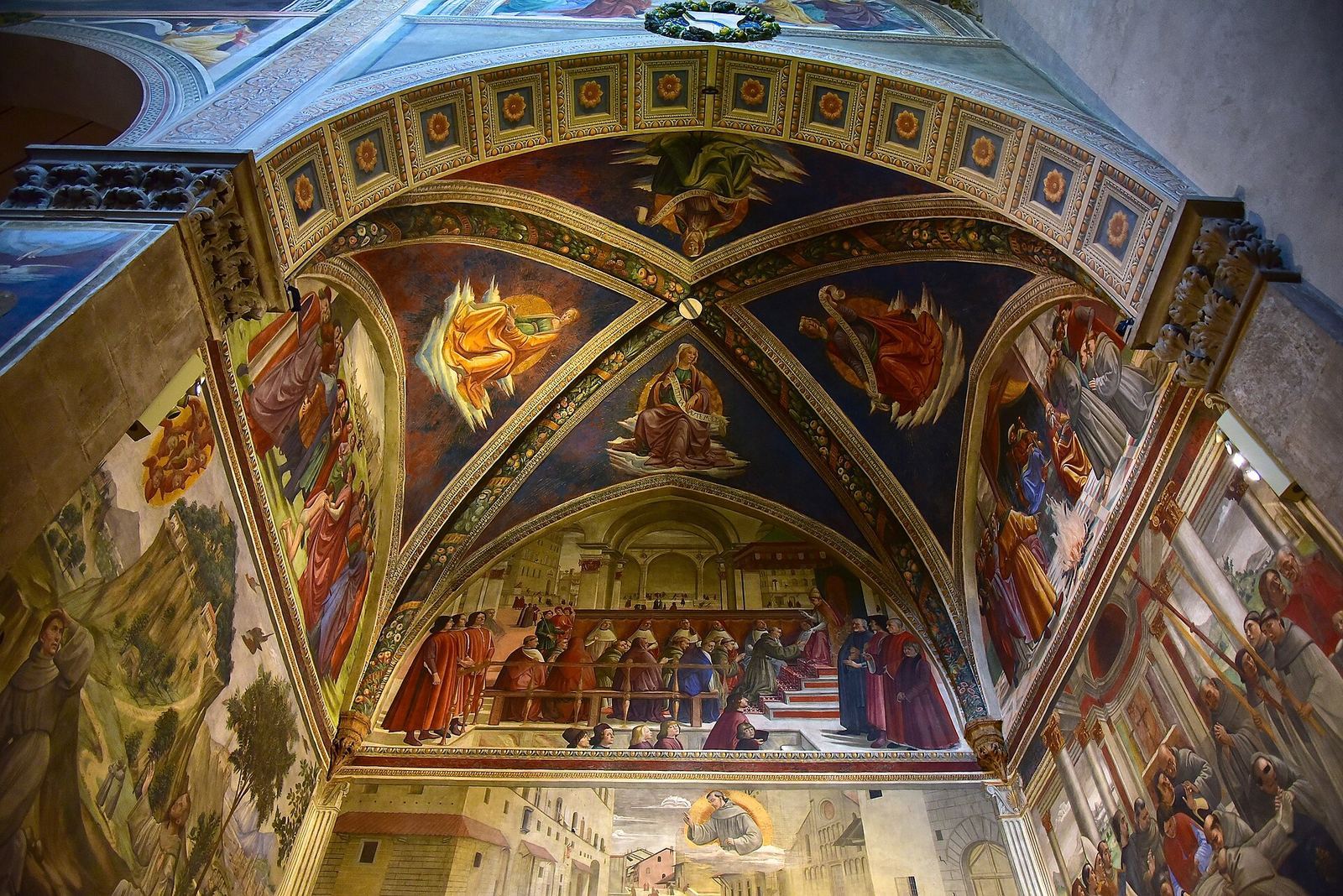
The chapel occupies the final position in the right transept of Santa Trinita. Its narrow, tall interior measures 5.23 by 3.72 metres and rises to about 20 metres. A pointed arch and a cross-vaulted ceiling, formed by intersecting vaulted sections, belong to its Gothic structure. Renaissance painting and ornament were adapted to this older space. The six scenes on three walls are enclosed by painted architectural elements that create the illusion of built surroundings.
Interior Architecture and Painted Scenes
The Vault and Painted Framework
Four Sibyls, prophetic women from classical tradition, sit on cloud-like thrones beneath a blue sky in the vault. Halos behind them send out golden rays, and each holds a scroll bearing a Latin prophecy associated with Virgil. Some Christians understood Virgil’s fourth Eclogue as a prediction of Christ. The figures are the Cumaean, Erythraean, and Agrippa Sibyls; the fourth, who has no scroll, may represent the Cimmerian. Ghirlandaio is credited with painting their faces, while workshop assistants probably completed the bodies. Flower and fruit garlands decorate the ribs between them. In places, the blue surface has worn away and the underlying red is visible.
Scenes on the Left Wall
In the upper scene, the Renunciation of Worldly Goods, Francis gives up his clothing and possessions in public. A bishop shields him while his angry father, Pietro Bernardone, is held back by other figures. The background depicts a northern European city, perhaps Geneva or Lyon, where Sassetti had worked for the Medici. Some figures in the scene are attributed to Ghirlandaio’s workshop.
Below it, the Miracle of the Stigmata shows Francis kneeling with his arms open as Christ appears on the cross among seraphim. The stigmata are wounds understood to correspond to those of Christ’s crucifixion. A rocky height represents La Verna, the setting of the event. Beside a lake, an imaginative view of Pisa includes its cathedral and leaning tower; a deer and birds add natural details. The painting was completed in ten days, and its arrangement may have been influenced by a marble pulpit relief by sculptor and architect Benedetto da Maiano at Santa Croce.
Confirmation of the Rule
Above the central wall, Pope Honorius III receives Francis and confirms the Franciscan Rule in 1223. Although the event takes place in Rome, the painted setting includes Florentine landmarks: Piazza della Signoria, Palazzo Vecchio, the Loggia dei Lanzi before its later statues were added, and San Pier Scheraggio before the church was demolished to make way for the Uffizi. Florence’s heraldic lion, the Marzocco, stands on a platform at Palazzo Vecchio. The chapel arch becomes part of an imagined open portico. Stairs, the church interior, and the distant setting create three successive layers of space.
A drawing now in Berlin shows an earlier design for the scene without the Florentine portraits. In the completed painting, the figures include Antonio Pucci, a senior civic officer known as the Gonfaloniere di Giustizia; Lorenzo de’ Medici; and Francesco Sassetti with his son Federigo. Lorenzo’s sons Giuliano, Piero, and Giovanni, the future Pope Leo X, appear with their tutor Angelo Poliziano and the Medici educators Luigi Pulci and Matteo Franco. Sassetti points toward his other sons, Galeazzo, Teodoro, and Cosimo. The portraits acknowledge the Medici family’s support for him.
The Resurrection of the Boy
The lower central scene depicts a miracle attributed to Francis after his death. A child who had fallen from a window of Palazzo Spini appears alive, seated with joined hands on a covered bier, while Francis blesses him from above. Onlookers include Sassetti family members and other Florentines. The five women to the left are probably Sassetti’s daughters, and their husbands or fiancés may be among the men opposite. Ghirlandaio appears at the front on the left; his brother-in-law, the painter Sebastiano Mainardi, stands beside him in profile. A dark-skinned female servant is also portrayed. Other proposed identifications include Maso degli Albizzi, Angelo Acciaioli, Palla Strozzi, Neri di Gino Capponi, Poliziano, and Fonzio, though some remain uncertain.
The background records the appearance of the piazza in the fifteenth century. It includes Santa Trinita’s former Romanesque façade, Palazzo Spini in its fortress-like form, Palazzo Gianfigliazzi, part of Palazzo Minerbetti, and an earlier Ponte Santa Trinita. Assistants are thought to have painted the figures behind the bier. Two carpenters at work allude to the street’s former name, “Street of the Woodworkers.”
Scenes on the Right Wall
In the upper Test of Fire, Francis preaches before the Ayyubid sultan al-Kamil, a ruler of Egypt and parts of the eastern Mediterranean. The sultan challenges Francis to cross a fire as proof of his holiness; Francis challenges the sultan’s advisers in turn. Al-Kamil occupies the centre, with Francis and his friars on the right and the advisers on the left. A foreground figure, seen from behind, directs attention into the scene.
The lower painting, the Death of Saint Francis, sets the saint’s body on a bier in a large Renaissance church. Priests pray, three young clerics carry a cross and two processional candles, and grieving friars gather around him. A man in red, identified as Girolamo, searches for the wound in Francis’s side. Ghirlandaio completed the scene in 28 days. Three figures on the right, a father, son, and nephew, may be connected with the Sassetti family; Poliziano and Fonzio also appear.
Altar and Family Tombs
The Adoration of the Shepherds
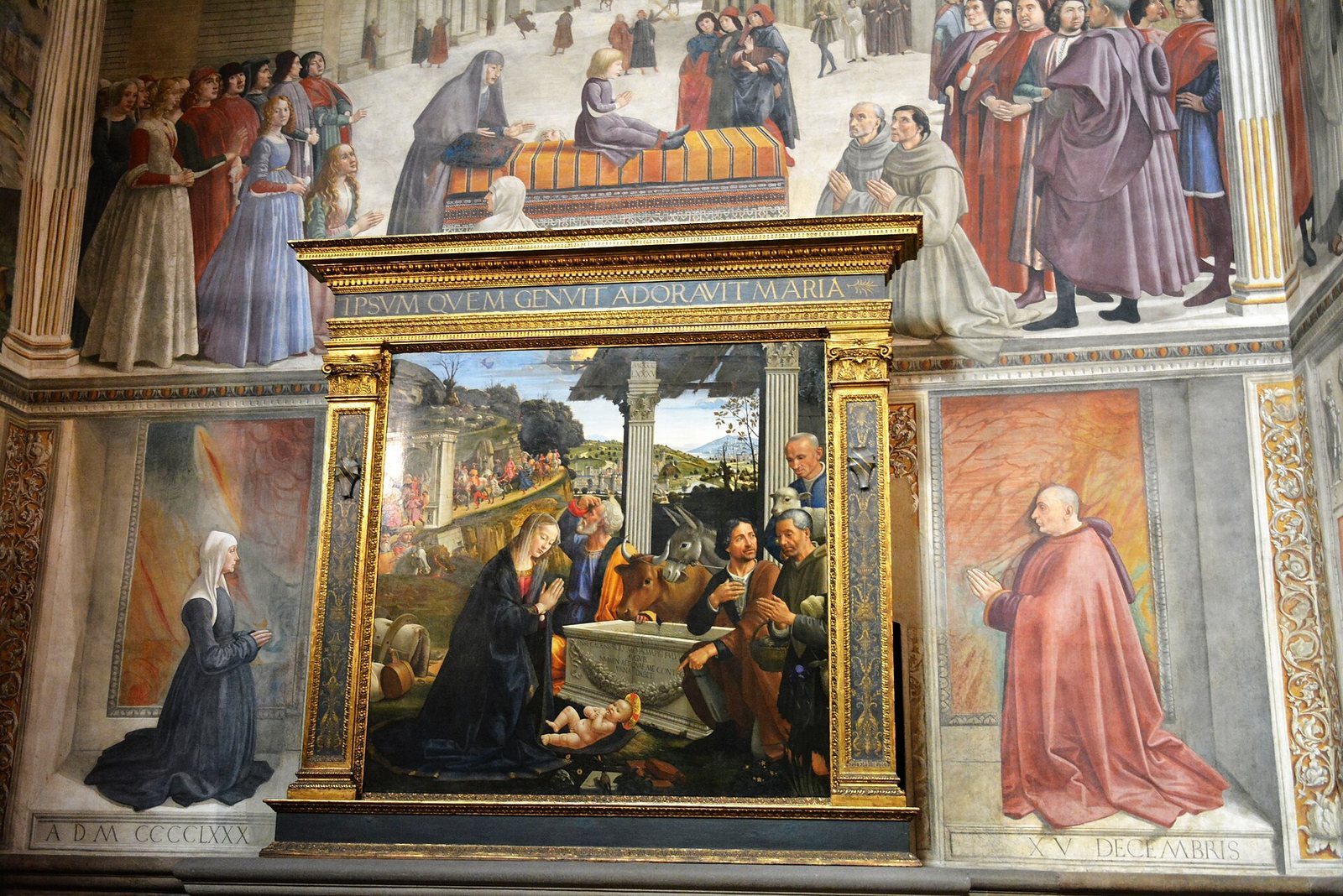
The altar panel, Adoration of the Shepherds, is a 167-by-167-centimetre painting on wood dated 1485. Mary kneels at the left before the Child, who lies in an ancient Roman sarcophagus, or stone coffin, used as a manger. Joseph looks toward the approaching procession, while an angel announces Christ’s birth to the shepherds. One of the three shepherds on the right points toward the Child and is a self-portrait of Ghirlandaio. The realistic details and treatment of the shepherds reflect the influence of Flemish painter Hugo van der Goes’s Portinari Altarpiece, which arrived in Florence in 1483. Painted marble surrounds the panel.
The sarcophagus bears an inscription about the Roman augur Fulvius, a religious official who interpreted signs. In the legend represented, Fulvius foretold that a god would rise from the vessel that covered him. An inscription on the triumphal arch refers to its dedication to the Roman general Pompey by the temple priest Hyrcanus. These classical references, together with views of Rome and Jerusalem, frame the transition from pagan and Jewish traditions to Christianity. An ox and donkey stand for Jews and gentiles. Jerusalem appears in the distance as a domed building beside a dead tree associated with its conquest. The view of Rome includes tombs linked to Augustus and Hadrian; Hadrian was then believed to lie beneath the Torre delle Milizie. A church resembling Florence Cathedral in the Roman view suggests Florence as a new Rome.
Three rocks in the foreground refer to the meaning of the Sassetti name, “small rocks,” and a goldfinch on one of them symbolizes Christ’s Passion and resurrection. The inscription on the frame reads Ipsum quem genuit adoravit Maria, meaning “Mary adored the one whom she bore.”
The Sassetti Tombs and Donor Portraits
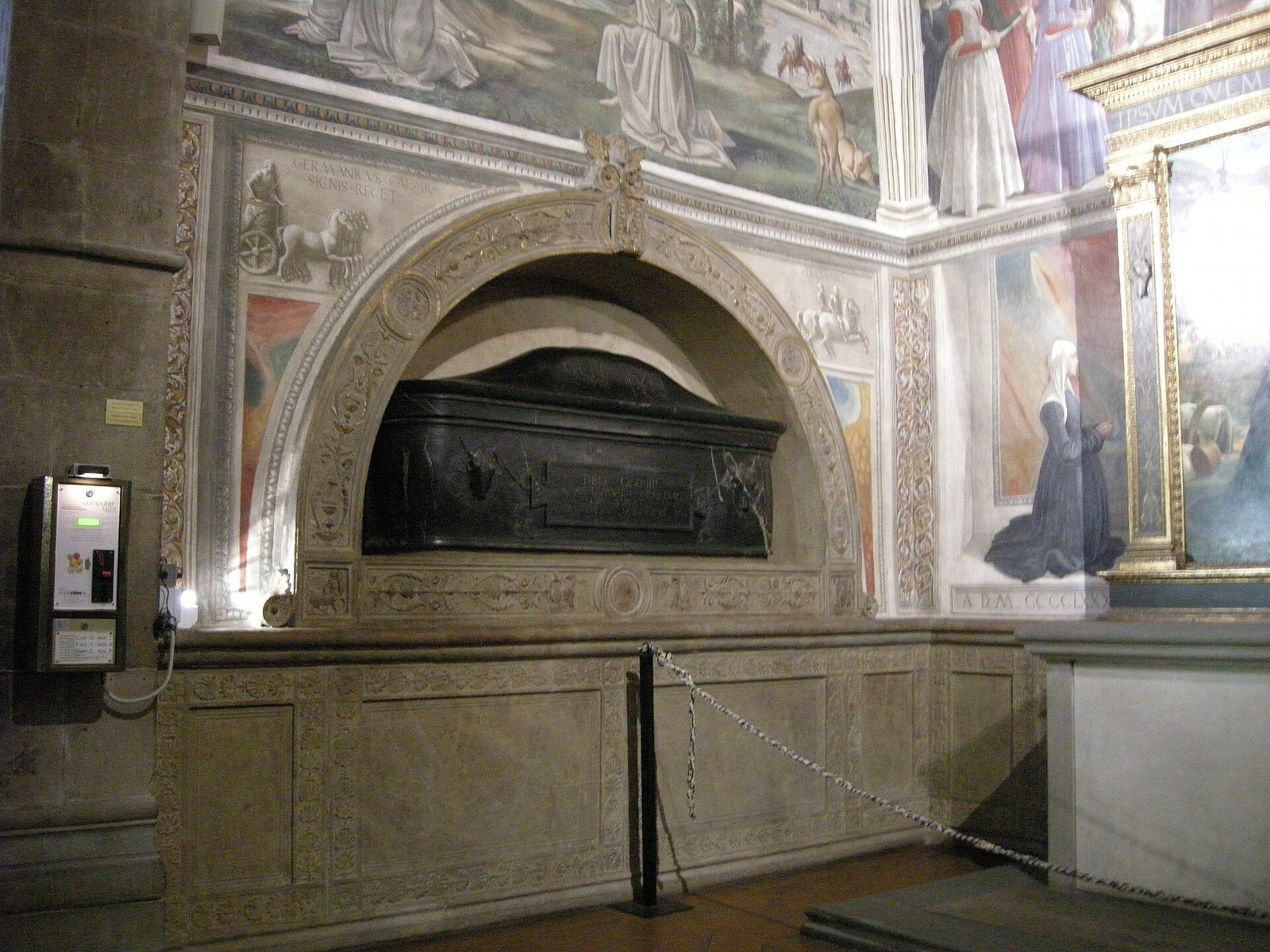
The tomb of Francesco Sassetti is on the right side wall and that of his wife, Nera Corsi, is on the left, both above a low plinth near the altar. Renaissance architect and sculptor Giuliano da Sangallo designed them. Their coffins are made of hard black stone and carry restrained low-relief carvings with Latin inscriptions in capital letters. Grey sandstone arches around them have carved and gilded decoration. Monochrome classical figures surround the tombs; their exact meanings are uncertain, and they may draw on Roman coins in Sassetti’s collection.
Francesco’s tomb features ox-skull motifs, garlands, and a plaque with two handles. Carvings at the arch base include a possible funeral scene, centaurs, and love figures approaching a sacrifice, framed by the family’s coats of arms. On Nera’s tomb, centaurs carry Sassetti-Corsi shields and wield slings and stones, making a visual play on the Sassetti name. Other carvings include sea nymphs, some in affectionate poses with centaur-like sea beings, and a figure on a ship representing Fortune. One centaur may be Chiron, associated with wisdom and practical skill. The love figures approach a vessel of ashes, suggesting renewal after death; the sea nymphs evoke marital affection and a journey to the Isles of the Blessed. Together, the tomb imagery brings together personal qualities and relationships, fortune, death, and the possibility of renewal.
Kneeling portraits of Francesco and Nera flank the altar and face the Adoration of the Shepherds. Francesco wears red and clasps his hands; Nera wears a white head covering and a black dress. Across the chapel, painted architecture, orderly perspective, contemporary figures, and details of city life bring sacred narratives into the world of the family and its Florentine contemporaries. Ghirlandaio gave greater attention to the more visible central passages, while assistants contributed more to some of the upper and side scenes.
Paintings Above the Chapel Entrance
The exterior paintings are in poorer condition than the interior decoration, and their perspective was arranged for viewing from below.
The Sibyl and Augustus
An arched panel above the chapel opening shows the Tiburtine Sibyl announcing the Messiah’s birth to Emperor Augustus. Against a faint landscape representing Rome’s Capitol, Augustus and two men stand on the left, while the Sibyl and two women appear on the right. The figures point toward a sun containing Christ’s trigram. The Sibyl may be a portrait of Sassetti’s daughter Sibilla. Beneath the scene, the family coat of arms sits within a wreath made of coloured glazed terracotta.
David on the Pier
Beside the panel, on the painted continuation of the pier between this chapel and the next, David appears in monochrome with gilding, imitating a statue. He holds a sword and sling, carries a shield bearing the Sassetti arms, and stands above Goliath’s severed head. An inscription on the pedestal links the figure to homeland and Christian glory. David serves as a family heraldic marker, foreshadows the Nativity in the altarpiece, and represents a defender of the city.