Basilica of the Holy Trinity: A Vallombrosan Church in Florence


Site at a Glance
- Rating
- 4.6
- Popularity
- Medium
- Country
- Italy
- Primary era
- Medieval
- Eras represented
- Medieval, Early Modern
- Civilizations
- Grand Duchy of Tuscany, Republic of Florence
- Site type
- Religious
- Remains
- Basilica
On this page29 sections
History
The Basilica of the Holy Trinity is a Roman Catholic church in Florence, Italy, built and developed through the work of the Vallombrosan monastic order. Facing Piazza Santa Trinita, it became one of Florence’s early Gothic churches, acquired major works of art, and now has the status of a minor basilica. The church also gave its name to the nearby Ponte Santa Trinita.
Origins and Vallombrosan foundation
An earlier church dedicated to Santa Maria dello Spasimo stood on the site by 1077. It belonged to the Vallombrosans, a Benedictine congregation founded in the eleventh century by the Florentine nobleman Giovanni Gualberto. The church originally lay beyond Florence’s walls, but the surrounding area was incorporated into the city between 1172 and 1175. The earlier building may itself have replaced a Carolingian oratory.
By the late twelfth century the church had become a parish church, and it received abbey status during the first half of the fourteenth century. Its association with the Vallombrosans gave Santa Trinita an important institutional and religious role in Florence, while the community’s connection with Giovanni Gualberto remained central to the church’s identity.
Gothic rebuilding
A major Gothic enlargement and rebuilding began between 1250 and 1258. The design has been attributed to Nicola Pisano or, more probably, to Neri di Fioravanti. Construction continued from about 1300 to 1330, then stopped during the plague of 1348. Work resumed around 1365 and continued until 1405.
During the fourteenth century, the church gained side chapels and extensive fresco decoration. Its Vallombrosan prestige attracted important commissions, including Cimabue’s Maesta. Much of the medieval decoration was later covered or destroyed as the interior was repeatedly altered.
Counter-Reformation remodelling
During the Counter-Reformation, the Catholic renewal movement of the sixteenth and seventeenth centuries, the Vallombrosans commissioned Bernardo Buontalenti to remodel the presbytery and rebuild the monastery. In 1574 he removed the monks’ choir, created a monumental altar, and introduced an unusual bat-wing staircase. The altar and staircase were later removed, and the staircase is now preserved in Santo Stefano al Ponte.
Buontalenti designed the present façade in 1593 and 1594, while Giovanni Battista Caccini supplied its sculpture. The monastery cloister was built between 1584 and 1593 by Alfonso Parigi the Elder, following Buontalenti’s designs. Further chapel renovations were undertaken by Gherardo Silvani, Ludovico Cigoli, and other artists during the late sixteenth and seventeenth centuries. Most of the side chapels were remodelled in the seventeenth century.
Whitewashing, restoration, and flood damage
After the flood of 1740, the church was extensively whitewashed. This treatment covered many damaged frescoes, and modernization of the choir and nave in 1760 and 1761 destroyed almost all of Alessio Baldovinetti’s fifteenth-century fresco cycle in the main chapel.
During the French occupation, Vivant Denon selected Mariotto Albertinelli’s Madonna and Child with Two Saints for the Napoleonic seizures. The painting was sent to France and remains in the Louvre. Nineteenth-century restorers attempted to recover an imagined medieval and Renaissance appearance. Their work removed many Baroque and seventeenth-century additions, including Buontalenti’s altar, and caused substantial loss of historical fabric. It also led to the rediscovery of concealed frescoes and artworks.
Works transferred from the suppressed Vallombrosan church of San Pancrazio included Neri di Bicci’s fresco of Giovanni Gualberto among Vallombrosan saints and Luca della Robbia’s tomb of Benozzo Federighi. The 1966 flood damaged the church, after which emergency measures and later conservation campaigns treated the frescoes and removed some nineteenth-century reconstructions.
The complex today
The former monastery is now partly occupied by the University of Florence’s Faculty of Education and by other institutions. A fifteenth-century wooden crucifix in the monastery was restored in 2021 and subsequently attributed to the early career of Antonio da Sangallo the Elder, possibly with assistance from Giuliano’s workshop. The church and monastery remain an important center of Florentine art from several periods. The complex forms part of Florence’s World Heritage designation and is recognized as cultural heritage of Florence.
Remains
Plan and medieval fabric
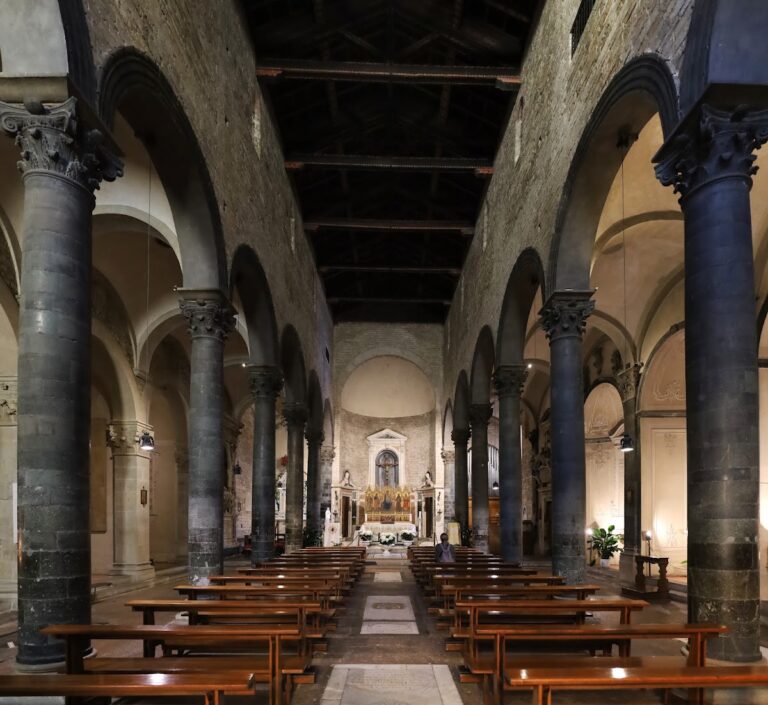
The church has a T-shaped plan, or tau cross, with a short transept and a square apse. Three naves are divided by slender rectangular piers carrying pointed arches and cross vaults. The piers and arches of the central nave gradually diverge and rise toward the transept. This carefully arranged perspective makes the interior appear to draw toward the altar and made the church appear larger when viewed from the monks’ side.
Five chapels line each side of the naves, with four more beside the main chapel. The right transept ends in the small chapel of San Giovanni Gualberto, while the left transept contains the former Strozzi Chapel, now used as the sacristy. A fifteenth-century portal opens from the right transept toward Via del Parione. Its vestibule contains six niche tombs with pointed arches, including one with a relief of Christ in Pieta from the second half of the fourteenth century, associated with the school of Andrea Pisano.
Counter-façade and crypt
The Romanesque counter-façade preserves traces of the earlier church. These include a fifteenth-century fresco of the Trinity, a fourteenth-century tomb slab of the abbots of San Pancrazio, and the tomb slab of Giovanni di Antonio Amati, attributed to Antonio del Pollaiolo. A surviving Crucifix forms the remaining fragment of Paolo Uccello’s fresco of the Stigmata of Saint Francis.
Below the church, the crypt contains green-marble columns that formerly stood on white-marble bases. Traces of the earlier presbytery pavement include a black-and-white mosaic with fantastic animals, providing physical evidence of an earlier phase beneath the Gothic building.
Façade, tower, and cloister
Buontalenti’s façade
The present façade is a symmetrical late Florentine Mannerist design divided into three zones by two orders of pilasters. The central nave is concealed behind a pedimented upper section with a circular window. Its narrow vertical composition leaves the side sections exposed, and the circular window does not align with the interior opening.
The exposed sides receive different treatments. The left is covered with diamond-point rustication and contains a niche with a saint’s statue, while the right is finished in plain plaster. The wooden doors date from 1640. Caccini made the statue of Saint Alexius and the Trinity relief above the principal entrance in 1594.
Bell tower
The bell tower rests against a side wall of the church and has no independent foundations. Access is reached from the roof through a narrow passage and ladder rather than directly from the church interior. Donatello’s terracotta Madonna and Child, formerly set into the tower, is now preserved in the Davanzi Chapel.
Cloister and former refectory
The cloister, built between 1584 and 1593, is raised above street level and has arcades on all four sides. Round arches and cross vaults rest on substantial columns with Doric capitals. Architraved windows run above a string course, and a well surrounded by flower beds occupies the center.
The former monastery refectory, now part of the university library, contains frescoes by Giovanni da San Giovanni, Nicodemo Ferrucci, and Jacopo Confortini. Painted between 1630 and 1632, they show the Virgin in Glory received by the Trinity, with scenes of Gospel banquets in the lunettes.
Side chapels
Gianfigliazzi Chapel
The Gianfigliazzi, or San Benedetto, Chapel retains a ceiling fresco attributed to Cenni di Francesco, figures of the penitent Saint Benedict and eight apostles, and the sinopia, or preparatory drawing beneath a fresco, of the Communion of Saint Mary of Egypt. Its present form dates from Gherardo Silvani’s intervention around 1630. The altar contains the fourteenth-century wooden Crucifix of Providence, which remains associated with popular devotion.
Davizzi Chapel
Matteo Nigetti remodelled the Davizzi Chapel around 1640 to 1642. Its altar contains Francesco Curradi’s signed and dated Preaching of Saint John the Baptist, painted in 1649.
Cialli-Sernigi Chapel
The Cialli-Sernigi Chapel contains Neri di Bicci’s Madonna and Child with Four Saints, painted around 1466 with a gold background and predella, the narrow painted section beneath an altarpiece. It also preserves a fragmentary fresco of the Mystic Marriage of Saint Catherine of Alexandria by Spinello Aretino, dated 1390 to 1395, together with its sinopia.
Bartolini Salimbeni Chapel
The Bartolini Salimbeni Chapel retains its original enclosure grille, probably made around 1420 by Manfredi di Franco of Pistoia. Lorenzo Monaco painted its Stories of the Virgin between 1420 and 1425, covering earlier paintings by Spinello Aretino. The chapel also retains Lorenzo Monaco’s Annunciation altarpiece and was restored in a campaign completed in 2004.
Ardinghelli Chapel
The Ardinghelli Chapel contains Giovanni Toscani’s frescoes, including an Imago pietatis dated 1423 to 1424. Its 1552 altar incorporates marble from Benedetto da Rovezzano’s unfinished tomb of Giovanni Gualberto. The altarpiece, a Resurrection of Christ and Saints, was traditionally attributed to Maso da San Friano, but is now attributed to Francesco del Brina and dated 1582.
Sassetti Chapel
Domenico Ghirlandaio’s fresco cycle of the Stories of Saint Francis fills the Sassetti Chapel. Francesco Sassetti commissioned the cycle, which was painted around 1483 to 1486. Its scenes include contemporary views of Florence and portraits of Sassetti, his wife, Lorenzo de’ Medici, Luigi Pulci, Sassetti’s son Teodoro, and members of the Medici family. Agnolo Poliziano appears leading the Medici children up a staircase.
The chapel’s altarpiece is Ghirlandaio’s Adoration of the Shepherds, painted around 1485 and incorporating close quotations from Hugo van der Goes’s Portinari Triptych. The chapel also contains the tombs of Francesco Sassetti and Nera Corsi by Giuliano da Sangallo, four Sibyls on the vault, and exterior frescoes by Ghirlandaio. These include the Tiburtine Sibyl announcing the birth of the Redeemer to Augustus and a painted David.
Doni Chapel
Ludovico Cigoli remodelled the Doni Chapel between 1559 and 1613. Enclosed by a grille, it has an exterior fresco of Christ in Glory attributed to Giovanni da Ponte and dated 1429 to 1430. Inside are a wooden Crucifix possibly from the mid-fourteenth century and Bernardo di Stefano Rosselli’s Madonna dello Spasimo, painted in the final decade of the fifteenth century.
Main chapel and transept spaces
Main chapel
The main chapel formerly held Alessio Baldovinetti’s Stories of the Old Testament, painted between 1471 and 1497. Surviving fragments include four badly damaged patriarchs in the vault and two lunettes showing the Sacrifice of Isaac and Moses Receiving the Tablets of the Law. These scenes were painted in the dry-fresco technique.
The main altar combines elements from different sources. Its Trinity paliotto, a decorated frontal attached to an altar, is attributed to Agostino di Duccio, while its pilaster strips come from the workshop of Desiderio da Settignano. Mariotto di Nardo’s Trinity Triptych, dated 1416 and commissioned by Niccolo Davanzati, is now in the Galleria dell’Accademia.
Usimbardi Chapel
Ludovico Cigoli remodelled the Usimbardi Chapel, probably by 1628. Its vault frescoes are by Fabrizio Boschi and Matteo Rosselli. The chapel contains Empoli’s Delivery of the Keys, begun around 1607, and Saint Peter on the Waters, begun by Cristofano Allori and completed by Zanobi Rosi in 1621. Its altar frontal is Tiziano Aspetti’s carved Martyrdom of Saint Lawrence, and the chapel also contains a Crucifix and funerary busts by Felice Palma. Exterior frescoes by Giovanni da Ponte date from around 1430 to 1434.
Scali Chapel
The Scali Chapel preserves fragmentary frescoes by Giovanni da Ponte and Smeraldo di Giovanni, dated 1434. They include the Evangelists and scenes of the Flaying and Beheading of Saint Bartholomew. The chapel also contains Luca della Robbia’s polychrome marble and glazed-terracotta tomb of Benozzo Federighi, bishop of Fiesole, who died in 1450. Made in 1454, the monument includes a recumbent effigy, a relief of Christ between the Virgin and Saint John, and a gilded floral frieze in polychrome glazed terracotta.
Chapels of Giovanni Gualberto and Compagni
The small Chapel of the Relics of Saint Giovanni Gualberto, at the head of the right transept, was designed by Giovanni Caccini and frescoed by Domenico Cresti, known as Il Passignano, in 1593 and 1594. Its scenes concern the translation of the saint’s body and the veneration of his relics.
The Compagni Chapel contains Neri di Bicci’s detached fresco of Giovanni Gualberto enthroned among Vallombrosan saints and beati. Painted in 1455 and transferred from the cloister of San Pancrazio, it is accompanied by Neri di Bicci’s Annunciation with the Expulsion of the Progenitors, painted after 1475. An exterior fresco by Lorenzo di Bicci shows Giovanni Gualberto forgiving his brother’s killer and dates from around 1430 to 1435. A plaque records the burial of the chronicler Dino Compagni in 1323.
Spini Chapel
The Spini Chapel contains Desiderio da Settignano’s wooden Magdalene, carved around 1450 from a willow trunk with modelled plaster hair. Giovanni d’Andrea, a pupil of Verrocchio, completed it in 1499. The chapel also has a fresco of a bishop saint attributed to Alesso Baldovinetti and dated around 1470.
Strozzi Chapel and sacristy
The former Strozzi Chapel, now the sacristy, was designed by Lorenzo Ghiberti between 1418 and 1423. It consists of three bays arranged in an L. Its main altar has Vittorio Barbieri’s signed and dated marble Pieta of 1743, freely inspired by Michelangelo’s Vatican Pieta. The sacristy also contains Alessandro Gherardini’s Exaltation of Saint Monica of 1697, the tomb of Onofrio Strozzi attributed to Pietro Lamberti or Michelozzo, and works by Luca della Robbia, Francesco di Simone Ferrucci, Puccio Capanna, Niccolo di Tommaso, and Pietro Torrigiani.
The former chapel once housed Gentile da Fabriano’s Adoration of the Magi of 1423 and the Deposition begun by Lorenzo Monaco and completed by Fra Angelico. The two paintings are now in museums, respectively the Uffizi and the Museo di San Marco.
Furnishings and piazza
The church preserves two marble holy-water stoups designed by Battista Lorenzi between 1581 and 1583. In the square before the church stands the Column of Justice, made from a column taken from the Baths of Caracalla in Rome. Pope Pius IV gave it to Cosimo I de’ Medici, and it was erected in 1565 to commemorate Florence’s victory at the Battle of Montemurlo.