Santuario della Madonna dei Prati: A Marian Sanctuary in Busseto
Site at a Glance
- Popularity
- Low
- Country
- Italy
- Primary era
- Early Modern
- Eras represented
- Early Modern, Modern
- Civilizations
- Duchy of Parma and Piacenza, Italian
- Site type
- Religious
- Remains
- Sanctuary
On this page12 sections
History
Foundation and pilgrimage
The Santuario della Madonna dei Prati is a Roman Catholic church in the Madonna dei Prati locality of Busseto, in Italy’s Parma province. Construction began in 1690 and was completed in 1696, creating a larger place of worship for devotees of a Marian image and the pilgrims who came to it.
Until the early seventeenth century, the Colombarola meadows belonged to the Boselli family and had no buildings. In 1632, devotees placed a sixteenth-century image of the Madonna in a small chapel built for that purpose. Jesuits from Fidenza later restored the chapel, which depended on the nearby Church of San Michele Arcangelo in Roncole.
As pilgrim numbers and offerings grew, Bishop Niccolò Carranza of Fidenza approved a larger church around 1680. Giulio Cesare Boselli disputed the project, claiming rights both to the land and to the alms given at the chapel. The conflict ended in 1690, when Ranuccio II Farnese, Duke of Parma, intervened and required Boselli to transfer the land without payment.
Architect Francesco Callegari began work with a western portico, followed by the oratory, a small place of worship. It opened in 1696 under the dedication of the Most Holy Name of Mary, a Catholic devotion honoring Mary’s name. The dedication also commemorated the 1683 Battle of Vienna, which ended the Ottoman siege after a relief force defeated the besieging army. Donations supported later fittings; in 1703, Giulio Cesare Boselli’s sons provided furnishings and decorations for the high altar.
Giuseppe Verdi and the 1828 lightning strike
A story from around 1820 connects the sanctuary’s history with the young Giuseppe Verdi, later an Italian opera composer. While serving Mass at San Michele Arcangelo in Roncole, Verdi became absorbed by the organ and failed to respond to the priest, Giacomo Masini. Masini kicked him, and Verdi slipped down the altar steps, crying, “May God send you a lightning bolt!”
On 14 September 1828, during the Madonna’s feast, Verdi was heading to the sanctuary for vespers when a storm led him to shelter at an acquaintance’s home. Lightning struck the church during the service, killing Masini, three other celebrants, two choir singers, including Verdi’s relative Gaetano Bianchi, and two dogs. The strike burned the devotional ex-votos, offerings made in fulfillment of or gratitude for a vow, and melted gilding on the altarpiece. Verdi arrived afterward, unaware of the deaths, and was deeply shaken.
Renewal and later use
The church later fell into disrepair and closed for worship. Its rectory became the home of a municipal road-maintenance worker. Interest in the oratory revived in 1885, and in 1904 Bishop Pietro Terroni raised it to the status of a Marian sanctuary. Bishop Giuseppe Fabbrucci made it a parish in 1926. It serves within the Bassa Parmense vicariate, a grouping of parishes in the Diocese of Fidenza, the bishop’s territorial jurisdiction.
A bell tower was added in 1955. Severe storm damage led to roof repairs in 1971. In November 2018, a beam failed and part of the roof collapsed, prompting the church’s closure for worship.
Remains
The church has a central plan, organized around a central space, and an apse, a rounded end containing the altar area. Its forecourt fronts the building, with the rectory to the east and a service building to the west. Brick defines the exterior, while plastered walls and vaulted ceilings shape the interior.
Exterior and adjoining buildings
Facade and bell tower
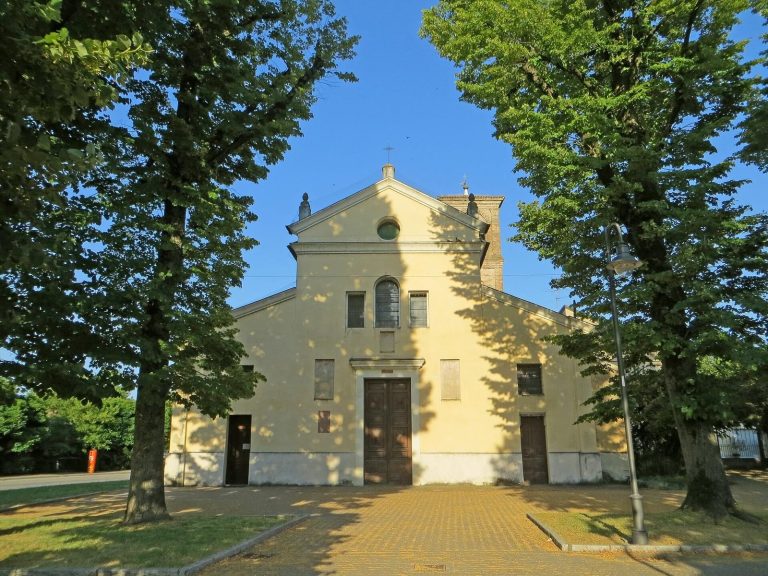
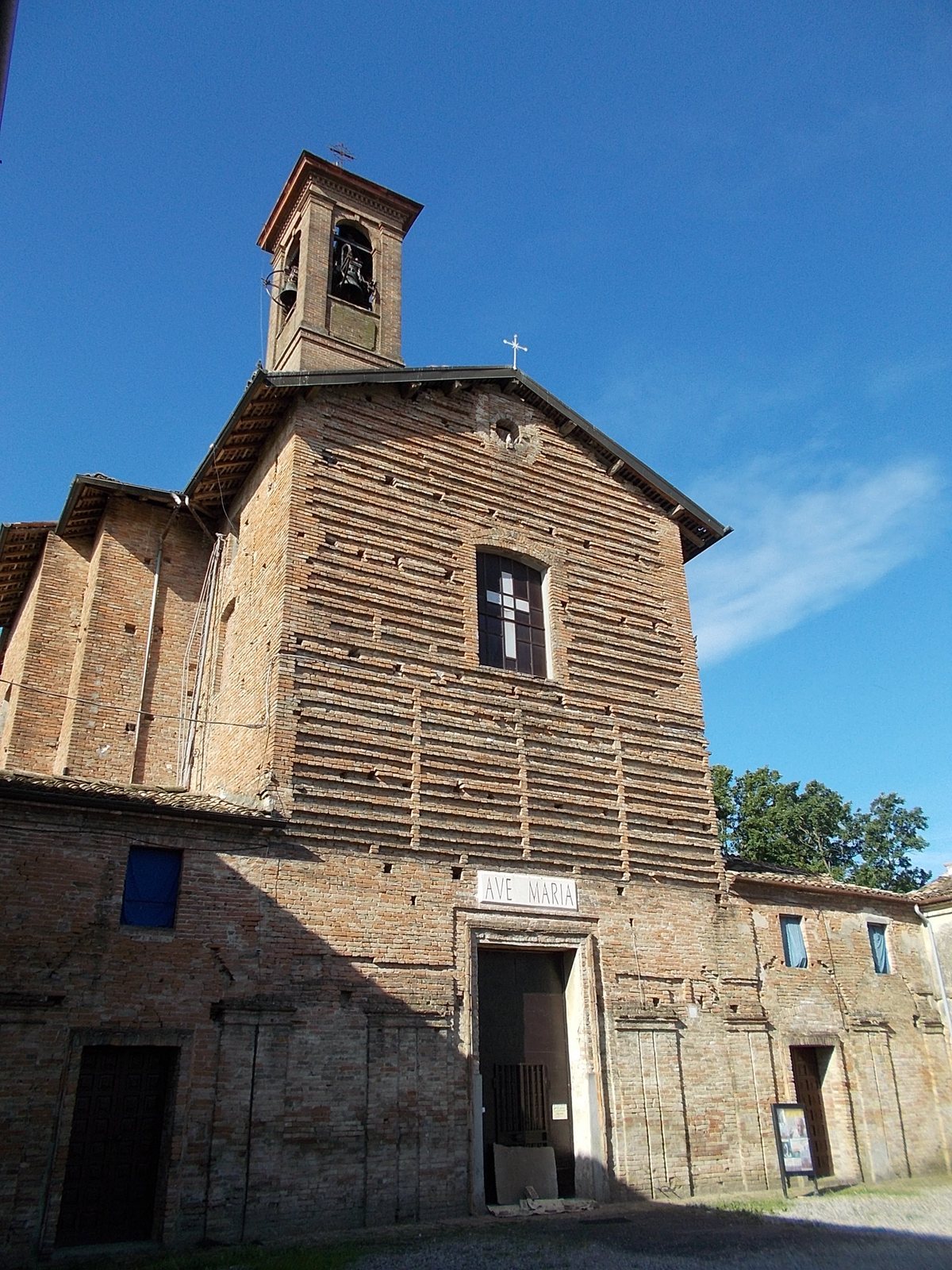
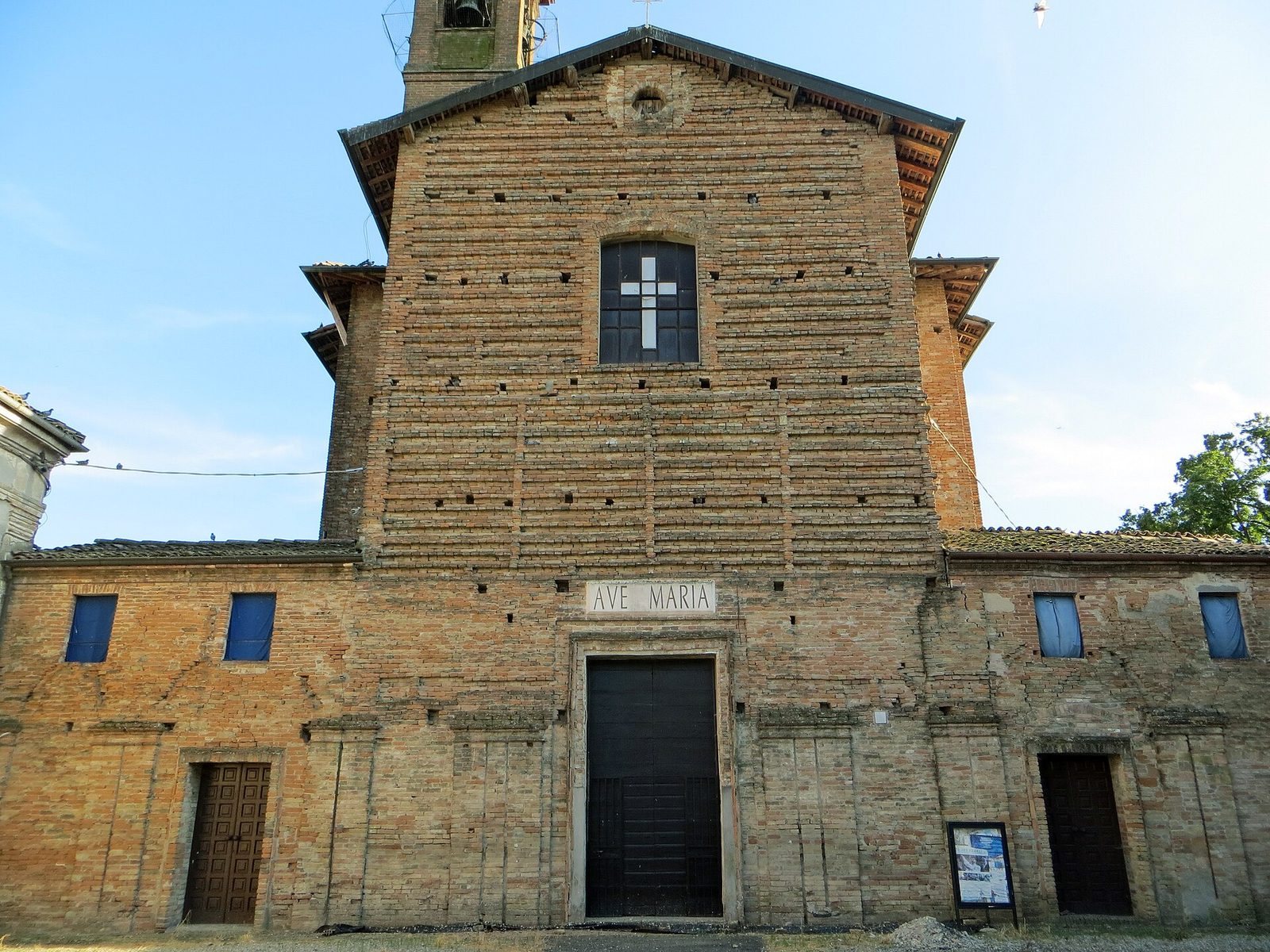
The symmetrical, gabled façade rises 17 metres and is built of brick. A broad central doorway has a shallow frame bearing the inscription AVE MARIA. Pilasters, shallow projections resembling columns, flank the entrance. Above it are a low-arched window and, near the top of the façade, a small circular opening. To the left stands a slender, 27-metre bell tower. Its bell chamber has a round-arched opening on each side and holds eight bells.
Side ranges and service buildings
Two symmetrical, two-storey ranges continue along the church’s sides. Porticoes once projected from them, but were removed in the early nineteenth century after becoming unsafe. The two-storey rectory has an attic, a plastered exterior with pilasters and horizontal bands, and a deteriorated surface. The two-storey service building occupies the site of the seventeenth-century chapel. Its brick pillars and segmental arches retain the form of the earlier portico, which was later enclosed.
Interior and altars
Nave and high altar
The high nave has a barrel vault, a long, curved ceiling, with curved sections known as lunettes. Two broad side chapels open near its midpoint. Shallow pilasters with Doric capitals, the plain tops of columns, divide the plastered walls and support a projecting horizontal band. The ropes for the tower bells can be seen to the left of the entrance; a smaller bell beside the sacristy, a room for preparing services and storing religious objects, signals the beginning of services.
A canopy crowns the apse above the high altar. Its altarpiece is a 1950 painting of the Madonna dei Prati by Italian painter Giuseppe Moroni, set in a large white-and-gold Baroque wooden frame with floral carving and six small angels. The painting covers the venerated sixteenth-century fresco. The fresco was placed in the chapel in 1632, moved behind the high altar late in the seventeenth century, and raised in 1912; that work damaged it in part, after which it was concealed. A carved wooden choir stands below the altarpiece.
The present high altar dates to 1985. A lacquered wooden altar formerly in the presbytery now stands in the Chapel of the Miracle of Saint Anthony. The fixed marble altar installed in 1904 to replace a portable one has been kept in the sacristy since 1985.
Chapel of the Miracle of Saint Anthony
The right-hand chapel contains a painting of Saint Anthony resurrecting a child. It is a copy of a sixteenth-century work by Girolamo Mazzola Bedoli, now in the National Museum of Capodimonte in Naples. A carved and gilded Baroque frame surrounds the copy, which hangs above the lacquered wooden altar donated by the Boselli family in 1703. An early eighteenth-century oval painting of Saint Louis Gonzaga contemplating the Crucifix hangs on the chapel’s left wall. The chapel also contains a twentieth-century wooden statue of Saint Anthony the Abbot, carved by Insam and Prinoth of Ortisei.
Chapel of the Holy Family
The left-hand chapel is dedicated to the Holy Family. Its altarpiece depicts God the Father and the Holy Family and is attributed either to one of the Campi brothers or to Pasquale Ottino. A richly carved, monumental Baroque wooden frame surrounds the painting, which was probably commissioned by the Pallavicino family. Below it stands a polychrome marble altar, topped by a nineteenth-century gilded wooden tabernacle, a container for consecrated Eucharistic bread, with carved and inlaid decoration. An early eighteenth-century oval painting of Saints Lucy and Apollonia hangs on the chapel’s right wall. The same Parma painter made it and the oval painting in the opposite chapel.