San Salvador Sanctuary: A Marian Pilgrimage Site in Mallorca
Site at a Glance
- Popularity
- High
- Country
- Spain
- Primary era
- Early Modern
- Eras represented
- Medieval, Early Modern, Modern
- Civilizations
- Crown of Aragon, Spanish
- Site type
- Religious
- Remains
- Sanctuary
On this page15 sections
History
San Salvador Sanctuary is a religious complex on Puig de Sant Salvador near Felanitx, on Mallorca, Spain. Its origins date to 1348, when plague killed about one-fifth of Mallorca’s population and roughly half the people of Felanitx. The municipality and the castellan of Castell de Santueri, an official responsible for a castle and its district, sought permission from King Pere IV of Aragon, also known as Peter the Ceremonious. After receiving approval, they built a modest chapel in gratitude for the survival of the remaining inhabitants and provided a cistern. The king endowed a foundation for the celebration of Mass, and Pedro Bosch is traditionally named as its first friar.
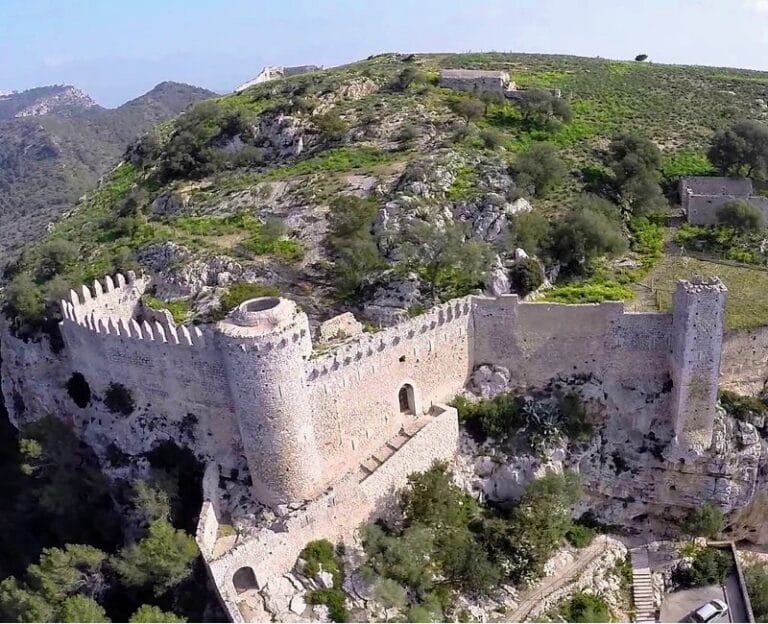
A tradition places the hermit Romeo de Burguera in a cave on the mountain during the first half of the fourteenth century. Hermits lived at the sanctuary from that century onward. In the fifteenth century, the exposed summit also served as a lookout. Signal fires linked it with watchtowers at Portocolom, Monte Sión, Campos, Santanyí, and elsewhere, warning settlements of frequent pirate raids.
Marian devotion and pilgrimage
Devotion to the Virgin of Sant Salvador emerged in the fifteenth century. Legend tells that a shepherd saw her image shining in the darkness of summer and that an angel instructed him to carry it up the mountain. An inventory from 1486 lists a chapel with two images of Mary, a votive offering, meaning a gift made in fulfilment of a vow or in gratitude, and a statuette. The image was identified as Our Lady of Sant Salvador in 1572. During the sixteenth century, the church was enlarged and the sanctuary became a Marian shrine, a change reflected in its devotional gifts and images.
The earlier church was dedicated to Christ and contained a relief depicting the Passion of the Image of the Savior. This medieval Christian legend tells of a profaned image of Christ that supposedly bled. It became part of an anti-Jewish polemical tradition, and its alleged events are not established history. In 1570 Pope Pius V promulgated a revised Roman Missal, the liturgical book used in the Roman Rite. Devotion to the relief’s subject subsequently declined at the chapel of San Miguel in Felanitx, and the relief was transferred to Sant Salvador between 1576 and 1589. Changes made in 1595 were connected with a grammar school founded in the middle of the sixteenth century. A brotherhood established in 1601 helped the chapel and hermitage develop into a pilgrimage destination.
The eighteenth-century church
The present church was built between 1707 and 1715 and consecrated on 24 August 1716 as the church of Our Lady of Sant Salvador. The broader eighteenth-century complex is dated to 1707–1734. It replaced the earlier church as pilgrim numbers grew; the Passion relief was placed in a side chapel, while a Marian altarpiece occupied the principal position. The sanctuary also continued to serve as a refuge in times of danger.
Hermits and modern changes
Three hermits lived in the monastery hostel in 1824. Permanent residence ended in 1851 because of the harsh conditions, though religious members of the region continued to visit occasionally and for religious purposes. Felanitx sold the sanctuary at auction in 1885. The buyer, Juan Antonio Puig y Montserrat, an archbishop of Puerto Rico born in Felanitx, transferred the complex to the Diocese of Mallorca. In 1891 the Mallorcan Congregation of Hermits of Saint Paul and Saint Anthony, a religious community whose members lived as hermits, took responsibility for pastoral care and administration. It remained in charge until 1992.
Felanitx’s municipal school used the sanctuary as a boarding school in 1922. Planning for a mountain road took place from 1917 to 1923; construction followed from 1923 to 1927, and the road was paved in 1964. Work on a monument to Christ the King began in 1928 and was completed in 1934. Its stark appearance contrasted with the simpler monastery, prompting local controversy, although it later became popular. During the Spanish Civil War, three bombs fell on the sanctuary and one on the monument, but none caused damage.
On 8 September 1934 the church returned to the ownership of the parish of Felanitx, and Bishop José Miralles y Sbert authorized the solemn annual coronation of the Marian statuette. The church’s main altar area was remodeled between 1934 and 1942. Since 1992 the complex has been managed separately from the hermit congregation, and its buildings and land belong to the Diocese of Mallorca. It was declared a cultural property of interest in 1993. The annual observance falls on 8 September, the Nativity of Mary. Every 25 years the statuette is carried in procession to Felanitx’s parish church of San Miguel. A further traditional gathering, the pancaritat, takes place on the first Sunday after Easter.
Remains
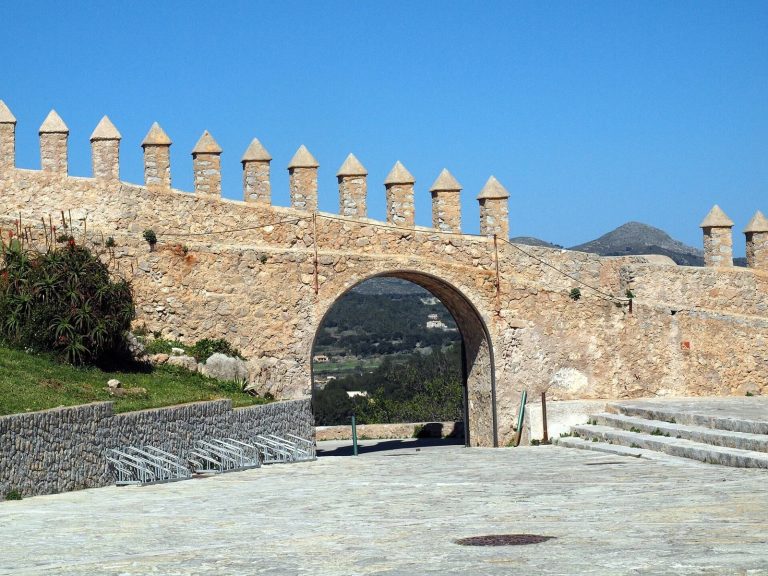
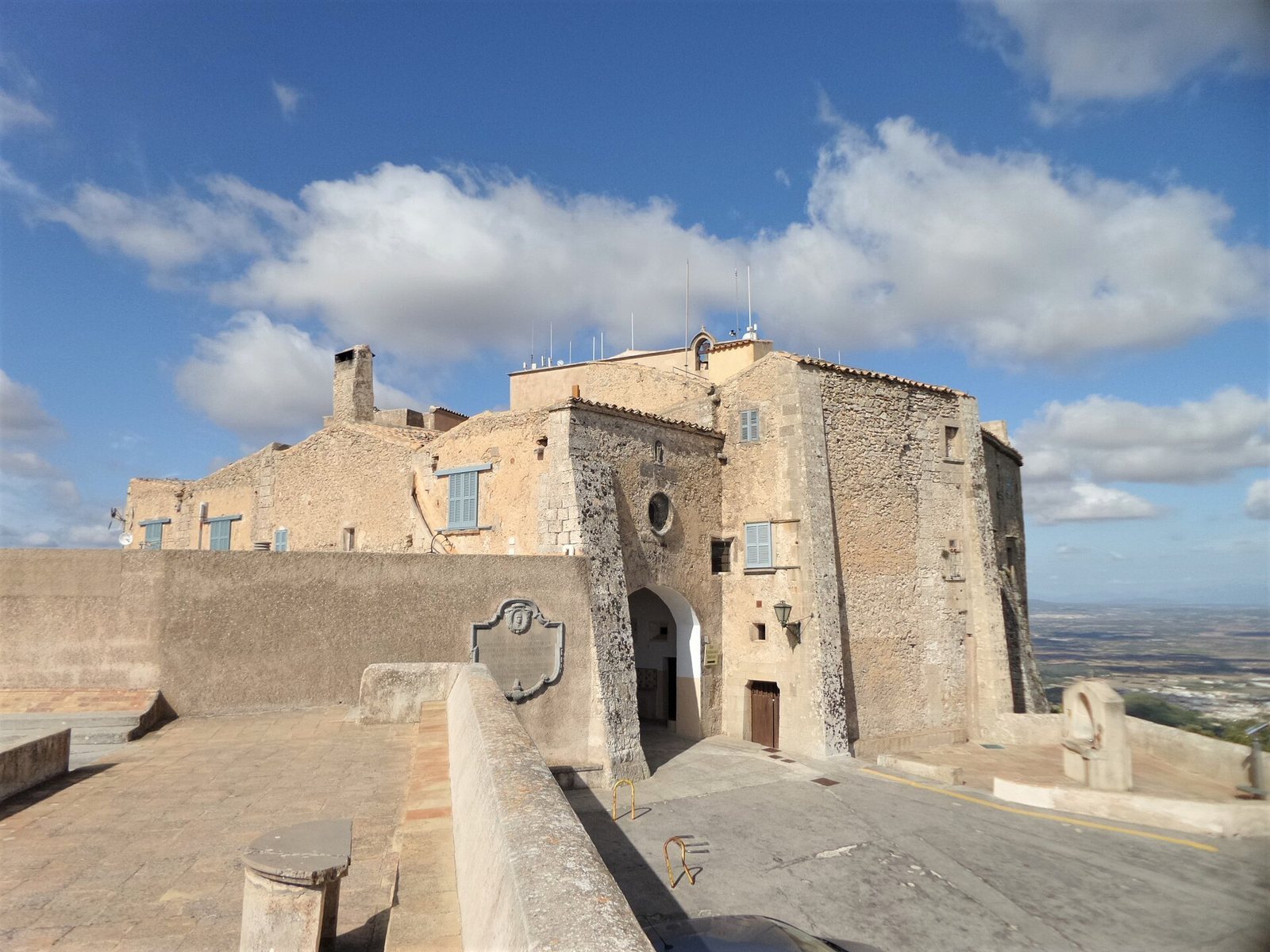
The sanctuary occupies the summit plateau of Puig de Sant Salvador, in the Serra de Llevant in southeastern Mallorca, at about 509 metres above sea level. Its church and former monastery hostel form the central complex, whose exterior has a fortress-like character. The church has several side chapels, and a cistern was built with the original chapel. A cave associated with the hermit tradition lies on the mountain.
Church and monastery complex
Church and Marian altar
The high altar stands in the apse, the rounded end of the church, and holds a fifteenth-century Gothic statuette of the Madonna and Child about 50 centimetres high. In the eighteenth century, sculptor Pere Coronero added Baroque figures and decoration. From 1903, the statuette stood beneath a Romanesque arch flanked by four columns with twisted shafts.
Mallorcan sculptor Tomàs Vila Mayol made the alabaster altarpiece in 1942 on commission from the town of Felanitx. Its inscriptions address Mary as queen, mother of mercy and of the Savior, health of the sick, refuge of sinners, comforter of the afflicted, and help of Christians; a further inscription asks her to pray for sinners. Side stairways let pilgrims approach to just below the statuette. A marble altar in the main altar area was consecrated in 1963. In February and October, low morning sunlight can pass through a rose window and illuminate the statuette for several minutes.
The church entrance contains a Nativity display set in an artificial cave, with scenes of the search for lodging, the shepherds’ adoration, and the visit of the Magi. An image of the Madonna of unknown origin is positioned above the courtyard portal. A small room before the church holds gifts, mementos, and photographs left in gratitude for deliverance from illness or other difficulties. Poems by Mallorcan poets Mateu Obrador and Llorenç Riber are displayed outside the church and hostel and celebrate the sanctuary’s foundation legend.
Passion relief
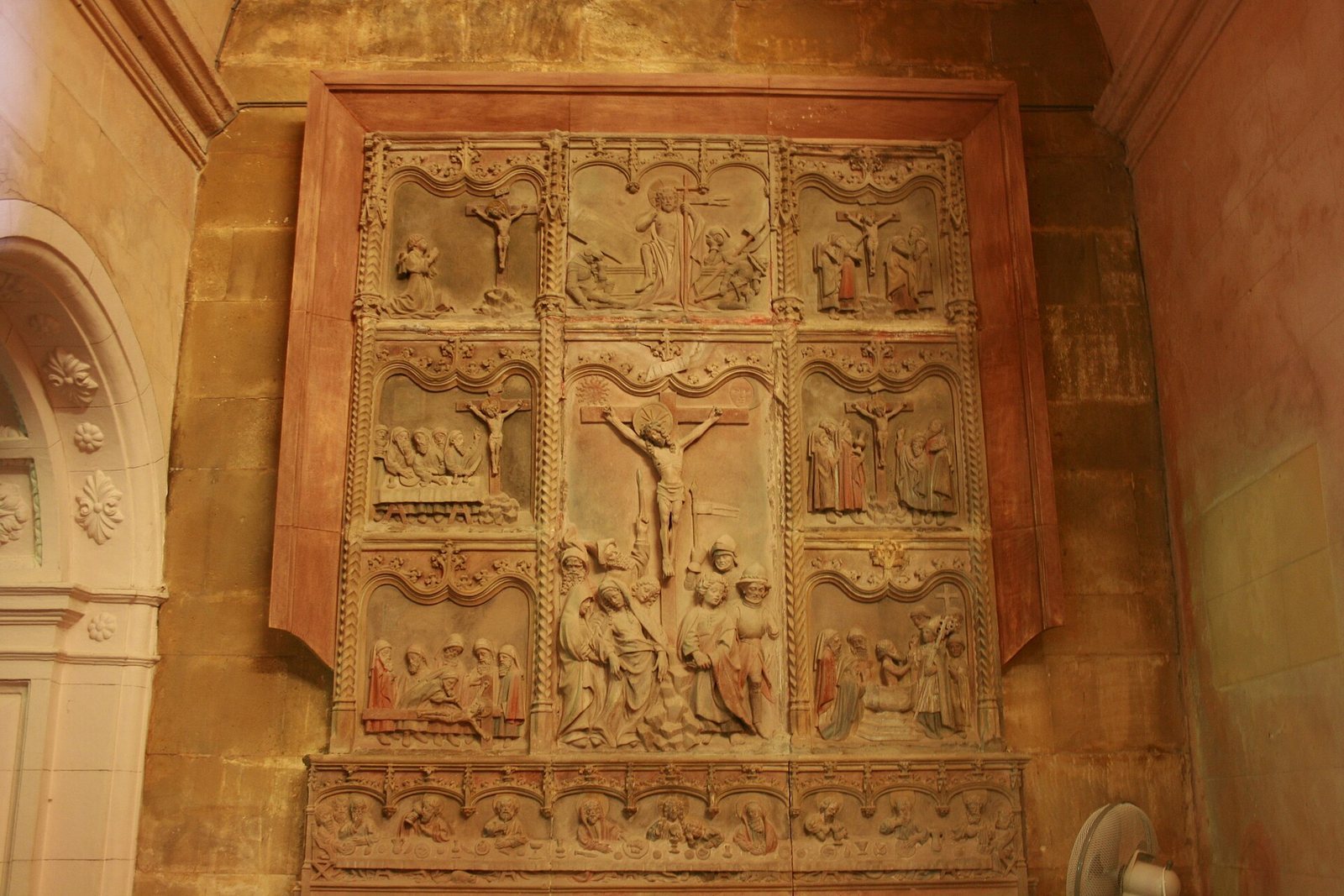
The stone relief measures 2.70 metres high and 2.40 metres wide. Earlier attributions linked it to Guillem Sagrera or his workshop, but an examination of surviving painted pigments in 2018 identified Huguet Barxa as the sculptor and dated the carving to 1448–1453. The painting is attributed to Juan Marsol. Since 1716 the relief has stood in a side chapel on the right of the church.
The relief depicts Christ’s Passion, crucifixion, and resurrection. In the lower section of the altarpiece, or predella, the Last Supper appears below a central image of Christ on the cross. Six flanking scenes refer to the Passion of the Image of the Savior, the medieval legend about a crucifixion image in Beirut that was supposedly profaned and made to bleed. The imagery equates the destruction of an image with Christ’s execution and presents Jews as alleged perpetrators, reflecting the legend’s anti-Jewish polemical tradition. The lower-left scene, in which Jesus is nailed to the cross, also evokes the false accusation that the image was ritually crucified again.
Former monastery hostel
The hostel occupies the former monastery complex. Its entrance displays a relief of the Last Supper that reproduces the original above the Puerta del Mirador of La Seu Cathedral in Palma.
Mountain route and chapels
Old pilgrimage route
The former route from Felanitx followed the old road of Sant Salvador to a large stone cross at the mountain’s foot, at an elevation of 207 metres, then climbed through pine forest along the northern slope. The path begins broad and partly paved before becoming steep and narrow higher up. A former hospice in Felanitx accommodated pilgrims associated with the sanctuary.
Bon Pastor chapel and Stations of the Cross
Halfway up the mountain, the chapel of Mare de Déu del Bon Pastor, also known as La Capellata, was built in 1910 under the direction of Antoni Maria Alcover in a Neo-Romanesque style, a revival of Romanesque forms. It replaced a sixteenth-century chapel said to have been richly decorated with glazed tiles. The chapel marks the place where legend says the shepherd found the Marian image. Opposite it, a stairway begins the old Stations of the Cross route, where thirteen stations with sixteenth-century tile images survive. The route also passes the Pedra dels Perdons, or Rock of Forgiveness, which local legend identifies as the site of a giant’s house.
Summit monuments and nearby cross
Christ the King monument
The monument stands on the southern part of the summit plateau and rises 37 metres. Its square concrete base measures 8 metres on each side and supports a 7-metre statue of blackened bronze. Christ wears a crown and halo and extends his right hand in a protective gesture. The halo bears the words King of Kings and Lord of Lords; the monument also displays the IHS monogram, a traditional abbreviation for Jesus, and the inscription Jesus Christ King. A Sacred Heart appears on the statue’s chest. The monument is attributed to Francesc Salvà Pizà or, more probably, Tomàs Vila Mayol, who is said to have begun work on it in 1927. A bishop’s coat of arms is set about halfway up the structure.
Inscriptions on the east and west sides of the base invite the reader to observe the canonical hours, set times of daily prayer, from the Office for the Dead, a liturgy for the deceased. A chapel beneath the base provides a place for devotion and meditation and contains the remains of Mateo Alzamora and five hermits. An altar below bears an inscription from the Te Deum, a Christian hymn of praise.
Creu del Picot
The Creu del Picot stands on the lower Puig de Milá, about 250 metres north of the summit plateau. This 14-metre stone cross was erected in 1957 after storms and weather destroyed two earlier crosses, a wooden one from the late nineteenth century and an 11-metre metal one that stood from 1927 to 1951. Its inscription, dated 25 August 1957, means, Brothers, these arms are always open to everyone.