Castell de Cabrera: A Coastal Defensive Castle in Spain


Site at a Glance
- Rating
- 4.7
- Popularity
- Low
- Country
- Spain
- Primary era
- Medieval
- Eras represented
- Medieval, Early Modern
- Civilizations
- Crown of Aragon, Spanish
- Site type
- Military
- Remains
- Castle
On this page5 sections
History
Castell de Cabrera is a coastal castle in Spain, built during the fourteenth century, probably in its latter half. It originally stood as a defensive watchpoint and later developed into a fortified position protecting Cabrera from attacks by pirates and other military forces affecting the Balearic Islands.
Foundation and early expansion
The earliest documentary reference dates from 1410, when the tower keepers Pedro and Guillermo Zaragoza were already serving at the fortification and receiving their full salaries. Their presence shows that the site was operational by that date. The first structure may have been little more than a watchtower.
In 1425, Bernat Zaragoza, usufructuary of Cabrera and acting for the Paborde of Tarragona, a senior ecclesiastical officeholder linked to Tarragona’s cathedral institution, reached an agreement with the University of the City and Kingdom of Mallorca. This historic governing institution of the island, rather than a modern university, undertook arrangements for maintaining a garrison to defend Mallorca and the castle. The reference to the castle as newly completed suggests that the original tower had been enlarged.
Attacks and military service
The castle was repeatedly attacked and rebuilt. In 1510, two Barbary galleys captured the tower keepers and 22 fishermen before destroying the tower. A sudden storm gave relief forces time to arrive and release the captives.
In 1550, Dragut, an Ottoman corsair and naval commander, captured Cabrera with 1,500 men. His forces seized the castle’s artillery and completely demolished the building. During the sixteenth century, a chapel was also built so clergy from Santanyí could celebrate Mass for the garrison. The repeated damage and rebuilding of this period substantially changed the fortification, which was destroyed and reconstructed at least ten times during the century.
After restoration and improvements, the castle came under the authority of the University of Mallorca in 1698. During the War of the Spanish Succession, an early-eighteenth-century conflict over the Spanish monarchy, its governor was the military officer Francisco Mariscal. In 1715 he commanded about 20 soldiers and watched for possible Bourbon incursions, meaning attacks or military operations by forces supporting the Bourbon claimant. The castle fired its artillery for the last time in this setting. From 1716 onward, it was placed under royal authority.
Later functions and protection
The fortification retained a military role until the nineteenth century. It also served as a quarantine tower, where people or vessels suspected of carrying contagious disease could be isolated, and as a prison. The tower keepers faced particular danger because they had few opportunities to withdraw during an attack, so their pay was the highest assigned in the Balearic Islands. Guards were often convicts whose sentences were commuted in return for this service.
Castell de Cabrera is recognized as a monument of cultural interest under Spain’s heritage system, with the designation recorded on 30 November 1993.
Remains
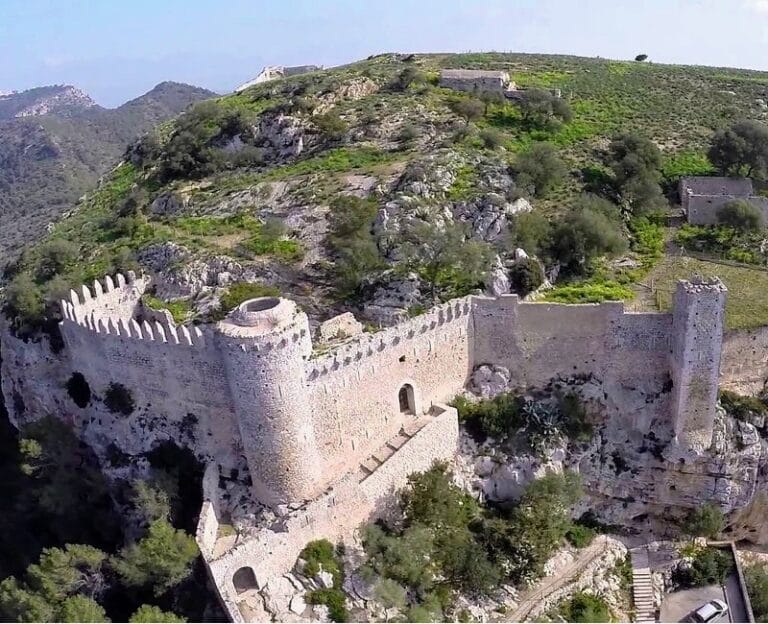
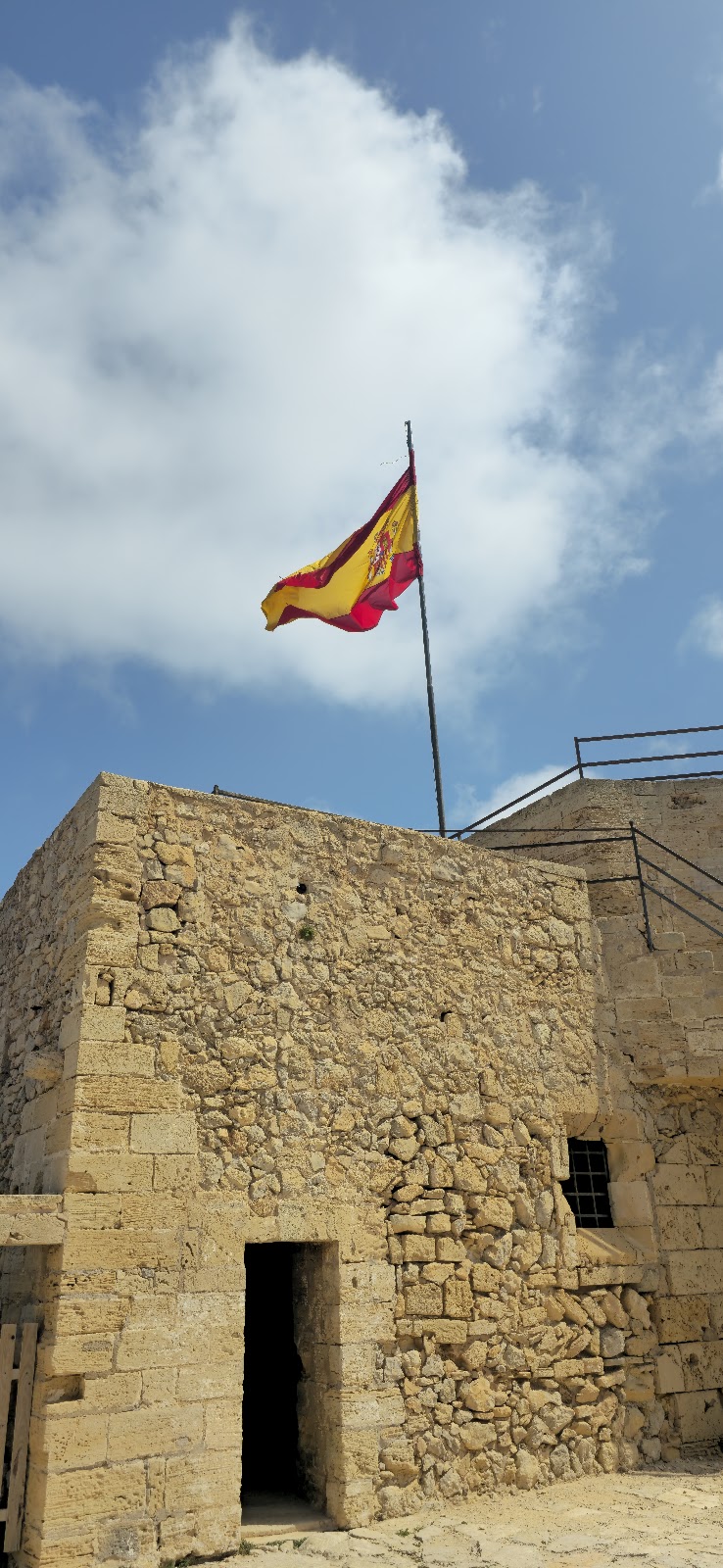
The castle stands 72 metres above sea level on the eastern tip of the entrance to Cabrera’s natural harbour. Its present form is a solid, slightly elongated hexagonal mass built of stone. Repeated attacks and rebuilding have left it substantially different from the original construction.
The castle’s artillery was seized during Dragut’s attack in 1550. The sixteenth-century chapel built for the garrison remains part of the site’s architectural history. The castle is currently considered stable, although a restoration carried out a few years ago was judged unsuccessful.
Nearby sites