Santo Stanislao dei Polacchi: Rome’s Polish National Church
Site at a Glance
- Popularity
- Medium
- Country
- Italy
- Primary era
- Early Modern
- Eras represented
- Early Modern, Modern
- Civilizations
- Italian, Papal States
- Site type
- Religious
- Remains
- Church
On this page14 sections
History
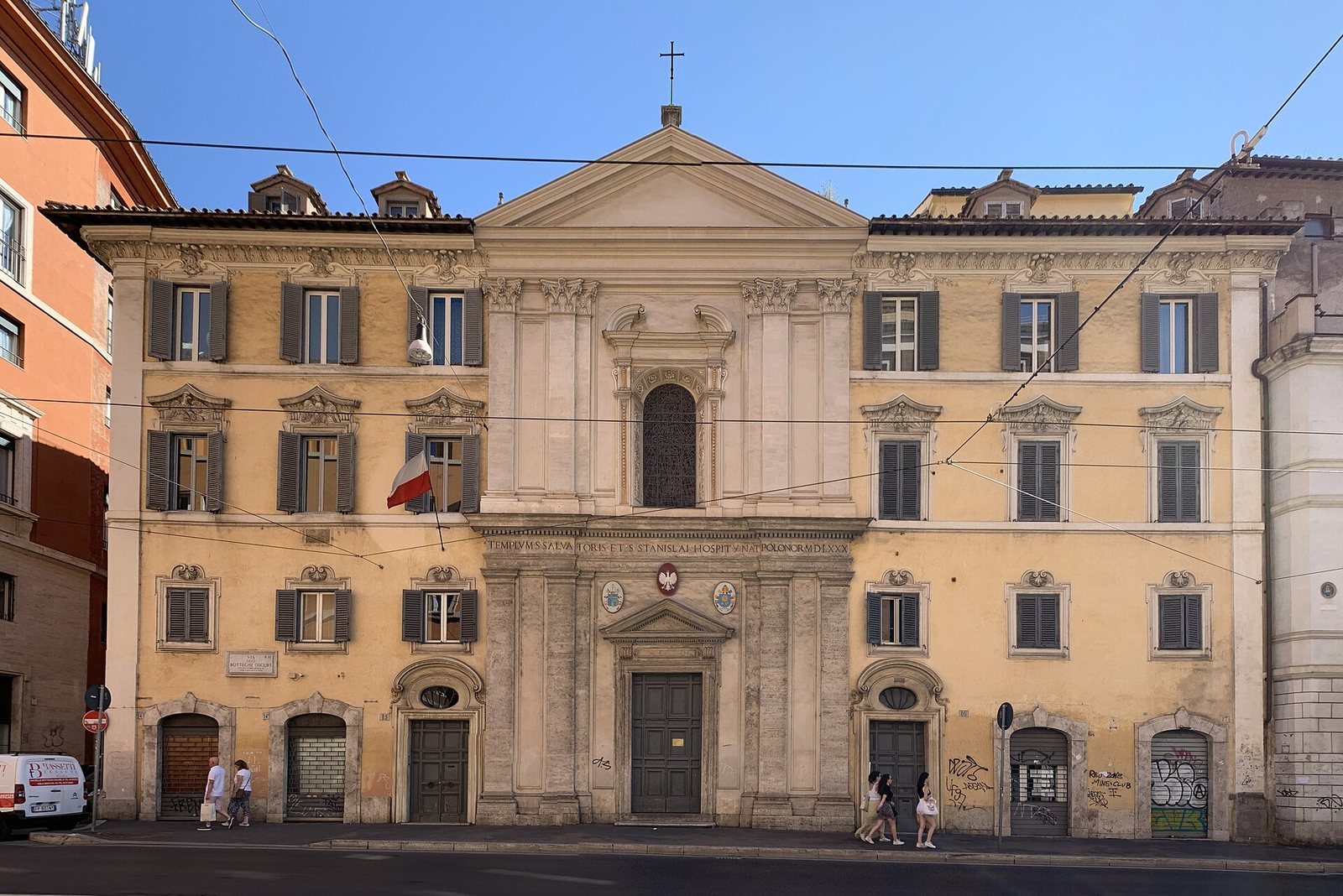
Santo Stanislao dei Polacchi is a Roman Catholic church in Rome, Italy, dedicated to Saint Stanislaus of Szczepanów, an eleventh-century bishop and martyr venerated as Poland’s patron saint. It serves as the national church for Poles living in Rome. Its present Baroque appearance followed rebuilding in 1757. The church developed from a medieval predecessor built over the remains of the Circus Flaminius, an ancient Roman public-event precinct.
The medieval church
The predecessor was known as San Salvatore in pensilis de Sorraca and appears in records from 1174 and 1209. The name’s pensilis has been interpreted in two ways: it may refer to raised platforms used by prostitutes beside the church, or derive from the German word pisil, meaning “oven,” in reference to furnaces in the circus. De Sorraca refers to a family of that name. In October 1285, a rebuilding took place under Jerome, bishop of Palestrina. An inscription commemorating the work survives.
A Polish church and hospice
During the 1575 Jubilee Year, a designated period of pilgrimage and spiritual observance, Polish cardinal Stanislaus Hosius recognized that Poles in Rome lacked a place for pastoral support. Pope Gregory XIII granted him the church for Polish use. Hosius took possession on 6 December 1578, and rebuilding began in the early 1580s, almost from the foundations because the building was in poor condition. Queen Anna Jagiellon, her husband King Stephen Báthory, and wealthy Polish noble families contributed funds. After Hosius’s death, his secretary Stanisław Reszka completed the work. Cardinal Jerzy Radziwiłł, bishop of Kraków, consecrated the rebuilt church in 1591. A hospice beside it supported Polish pilgrims and students, and the church and hospice became a central institution for Polish pastoral life in Rome.
Popes also visited to pray for Polish military success, particularly against the Ottoman Empire, and to give thanks after victories. Alexander VII came in 1657 and 1661, Clement X in 1672, and Innocent XI in 1683.
Eighteenth-century rebuilding
An eighteenth-century campaign directed by architect Ignazio Brocchi involved the church and adjoining buildings. The present appearance followed rebuilding in 1757, while interior decoration dates to the reign of Stanisław August Poniatowski, the last king of the Polish-Lithuanian Commonwealth.
Loss and restoration
After the partitions of Poland, late-eighteenth-century annexations that ended the Polish-Lithuanian Commonwealth, the church and hospice entered a difficult period. During the French occupation of Rome under Napoleon Bonaparte, a French military ruler, residents were expelled from the hospice, troops were housed in the buildings, and the premises were confiscated. After the Congress of Vienna in 1815, the Russian ruler, acting as king of Poland, took control of the church and institution. The church was put to Eastern Orthodox use, and the hospice became a Russian centre for pilgrims. Most of the church’s valuable possessions were sold. Items retained included a monstrance, a vessel used to display the consecrated Eucharist, donated by Duke Stanislaus Poniatowski, and a reliquary, a container for religious relics, given by Andrzej Stanisław Załuski, bishop of Kraków.
In 1920, following the efforts of Kraków bishop Adam Stefan Sapieha, Poles regained their rights to the church and institution. The church was then in ruins. Renovation continued over several decades, with work interrupted from 1939 to 1947; completion came in 1991, the 400th anniversary of its consecration. Archbishop Szczepan Wesoły oversaw the final work. Priests of the Society of Christ for Poles Living Abroad have served at the church since the late 1940s. The first were Walery Przekop and Franciszek Okroy, both former prisoners of Dachau, a Nazi concentration camp in Germany. The Society directed the pastoral establishment from 1959 to 2007, and Sisters of the Sacred Heart also serve there.
Remains
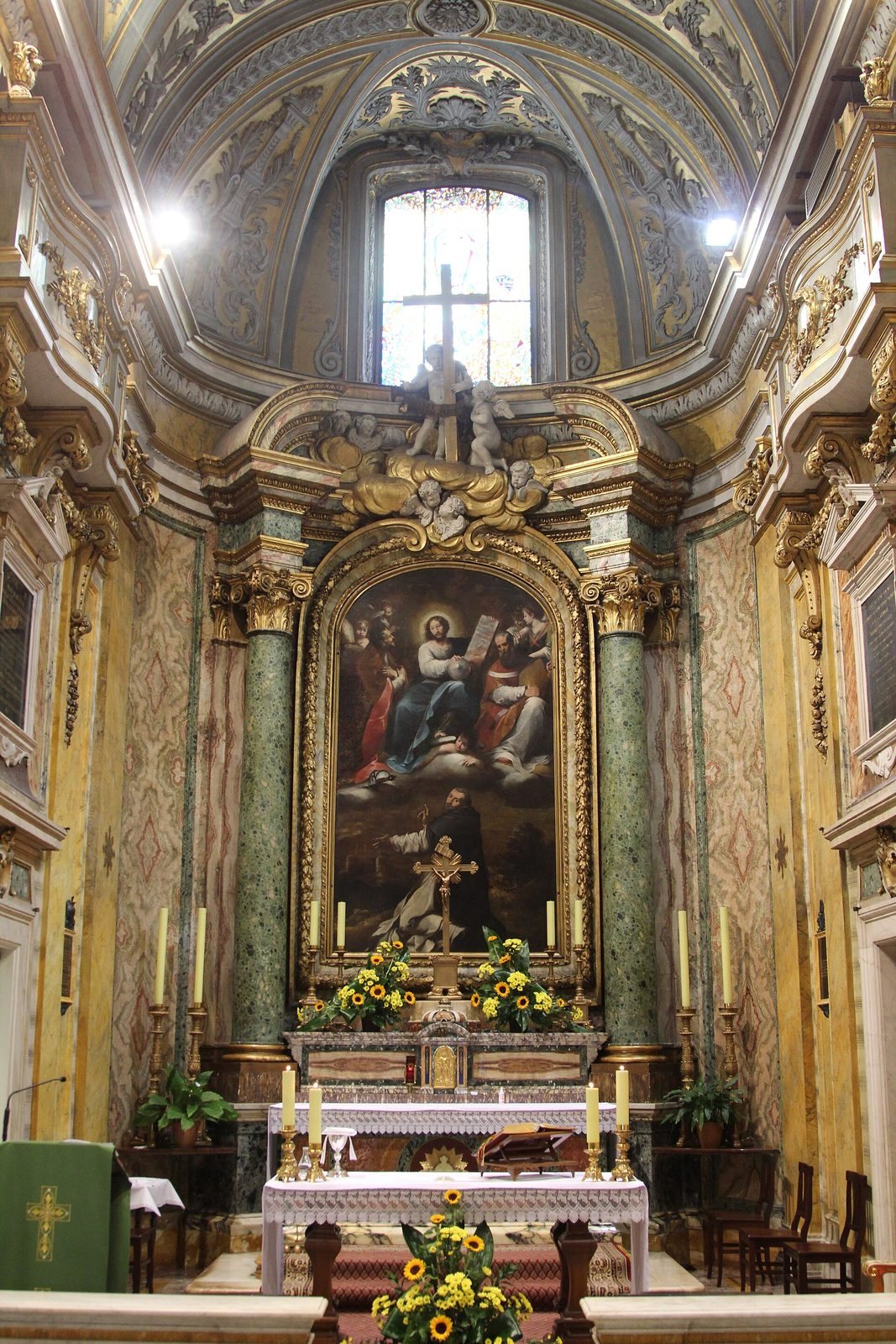
The church has a single nave, or central worship space, with two chapels on each side. Its Baroque interior brings together a decorated vault, a high altar and a sequence of side chapels.
Exterior and medieval evidence
Façade
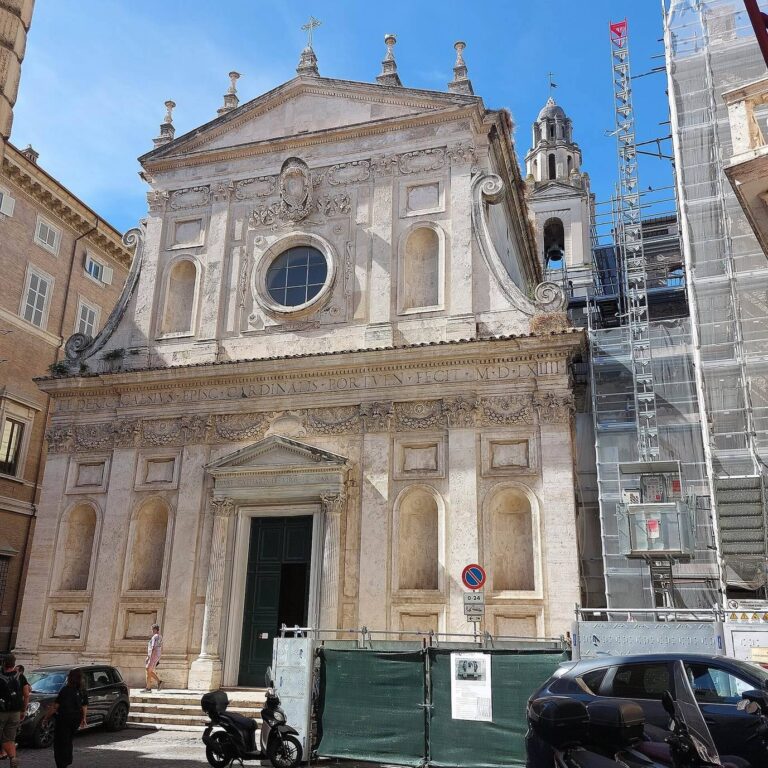
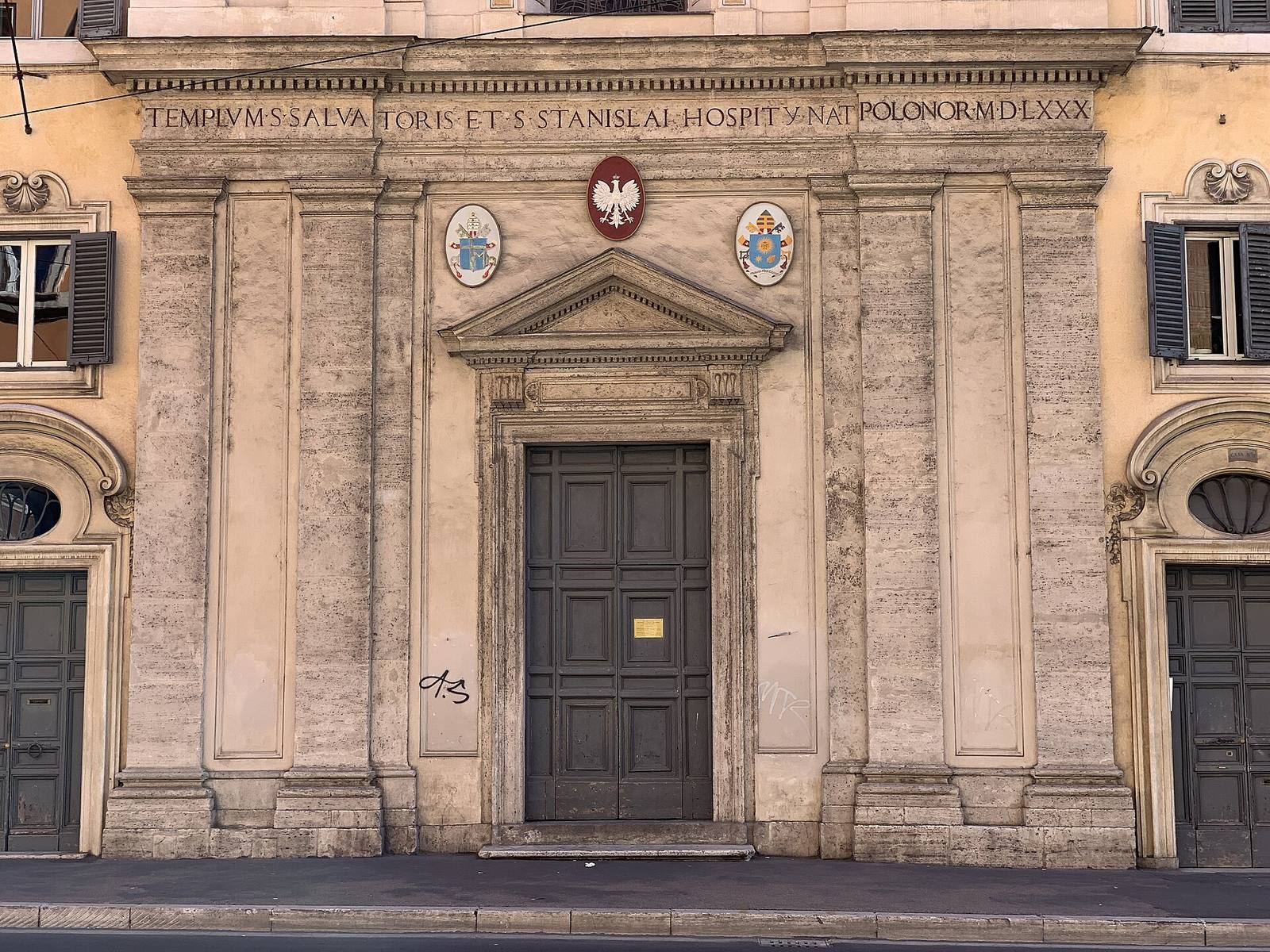
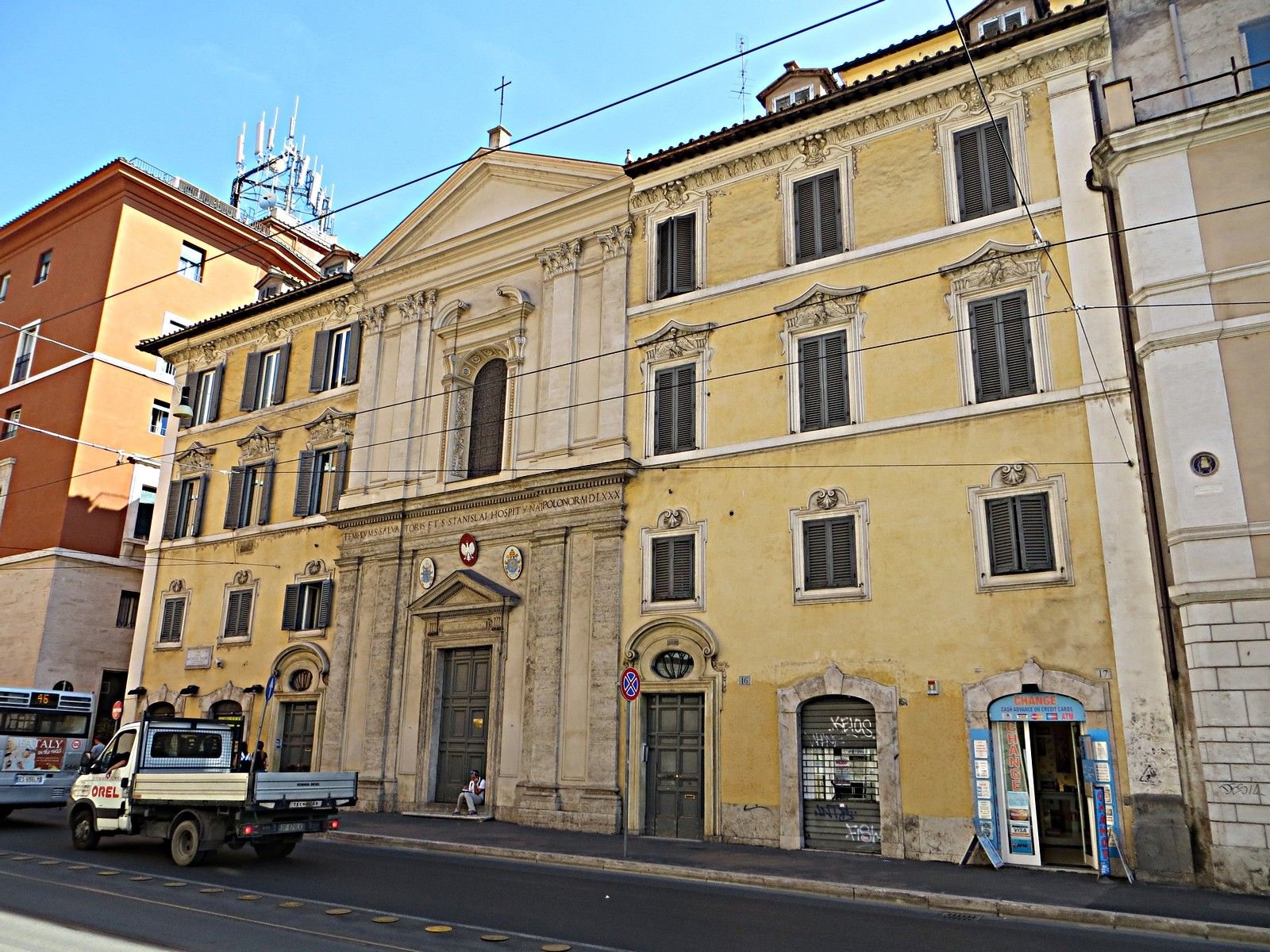
The façade, designed by Francesco Ferrari, dates to 1735.
Medieval inscription
The inscription commemorating the medieval church’s rebuilding is now in the entrance hall of Palazzo Busiri on Via Aurora. It is the only surviving remnant of that church.
Interior
Vault and high altar
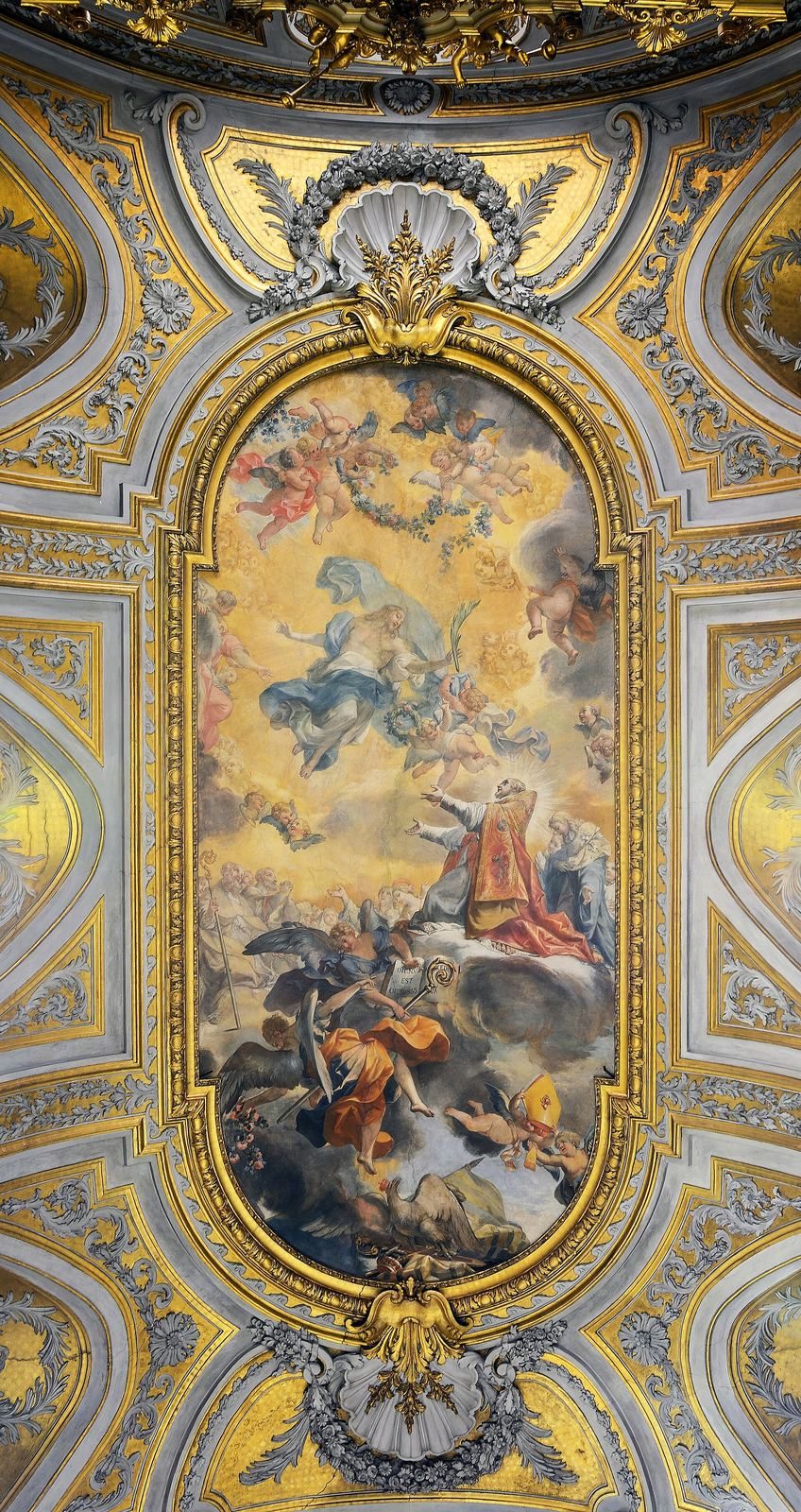
The richly decorated vault bears Ermenegildo Costantini’s painting The Glory of Saint Stanislaus. The Ciołek coat of arms is set above the presbytery, the clergy’s area around the main altar. At the high altar, an altarpiece, an artwork placed on or behind an altar, by Antiveduto Gramatica shows Jesus with Saints Stanislaus and Hyacinth, a Polish Dominican saint. The work dates to the late sixteenth century. The interior also contains eighteenth-century paintings by Taddeo Kuntze and other Polish artists.
Right-hand chapels
The first chapel on the right is dedicated to Saint Casimir of Kraków, a Polish-Lithuanian prince and saint. It contains Franciszek Smuglewicz’s Miracle of Saint Casimir. The next chapel is dedicated to Saint Stanislaus. Its altarpiece by Taddeo Kuntze depicts the saint raising a dead person, with a reproduction of the Black Madonna of Częstochowa placed below it.
Left-hand chapels
The first chapel on the left honours Saint John Cantius, a Polish priest and theologian. Its altarpiece by Sicilian painter Salvatore Monosilio depicts the saint offering his possessions to the poor. Above the altar is an oval painting of Saint Stanislaus Kostka, a Polish Jesuit, receiving communion from an angel. The second chapel is dedicated to Saint Hedwig of Andechs, a medieval duchess and saint. Above its altar hangs Szymon Czechowicz’s 1725 painting Saint Hedwig Adoring a Crucifix. Opposite it is a copy of the Our Lady of Mercy image from the Gate of Dawn in Vilnius, donated by Lithuanian Countess Janina Umiastauskienė.
Organ
A Tamburini organ, opus 168, dating to 1936, stands on the choir gallery above the entrance. It has electrically operated action, 16 stops, which select ranks of pipes, two manuals, or hand keyboards, and a foot-operated pedal keyboard. Its pipes are enclosed in a swell box, a case with shutters that vary the sound.