Santo Sepolcro: A Pilgrimage Chapel and Holy Sepulchre Replica in Italy
Site at a Glance
- Popularity
- Very Low
- Country
- Italy
- Primary era
- Early Modern
- Eras represented
- Early Modern
- Civilizations
- Papal States
- Site type
- Religious
- Remains
- Chapel
On this page8 sections
History
Foundation and enlargement
Santo Sepolcro is a Catholic church in Italy, built in 1674 by Count Girolamo Cellesi as a modest chapel dedicated to Our Lady of Succour of Pistoia. Cellesi obtained permission from the bishop of Bagnoregio before construction.
In 1703, Count Francesco Cellesi sought sacred relics from the Franciscan Custody of the Holy Land, the Franciscan institution responsible for Catholic holy places in the region. He enlarged the chapel to twice its original size to accommodate an edicule, a small shrine or built enclosure, modeled on the one enclosing Jesus’ traditional tomb in Jerusalem’s Basilica of the Holy Sepulchre. The relics arrived in February 1704, and the bishop of Bagnoregio consecrated the church on 7 March. A large rock that could not be removed during construction required a change to the replica’s design.
Pilgrimage and later use
Santo Sepolcro joined a European circuit of buildings deliberately made as copies or memorials of Jerusalem’s Edicule. In a Christian tradition associated with Constantine I, a Roman emperor of the early fourth century, and his mother Helena, the rock at Jerusalem was identified with Calvary, where Jesus was crucified. His tomb was traditionally placed at the foot of the rock. At Santo Sepolcro, the incorporated stone echoed this feature.
The church was entrusted to the Confraternity of Jesus and Mary and the Holy Sepulchre, a religious association of laypeople also known as the Company of the Passion of Jesus and Mary or the Company of the Holy Sepulchre. It has two dedications, to Our Lady of Succour and the Holy Sepulchre, and is now commonly known by the latter. It belongs to the Diocese of Viterbo and serves as a cemetery chapel.
The church became a Catholic pilgrimage destination in the Tiber Valley, reached by a short detour from the Via Francigena, a historic route to Rome. Here the route followed a section of the ancient Roman Via Cassia between Acquapendente and Viterbo. Pilgrims came until the end of the nineteenth century, encouraged in part by a brief from Pope Clement XI, who permitted them to receive indulgences, the remission of temporal punishment for sins whose guilt had been forgiven. Santo Sepolcro remains among the important replicas of the Edicule in Europe.
Remains
Church and Edicule
Church
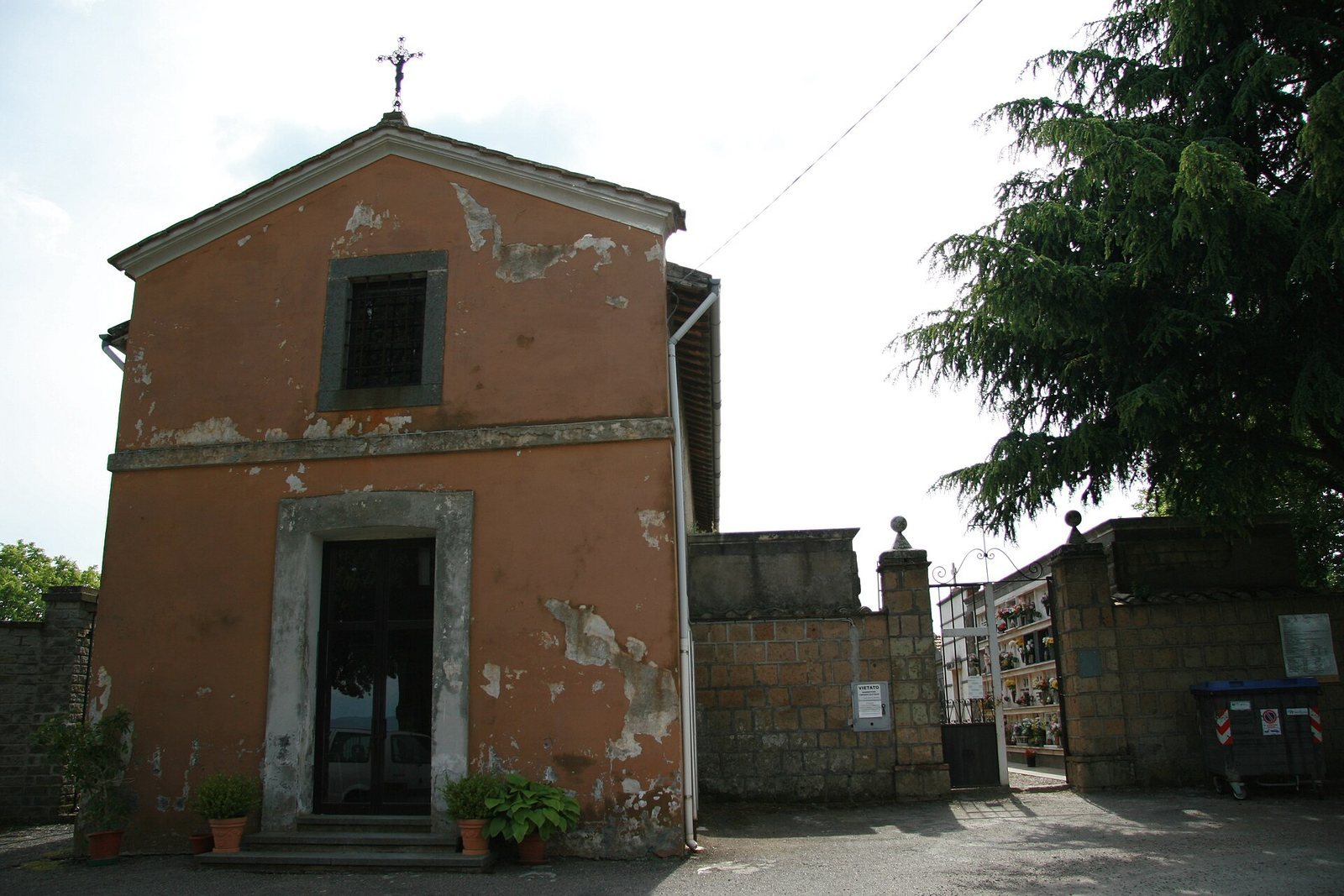
The church stands directly beside the cemetery wall. Its single nave has a main entrance facing northeast.
Edicule
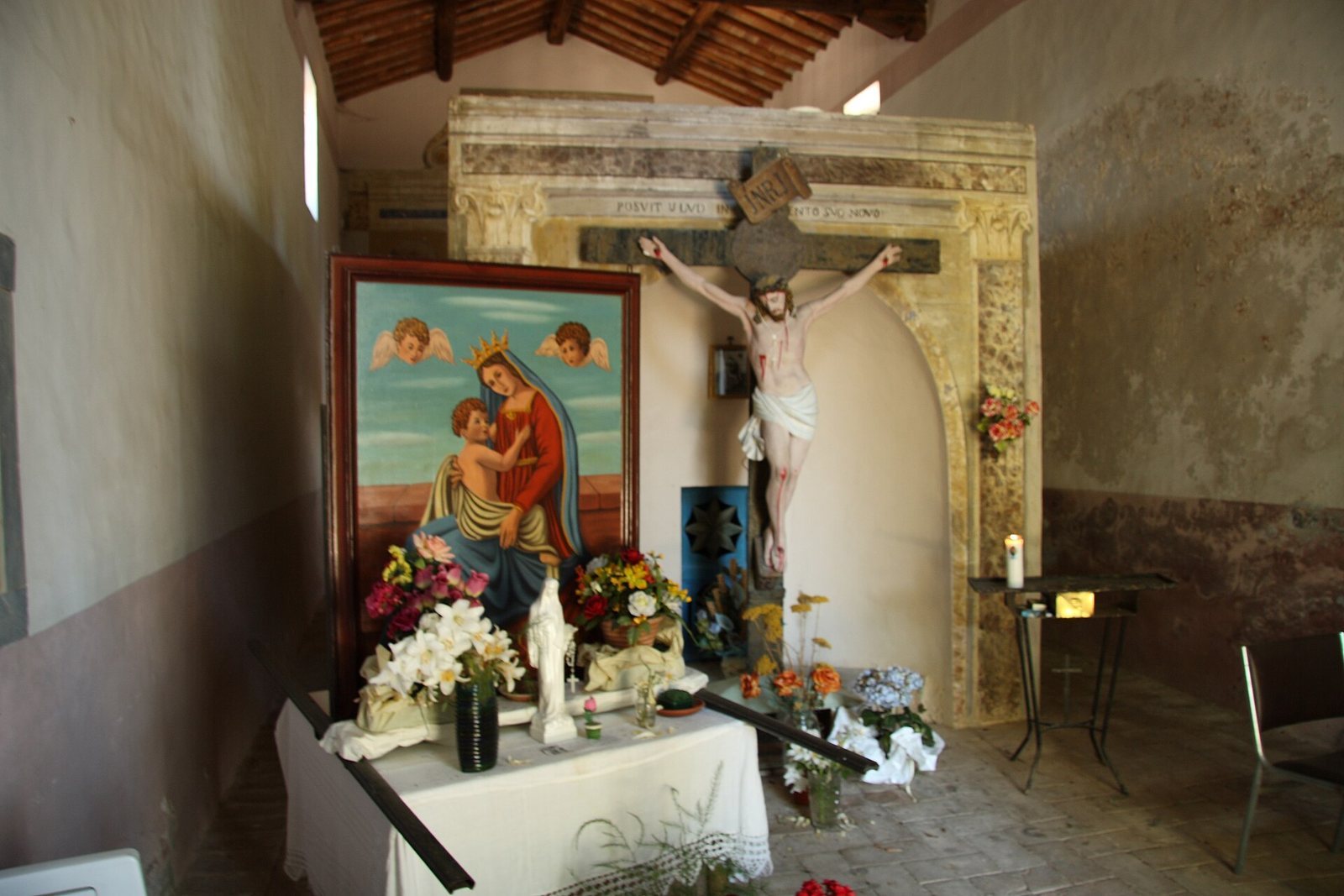
The replica incorporates the rock encountered during construction, which can be seen through an opening at the rear. A description from 1939 records a small dome resting on slender columns above the Edicule; the dome has since been lost. Inside its masonry burial chamber, a wooden crucifix stands apart from the rear wall, with a reliquary at its base.
Approach and surrounding landmarks
A steep, cypress-lined path was originally the church’s only approach; it is now part of Via Cleopino Bianchi. The church and surrounding topographic landmarks probably served as reference points when the avenue was laid out. Continuing its line across the cemetery leads toward the dome of the Cathedral of Santa Margherita in Montefiascone, 11 km away. In the other direction, the avenue points toward San Michele in Teverina, also known as Castel Piero. A small belvedere on the hill offers a broad panorama. Mount Terminillo, 70 km away, is visible and almost always snow-covered; Mount Amiata, 55 km away, can be seen in the opposite direction depending on the viewpoint.