Rocca dei Papi: Papal Fortress and Residence in Montefiascone, Italy


Site at a Glance
- Rating
- 4.4
- Popularity
- Medium
- Country
- Italy
- Primary era
- Medieval
- External website
- Open
- Eras represented
- Iron Age, Classical, Medieval, Early Modern
- Civilizations
- Etruscan, Papal States
- Site type
- Military
- Remains
- Castle
On this page13 sections
History
Rocca dei Papi is a papal fortress in Montefiascone, Italy, developed by the papal government from a medieval stronghold during the thirteenth century. Built on a hill 633 metres above sea level, it occupied a naturally defensible position overlooking the surrounding valley and guarded routes that included the ancient Via Cassia and the medieval Via Francigena.
Early settlement and medieval stronghold
The hill was inhabited from the Iron Age, when its position offered control over the surrounding landscape. Archaeological remains from a Proto-Villanovan settlement, dating to approximately the ninth or eighth century BC, were found in the area now occupied by the fortress. An Etruscan defensive wall made from tufa blocks was probably constructed between the sixth and third centuries BC.
By the medieval period, a fortified stronghold, probably built largely of wood, stood on the hill. Frederick Barbarossa, the twelfth-century Holy Roman Emperor Frederick I, occupied it during his campaigns in Italy and conflicts with the papacy. Papal forces later retook the position, after which Pope Innocent III recognized its value in defending the region.
Papal administration and expansion
In 1207, Innocent III transferred the seat of the rector of the Patrimony of Saint Peter in Tuscia to Montefiascone. This territory was the papal administrative domain in Tuscia, and its rector was the official responsible for governing it. Because Montefiascone was easier to defend, Innocent III ordered extensive changes to the earlier stronghold, beginning the construction of the Rocca in substantially its later form.
Later popes enlarged and remodeled the fortress. Urban IV, who frequently stayed in Montefiascone, strengthened its tower, while Martin V, who spent long winter periods there, granted it the status of a special castle of the Church. From 1321 to 1342, the Rocca housed the Papal Mint.
During the Avignon Papacy, the period from 1309 to 1377 when the popes resided in Avignon rather than Rome, Montefiascone and its fortress became a centre for administering papal territories in central Italy. From 1353, Cardinal Egidio Albornoz used the Rocca as one of his first bases in efforts to restore papal control over Lazio and other territories in Italy on behalf of Pope Innocent VI.
Renaissance residence and military modernization
Pope Urban V began the Rocca’s most prosperous period. In 1367 he ordered further enlargement, including the excavation of a large cistern in the forecourt, and made the fortress one of his preferred summer residences. During the early sixteenth century, Cesare Borgia initiated the modernization of the stronghold, with the work directed by Antonio da Sangallo the Elder, a Renaissance architect and military engineer. The changes improved its ability to withstand firearms, which had become widespread in warfare.
Antonio da Sangallo the Younger continued the work during the first half of the sixteenth century. In 1516 he created the Renaissance inner courtyard and strengthened the enclosing walls. Julius II, Leo X, and Clement VII frequently used the Rocca as a summer residence. Leo X sometimes stayed there with his entire court, while Clement VII took refuge in the fortress during the Sack of Rome in 1527.
Decline, reuse, and restoration
The Rocca’s position among papal residences declined under Paul III Farnese. He ordered much of its military garrison, including five large defensive cannons, to be moved to the fortress of Perugia, which he had commissioned. The rectorship of the Patrimony of Saint Peter in Tuscia was also transferred to Viterbo, contributing to the decline of Montefiascone and its fortress.
The spread of plague in Montefiascone in 1657 and a severe earthquake in 1695 accelerated this decline. In 1691, the Rocca was ceded to Cardinal Gregorio Barbarigo, who removed building material for the town’s new seminary and converted the remaining structure into a warehouse. Its strategic military function ended in the seventeenth century.
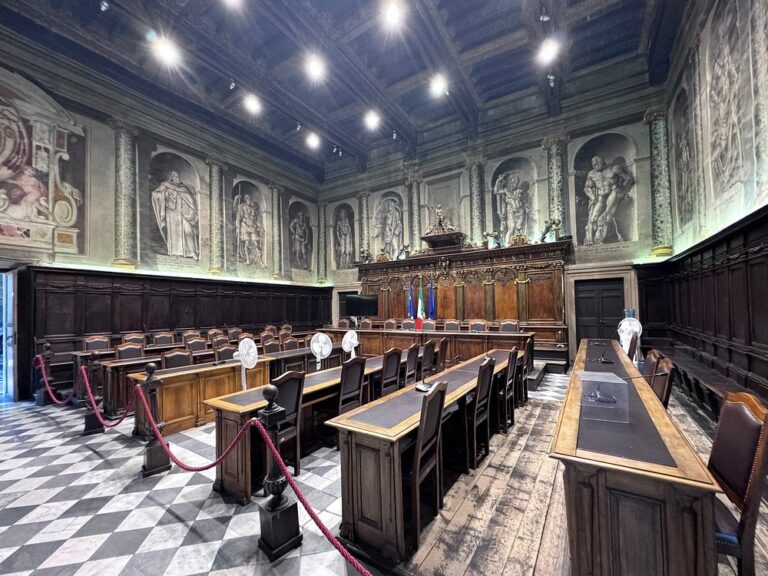
The Italian state confiscated the Rocca in 1870 and later returned it to the municipality of Montefiascone, which remains its owner. Beginning in 1983, the municipality commissioned major restoration and recovery works. The fortress is designated as Italian national heritage.
Remains
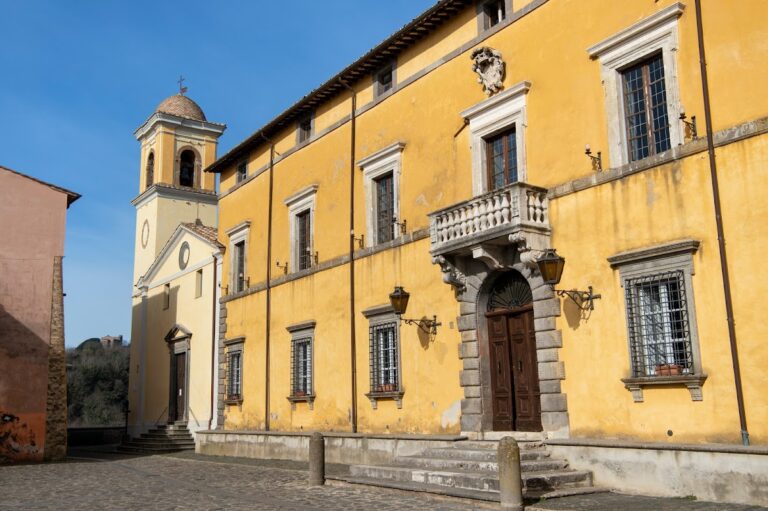
The surviving Rocca preserves elements of a fifteenth- and sixteenth-century defensive complex arranged on a trapezoidal plan, with large towers at the corners. Its position on the hill remains central to the character of the site, while the surviving structures combine fortified walls, towers, palace rooms, archaeological evidence, and later civic adaptations.
Fortifications and palace
Towers and defensive enclosure
The defensive complex included large corner towers, among them the imposing north-west tower and the southern corner tower known as the Torre del Pellegrino. The latter overlooks Lake Bolsena and the surrounding countryside. A bridge across the ancient moat leads to the present palace, preserving the relationship between the fortified approach and the residential building.
Palace and Renaissance courtyard
The palace has two floors and a basement. Its upper floor is covered by a pitched ceiling articulated by large round arches. Access to it is provided from the ground floor through the north-west corner tower and from outside by a staircase above the portico. The basement is principally formed by a large rectangular room.
Antonio da Sangallo the Younger’s Renaissance loggia, an open gallery or covered arcade, originally enclosed a rectangular courtyard. Inscriptions on the pillars supporting the arcades give the date 1516 and name Pope Leo X, referring to the completion of works commissioned by him.
Archaeological and later features
Lombard burial area
Restoration during the 1980s exposed graves from a Lombard-period burial area dating to the sixth or seventh century. The Lombards were a Germanic people who established a kingdom in Italy during those centuries. The burial remains can be seen beneath transparent floor slabs, incorporating the archaeological evidence into the restored structure.
Cistern and Italian-style garden
A large cistern, a constructed reservoir for storing water, was excavated in the forecourt during the enlargement ordered by Urban V in 1367. At the foot of the Rocca, an Italian-style garden was built in 1736 by Cardinal Pompeo Aldrovandi, adding a later landscaped element to the fortress setting.
Museum and former stables
Since 2006, the ground floor has housed a small museum dedicated to Antonio da Sangallo the Younger. Its collections include photographs, drawings, and plaster casts illustrating his work. The broad hall formed from the former stables in the semi-basement houses the Tuscia Provincial Wine Centre.